
Olympic Criticism

The Olympic Games are, like every international organization, subject to criticism. In democracies this is part of the DNA of democracies that you can voice your criticisms openly without being threatened by persecution or arrest. The Olympic Games have since its beginning in ancient or modern times favored sport disciplines that have a link to warfare. The spectrum of disciplines has been extended recently to blur a bit this belligerent image of the Games. However even the break dance is performed in a kind of battle or competition between two adversaries. This is the reason why totalitarian states have (had) a predilection to show off their state sponsored warriors in the Olympic Games. Nazi Germany and the Berlin 1936 Games were the worst example of how the Games can get abused only to demonstrate a country’s force through athletes. Dictatorships of our times are not much different in this regard. Showing how many successful athletes (soldiers) you are able to produce is somehow an indicator of your professional training system of elite performance. Now, add to it the top performance in the Paralympic Games like Paris 2024 and you can even demonstrate how well you are able to care for and train potentially even also for mutilated warriors. Criticism of preparations of warriors and war masked through sport competitions are maybe unfair or utterly displaced here. It is, nevertheless, much better to compete on the sports-field rather than with loaded weapons. Only in retrospect, we often understand, why some nations made such enormous efforts to demonstrate a commitment to win as much as possible. With a growing enthusiasm for the Olympic Games the critical reflections rise as well.

Paris libéré

It is with great pleasure to follow how Paris commemorates the liberation of Paris from Nazi-Germany 80 years ago. (Quote from De Gaulle “Paris libéré”.) On the 25th of August 1944 the city of Paris was finally liberated by French armies and the support of the local resistance movement. Similar to the journey of the Olympic flame on the way to Paris, we can follow each city celebrating the liberation from the occupants. Beginning with the landing in the Normandy of the Allied troops, the chasing of the enemy has been a matter of time, but still incurred huge human losses. More than 4 years of Nazi symbols in Paris were finally brought to an end and celebrations on the streets became a symbol for the enormous relief this liberation has meant to the population of Paris, France and hope to many neighbouring, but still occupied territories.
Several documentaries on television and radio allow to empathize with the joy of this time. Enduring the hardships imposed and, for many, risking their lives in clandestine networks of the resistance were honoured by the success of the liberation of the city without the massive destruction, which was to be expected.
A book edited by Ulla Plener (2007) highlights the supporting role played by some women originally from Germany to support the French Resistance movement. It still is not common to understand the retreat of Nazi-Germany also in Germany as the progressive liberation of the country from the terrors of a dictatorship.

Superstates reloaded

We live in an age of superstates. Such is the conclusion of Alasdair Roberts (2023). China(1.4), India (1.2), USA (0.33) and the EU (0.45) in billions of people jointly host about 40% of the world’s population (UN data). The Russian Federation with a population of 0.15, Japan 0.13 rank further behind, for example Pakistan 0.24 and Indonesia 0.27. Nothern, Eastern and Western Africa (0.25;0.46;0.42 respectively) have a huge unfulfilled potential that does not reach the impact it deserves.

These big and populated entities contrast with the increasing number of small states that have become new members of the United Nations. The institution of the United Nations, through its setup as an international rule based governance structure, has facilitated small states to seek voice and influence in the international arena of politics. The UN had 51 members in 1945 and has now a membership of 193 of all listed states of 237 on the globe. The increase in membership is due to many small states joining the UN after independence from big imperial powers. The international power relations, however, are only partially determined by population size but economic and military factors. The so-called superstates reach power through their power of direct and indirect “persuasion. Therefore the relationship between small and big states remains a delicate balance of power. Russia attempted to grab Ukraine and its population of 410 millions to remain in the league of superstates by population size and has suffered a hefty setback which further unsettles the disequilibrium of its male (68) and female (78) population with predominantly male soldiers’ lives lost.

Whereas we have seen the small states’ numbers on the rise in the last few decades, the expansion of superstates from Russia, China, India or Pakistan remain a threat to peace on the globe. The crystallization of a multi polar world order is on its way, but the stakes are high and unsettling in many respects. The fallout of war stalls the adaptation to climate change and increases the millions of starving people on the globe. the attempt to reach superstate status by already big states is probably the greatest danger we shall face for the coming years. Preparing for the instability of the world in transition to an increasing multi polar world order will dominate the political agenda of many intermediate powers as well as smaller states. (Image Globe Moscow 1994, displayed Stabi Berlin 2024)

Women Advisors

Contrary to many men and clergy advising noble governors, many of them famous as womanizers, there is a long tradition of women as advisors as well. The first woman that received high reputation as advisor is “Christine de Pizan“. She was born in Italy and migrated to France with her father who was a scientist and advisor to  “Charles V” as medical doctor and astrologist, but who died soon after the move to the French court. With the access to a unique library at the time Christine de Pizan benefited from the best of knowledge and her literary and scientific competences made her famous later on. She could even be compared to Clausewitz as a well known writer on war strategies, but has a much broader literary reach compared over centuries.
Christine de Pizan became a writer in her own right, publishing under her own name in the late 14th century already and not only in literary work, but in fields previously thought to be domains of male writers only. One of her writings “Livre des fais d’armes et de chevalerie” is a testimony of her political and strategic thinking and advice. It remains a unique piece of a woman as advisor in military affairs published in 1410. The translation into “Alemannisch” (1460) highlights the importance of her strategic advice beyond France.
Her literary excellence has been widely appreciated not the least in her praise of Jeanne d’Arc in her “Ditiè”, the poem in honor of Jeanne d’Arc. (source with translation). Christine de Pizan also wrote on peace (Le livre de la paix” 1412 and the “Livre du chemin de longue étude“, today we would translate it as a book on lifelong learning.
(Source: Zimmermann, Margarete, 2005: Minervas jüngere Schwester: Die politische Schrifstellerin Christine de Pizan, Stabi Berlin, KulturStiftung der Länder Patrimonia 265 und SPK.
(Image: Extrait Christine de Pizan im Gespräch mit Minerva. BNF, Paris, Ms. fr 603, fol.21r)

Broken Promises

In a library catalogue, the entry of « broken promises «  returns more than 3000 times that the title has been used. « Promises kept » is almost as popular. A rapid inspection of titles reveals that the former titles suggest more factual analyses, whereas the latter is frequently used in the form of an imperative in combination with “should be kept”. The book by Fritz Bartel “The Triumph of Boken Promises …” (2022) demonstrates the importance of the concept of broken promises in the social sciences. The rivalry between socialism, capitalism and the rise of neoliberalism is strongly influenced by the way they handle the breaking of promises made to their respective societies. The promises of increasing wealth and wellbeing have been part of all political regimes. To keep these promises is a completely different story. Especially since the first and second oil crises and many other kinds of crises, it has become much harder to keep these promises. Working hours, retirement ages or minimum wages are all at risk to no longer live up to the promises made in earlier periods. This has put welfare states under pressure that millions of voters perceive politics as a “game” of broken promises. Socialist political regimes like Russia are ready to use physical violence to shut up people that remind leaders of these broken promises. In democracies the ballot box is often used to sanction governments that do not live up to expectations of previous promises. A lot is about public infrastructure which is failing people. Migration, education, social and labor reforms are on top of the political agenda if it comes down to broken promises. The elections of the European Parliament gave many a chance to express their discontent about various broken promises. Maybe democracy is better in providing forms of letting off steam early and protracted protests rather than the Russian way to suppress any critical analysis, let alone opposition movements. Just like the move from industrial production to services as production models, with AI we are likely to see similar problems and probably also broken promises. The challenge is huge and promises should be made with an eye of what promises could be kept.

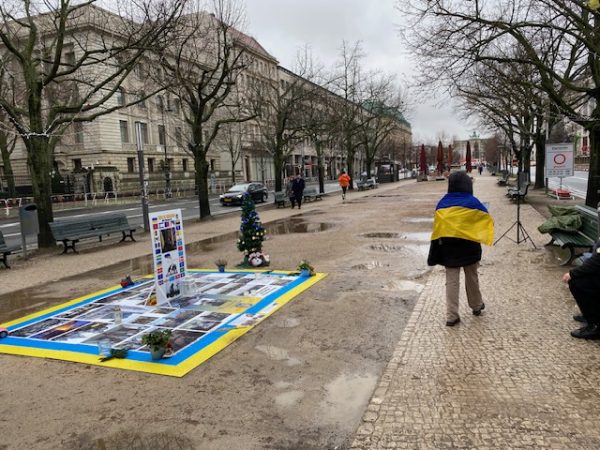
Public swimming pool closed for reconstruction 2024

Russian Angst

The title of a book “Russian Angst” by Thomas Franke summarizes the state of Russian society under Putin. It dates back to 2017, but the underlying process of Angst in the Russian society is increasing rather than diminishing due to the already 2 years long intensive hot war of Russia against Ukraine. The Russian Angst is a fear of a continued roll back of its authoritarian rule in Eastern parts of the world and its internal threat that its own people will claim more rights like freedom of speech, freedom of the press and effective democratic voting rights. In a dictatorship the “Angst” is a pervasive phenomenon which creeps into all spheres of live. Franke and Dornblüth (2023) describe the toxic society in Russia. Intoxication and torture of opponents are used by the Putin regime as a threat to suppress critical voices in Russia. Through this a climate of “Angst” is spread so that any internal opposition has to face very high risks to utter any discontent. The experience of a barbarian, totalitarian regime is well known. The threat to life and the presence of intimidation to any disobedient behaviour are strictly persecuted. Nevertheless, the need to think beyond the Putin regime is well under way. The more external and internal, real or imagined threats are countered with brutal force, the more the regime reveals its true kind of governance by force. This invites and leads to the strengthening of counter forces both internally and externally. It seems like box fight in the before last round of a very vulnerable, weakened and isolated boxer. Not many will bet on the likely loser and more countries who previously supported Putin will stop their erroneous policy. Russian Angst and loneliness will further increase.

Satellites

Every now and again satellites make headlines. In international politics the “Sputnik moment” of 1957 was such a key defining moment. Russia sending a satellite into space set off a massive investment programme in the United States to counter a potential threat from Russia coming from space. In 2024 we discuss again the next ratcheting up of in a race of armament threatening the earth from space. Russia is believed to enable satellites to carry a nuclear bomb that would orbit around the earth and could lead to mass destruction of satellites that nowadays enable navigation, communication and monitoring what is happening on earth.
As beyond the state-owned satellite networks there has been a private satellite network that assisted Ukraine to defend itself against the Russian aggression, we probably are about to witness the extension of warfare on earth into space. In addition to the so-called cyberwar, which threatens computer-based systems with viruses, ransomware or break-downs, we may face new kinds of threats. We shall have to consider this as part of modern warfare.
Since the late 1960s there exists an international agreement not to use space for nuclear arms. However, Russia does no longer seem to respect its commitment to this. A further escalation of the war of Russia in Ukraine with “conventional” weapons carries the risk to set off another arms race including the earths orbit. This is no science-fiction or whistle blowing, but based on a high-level report and press coverage by the New York Times on 2024-2-17 (Link).
The outrageous implication of such a massive explosion in space is that its implications of the globe on parts of the world and people not being a party in the war will suffer most likely as much as the opposed nations. The food shortages due to Russia’s aggression caused people in Africa to suffer or even die of hunger. Satellite outages of a massive scale will have severe consequences as well.
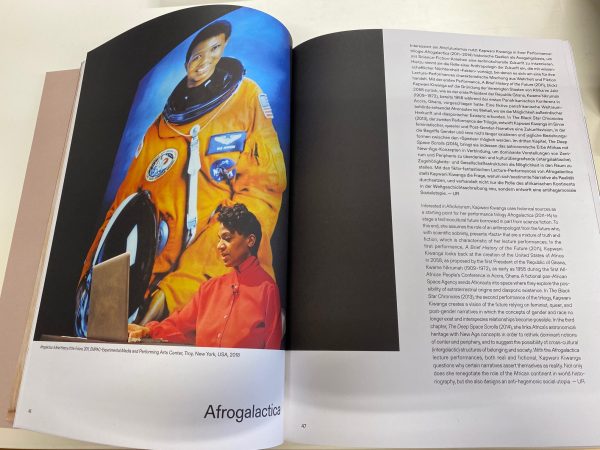
Information and communication systems have proven to be determining the outcome of a war. This has been one lesson of more than two hundred years of studying military strategies since Clausewitz. Space and satellites have apparently not contributed to improve the understanding of each other, but only the communication within the respective communication bubbles. Maybe artists can help us to overcome the danger of escalation. (Image: “Afrogalactica” by Kapwani Kiwanga 2011: calogue of exhibition “The length of the horizon” Wolfsburg and Copenhagen 2023).

Peaceful aggression

It is the merit of youth to try out and get away with new things. The peace movements of the 60s and 70s have had their origin in peaceful actions or sit-ins that managed to raise awareness of aggressive foreign policies of the U.S. and allies. The aim of peaceful meeting was to have an impact on government policies by not being aggressive towards anybody. The political force stems from the power of peaceful persuasion by not forcing persons of other opinions. We are many and we think differently.
The climate activists of 2023 have chosen a different route before abolishing their so-called peaceful activism. This form of protest consists in reaching media attention by blocking road circulation at critical intersections. It turned out to be perceived as an aggression for many persons much unlike the peaceful actions from decades before, which were also sit-ins, but in areas with no or little traffic.
Similar to the distinction in freedom from violence versus freedom to do something. The notion of aggression has 2 orientations. Not being aggressive towards somebody or something could be understood as peaceful aggression if the activity or non-activity has an effect on other persons as if they suffered a form of aggression. In the eyes of the spectator the peaceful road blocks may have a violent impact. Reactions might follow accordingly in a spiral of violence rather than the proclaimed peaceful impact. There is, therefore, a fundamental difference between the peaceful peace movements and the “peaceful aggression” of many of the climate activists blocking roads. Rather than spreading peace, the outcome is a rather violent reaction against perceived unacceptable hindrance to do something.
To meet in a church in the presence of priests (2023-9-23, 12 apostles in Berlin-Tiergarten) does not change the thrust of the campaign, which I coin as peaceful aggression. Therein lies the eventual failure to reach more popular support for the cause and the action of the self-proclaimed “last generation”. In ratcheting up the spiral of aggression, the movement contributed to the rising frustration of persons with no or only very difficult alternatives to their means of transportation. Aggressive opponents of the movement received undue media attention and, probably, hardened the opposition to the climate cause.
In analogy to cold versus hot war, we have entered a period with peaceful aggression versus aggressive aggression. Difficult times for peaceful peace movements.

Clausewitz 3

As the Russian aggression in Ukraine continues it is interesting to re-read Clausewitz again. In his major work on strategy in warfare we rediscover lots of strategies that Putin’s army applies in the war against Ukraine. But equally, the successful defence strategy of Ukraine with a sizable difference in the size of the army, they both let us better understand the theoretical considerations and relevance of Clausewitz until today. For example,the overriding importance of the size of an army in comparison to the opponent was discarded by Clausewitz (p.111-112) already. He refers to the battles at Rossbach and Leuthen in the Seven Years’ War 1756-1763. Frederic the Great won 2 battles despite having armies of half the size or even less at his disposal (Tempelhoff). Training and morale of the armies is an important part of the explanation of a later outcome. In terms of strategy Clausewitz mentions surprise and wit in chapters as well. The next 3 chapters are devoted to (in modern words) distribution and mobility of forces in space and across time including additionally a strategic reserve. The “classical warfare” which Clausewitz transforms into a theory of warfare is followed with horrific resemblance by Putin’s Russia in the 21st century. “War is an instrument of politics” writes Clausewitz 200 years ago (p. 467-8).
The painters or theorists that attempted to go beyond this rationale have had a hard time to convince politicians otherwise. The idea that law and courts will replace the atrocious power play of nations is silenced again for some years, only to come back with more force eventually.
(Image Extract from Nationalgalerie and Digital Collection of Gemäldegalerie 2024-1 by Adolphe Menzel “Ansprache Friedrich des Großen an seine Generale vor der Schlacht bei Leuthen 1757) unvollendet.

Finding Peace

In international conflicts it the task of diplomacy to find or negotiate peace agreements. Monitoring of the evolution and progress is part of the deal. For societies internally it is equally important to find peace again. Totalitarian regimes are characterized by terror and intimidation of its own citizens. This holds true today as much as in the past. Finding peace, however, necessitates to prosecute criminals and this irrespective of their previous or current status in society. The American authorities after the 2nd world war have held more than ten thousand prisoners due to their commanding functions in the NS-time. After 3 years of imprisonment and attempts of so-called re-education the evaluation of the results were of very modest success. Most prisoners would find excuses rather than admit to their participation in the killing machine of the Nazi throughout Europe and over more than a decade.

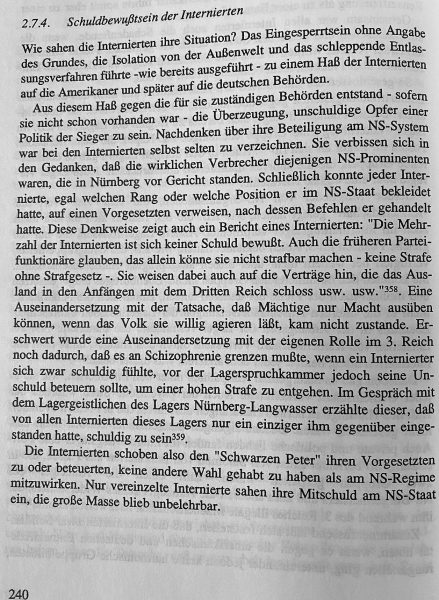
The study by Christa Horn (1992) “Die Internierungs- und Arbeitslager in Bayern 1945-1952” comes to the same sobering conclusion (p. 127 extract below). This bears the danger that the totalitarian ideology continues to have supporters and even the transmission to other generations might be attempted. This highlights the importance of reconciliation in the lengthy process of finding peace. It far from easy to resolve who is guilty and of what. The Americans started the process before handing over responsibility to the regional judicial system. More than 75 years after 1945 we still have to name and insist on the criminal behavior of the totalitarian regime with millions of party officials and even more followers. Finding peace is a protracted process if not a struggle that involves 3 and maybe 4 generations by now.