Superstates reloaded

We live in an age of superstates. Such is the conclusion of Alasdair Roberts (2023). China(1.4), India (1.2), USA (0.33) and the EU (0.45) in billions of people jointly host about 40% of the world’s population (UN data). The Russian Federation with a population of 0.15, Japan 0.13 rank further behind, for example Pakistan 0.24 and Indonesia 0.27. Nothern, Eastern and Western Africa (0.25;0.46;0.42 respectively) have a huge unfulfilled potential that does not reach the impact it deserves.

These big and populated entities contrast with the increasing number of small states that have become new members of the United Nations. The institution of the United Nations, through its setup as an international rule based governance structure, has facilitated small states to seek voice and influence in the international arena of politics. The UN had 51 members in 1945 and has now a membership of 193 of all listed states of 237 on the globe. The increase in membership is due to many small states joining the UN after independence from big imperial powers. The international power relations, however, are only partially determined by population size but economic and military factors. The so-called superstates reach power through their power of direct and indirect “persuasion. Therefore the relationship between small and big states remains a delicate balance of power. Russia attempted to grab Ukraine and its population of 410 millions to remain in the league of superstates by population size and has suffered a hefty setback which further unsettles the disequilibrium of its male (68) and female (78) population with predominantly male soldiers’ lives lost.

Whereas we have seen the small states’ numbers on the rise in the last few decades, the expansion of superstates from Russia, China, India or Pakistan remain a threat to peace on the globe. The crystallization of a multi polar world order is on its way, but the stakes are high and unsettling in many respects. The fallout of war stalls the adaptation to climate change and increases the millions of starving people on the globe. the attempt to reach superstate status by already big states is probably the greatest danger we shall face for the coming years. Preparing for the instability of the world in transition to an increasing multi polar world order will dominate the political agenda of many intermediate powers as well as smaller states. (Image Globe Moscow 1994, displayed Stabi Berlin 2024)

Webpage Analytics

I do not collect data of detailed webpage analytics. Therefore, I thought I do not know anything and do not want to know anything about webpage visits of this webpage. However, the most basic information of how many times the webpage is visited per months is given by the hosting service of the webpage. The previous jump beyond 20.000 visits/month had the implication to move the security level of the webpage for me and all visitors to a higher level. Additional information of how many seconds an “internaut” is staying on the webpage tells, maybe a little bit about the interest in the content or image of a specific entry. Reaching 84.000 visitors/month was a surprise that asks for an explanation. Apparently, the most visited page is the blog entry on “geo-politics”. The longest time people stayed on a page or blog entry is a recent entry on “nutrition policy”.
Other statistics show that people who visited an entry on “find trust”, trusted in the webpage to click on many other entries or pages on “www.schoemann.org”.
I do not collect data or statistics on where visitors go after a visit. The hosting service, however, measures the so-called “jump-off” rate. This indicates the importance of the webpage as spring board to jump to other pages on the internet. It is usually = 1, just showing that you left somewhere. For some pages this reaches higher levels according to the number of links you offer on a blog entry, for example. It gives an indication whether you manage to lead on readers to explore the topic further. This is a usual evaluation question of lectures and seminars given at universities.
Last but not least, even without collecting any “real data” about visitors, it is part of the minimum information your browser transmits is the “operating system” used for access. Your smartphone provides the information on IOS, Android, Linux, or Windows versions used. These technical purposes remind me that there are still vast amounts of users of what we believe are outdated operating systems. Windows 7 and Windows 10 are still heavily in use across the globe. The hype around the latest operating system and smartphone is most likely only a phenomenon of the rich and wealthy in the rich parts of the western world. This reminds me to include images, which are small in data size to allow fast downloads in all parts of the world. We should embrace this as an important topic of geo-political relevance.

Women Advisors

Contrary to many men and clergy advising noble governors, many of them famous as womanizers, there is a long tradition of women as advisors as well. The first woman that received high reputation as advisor is “Christine de Pizan“. She was born in Italy and migrated to France with her father who was a scientist and advisor to  “Charles V” as medical doctor and astrologist, but who died soon after the move to the French court. With the access to a unique library at the time Christine de Pizan benefited from the best of knowledge and her literary and scientific competences made her famous later on. She could even be compared to Clausewitz as a well known writer on war strategies, but has a much broader literary reach compared over centuries.
Christine de Pizan became a writer in her own right, publishing under her own name in the late 14th century already and not only in literary work, but in fields previously thought to be domains of male writers only. One of her writings “Livre des fais d’armes et de chevalerie” is a testimony of her political and strategic thinking and advice. It remains a unique piece of a woman as advisor in military affairs published in 1410. The translation into “Alemannisch” (1460) highlights the importance of her strategic advice beyond France.
Her literary excellence has been widely appreciated not the least in her praise of Jeanne d’Arc in her “Ditiè”, the poem in honor of Jeanne d’Arc. (source with translation). Christine de Pizan also wrote on peace (Le livre de la paix” 1412 and the “Livre du chemin de longue étude“, today we would translate it as a book on lifelong learning.
(Source: Zimmermann, Margarete, 2005: Minervas jüngere Schwester: Die politische Schrifstellerin Christine de Pizan, Stabi Berlin, KulturStiftung der Länder Patrimonia 265 und SPK.
(Image: Extrait Christine de Pizan im Gespräch mit Minerva. BNF, Paris, Ms. fr 603, fol.21r)

Nutrition Competence

Nutrition is a good example of how a long lasting disregard in education and learning systems has led to huge medical costs for individuals and societies nowadays. The obesity pandemic calls for urgent action and policy changes in the field of nutrition policies and learning goals for children and adults. Medical doctors have mostly discarded that it is also their responsibility to provide medical guidance on nutrition, as this is highly controversial at times and asks for behavioural changes of the patient. School teachers see little scope to act on the issue due to increasing demands in fields of literacy, numeracy, problem-solving, digital and communication skills. Hence, the hope is to fill the instruction and learning gaps with a hybrid approach of nurses taking on both roles and communicate with children as well as adults alike. This is a tough challenge for these persons, but hopes a high that they can make a significant improvement to the nutrition competences of individuals, pupils, their parents and specific target groups.
The starting point is to recognize that there is an issue with nutrition. The next to establish the best evidence and based on this to develop a curriculum for the nurses to be well-prepared for the challenge in the field. Even with the differentiation of different levels of competences, the learning has to be rather encompassing several related fields as well. Individual, behavioural as well as society-level factors like biology, technology, religious beliefs, economic and social factors determine nutritional choices and consumption. Just because there are so many factors to consider  does not justify to keep nutrition out of school curricula for example. Nutrition is a fine example of a topic which links disciplines across a broad range. It is a tasty, at times spicy mixture of issues to learn and apply. The former is the beginning, the latter the real challenge which needs ample and repeated guidance or coaching. (Image: Extrait of Abraham Mignon, 1640-1679, Undergrowth with flowers, animals and insects, MRBA Brussels)

Nutrition Policy

The evidence on nutrition policies has accumulated a series of policy recommendations based on the best available evidence. The German Institute of Human Nutrition has presented these results repeatedly not only to the scientific community, but also to the interested public at the Science Week or the Long Night of Science. Their leaflet on the tools to improve our human nutrition in market economies highlights “nutrition competence” as a key component of a broad strategy to improve our food and subsequently health. Nutrition goes beyond the biological ingredients of food to include basic understandings of human metabolism including the times and timing of meals. This competence has to be transmitted to preschoolers, pupils as well as adults to stem the waves of obesity (ARTE Docu). Learning how to manage your own nutrition is a crucial competence to strive and survive. In schools it can have substantial impacts on performance and inequality of opportunities as well.

The science-based policy recommendations propose to alter the structure of costs, for example via tax reductions, in favor of healthy food. Plain water should be substantially cheaper than sweet beverages or alcoholic drinks. Nuts and proteins from vegetables fall in the same category as plain water. It is in the longer term interest of all of us that schools, canteens at work places or homes for the elderly offer also healthy nutrition at least as a daily option. More sustainability in food production is last, but not least part of nutrition policies. A lot to chew on to improve nutrition.

Food Future

What do we have for dinner today, tomorrow or in 10 years from today? Research Institutes presented some of their insights based on solid evidence in the open door event in Berlin. The 5 years of the project “food4future” are over and my glance through some of the results suggests that we shall have many more proteins, most from vegetable sources, on our plates. The arguments for improved sustainability are rather compelling. The taste of these products that currently have higher amounts of bitter taste might be solved. Similarly sea food beyond fish like halophyte will enter our diet. The salty taste can be incorporated in meals in which we add salt or other spices anyway. These elements might make it possible to feed the 8 billion people on our planet. We probably also need to include protein rich insects in the meal plans of the still growing human species. It appears like a rather long shot into the future of nutrition, but if we do not think ahead and start the change in our mindsets we shall be badly prepared for the future and more people will decide to seek food in other places of the earth rather than stay hungry. It also helps us to refocus our priorities in nutrition and aim for a better balance of the pleasures of eating and sustainability. The issue of food for future generations starts with food for thought in the abundantly nourished Northern parts of the planet. (Image: AI Copilot, Prompt: 2 couples enjoy eating a meal of halophytes and insects, 2024-6-25)

Smoking Vaping

Both smoking and vaping are big business. Nicotine is well known for its addictive capacity. Once started, it is very hard to give it up again. For many decades we devote considerable efforts and costs to encourage people to give up on smoking or, better, not to start smoking in the first place. The young are particularly vulnerable as damages persist for a longer time. Progress has been made to reduce passive smoking of children and people in restaurants, at work and public spaces. The relatively recent trend of vaping instead of smoking is considered less harmful, but scientific long-term evaluations, whether these effects are lasting for several years, are still missing.
A repeated cross-section study in England (Tattan-Birch et al. 2024) has revealed that the declining trend of nicotine use has already been reversed among youth due to the rise in vaping. Vaping seems to move from the fashionable niche product to the popular mainstream among youth. The addicts are only cost-sensitive on the margin. The relative prices of smoking and vaping might play a role to put people on different health trajectories. The question is not between either smoking or vaping, but for some it is both, although it should be none of both. The question of smoking yes/no is likely to be framed as either vaping/or smoking.  The re-framing of the question shows the harmful potential in the longer run. We shall have a hard time to convince people and particularly youth not to be tempted by either/or but to focus on their long-term health trajectory and potential. (Image: Extrait from Arnold Böcklin, Self-portrait with death playing the violine 1872, Alte Nationalgalerie Berlin)

Aussensicht Innensicht

Die Sicht vom Skulpturengarten der Neuen Nationalgalerie auf die laufende Ausstellung „Zerreissprobe…“ erlaubt einen tiefen historischen Einblick in die 1980er Jahre. Die Sammlung von Postern des Künstlers Klaus Staeck zeigen die bewegenden Themen der achtziger Jahre. Frauenrechte, Umweltschutz, Sicherheit sowie Medienwirtschaft. 40 Jahre später beschäftigen uns weiterhin, Lösungen für die plakatierten Themen zu finden. Images können Themen so zuspitzen, dass Anklagen daraus werden. Texte sind im Vergleich zu der Eindrücklichkeit der Bilder ein vergleichsweise stumpfes Schwert. Es ist aber gerade die Verbindung von Bild und Text, die Eindrücke verstärkt. „Meme“ Creators sind ein standard tool das die Kommerzialisierung und die Promotion weiter befördert haben. Kunstformen hatten diesen Trend bereits vorweggenommen.

European Voters

Elections of the European Parliament are more about a learning and participation experience than about crucial political influence. This seems to be the lesson learned from the relatively low voter turnout in many countries in 2024-6. Belgium reached by far the highest percentage (90%) of participants, but it had federal and regional elections at the same time. Croatian voters could not be bothered with these elections with just 21% of turnout. Many countries hovered around the 50% participation mark like France, Spain, Italy, Ireland and Sweden. Germany reached almost 65% which is relatively high, but due to its population size, it sends the most MEPs to Brussels later on. The most surprising result is the extremely low turnout in the former Eastern, Southern Eastern and Baltic states of the European Union. Apparently, the voters in these countries care little about their political option to vote for MEPs. This should worry all other parts of Europe profoundly as we invest billions in infrastructure and social cohesion to keep the European Union an open house for all East and West, South and North. The challenges for the next 5 years are huge. The expectations are high, but the commitment to democratic procedures like voting and decisions through the ballot box are not to be taken for granted throughout Europe. (Image European Parliament 2024-6-11)

Screening Paradoxon

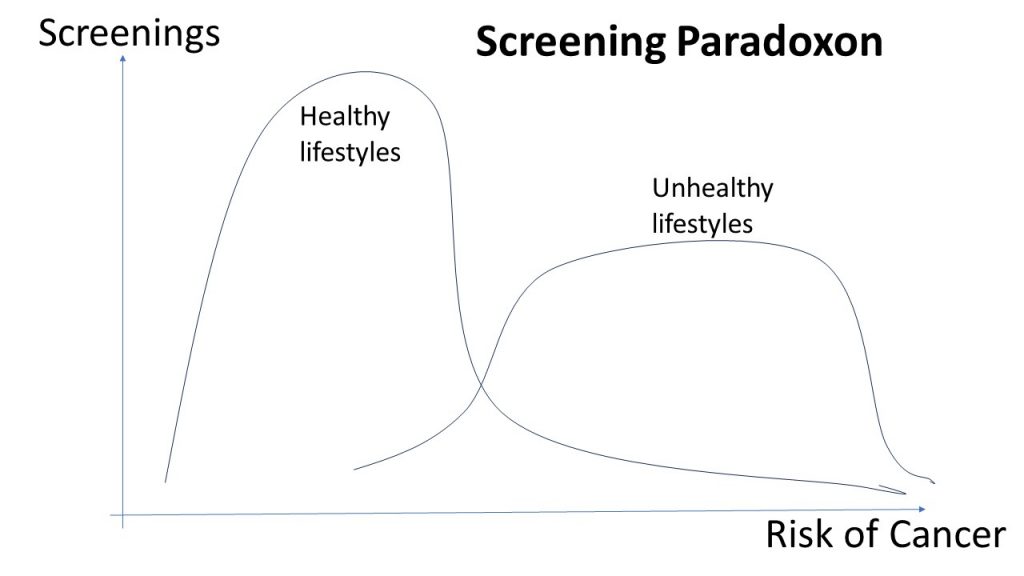
In the field of public health the screening paradoxon is a well-known feature of large scale programs to check for and contain the large increases in cancer among populations. A recent medical study underscores the necessity to curtail the screening paradox in Europe. The screening paradoxon is defined as “the underuse of screening by those with unhealthy lifestyles and high risks”. The opposite cases, “the overuse of screening by those with healthy lifestyles and low risks” only cause a problem for the costs of the health system as those unlikely of attaining a form of cancer make extensive use of screening. In terms of social inequality we have to be concerned about both ends of these distributions. The publicly available screening programs are skewed towards the higher educated with risk awareness as well as healthy life styles. More of them participate in screening. The other distribution of actual risks and detection of cancer is skewed towards the other end of the risk distribution. The 2 probability distributions overlap to an extent that is most likely co-determined by cultural factors like general attitudes towards prevention.
With the increase in cancer rates generally and due to demographic aging of societies, we shall need to target our resources devoted to health more precisely rather than spending too much on screening of people with very low risks. Increasing the duration between screenings might not impede detection rates of those with healthy lifestyles, but could allow to devote more resources to those people who are hard to reach by screening programs so far. Evaluations of such programs are necessary to judge the need for more targeted programs.(Image own representation inspired by Ola et al. 2024)