In economics all students go through the calculus of comparative advantage. People, regions or whole countries tend to apply comparative advantage to their production systems and ensuing internal or external trade. The basic rationale developed by David Ricardo has not changed that much over 200 years. The fields of application, however, are continuously expanded. Lindsay and Gartzke (2020) have applied the comparative advantage rationale to military strategy. The paper quotes 26 times Clausewitz and demonstrates the links of strategy to the basic economic and social rationale of comparative advantage. It is the politics of production that even the presence of trade may override the rationale of comparative advantage to favour local production of “operational domains” or military equipment.
In Russia’s aggression and war against Ukraine own production and trading of weapons has returned to the forefront of the concerns. In addition to the production of ammunition, the provision of drones has dominated the international arms trade related to the Russian aggression. Resources and time for production are additional factors that have an impact on availability of weapons at the right time at the right place and with the sufficiently trained persons to operate them.
The strategies that cross domains or combine domains seem the most promising. The careful analysis of your own comparative advantages or disadvantages needs to be the basis of any strategic decisions. This has been known for 2 centuries at least and is still valid in many fields of application. Additional considerations for “home production” might add to the complexity of the issue. Sustainability has also found its way into the field of comparative advantage at last. This may alter the analysis of comparative advantage of operational domains as well. Lots of unresolved puzzles still around. It will need years to sort this out despite the urgency of the Russian aggression on Ukraine.(Image: AI Copilot.2024-4-30 2 political leaders deal weapons. One has a comparative advantage in ships. The other one has a comparative advantage in aircrafts. they deal together)

Russian Angst
The title of a book “Russian Angst” by Thomas Franke summarizes the state of Russian society under Putin. It dates back to 2017, but the underlying process of Angst in the Russian society is increasing rather than diminishing due to the already 2 years long intensive hot war of Russia against Ukraine. The Russian Angst is a fear of a continued roll back of its authoritarian rule in Eastern parts of the world and its internal threat that its own people will claim more rights like freedom of speech, freedom of the press and effective democratic voting rights. In a dictatorship the “Angst” is a pervasive phenomenon which creeps into all spheres of live. Franke and Dornblüth (2023) describe the toxic society in Russia. Intoxication and torture of opponents are used by the Putin regime as a threat to suppress critical voices in Russia. Through this a climate of “Angst” is spread so that any internal opposition has to face very high risks to utter any discontent. The experience of a barbarian, totalitarian regime is well known. The threat to life and the presence of intimidation to any disobedient behaviour are strictly persecuted. Nevertheless, the need to think beyond the Putin regime is well under way. The more external and internal, real or imagined threats are countered with brutal force, the more the regime reveals its true kind of governance by force. This invites and leads to the strengthening of counter forces both internally and externally. It seems like box fight in the before last round of a very vulnerable, weakened and isolated boxer. Not many will bet on the likely loser and more countries who previously supported Putin will stop their erroneous policy. Russian Angst and loneliness will further increase. 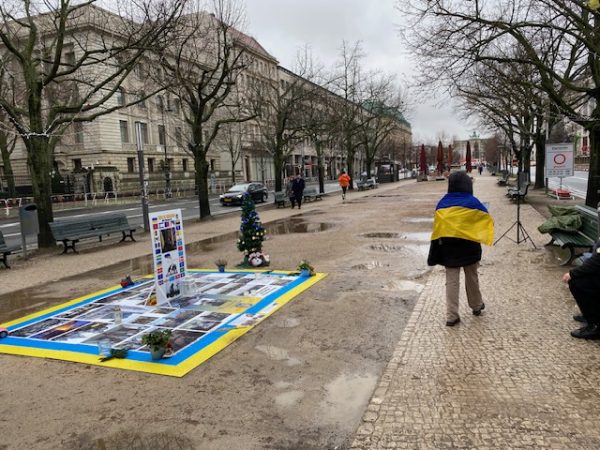
Personal Health
Most people would agree, health is a personal issue. From the onset of life, we have package of genes that predetermine a number of factors of our personal health. Epigenetics has taught us there are many factors to take into account additionally. Environmental factors have huge impacts as well. Improvements in the availability of medical devices in the hands of individuals as well as AI systems on portable devices like smartphones facilitate the monitoring of personal health. Several indicators of early-onset of illness can be retrieved from such devices. Dunn et al. (2024) show that prior to the onset of symptoms of Covid-19 or influenza portable devices can indicate the presence of infections through indicators of resting body temperature, heart rate/min, heart rate variability/millisecond or respiratory rate/min. Combined with the indicators of air quality, indoors as well as outdoors, the presence of allergens a much more personalized data set emerges which can easily be part of an AI-assisted diagnosis. More abundant personal health data and analytical power allows remote and digital health applications to inform patients, medical doctors and the public at large. Digital health technologies are only at the beginning to unfold their potential. Prevention becomes more feasible using such devices, medical professionals should be allowed to focus on interpretation of data and treatment rather than simple data gathering. Thinking about digital health technologies points in the direction of dealing with climate and environmental hazards as sickening causes more forcefully. Personal medicine and personal health are, after all, still heavily dependent on health and safety at work, commuting practices and all sorts of pollution. Personal health, however, is a good starting point to raise awareness of the potentials of digital health technologies to better our lives.
(Image: AI MS-Copilot: 2 robots run in a city. They sweat. The air is full of smog. 2 other robots rest near pool. All look at their wrist watch showing heart beats)

Opportunity Costs
Skiing in winter is a pleasure that has become more elitist. The downhill skiing has always been an expensive sport, but affordable school holidays gave the sport a more accessible touch. The cheaper version of long distance skiing or skating on larger trails involves much more endurance. The report of the French Cour des Comptes in 2024 questions the sense of the huge investment that is still devoted to save the pleasure of the few. I
nstead of investment to the benefit of relatively few persons, these funds could put the money into a more sustainable, socially and ecological productive purpose. Installations could be used all year round rather than in the few weeks at best months with snow. It is remarkable that the court has highlighted this kind of opportunity costs of such installations. Instead of investing in soon to be obsolete infrastructure at lower altitudes like water reservoirs and water canons, this money could already start the eventually necessary transition process. Each € spent is not only lost for the transition, but might create additional environmental liabilities and damage.
From economists it is to be expected that they mention competition in their arguments. Not all stations of skiing will survive. Put more dramatically, in the process of closing skiing at lower and middle level altitude, competition intensifies between stations and of who can survive. Public funds should not be misused in this endeavour. Lobbying is strong and political incumbents tend to favour the merit and legacy of digging for the white gold. Changes of mind sets, investment narratives and decisions are tough. From much downhill skiing we might soon remember only the downward slope before the healthy aspects of climbing a slope takes the upper hand.
Publishing2024
With new channels of publishing online the publishing world continues to change. Scientific research moves also online and the reach of audiences has become a much more important factor in evaluation of success. Elite circles of in-groups publishing and quoting each other have a harder time to survive. It is a form of democratising the world of research which is by very large amounts financed by public budgets. Public radio and television now start to feel the heat as so-called influencers, some working independently, challenge the world of traditional journalism. The good news is that there are many more people active to produce news and entertainment and the two separate worlds become more and more integrated. Young people who have left the “official” media world, engage with their own peer groups and make their voices heard and more influential. The quality of the provision of information is, however, a matter of concern. Audiences will have to check even more carefully than before which sources can be trusted. This is not an easy task. Speed of spreading information becomes an additional factor. It has always been like that, but the rhythm of a daily or weekly newspaper was very different from the publishing and consumption of news and information today.
The second factor that has drastically changed is the influence of “external” influences and information as well as disinformation campaigns that have an impact on “internal” reporting and commenting. What used to be the world of professional journalists has become an accessible possibility for many more than journalists. Publishing has become a very different world from the printing days and yet printing remains one important channel of publishing. (Link to own edited volumes of blog post for printing here).
Previously, we prepared the manuscript in paper, nowadays this seems to move online and the edited and sometimes corrected versions will be published in print later on. The challenge to science and journalism is ticking. Not accepting that there is a serious challenge is no solution either. (Image from Exposition “Books that made Europe”, 2016)
Greedflation
The teaching of economics and socioeconomic policies has to deal with the topics around inflation and economic inequality for centuries. Greedflation has become a newly coined term for the rise of inflation due to greedy firms who use a window of opportunity to achieve extra profit margins or windfall profits. At a time of perceived price rises in many sectors, sectors that have no cost increases might still try to push prices higher simply because almost everybody else does so. Higher profits then show up in the reporting season of enterprises quoted at the stock exchange and the increase in inequality between wage earners and shareholders will rise. Greedflation is a summary term for it. The ECB European Central Bank has mentioned this and Reuters has reported on it as well end of June 2023. Since then a wait and see strategy has been adopted. Now in February 2024 we witness the wider spread of extraordinary profits of big firms not only in the fossil energy sector but also bog banks. The economies and societies suffer huge losses and a massive redistribution of capital. Subsidies introduced to lower the shock of the coronavirus crisis and the Russian aggression are unpopular to be scaled back. Employees and their trade unions have a hard time negotiating adequate wage increases whereas most companies use the momentum of seemingly general price rises to push profit margins. The translation of this mechanism to the political economy risks to jeopardize the support for capitalism and market forces in general. Another wave of increasing inequality endangers the survival of democratic societies. Countries with only a short experience of the functioning of market economies are at a particular risk. Germany’s decline into dictatorship in the 1930s after the severe economic crisis should be remembered as a major threat. Greedflation is a very serious and very real threat which we have to address with economic and social policies rather than waiting until the European elections have passed. Time to act, the thinking has been done. Evidence accumulates to make the political case.
Force of dependency
Drugs have their particular strength in creating dependency. This is well known for tobacco or alcohol. Helping people to overcome the forces of dependency has its merits. At the same time it is big business. Vaping instead of smoking might be a way out one dependence but into another one. In the end it is an empirical question how many persons can escape the force of dependency of both types. Important to test the probability to get rid of the dependency altogether. With respect to hard, life-threatening drugs like Nitazene the death toll keeps rising in the UK. In the latter case changing the dependency is already a success. The sustainable deflection from drug dependency has to address underlying issues and health hazards. It is a rather individual issue. Society wide evaluation studies need to inform the debate also about placebo effects. The force of dependency might not only be physiological but psychological or linked to the social environment. All these potential effects have to be carefully sorted out before simple pseudo-solutions are implemented. Even the price and availability of drugs is part of the overall equation to solve the force of dependency.

Flooding
Flooding after abundant rain fall is an almost worldwide phenomenon. This is why research has taken up the issue for some time now. 2 recently published papers hint at direct and indirect consequences of excessive rain and flooding which usually are not taken into account. The Lancet respiratory medicine has highlighted the second round effects of flooding which consists in the latent danger of mould creeping into buildings even after the immediate effect of the flood has vanished. It is the mould with its longer duration that causes major respiratory health and safety hazards on top of the instantaneous casualties and epidemic health risks (Link to study 2024).
The second study focuses on “the need for more systematic understanding of how societal structures and vulnerabilities moderate disaster risk” (Link to study). In wealthy countries the flood mortality is substantially lower than in comparatively poor countries. More sophisticated anticipation systems play a major role in reducing casualties. Flood-induced displacements remain hard to predict despite a reasonable explanatory power of the statistical model as the authors point out. Additionally it remains an important question to estimate the share of people who (want to) return after being displaced due to flooding. The frequency of flooding plays a role in combination with the severity of flooding. Climate change might be an additional hazard in the sense that more frequent flooding will change the propensity of people to permanently relocate rather than returning after displacement. Social networks, support and solidarity with the victims of flooding as well as reconstruction efforts will play a crucial role in dealing with these environmental hazards.
Building higher dikes is a worthwhile solution in regions that can afford them (Rotterdam example). It is hardly a solution for countries with little resources to invest in protection in face of an already suffering and displaced population. Dealing with mould after the flooding only adds yet another health hazard to an already difficult situation. 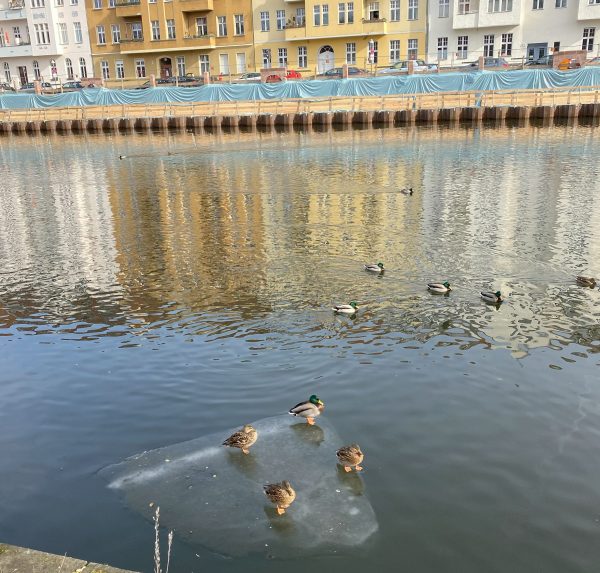
Urban Living
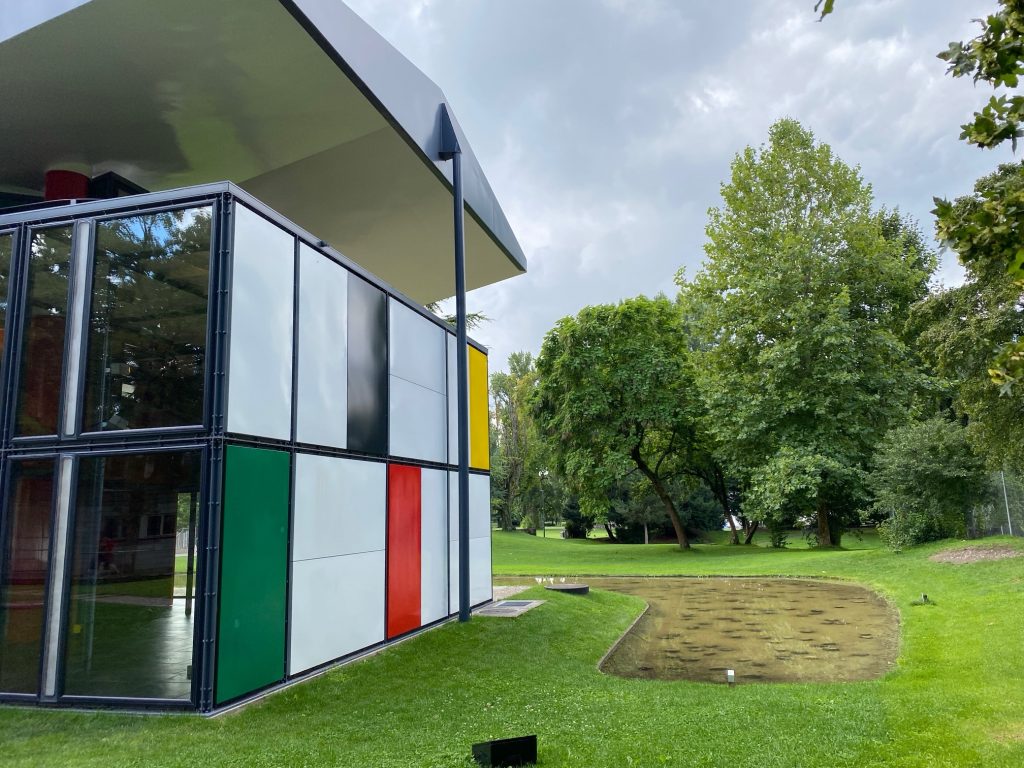
Each time I pass by the closed airport in the middle of Berlin I am amazed by the crazy idea to have built this and maintained throughout the 20th century. Paris is desperately trying to re-naturalize small areas and roads, while in Berlin there is now still the huge park to enjoy for all. Sports activities benefit the most. What an amazing asset in the neighborhoods for so many in need to walk, run or cycle a bit to keep their exercise level up throughout their life course. It has still a huge potential to activate people. It just needs a bit more organizations and volunteers to embrace the opportunities. Only in comparison to other cities you realize what an asset this is now. It will remain a challenge to preserve this centrally located treasure for the benefit of all. In Paris the deconstruction of concrete is taking shape and 300 new sites have been identified for re-naturalization, as reported in LeMonde. In Zurich green spaces in the center have been saved and renovated with a lot of money to allow more people to enjoy the benefits of a green environment near the city center. The house and park by architect Le Corbusier is a fine example of this. Image below. The garden around the house is publicly accessible. As air pollution is threatening more and more and heating in cities is a serious health threat we would really like to welcome more preservation and re-naturalization in inner cities.
Sectoral Change
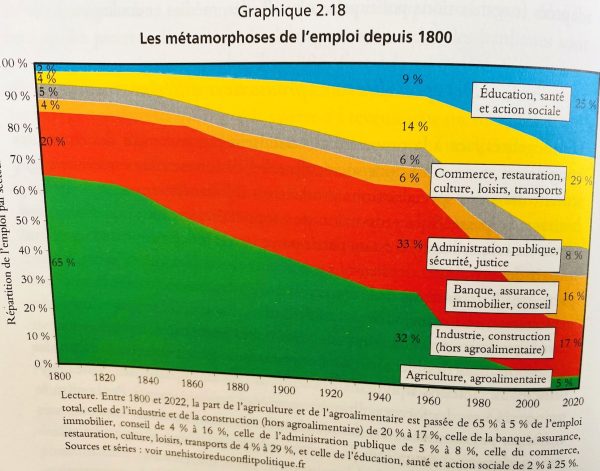
The long-term view of sectoral change in France, for example, from 1800-2022 (Cagé and Piketty, 2023 p. 128) allows us to zoom out of our narrow focus of the last few years of economic change. The decline of agriculture is the most remarkable. The reduction of employment in industry and construction has been an ongoing trend as well. Banking, insurances, property and consulting have seen remarkable expansion over these years. Public services, security and legal affairs are still on a moderate rise. Other sectors like education, health, commerce and transport manage to grow equally.
The merit of the comprehensive volume by Cagé and Piketty (2023) is that it is thoroughly data driven and based on quite unique long data series. The data on structural change and just the employment trends depicted below refocus our attention on likely consequences of these changes.
For the 2 authors we should redirect our attention much more to the implications of these trends (like rising inequality) on political conflicts and power struggles. Democracies are at risk, if we continue to ignore these seminal changes of industrial structures and shifts in employment. The traditional strongholds of trade unions and progressive forces in the manufacturing and construction industries as well as in public transport seem to have unaccounted implications for our political systems as well. The volume by Cagé and Piketty (2023) will soon be available in English and reach broader audiences just-in-time for the European Parliament elections in June 2024. Particularly the spatial implications and how the neglect to take into account the fundamental differences between the rural development and structural change needs urgent reconsideration. After the time for reading and working with the data (LINK) is the time for action to preserve our European Dream of peace and social development.