Marc Aurel Book 6

Some passages of Book 6 can be understood like quotes of much later works, even like writings of the enlightenment period. Take this one: “If someone can prove me wrong and show me my mistake in any thought or action, I shall gladly change. I seek the truth, which never harmed anyone: the harm is to persist in one’s own self-deception and ignorance.” (para 21 in Penguin Classics version, also in Greek original and French translation).
The same passage in historic English: “If anybody shall reprove me, and shall make it apparent unto me, that in any either opinion or action of mine I do err, I will most gladly retract. For it is the truth that I seek after, by which I am sure that never any man was hurt; and as sure, that he is hurt that continueth in any error, or ignorance whatsoever.” (Para XX in Gutenberg.org online reader).
Why is this already an enlightened vision of truth? In the search for truth, he is open to criticism or doubt by others (maybe even irrespective of societal standing) and, moreover, ready to change his conviction and action. Religious doctrines of the time and many centuries after his writings would not have accepted such a doubtful mind who might change due to (scientific) reasons. Long before “Cogito ergo sum” (René Descartes, (1637), I think, therefore I am, of the early enlightenment, Marc Aurel might be summarized in this paragraph as “Cogito, ergo dubio”, I think, therefore I doubt – and I may change accordingly.
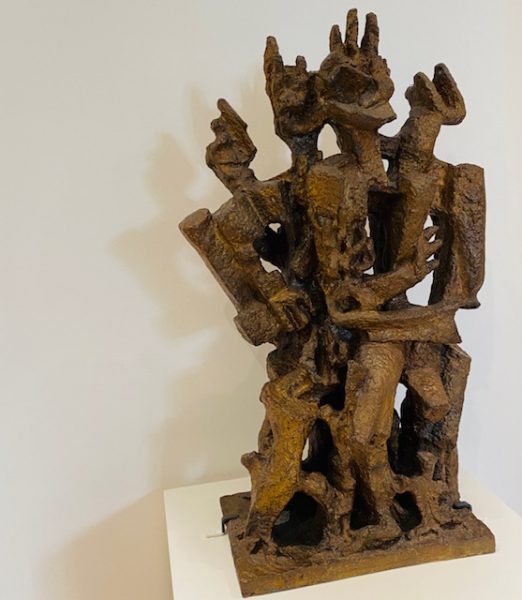
(Image: Ossip Zadkine, Forêt humaine, Musée Zadkine Paris)
Marc Aurel Book 1

The reading of Marc Aurel’s Meditations in its Book 1 offers first of all his acknowledgments of people who had a lasting impact on him or offered learnings to him. He presented these learnings or take-home lessons as we call this nowadays in a style of “positive psychology”. This means writes about the positive influences and which kinds of positive behaviors he saw in living examples of others and which he felt were particularly worthy of general consideration. In philosophical retrospect we might read the book 1 as a list of “categorical imperatives” which would make a decent life feasible for all. His acknowledgments start with 1 line on his grandfather (decency and mild temper), 2 lines on his biological father (integrity and manliness), 3 lines on his mother (piety, generosity, avoidance of wrongdoing and simplicity of living), but 4 lines on his tutor, even more on other advisers, 20+ on his adoptive father, which is more than on “the gods”.  All these experiences impregnated him with a sense for a “ruler’s responsibility for the common good”. (p.8). The stoic virtue lies in the extensive list of positive contributions from others to make him the rather unique philosopher and emperor.

Napoleon legacy

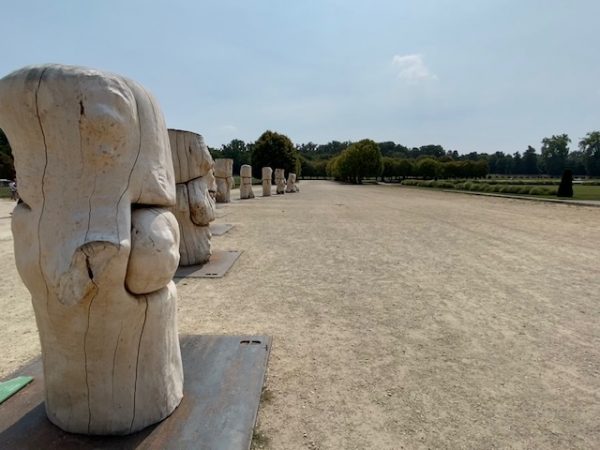
It is huge historical project to try to summarize the legacy of Napoleon Bonaparte. AI is by design less hesitant to come up with any length of a summary statement some with good references on which the statement is based. In combination with a visit at Fontainebleau and a first hand impression of the environment of the autocratic ruler, the remainders like the introduction of a Civil Code to guide also administrations to lawful conduct, we still see influences of this legal innovation in many other countries across the globe. The recognition of Jews as equal citizens and to allow equal access to property and many professions have been influential across Europe mostly in occupied territories. Military service for Jews in Napoleon’s army was another consequence, which spread into the Prussian army and the 1st world war. It is in the 21st century that we see shifts towards more authoritarian governance styles spreading again, we did not want to see this happen until Russia‘s war in Ukraine. (Image: La Chair de la forêt, Frénésie des Géants by  Wang Keping Fontainebleau 2025-8)

Fontainebleau library

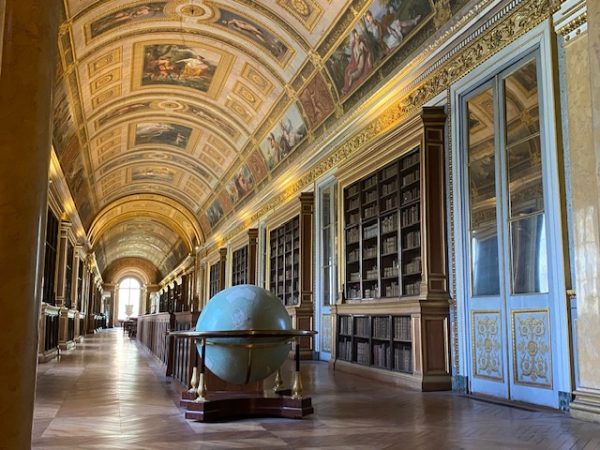
The “Galerie de Diane” in Fontainebleau has been built during Napoleon’s reign. It hosts the library with a large collection of books. The function of the books seems to be more to intimidate the persons passing by rather than ready for inspection. The globe at the entrance reflects the ambition of the ruler. The fact that you have to walk some stairs upwards increases the impression to be little compared to this universe of knowledge. It is great that libraries have flipped this perspective and today we study the period of Napoleon’s reign with our democratic values in mind. The top-down approach was the incarnation of Napoleon’s style of government. Despite the revival of such governance styles in the 21st century across the globe, they are unlikely to last for more years than Napoleon’s fate. A simple reason for this may be the only representative or intimidating role of knowledge in such forms of governance rather than an open mind approach. 

Fontainebleau Throne

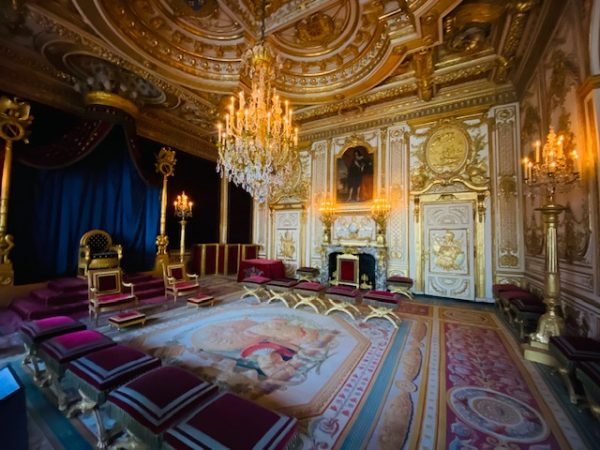
The French history is full of kings and emperors who have ruled the country. The Chateau Fontainebleau has the longest history of kings who lived there and held office, a pre-modern version of “home office”. The most remarkable and distinguished furniture of a king is the throne reserved for office hours. Napoleon created a special throne room at Fontainebleau which is also the only one preserved in its original form until today. It is just one of the home office rooms of the emperor. The antechambers, council room and study had to be passed before to reach the ear and audience of the emperor. The history of the home office and thrones have been intertwined ever since. 

Korean Independence

The independence of a country is sometimes a long struggle. At particular points in time, a window of opportunity may open up, which allows to change the course of history. In many cases the opportunity to gain independence has been prepared for several decades, at least from 1919 onwards to come to fruition only after the end of the Pacific war, shortly after the Nazi-regime was defeated. The long and relentless preparation of the Korean Provisional Government ensured that a consensual constitution was ready to be adopted and elections to be held. The resulting division of Korea into 2 parts (South and North), just like East and West Germany, is rather long lived on historical time scales. For that matter, the hope of a peaceful unification needs to be reiterated again and again. The informative exhibition of the Korean Cultural Center to Belgium and the EU highlights the continued “Dream of Peace” which continues even after more than 100 years.

History coined

It is an ambitious project to frame history of a country or continent according to the succession of coins. In the KBR such an attempt is currently on display in 2025. The history of a country in the center of Europe is reflected sometimes through different occupying forces who imposed their currency onto the occupied territories. The Greeks and Romans had an overriding impact on the development of coins in human history and society.  Precious metals were used as basis to embody lasting value into coins. The images on coins are also a way to reiterate the dominance of a new ruler or governance. From the Roman occupation there are nice specoin the KBR collection as Julius Caesar named one part of the 4 occupied territories “Belgica” beyond what we define as borders of Belgium in the 21st century. Control of your own currency means also to be able to produce unique pieces in your own foundries. The history of coins is also a history coined by those in power to enforce their political power onto the economy. (Image: KBR, The history of Belgium illustrated through coins, 2025).

Permanently anxious

„There’s a set of forces that want us to be permanently anxious“, is the phrase chosen by Tony Cokes in the exhibit just outside the „Palais Populaire“ in Berlin in 2025-5. International politics and the economic upheaval caused by Trump’s tariffs contribute to the already existing other sources of anxiety like nuclear energy and warfare. Global warming causing more extreme weather events add more man-made reasons for anxiety. The next generations will have to foot the bills we have left to them unpaid. Our current shortsightedness increases anxieties which previous generations have not known of a similar kind or in that combination. 

Community building and solidarity are ways to overcome such overwhelming anxieties. Supranational organizations like the European Union have an even stronger role to play to reassure its people with credible signs of solidarity. We are not alone in the struggle to overcome the anxiety that is creeping up around us. We are certainly stronger together than individually dealing with unspecified fears. „We shall overcome …“

Leber JA

In Berlin Schoeneberg there is a memorial in preparation for the courageous couple of Julius and Annedore Leber. Julius Leber has been incarcerated several times by the Nazi officials, tortured and finally executed in Berlin. A link to the group of people trying to overthrow the NS regime (1944-7-20) caused his arrest and execution in January 1945. His wife Annedore published several accounts of the resistance movements, which existed during the NS regime. These people were aware of the fact that they were risking their life with such activities, but persisted nevertheless. We owe Julius and Annedore Leber a decent commemoration as we need to remember that such courageous examples existed even until the last few months of the NS dictatorship. The site allows for a building and learning center which could serve as an archive and encouragement to fight for democracy. It is less obvious than we thought it would be.

Local history

In Berlin and many other big cities in Germany like Munich and Hamburg there are local history projects which tell the stories of specific places or a house linked to liberation day or deportation or courageous acts during the Nazi  grip on Germany and terror across Europe. The initiative « Denkmal am Ort » has become a kind of citizen science project which brings people together to raise awareness again for the cruelties committed under the dictatorship of Hitler and the fascist political movements. Remembrance is not a passive form it can take many active forms as well by simply trying to find an answer to the question what happened during the 30s, 40 and 1950s in the house you are currently living in? Access to archives of cities and small towns can tell very surprising stories about local history. It is a great inter generational experience as well and sometimes the unspoken history turns into a great conversation about history and responsibilities. History is everywhere you just need to keep your eyes and mind open.