
It seems like a horrific idea to talk about the need of war. We might have deemed it outdated to read about the terrible love of war or about the strategy of war. However, the time of war is back in Europe and Eastern Europe feels the real threat and Ukraine the bombs hailing from Russia. Why does Putin love war? The love of war is largely driven by domestic issues. Staying in power for unliked authoritarian leaders is easiest if they indulge in external conflicts. Dictators love war because it makes it easier for them to sustain leadership through brutal force within the country due to a proclaimed external threat or even outright engagement in war. Democratically elected leaders know that they will leave office eventually in a peaceful way (exceptions like Trump are rare). Dictators use any force or terror necessary to stay in power. The love of war is part of this.
Hence, the need of war goes without questioning, if a country in decline or at risk of decline tries to uphold an inefficient, belligerent regime. Beyond rational reasons, such regimes will abuse ideation about national pride, the national interest and anything pertaining to some supposed myths of nationhood to justify its need of war. The dictators have all failed eventually as resistance against this need of useless war is found out by enemies either within or externally. But thousands or millions of victims will suffer. The pressure against the need of war has to rise internally from opposition as well as from alliances of democracies that do not need war to motivate their people to achieve the best they are able to deliver.
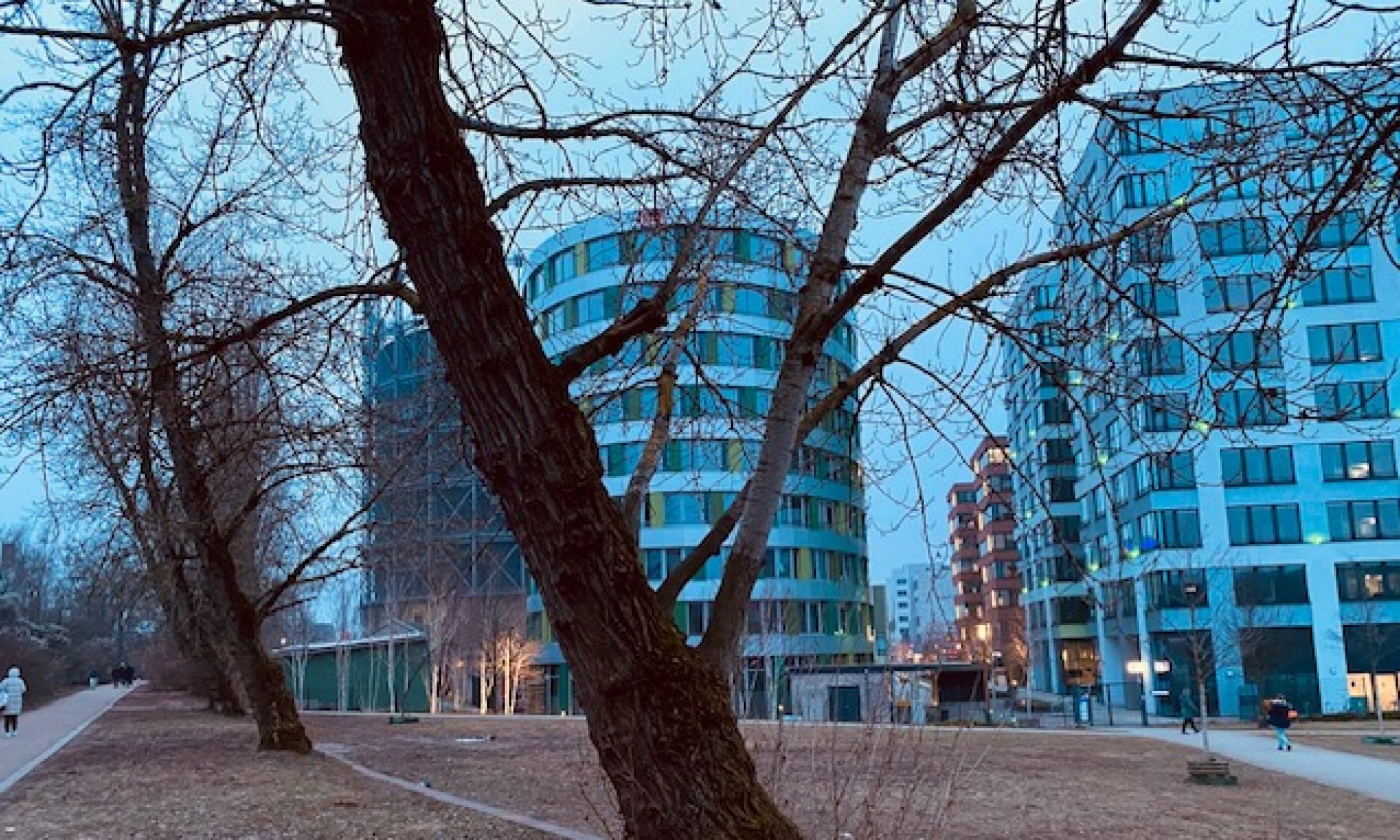
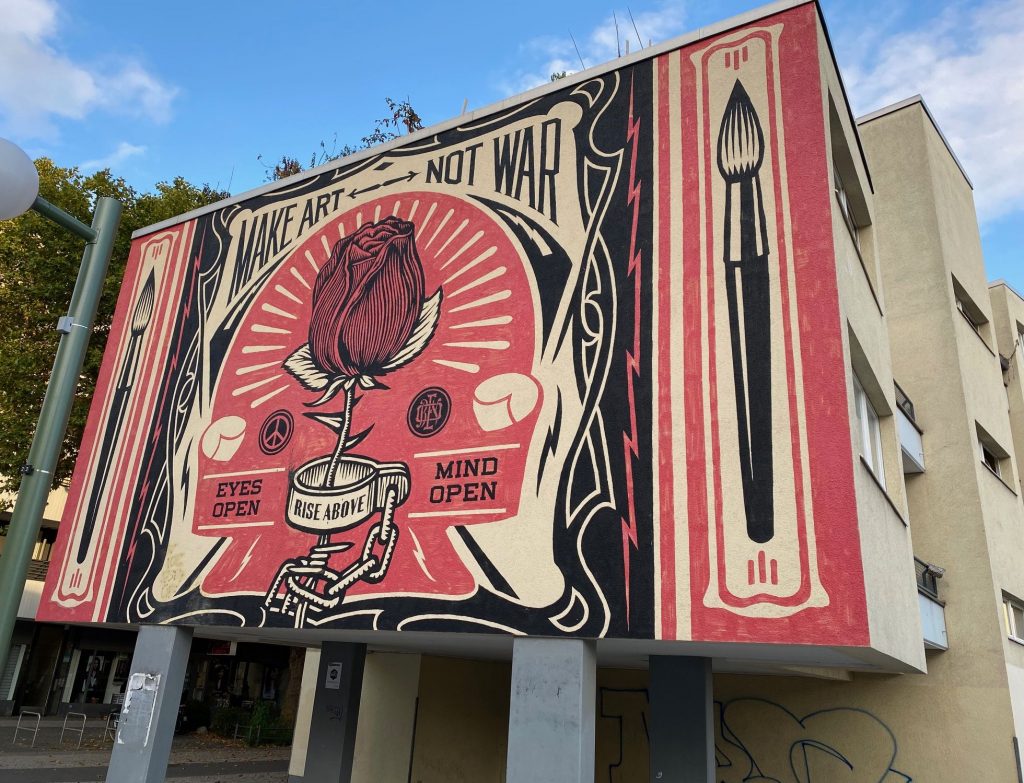
Therefore, the defence of democratic rule is, at the same time, a fight against the need of war by some doomed regimes. After winning the war comes the difficult task of winning peace. This means to create a state of affairs and a state of mind that can do without the need of war. If the external threat diminishes the internal threats might rise and have to be contained as well. Lots of challenges, even for mature democracies. (Image: Berlin 2022-10)
Corruption Watch
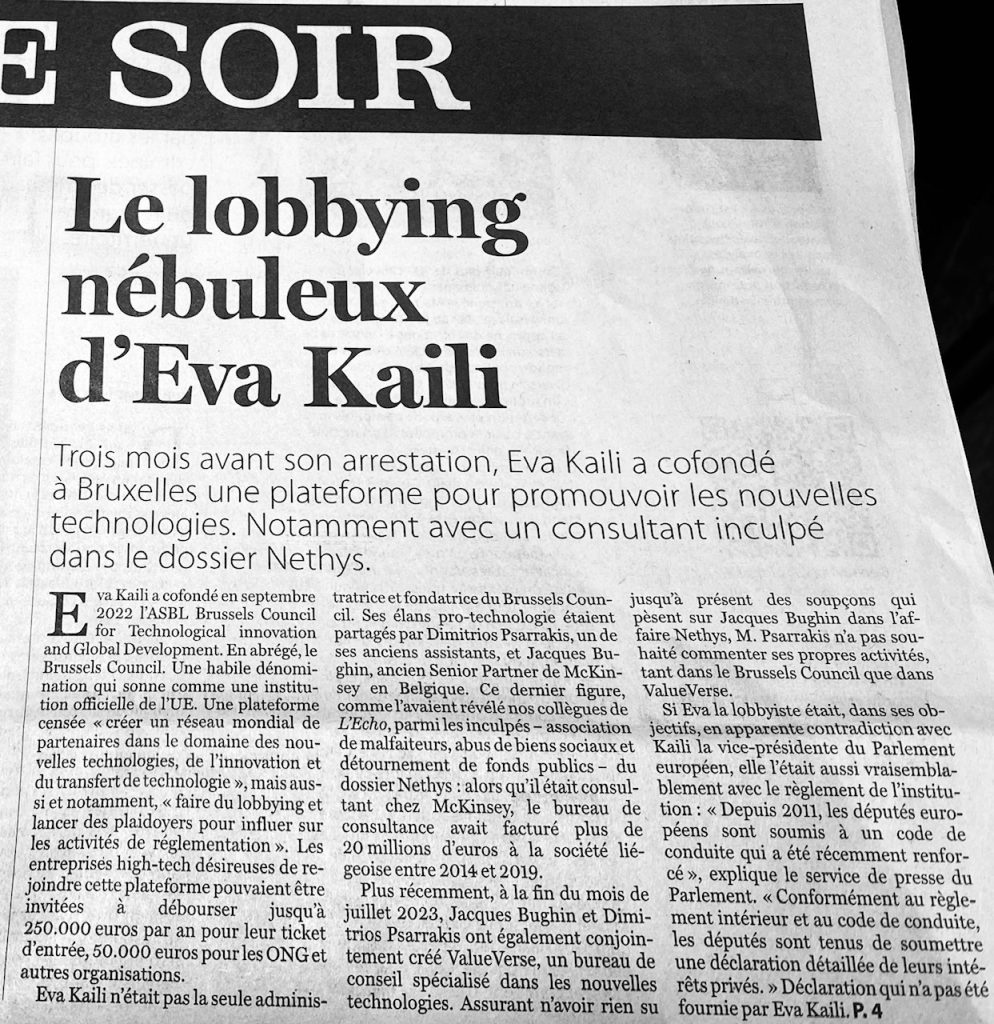
There is a persistent need to watch carefully whether corruption is involved in political as well as economic deals. Transparency Watch is doing a great job in reporting on corruption cases. In democracy we can talk openly about corruption but in authoritarian regimes it is life-threatening for yourself to talk and report on corruption. The case in Europe around the network of Eva Kaili continues to make headlines due to the ruthless abuse of rules the European Parliament. (Link to Le Soir, image below, 2024) The close monitoring of activities and lobbying of powerful industrial interests targeted on parliamentary candidates and officials will continue to be essential for the survival of democracy. The organization „Abgeordnetenwatch.de“ is doing just this. Investigative journalism needs to complement the work of NGOs in this field. Thanks to these efforts it has become much harder to cover up corruption. Only if the risk to be found out is a credible threat corruption can be contained. Let us watch out carefully and probably with the assistance of AI to uncover early any attempts of corruption.
Opportunity Costs
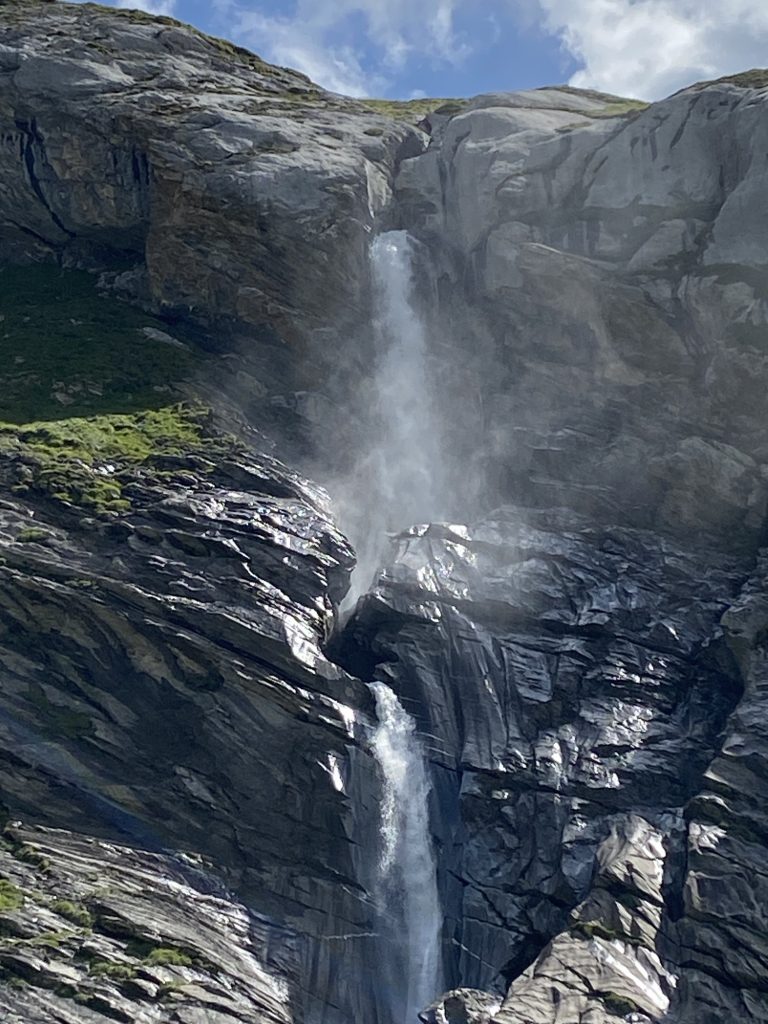
Skiing in winter is a pleasure that has become more elitist. The downhill skiing has always been an expensive sport, but affordable school holidays gave the sport a more accessible touch. The cheaper version of long distance skiing or skating on larger trails involves much more endurance. The report of the French Cour des Comptes in 2024 questions the sense of the huge investment that is still devoted to save the pleasure of the few. I
nstead of investment to the benefit of relatively few persons, these funds could put the money into a more sustainable, socially and ecological productive purpose. Installations could be used all year round rather than in the few weeks at best months with snow. It is remarkable that the court has highlighted this kind of opportunity costs of such installations. Instead of investing in soon to be obsolete infrastructure at lower altitudes like water reservoirs and water canons, this money could already start the eventually necessary transition process. Each € spent is not only lost for the transition, but might create additional environmental liabilities and damage.
From economists it is to be expected that they mention competition in their arguments. Not all stations of skiing will survive. Put more dramatically, in the process of closing skiing at lower and middle level altitude, competition intensifies between stations and of who can survive. Public funds should not be misused in this endeavour. Lobbying is strong and political incumbents tend to favour the merit and legacy of digging for the white gold. Changes of mind sets, investment narratives and decisions are tough. From much downhill skiing we might soon remember only the downward slope before the healthy aspects of climbing a slope takes the upper hand.
Wage indexation
Currently inflation increases rapidly in many countries. Yes, Argentine. The Euro-zone and EEA have mastered the peak of inflation due to shifting away from Russian dependency and cheap prices for energy and dealt with carry-on effects related to high energy inputs. The annual rate of inflation calculated for January 2024 has returned in the Euro-area to 2.8 % close to the European Central Bank target of 2% (compare figure below). Inflation puts wages under pressure, because household with little savings have a very hard time to cope with sudden price increases. For society as a whole, inflation raises many questions of differential impact of inflation on different parts of society. Savings become devalued, but debt might become easier to be repaid in so-called real terms.
Wage earners suffer in terms of lower purchasing power unless in subsequent wage negotiations pay rises can be achieved. This then depends of negotiation power of groups or sectors of the economy. Trade unions have to enter into tough negotiations and conflicts to even regain the same status quo previously achieved in wage negotiations. A series of conflicts and economic readjustments by more or less powerful sectors or representation comes into play.
All this is happening in a year of a series of national and regional elections as well as the European Parliament election in June. Political turbulance and the rise of extremists might be a result of a lack of taking into account the needs of lower wage groups who are likely to feel the full blast of the high inflation previously still today. Wage indexation as in Belgium, which fixes wages to the rise in inflation previously takes out most of the explosive power of a sudden rise in inflation at the risk of an upward wage-price spiral. The recent inflation figures for Belgium, however, show that this is not the case. An overshooting has been followed by an undershooting of the Euro-zone inflation. The political disturbance and risk of redistribution to more powerful groups in society can be limited through general wage indexation or indexation of for example just minimum wages.
The Russian caused spike in inflation has been successfully mastered in the EU. The political economy of redistribution through inflation will remain an important element unless wage indexation is used in more countries to escape populists’ and extremists’ voices.  (Image Eurostat data and ESTATEC app)
Election Re-election
Politics is a lot about decision making, coalition building and communication strategies. Therefore, there have been well established election and re-election cycles in all democracies, even the so-called illiberal pseudo-democracies. The time span between elections is itself a constituent part of democratic practice. 4 years of office for an elected parliamentarian seems to be common sense across many countries. More intensive participation and election schedules have advantages in tighter checks and balances, but may have disadvantages with respect to democratic fatigue, i.e. the time and effort needed to stay informed and cast votes. “Liquid democracy” is a concept of decision making which requires highly engaged persons willing to get involved beyond average commitments. Delegation to politicians within parties and parliaments remains an effective version of democratic practice. Checks against corruption and illegal practices is a necessary condition of each system of delegation. Rapidly changing governments are similarly perceived as a risk to democracies as the repeated call to the ballot box might be unsettling more than calming the spirits.
Berlin in 2024 (like 2023) provides another lesson on the sense of elections and re-elections. The repetition of parts of the federal election in parts of Berlin was required by the constitutional court. Due to failures in correct provision of access to voting and voting material results might have been biased. According to an online reporting by the local radio station (rbb24) based on the official electoral statistics, the participation in the re-election decreased from 75% to 51% in the 455 out of 2.256 districts that repeated the election. There seems to be a high level of democratic fatigue in these districts where the re-election in general accounts of participation in elections marks a low point in achievement. It appears worthwhile to question the judicial decision to repeat the election to the drastic reduction of representativity of the re-election. In statistical terms we trade one form of bias against another form of bias with an unclear overall outcome.
Organising elections is a professional task and requires specific competences. As this is at the heart of democracies, we need to improve our organisation and surveillance of this fundamental democratic process. Repetition seems to be worse than other second or third best solutions. Investing in democracy starts also at the ballot box. Electronic voting is not a panacea, but might be part of the solution. (Image source: Landeswahlleiter Berlin, left: Erststimmenmehrheit, right Wahlbeteiligung, combined election + re-election) 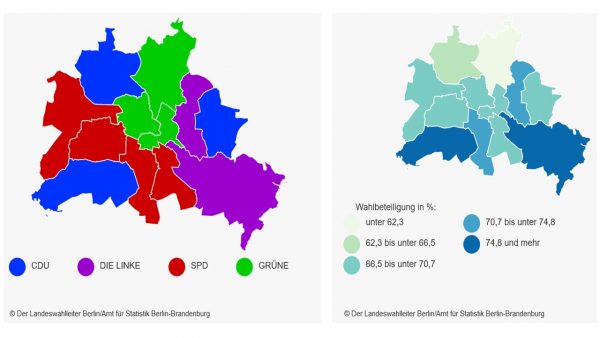
Timeless Values
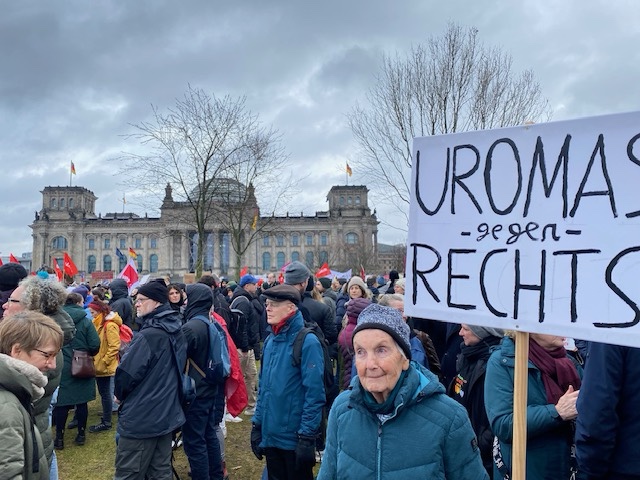
The declaration of human rights is more than 200 years old. However, the need to stand up for the defense of these rights needs many people to act accordingly. Political parties and courts are not strong enough to be the only defendants of democracy and human values. Solidarity across generations is another part of the struggle to defend democracy. In addition to the broad movement of “Omas gegen rechts”, the age distribution has been further enlarged with the “Uromas gegen rechts”. This most likely the generation with first hand life experiences from Nazi Germany and they should have reached an enlightened view of the horrors caused by the Nazi-regime. Unfortunately there are still some who continue to be prisoners in a fascist “brown” cage of mischievous memories. The great grandmother who was present at the demonstration was clear in her statement to stand up against right-wing extremism. (Image: With the permission of the lady I am happy to have evidence of the presence of super-agers at the demonstration in Berlin).
Fighting Fascists
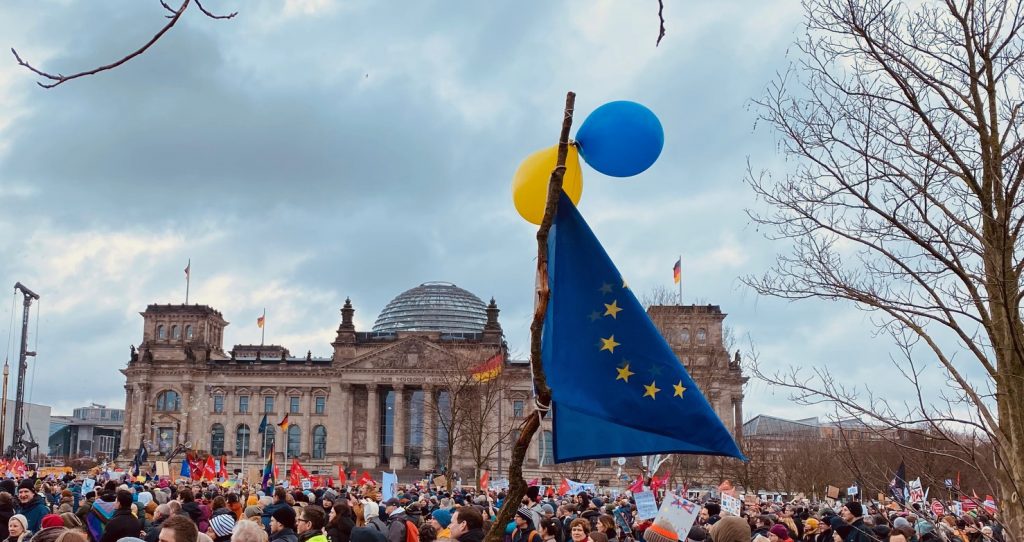
On february 3rd 2024 Berlin has seen the Parliament (Bundestag in the old Reichstag building) surrounded by young and old to raise their voice against the rise of right wing extremism in Germany. The broad alliance against extremism finds grassroots support from a very broad and diverse community. 1700 organizations have joined forces to send a strong signal that they are ready to act against the inhuman propaganda and persistent hate speech. The creativity to express the discontent in clear messages is impressive. Civil society is showing that diversity offers multiple benefits to find new ways to unite people. Great that European flags and balloons in Ukrainian colors where present as well. A movement of solidarity was felt with these people and that provides a strong message for the months ahead with so many elections taking place at the local, regional, national and European levels.
Zwangsarbeit
Die Annäherung an das Thema Zwangsarbeit ist nicht einfach. Auch heute prangern wir zu Recht Zwangsarbeit egal wo auf der Welt an. Die mit weitem Abstand grausamste und umfangreichste Durchführung von Zwangsarbeit haben die Nazis in Deutschland und von ihnen besetzten Gebieten vollzogen. Neben den Schrecken der Konzentrationslager mit dem millionenfachen Mord an Menschen jüdischer Abstammung ist die Aufarbeitung der Verbrechen in Zusammenhang mit der Zwangsarbeit lange in den Hintergrund getreten. Selbst die Zeitzeugen wie Francois Cavanna (2020, S. 10-11) vertraten die Ansicht, dass im Vergleich zu den Ermordungen und Kriegsopfern ihre Erfahrungen und Leiden im Zusammenhang mit der Zwangsarbeit in den Hintergrund traten. („… cela me rendit plus modéré dans l’expression de mes souffrances. … nous ne pouvons que fermer notre gueule. Ce que je fais. »).
Neben der systematischen Ermordungsmaschine der Konzentrationslager in der NS-Zeit verdient das millionenfache Leid und die Terrordrohungen und Anwendungen der Nazi gegenüber den ZwangsarbeiterInnen eine angemessene Bedeutung. Das Dokumentationszentrum NS Zwangsarbeit in Berlin Schöneweide bietet dafür eine hervorragende Ausgangsbasis. Die Ausstellung ist für alle Altersgruppen geeignet. Behutsamer Einstieg für Schulklassen ab der 5. Klasse und zum Nachdenken anregend für Erwachsene mit Informations- und Lerninteresse. Das Ausstellungskonzept mit seinen vielfältigen biografischen Materialien von Zeitzeugen erleichtert, neben der Faktenfülle, einen emotionalen Zugang zum Thema. Online lässt sich beispielsweise die Verteilung der Zwangsrekrutierten die Arbeitsdienst leisten mussten je nach Stadtviertel oder sogar Straße verfolgen (Link Datenbank und Map).
Die Löhne für deutsche ArbeiterInnen und Ost-ArbeiterInnen aus den osteuropäischen besetzten Gebieten waren fast zehnmal höher. Die in westlichen Besatzungsgebieten zwangsverpflichteten Personen oder selbst anfänglich mit scheinbar höheren Löhnen als vor Ort (Organisation Todt) üblich angeworbene Personen erfuhren die spätere Abwertung ihrer Entlohnung. Es bleibt die Betonung auf Zwang, Terror und Einschüchterung bei der Zwangsarbeit meistens in menschenunwürdigen Massenbaracken aus industrieller Massenproduktion. Einstieg in die Erfahrung: NS Zwangsarbeit Dokumenteationszentrum. 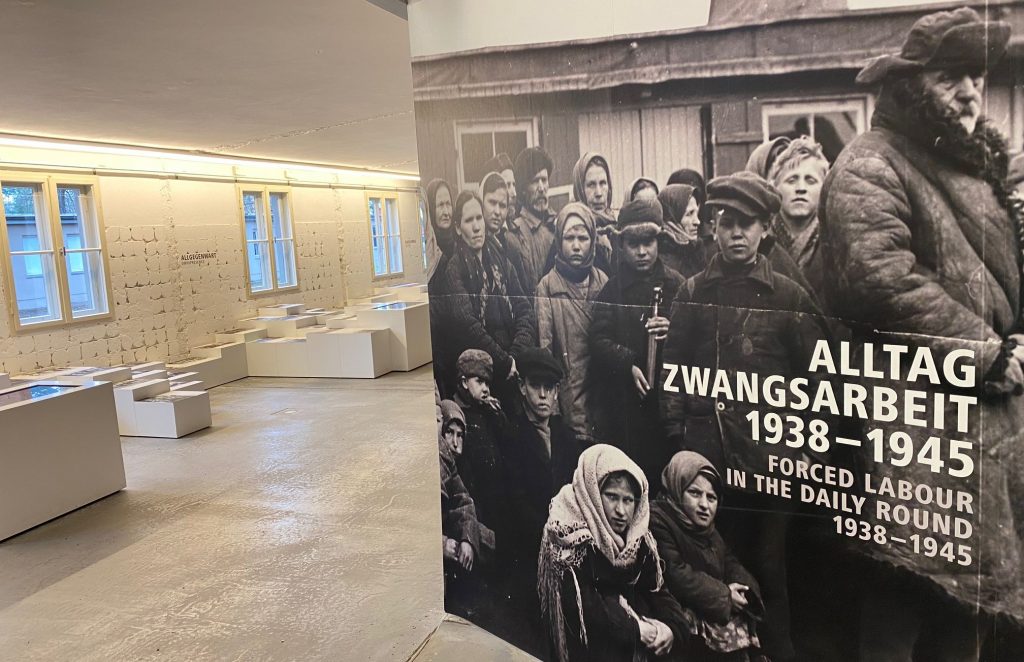
100 x 100
It is the horrible tragedy that Hamas terrorists after more than 100 days hold still more than 100 hostages. We shall never forget. Just like the terrorists taking hostages 51 years ago during the Munich Olympic games 1972. I believe it is about time to remember Winston Churchill’s famous words with a few changes, if I maybe allowed: “We shall never surrender. We shall fight terrorists on land and on sea. We shall fight them in the air and underground, in space if we need to.” This is part of not forgetting terror and staying alert to looming risks. For some the painful memories last their whole life long. Others, far too many, just forget, or worse, deny the facts. 
Sectoral Change
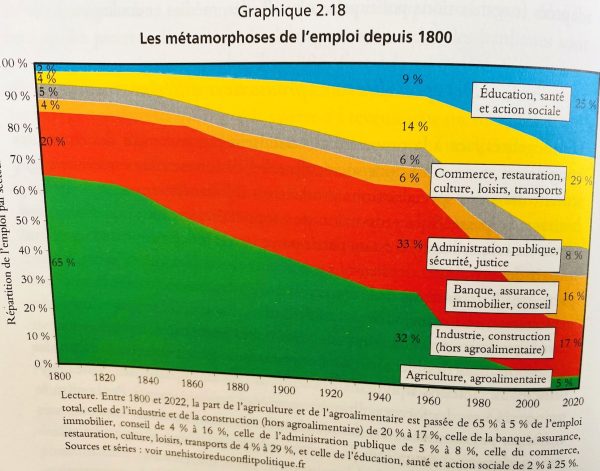
The long-term view of sectoral change in France, for example, from 1800-2022 (Cagé and Piketty, 2023 p. 128) allows us to zoom out of our narrow focus of the last few years of economic change. The decline of agriculture is the most remarkable. The reduction of employment in industry and construction has been an ongoing trend as well. Banking, insurances, property and consulting have seen remarkable expansion over these years. Public services, security and legal affairs are still on a moderate rise. Other sectors like education, health, commerce and transport manage to grow equally.
The merit of the comprehensive volume by Cagé and Piketty (2023) is that it is thoroughly data driven and based on quite unique long data series. The data on structural change and just the employment trends depicted below refocus our attention on likely consequences of these changes.
For the 2 authors we should redirect our attention much more to the implications of these trends (like rising inequality) on political conflicts and power struggles. Democracies are at risk, if we continue to ignore these seminal changes of industrial structures and shifts in employment. The traditional strongholds of trade unions and progressive forces in the manufacturing and construction industries as well as in public transport seem to have unaccounted implications for our political systems as well. The volume by Cagé and Piketty (2023) will soon be available in English and reach broader audiences just-in-time for the European Parliament elections in June 2024. Particularly the spatial implications and how the neglect to take into account the fundamental differences between the rural development and structural change needs urgent reconsideration. After the time for reading and working with the data (LINK) is the time for action to preserve our European Dream of peace and social development.