In economics all students go through the calculus of comparative advantage. People, regions or whole countries tend to apply comparative advantage to their production systems and ensuing internal or external trade. The basic rationale developed by David Ricardo has not changed that much over 200 years. The fields of application, however, are continuously expanded. Lindsay and Gartzke (2020) have applied the comparative advantage rationale to military strategy. The paper quotes 26 times Clausewitz and demonstrates the links of strategy to the basic economic and social rationale of comparative advantage. It is the politics of production that even the presence of trade may override the rationale of comparative advantage to favour local production of “operational domains” or military equipment.
In Russia’s aggression and war against Ukraine own production and trading of weapons has returned to the forefront of the concerns. In addition to the production of ammunition, the provision of drones has dominated the international arms trade related to the Russian aggression. Resources and time for production are additional factors that have an impact on availability of weapons at the right time at the right place and with the sufficiently trained persons to operate them.
The strategies that cross domains or combine domains seem the most promising. The careful analysis of your own comparative advantages or disadvantages needs to be the basis of any strategic decisions. This has been known for 2 centuries at least and is still valid in many fields of application. Additional considerations for “home production” might add to the complexity of the issue. Sustainability has also found its way into the field of comparative advantage at last. This may alter the analysis of comparative advantage of operational domains as well. Lots of unresolved puzzles still around. It will need years to sort this out despite the urgency of the Russian aggression on Ukraine.(Image: AI Copilot.2024-4-30 2 political leaders deal weapons. One has a comparative advantage in ships. The other one has a comparative advantage in aircrafts. they deal together)

AI Disruption
Many scientists started to question the disruptive potential of AI in, for example, the military’s domain. The Journal of Strategic Studies featured 3 papers on AI and autonomous systems more generally. The major argument by Anthony King is the reliance of autonomous systems on other systems mainly human operators even in the background to get these systems off the ground and maybe back again. Not only logistic support but also satellite communication is needed to guide and protect the operations. In quoting Clausewitz, Anthony King stated that war is a “collision of two living forces”. Strategy and counter-strategy will co-evolve as will attack and defence.
Jackie G. Schneider and Julia Macdonald (2024) advocate the use of autonomous and unmanned systems for their cost effectiveness. Economic costs as well as political costs are lower for these new strategic weapons. Mass fire power from swarms of drones is much cheaper than nuclear warheads and the home electorate is assumed to be more willing to accept and support limited and more precisely targeted unmanned missions. The disruption potential of AI is huge but it is most likely an addition to the arsenals than replacing them. (Image 2 swarms of drones fly in the air above tanks, created by AI – copilot-designer 2024-4-29).
Mehr vom Meer
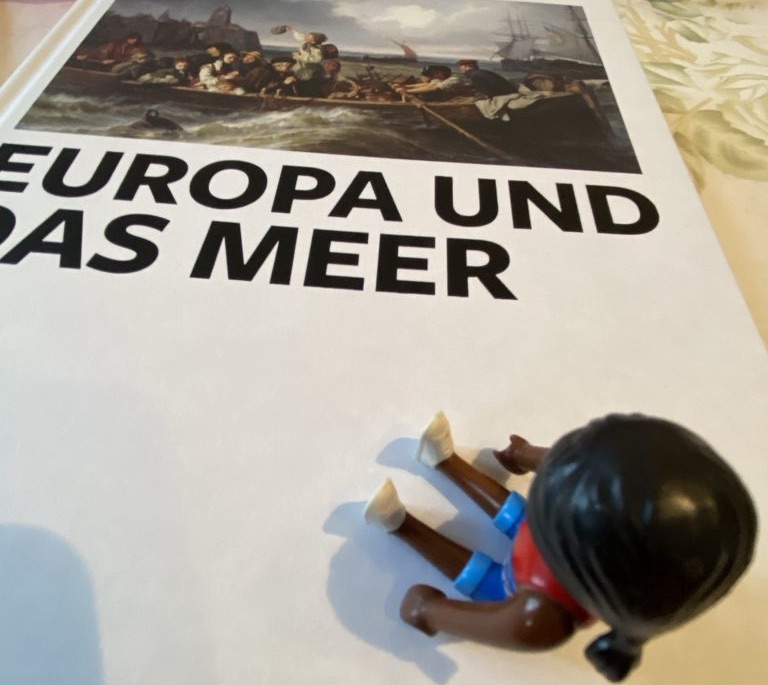
Wir sollten uns mehr um das Meer kümmern. Länder ohne Küsten finden meistens wenig Gründe, warum sie sich um das Meer bemühen sollten. Es ist doch so weit weg. Weit gefehlt. Erderwärmung erhöht die Meerestemperaturen und das wiederum beeinflusst massgeblich die Regenfälle im Inneren der Kontinente. Wir sitzen buchstäblich alle zusammen in einem Boot. Historisch betrachtet war das Meer mindestens seit der Antike Teil des machtpolitischen Kalküls der Beherrschung der Welt und der sie Bewohnenden. Wirtschaftliche Interessen waren ebenfalls Bestandteil der Erkundung und Eroberung des Meeresraums. Die Hansestädte in Europa bieten dazu noch heute gute Beispiele. Nach dem Sklavenhandel sind heute die Überseekabel und Rohstoffe des Meeres die begehrten Schätze des Meeres. Der Artenreichtum der Tiefsee wird erst seit kurzer Zeit intensiver erforscht. Externalisieren von Kosten des Umweltschutzes zu Lasten unserer Meere hat noch wenig Berücksichtigung in Wirtschaft und Gesellschaft gefunden. Tourismus- und Migrationsströme zum Meer, auf dem Meer und über das Meer stellen uns vor große Herausforderungen. Wir werden sicherlich mehr über das Meer reden müssen, und das ist keine Mär. Image aus „Europa und das Meer“ (DHM).
Russian Angst
The title of a book “Russian Angst” by Thomas Franke summarizes the state of Russian society under Putin. It dates back to 2017, but the underlying process of Angst in the Russian society is increasing rather than diminishing due to the already 2 years long intensive hot war of Russia against Ukraine. The Russian Angst is a fear of a continued roll back of its authoritarian rule in Eastern parts of the world and its internal threat that its own people will claim more rights like freedom of speech, freedom of the press and effective democratic voting rights. In a dictatorship the “Angst” is a pervasive phenomenon which creeps into all spheres of live. Franke and Dornblüth (2023) describe the toxic society in Russia. Intoxication and torture of opponents are used by the Putin regime as a threat to suppress critical voices in Russia. Through this a climate of “Angst” is spread so that any internal opposition has to face very high risks to utter any discontent. The experience of a barbarian, totalitarian regime is well known. The threat to life and the presence of intimidation to any disobedient behaviour are strictly persecuted. Nevertheless, the need to think beyond the Putin regime is well under way. The more external and internal, real or imagined threats are countered with brutal force, the more the regime reveals its true kind of governance by force. This invites and leads to the strengthening of counter forces both internally and externally. It seems like box fight in the before last round of a very vulnerable, weakened and isolated boxer. Not many will bet on the likely loser and more countries who previously supported Putin will stop their erroneous policy. Russian Angst and loneliness will further increase. 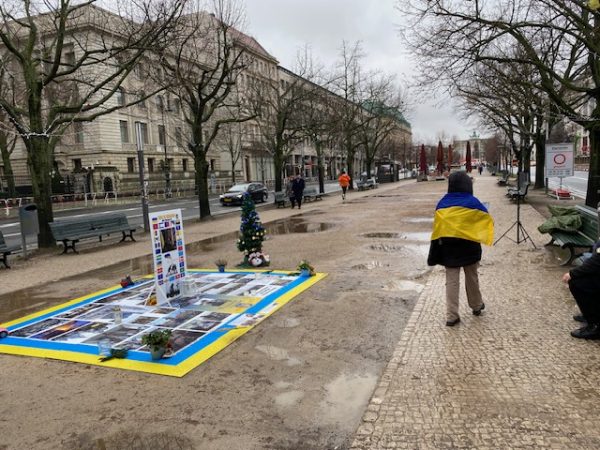
Need of War
It seems like a horrific idea to talk about the need of war. We might have deemed it outdated to read about the terrible love of war or about the strategy of war. However, the time of war is back in Europe and Eastern Europe feels the real threat and Ukraine the bombs hailing from Russia. Why does Putin love war? The love of war is largely driven by domestic issues. Staying in power for unliked authoritarian leaders is easiest if they indulge in external conflicts. Dictators love war because it makes it easier for them to sustain leadership through brutal force within the country due to a proclaimed external threat or even outright engagement in war. Democratically elected leaders know that they will leave office eventually in a peaceful way (exceptions like Trump are rare). Dictators use any force or terror necessary to stay in power. The love of war is part of this.
Hence, the need of war goes without questioning, if a country in decline or at risk of decline tries to uphold an inefficient, belligerent regime. Beyond rational reasons, such regimes will abuse ideation about national pride, the national interest and anything pertaining to some supposed myths of nationhood to justify its need of war. The dictators have all failed eventually as resistance against this need of useless war is found out by enemies either within or externally. But thousands or millions of victims will suffer. The pressure against the need of war has to rise internally from opposition as well as from alliances of democracies that do not need war to motivate their people to achieve the best they are able to deliver.
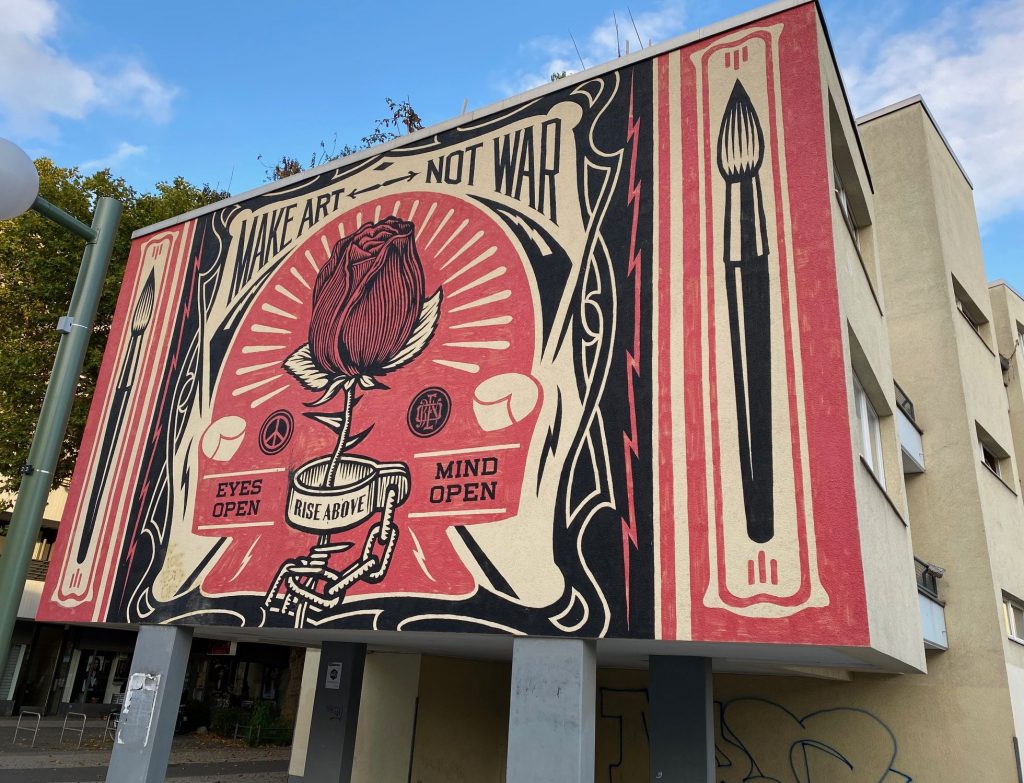
Therefore, the defence of democratic rule is, at the same time, a fight against the need of war by some doomed regimes. After winning the war comes the difficult task of winning peace. This means to create a state of affairs and a state of mind that can do without the need of war. If the external threat diminishes the internal threats might rise and have to be contained as well. Lots of challenges, even for mature democracies. (Image: Berlin 2022-10)
Corruption Watch
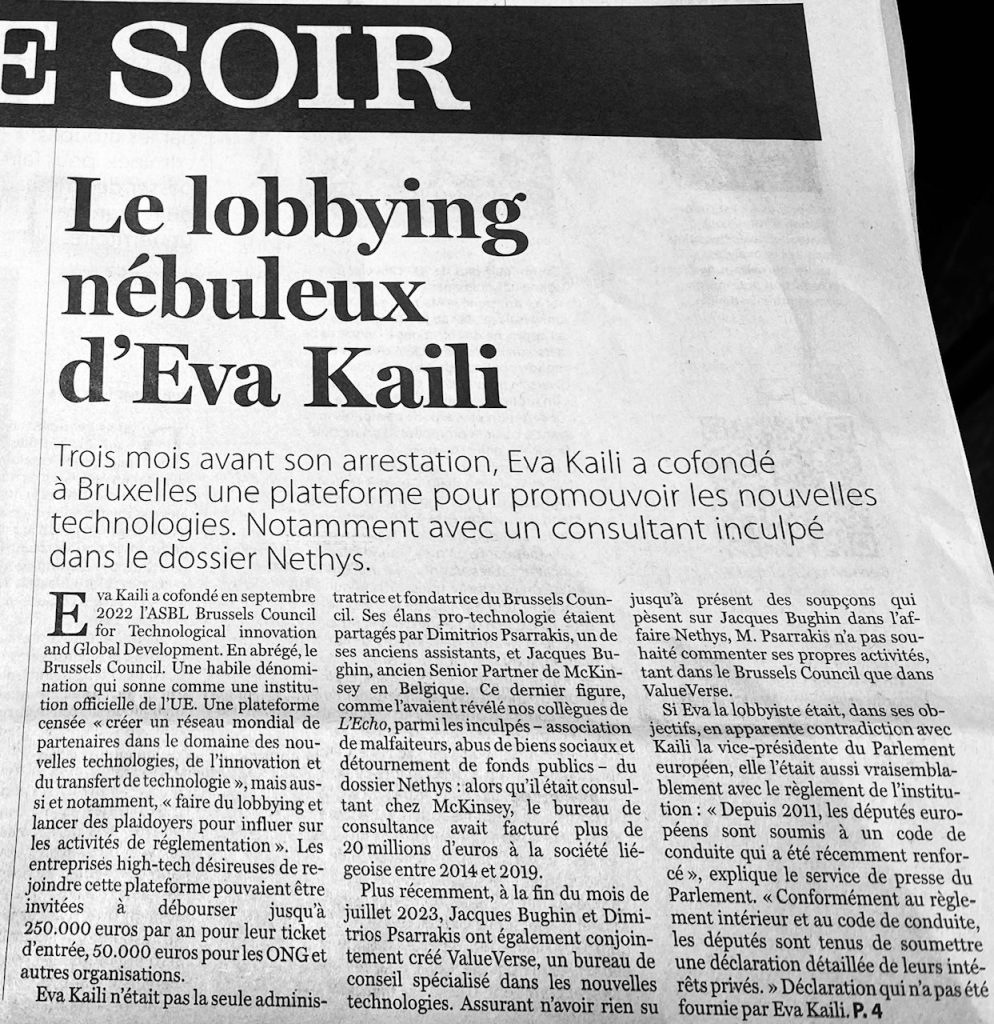
There is a persistent need to watch carefully whether corruption is involved in political as well as economic deals. Transparency Watch is doing a great job in reporting on corruption cases. In democracy we can talk openly about corruption but in authoritarian regimes it is life-threatening for yourself to talk and report on corruption. The case in Europe around the network of Eva Kaili continues to make headlines due to the ruthless abuse of rules the European Parliament. (Link to Le Soir, image below, 2024) The close monitoring of activities and lobbying of powerful industrial interests targeted on parliamentary candidates and officials will continue to be essential for the survival of democracy. The organization „Abgeordnetenwatch.de“ is doing just this. Investigative journalism needs to complement the work of NGOs in this field. Thanks to these efforts it has become much harder to cover up corruption. Only if the risk to be found out is a credible threat corruption can be contained. Let us watch out carefully and probably with the assistance of AI to uncover early any attempts of corruption.
Opportunity Costs
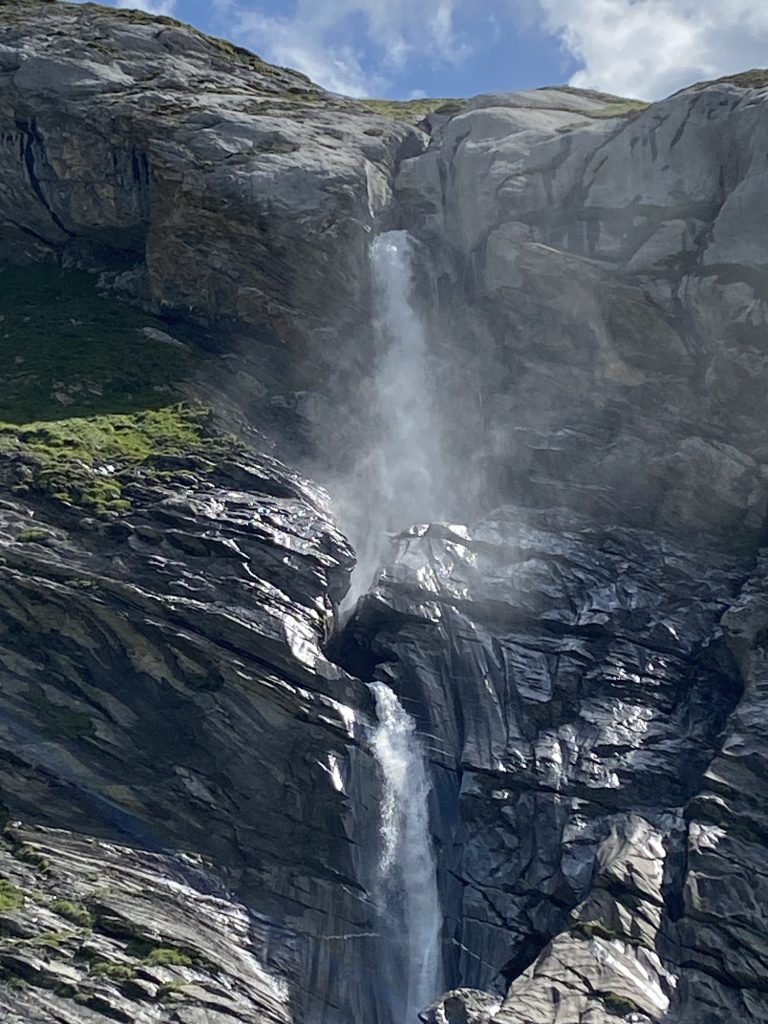
Skiing in winter is a pleasure that has become more elitist. The downhill skiing has always been an expensive sport, but affordable school holidays gave the sport a more accessible touch. The cheaper version of long distance skiing or skating on larger trails involves much more endurance. The report of the French Cour des Comptes in 2024 questions the sense of the huge investment that is still devoted to save the pleasure of the few. I
nstead of investment to the benefit of relatively few persons, these funds could put the money into a more sustainable, socially and ecological productive purpose. Installations could be used all year round rather than in the few weeks at best months with snow. It is remarkable that the court has highlighted this kind of opportunity costs of such installations. Instead of investing in soon to be obsolete infrastructure at lower altitudes like water reservoirs and water canons, this money could already start the eventually necessary transition process. Each € spent is not only lost for the transition, but might create additional environmental liabilities and damage.
From economists it is to be expected that they mention competition in their arguments. Not all stations of skiing will survive. Put more dramatically, in the process of closing skiing at lower and middle level altitude, competition intensifies between stations and of who can survive. Public funds should not be misused in this endeavour. Lobbying is strong and political incumbents tend to favour the merit and legacy of digging for the white gold. Changes of mind sets, investment narratives and decisions are tough. From much downhill skiing we might soon remember only the downward slope before the healthy aspects of climbing a slope takes the upper hand.
Wage indexation
Currently inflation increases rapidly in many countries. Yes, Argentine. The Euro-zone and EEA have mastered the peak of inflation due to shifting away from Russian dependency and cheap prices for energy and dealt with carry-on effects related to high energy inputs. The annual rate of inflation calculated for January 2024 has returned in the Euro-area to 2.8 % close to the European Central Bank target of 2% (compare figure below). Inflation puts wages under pressure, because household with little savings have a very hard time to cope with sudden price increases. For society as a whole, inflation raises many questions of differential impact of inflation on different parts of society. Savings become devalued, but debt might become easier to be repaid in so-called real terms.
Wage earners suffer in terms of lower purchasing power unless in subsequent wage negotiations pay rises can be achieved. This then depends of negotiation power of groups or sectors of the economy. Trade unions have to enter into tough negotiations and conflicts to even regain the same status quo previously achieved in wage negotiations. A series of conflicts and economic readjustments by more or less powerful sectors or representation comes into play.
All this is happening in a year of a series of national and regional elections as well as the European Parliament election in June. Political turbulance and the rise of extremists might be a result of a lack of taking into account the needs of lower wage groups who are likely to feel the full blast of the high inflation previously still today. Wage indexation as in Belgium, which fixes wages to the rise in inflation previously takes out most of the explosive power of a sudden rise in inflation at the risk of an upward wage-price spiral. The recent inflation figures for Belgium, however, show that this is not the case. An overshooting has been followed by an undershooting of the Euro-zone inflation. The political disturbance and risk of redistribution to more powerful groups in society can be limited through general wage indexation or indexation of for example just minimum wages.
The Russian caused spike in inflation has been successfully mastered in the EU. The political economy of redistribution through inflation will remain an important element unless wage indexation is used in more countries to escape populists’ and extremists’ voices.  (Image Eurostat data and ESTATEC app)
Election Re-election
Politics is a lot about decision making, coalition building and communication strategies. Therefore, there have been well established election and re-election cycles in all democracies, even the so-called illiberal pseudo-democracies. The time span between elections is itself a constituent part of democratic practice. 4 years of office for an elected parliamentarian seems to be common sense across many countries. More intensive participation and election schedules have advantages in tighter checks and balances, but may have disadvantages with respect to democratic fatigue, i.e. the time and effort needed to stay informed and cast votes. “Liquid democracy” is a concept of decision making which requires highly engaged persons willing to get involved beyond average commitments. Delegation to politicians within parties and parliaments remains an effective version of democratic practice. Checks against corruption and illegal practices is a necessary condition of each system of delegation. Rapidly changing governments are similarly perceived as a risk to democracies as the repeated call to the ballot box might be unsettling more than calming the spirits.
Berlin in 2024 (like 2023) provides another lesson on the sense of elections and re-elections. The repetition of parts of the federal election in parts of Berlin was required by the constitutional court. Due to failures in correct provision of access to voting and voting material results might have been biased. According to an online reporting by the local radio station (rbb24) based on the official electoral statistics, the participation in the re-election decreased from 75% to 51% in the 455 out of 2.256 districts that repeated the election. There seems to be a high level of democratic fatigue in these districts where the re-election in general accounts of participation in elections marks a low point in achievement. It appears worthwhile to question the judicial decision to repeat the election to the drastic reduction of representativity of the re-election. In statistical terms we trade one form of bias against another form of bias with an unclear overall outcome.
Organising elections is a professional task and requires specific competences. As this is at the heart of democracies, we need to improve our organisation and surveillance of this fundamental democratic process. Repetition seems to be worse than other second or third best solutions. Investing in democracy starts also at the ballot box. Electronic voting is not a panacea, but might be part of the solution. (Image source: Landeswahlleiter Berlin, left: Erststimmenmehrheit, right Wahlbeteiligung, combined election + re-election) 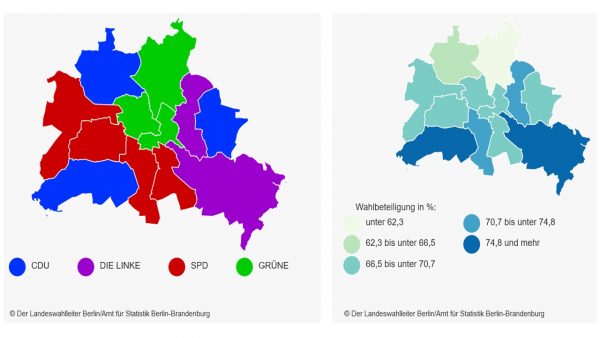
Timeless Values
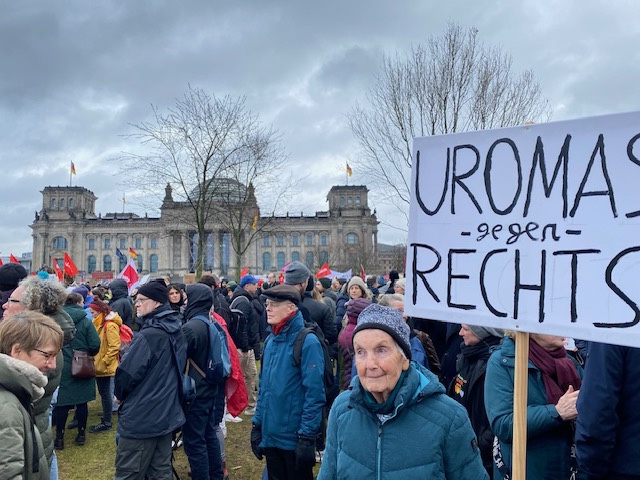
The declaration of human rights is more than 200 years old. However, the need to stand up for the defense of these rights needs many people to act accordingly. Political parties and courts are not strong enough to be the only defendants of democracy and human values. Solidarity across generations is another part of the struggle to defend democracy. In addition to the broad movement of “Omas gegen rechts”, the age distribution has been further enlarged with the “Uromas gegen rechts”. This most likely the generation with first hand life experiences from Nazi Germany and they should have reached an enlightened view of the horrors caused by the Nazi-regime. Unfortunately there are still some who continue to be prisoners in a fascist “brown” cage of mischievous memories. The great grandmother who was present at the demonstration was clear in her statement to stand up against right-wing extremism. (Image: With the permission of the lady I am happy to have evidence of the presence of super-agers at the demonstration in Berlin).