War came to us

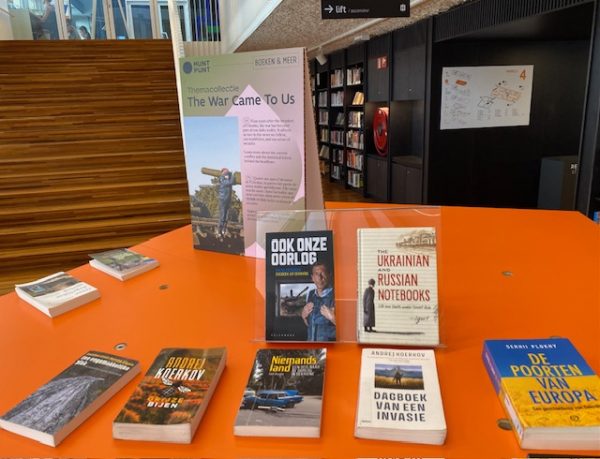
Ukrainian people had to make the horrific experience that « the war came to us ». Even if the Ukrainians were much better prepared than in 2014 with the illegal annexation of Crimea, the horrors of war to not seem to come to an end soon even in 2026. Putin’s war leading Russia into a miserable war experience has made other European nations face the rationale that war might come to them as well. Alliances are formed and reformed to be better prepared for escalations and more realistic threats as well. Huge budgets are vastes again for military purposes in view of a possible need for defense. CO2 emissions skyrocket at the same time, all due to Putin’s illusion of a greater Russian empire. We keep reading and learning our lessons from the brave Ukrainian defense.

Words versus Balls

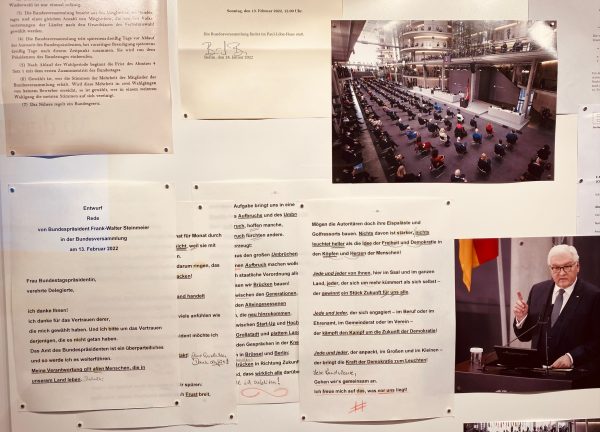
At the occasion of a visit to the “Deutsche Dom” in Berlin, which hosts the historical exhibition of the “Deutsche Bundestag”, I came across the memorable transcript of the speech by Bundespräsident Steinmeier (Image below), which he gave on 2022-2-13. The German President’s words come across as a forceful defense of freedom and democracy as a matter of mind and heart, and against the authoritarian leaders who keep constructing palaces of ice and golf resorts. (“Mögen die Autoritären doch ihre Eispaläste und Golfressorts bauen. Nichts davon ist stärker, nichts leuchtet heller als die Idee der Freiheit und Demokratie in den Köpfen und Herzen der Menschen!”, p.18). There is indeed an ongoing battle on which kind of diplomacy is more effective, words or playing golf together. Apparently the Finnish prime minister seems to be quite keen to play balls with President Trump on the golf course to ensure continued support of the 1000 km Russian Finnish border. Maybe, playing Ping Pong with the Chinese leadership might be more effective in balancing the trade books between Europe and China, just as much as golfing might do the trick with the current Trump administration. What’s your handicap in the golf and ping pong tournament of  international politics.

Communist Utopia

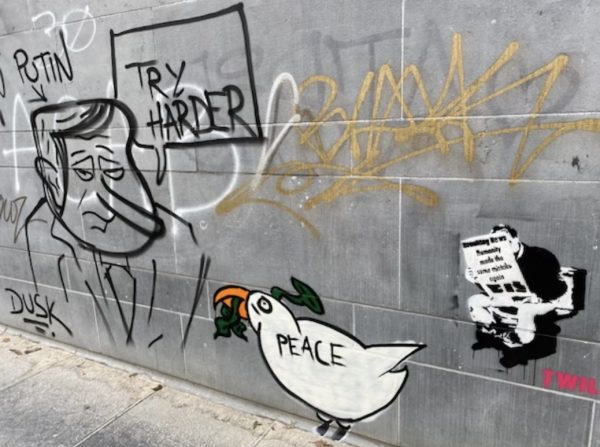
Putin has not only killed thousands of his own people, but he he has also killed the communists’ utopia of a better world and future, if only private property would be replaced by a top down, one party rule of a leadership that pretends to act on behalf of the people. Young Russians have little choice than to follow orders, learn how to bribe superiors not to be sent to the killing fields or be sanctioned. Putin has put an end to the ideas of Glasnost and Perestroika in Russia and utopian ideas about communism as well. He must have sensed it during his time in Eastern Germany that without brutality the Soviet union will not survive for long. As soon as he came back to Russia he prepared the shameless abuse of his power and ideas about a law-based socialist system in favor of the return of the military state. Borders are for those who believe in a rule-based international legal system. Changed to this international legal framework are hard to believe by European nations, but have to be accepted as a new form of “Realpolitik” in the international arena. (Image: Graffiti in Brussels Mont des Arts 2022-3-1) 

Perestroika – Glasnost

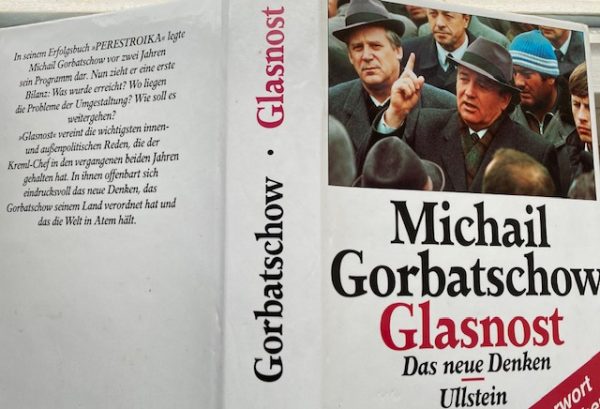
The extraordinary leadership of Michael Gorbatschow with his introduction and subsequent implementation of the principles of Perestroika and Glasnost has changed the lives of millions of people in Eastern Europe to the better. The independence of occupied countries became feasible. The aim to build a “socialist state based on law” (p. 86) and the belief in the power of the people without differentiation of what information is for all and what information is reserved to closed party circles and leadership were perceived as sweeping reforms. More than 25 years later there is little left over from these radical reforms. Putin and his narrow circles have locked in people and their freedom of expression again. The practice of Perestroika and Glasnost have been relegated to a distant dream again. (Image: book cover Gorbatschow).  


Make Russia pay

The initiative from the European Parliament to make Russia pay for its destruction in Ukraine could use about 200 billion Euro of frozen assets from Russia. Until a peace agreement is reached that sum could serve as a guarantee for infrastructure rebuilding in Ukraine already during the war by Russia on Ukraine’s civil infrastructure, like energy supply, airports and railways. It is an accomplishment of transparency to be able to trace the Russian assets. The largest amount is stored in Belgian banks according to the material distributed by the European Parliament. All these funds make up for a substantial effort that otherwise tax payers of other European countries will have to spend. The cooperation in the EU and beyond is at yet another test. Belgium plays a rather strange role in this respect as it benefits the most from many European Institutions and lobby groups being based there.

Reason for war

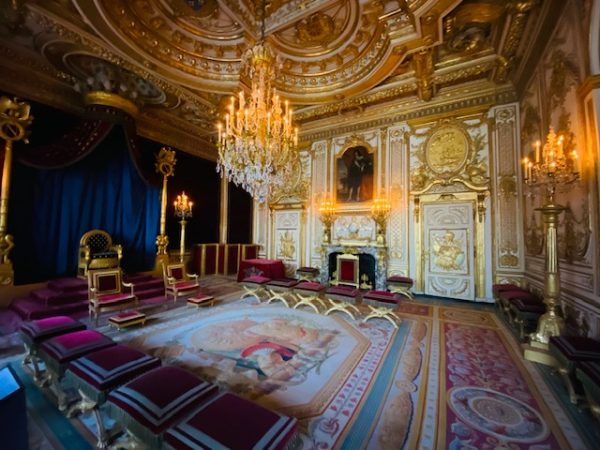
In his “Propositions on Happiness”, the French philosopher Émile-Auguste Chartie, called in short Alain (1925), takes issue with the strange predilection for war. In his proposition XLII Agir, he writes on war: “Je crois assez fort que ce qui plaît dans la guerre c’est qu’on la fait”. In later paragraph   XLVII on Aristotle, he takes up his recurrent concern to explain happiness with the importance of agency in one’s own life and actions. “Faire et non pas subir, tel est le fond de l’agréable“. In taking both quotes together, we understand that for Alain the reason for war consists primarily in the desire to demonstrate agency. In order words, the position of power, of being in charge, being in control of the political situation are the prime reasons to go to war. With the first quote stemming from 1911 Alain had already a sound understanding of what would happen decades later in the 1st and 2nd World War. Even Putin‘s war in Ukraine is probably a cynic demonstration of agency in a seemingly otherwise rather paralyzed country. With this in mind, Putin‘s wars in the 21st century appear as another chapter in the endless pursuit of cynic reasoning. (Sloterdijk, 1983). (Image: Throne Room at Fontainebleau since 17th century). 

Archers destroyed

In the attempt to explain modern warfare to people, the Roman and medieval languages are staging a comeback. The archers have found their way from warfare into art history and back again. George Barros explains recent defensive actions by Ukrainian military forces as the strategy to put the archers out of power rather than the arches.
Destroyed or unfit air planes can no longer launch missiles or bombs. The Russian reserves are, however, fairly numerous, but the air strikes on the modern archers have demonstrated an astonishing military intelligence on the Ukrainian side. The technological advances of the Ukrainian military services may shift the balance or raise the costs of war to Russia, considerably.

Killing fields

According to “Le Monde” dated 2025-5-26 the persons who died in the war initiated by Putin amount after 3 years to 250.000. The numb of injured soldiers would be 3-4 times as high. The loss of lives and tarnished life expectancy of persons involved in combat adds up to a huge loss for the Russian people. Being misled by political and military leaders, apparently substantial numbers of recruits for all sorts of services face the choice between the combat field or desertation. Tough choices which remind us of the moral conflict raised already during peace times if you were refusing to join the compulsory military service. Western people are better prepared for such moral dilemmas than the glorification of war in the Russian society. Of course, certainly in Germany we are thankful for the hardships the Russian army and people had to endure during the 2WW. Liberation Day would not have happened without the Soviets, Russia and Ukraine plus many other nations fighting until Nazi- Germany surrendered. The positional battles of the Great War seem to be back again enhanced with a war of drones. The killing fields for a generation of Russian troops is completely self inflicted. How many thousands Putin needs to acknowledge this cruelty? (Image exhibition by Yoko Ono Berlin Gropiusbau 2025-5).

Tchaikovsky home

During the time before the “Zeitenwende” it was easy to visit the home of the composer Pyotr Ilyich Tchaikovsky in St. Petersburg. Therefore, we refer to our memory of the visit and the already 10 years ago restrained liking and appreciation of the Russian officials for the aristocratic composer, even accused to not be sufficiently Russian in his music compared other Russian composers. The composer had diverse love affairs, which were also not conform to official doctrines. The world wide success of his compositions, mostly known for his ballet music, remains popular in the 21st century. Similar to Beethoven, the biography by Malte Korff (Tschaikowsky, in German), highlights the final symphony as his masterpiece. The seems to be a reason to study “the last works” of composers specifically. The mature compositions appear to reflect on previous work and build or comment on previous work. The 6. symphony “Pathétique” was completed in his last year of his life, only at age 53. The final IV-th piece of it is entitled “Adagio lamentoso” and ends in very calm tempo and almost silence like a withering away heart beat. To my surprise I found a similarly very quiet ending in one of his early piano composition when he was only 28 years old “Romance Opus 5, Andante cantabile”. This early piece also ended “più lento” and from pp to ppp. (compare extract of image of notes below).

Insecurity Council

The UN Security Council has been turned into the Insecurity Council. The UN Plenary Session voted with a 2/3 majority on 2025-2-24 the draft Resolution L.10 stating: “Three years after the Russian Federation’s full-scale invasion of Ukraine, the General Assembly today adopted two resolutions reaffirming Ukraine’s sovereignty and territorial integrity …”. As part of this resolution the UN General Assembly claims “accountability for the most serious crimes under international law committed on the territory of Ukraine …”.
The UN Insecurity Council (15 Members, China, USA Russia, F, UK as permanent Members) adopted  almost in parallel with 10 votes in favor and 5 abstentions (Denmark, France, Greece, Slovenia, United Kingdom) resolution 2774 (2025) calling for a swift end to conflict. The most notable change in international politics is the changed voting behavior of the USA, which has retreated from an outspoken condemnation of Russia as aggressor and occupant of foreign territory.
The “revealing of masks” in what appears to be a neo-imperialist period of time has come. The set-up of the post  1945 UN institution of the Security Council has lost a major function to prevent armed conflicts and early reaction potential. The force to aim for and guarantee international peace lies much more in the hand of the plenary of the UN rather than the small select Security Council dominated by previous superpowers largely due to their possession of nuclear weapons of mass destruction.
The voting of a resolution by the Insecurity Council, which is in contradiction with a resolution of the UN General Assembly concerning the spirit, if not the words, is a source of insecurity itself. A reform of the UN system, which risks to become a “shopping system” of lenient organizations, where you join and leave the organization (UNESCO, WHO, WTO …) will loose impact.
For many people and countries, the only hope for a guarantee of human rights lies with the United Nations Human Rights Charter, peace keeping missions and International Courts. The UN Security Council as an Insecurity Council is likely to let down many people truly seeking a peaceful life.
(Image: The Fall of Icarus, Pablo Picasso, at HQ UNESCO, Paris)