Scroll or stop

In 2026-10 the fundamental question is: to scroll or not to scroll? As we have moved into the individualistic society with omnipresence of the not-so-social media we keep scrolling through online content. Our attention habits are subject to so-called cliffhangers which aim to direct our attention on specific topics, surprising images or just steering us to more-of-the-same content. The social media ban for children fights against the addiction to endless scrolling. In most cases, what is good for children is also beneficial for adults. Hence, the “endless scrolling” (which I increased on this blog at several occasions, currently = 30 max entries) is from now on reduced to 10. After those 10 entries, you are invited to read more on one of those entries or use one-click proposed keywords or categories. The search of topics or names is another more specific entry into a social science perspective. Maybe, the invitation to scroll less, but stop more often and read or follow proposed links is a beginning to detox our online habits. 
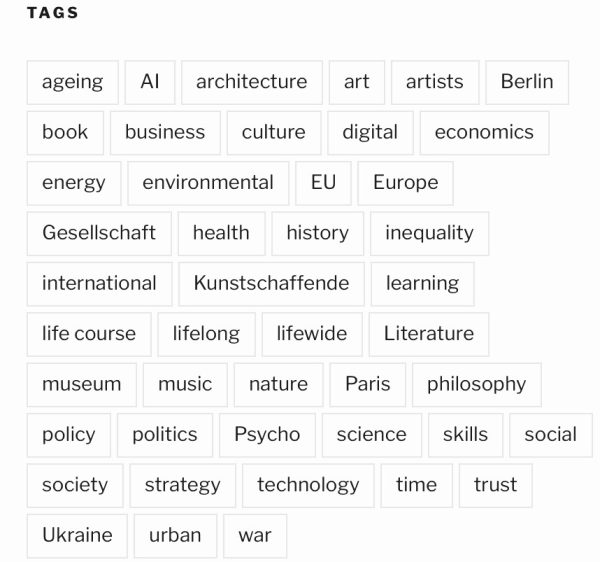
Tags on www.schoemann.org 2026-10
Screenshot

News impact democracy

The reporting on news in the media can be highly influential on election outcomes and therefore democracy. Bias in coverage of news arises from mainly 2 sources: (1) topics covered as opposed to the ones neglected, (2) the framing of the news which fit into a broader political narrative. A robust scientific analysis of the topic is difficult as the amount of data (articles, headlines, appearances) can be rather large. The paper by Haider et al. (2026) accomplished a major step forward through the systematic treatment of “selection bias” in news coverage. Related to news coverage, selection bias has both a statistical as well as a substantive meaning. The substantive finding of selection bias refers to the fact that the print media studied tend to prefer “horse race stories to policy issues” in upcoming elections, i. e. the focus on opposing candidates rather than the underlying policy choices. The negativity bias in reporting remains another constant in media research. 

chewing horse in Chantilly box

Visitor retention

For media, platforms, stores, webpages as well as blogs one of the more interesting measures about popularity or spread consists in visitor retention. It is a bit like counting the pages of a book you have read, which you have at home, or have you read them all? The zapping across radio or television channels is also an indicator or unsuccessful retention of viewers. Webpages, online stores or the blog entries here are all more or less directly trying to increase the retention of visitors on the same page. Maybe this can be considered as one of the first steps into a (not-so) social media addiction. The IT-sector offers tools for this.
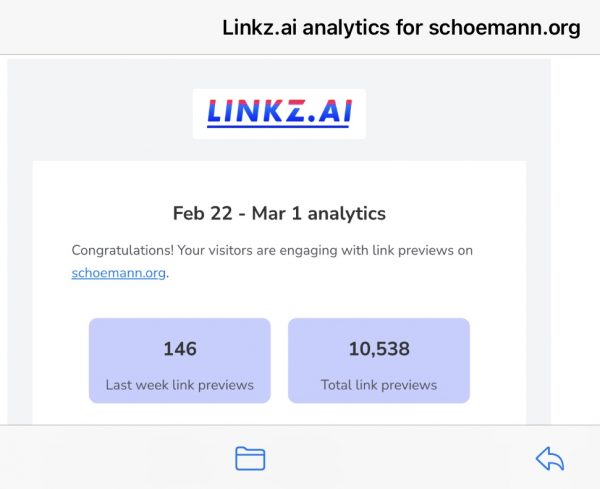
On this webpage “schoemann.org” we make use of “linkz.ai” a ready-made plug-in that provides overviews on the links entered on this webpage, mainly to avoid that visitors have many additional tabs opened in their browser, do not jump off to follow up the links, but rather stay on the same webpage and “scroll on”. At the same time this means referrals from other webpages, which use the same techniques, will be less frequent.
The visitor retention tool used on this webpage is besides the original content 😉 “linkz.ai”. This tool scans other blog entries and links, and proposes the image on the previewed link at the top of the blog preview, for example. Basic weekly frequencies on previews are provided, which might guide a strategy to increase visitor retention, if that is one of your objectives.
The current discussion of addictive potential of social media platforms could be measured through such tools as well and has probably been used already for years with even more sophistication and direct feedback loops into the algorithms.
(Image: basic own statistics Linkz.ai use 2026-2-28) 

Screenshot

AI Podcasting Me

Content producers have lots of tools at their disposal to get their content across to very different audiences. For some time the traditional media of newspapers, radio and TV were the prime outlets for content distribution. Social media have changed this to many more senders of content than before.
In the 21st century, AI allows to automate media productions. In a trial run I just used Google’s NetbookLM to generate 3 podcasts based on my own writings on AI over more than a year by now. The result is available and using artificial voices it is possible to broadcast yourself without revealing your own personal voice. I am not done with the evaluation of the outcome(s) yet, but the first impression is an interesting other form to spread content.
More tests are necessary to check for hallucinations as well.
Here are the links to my virtual podcasts:
AI, intimacy and insecurity

AI, Society and the Human Spirit

AI and the Human Mosaic: Navigating Our Interconnected Future

Journalists Scientists

In the theories of democracy journalism has entered the stage mainly in form of a controlling mechanism that is part of an extended checks and balances system of democracy. Independent journalists serve as effective multipliers and critical commentators which are an essential element of a well functioning democratic society. Social media’s ability to reach large audiences without adherence to independent journalists’ principles pose challenges to the way journalists are perceived by the public. The border between journalism and influencer marketing of products and opinions is continuously under pressure. Voices not heard,  underrepresented or those with few resources for large scale communication face difficulties to communicate their views in a market flooded with information and marketing. 

Another challenge to journalists is the fast evolution of scientific research and knowledge which at times derives from complicated theoretical and/or empirical methods. Hence, the relationship between journalistic reporting and scientific rigor and need for details in reporting are hard to reconcile. This necessitates a continuous dialogue between scientists and journalists to be aware of potentials and limitations to the co-evolution of the two disciplines. In order to avoid a self-referential subset in each discipline, the demonstration of successful cooperation between the two disciplines reveals the complementary role in many real-world instances. Investigative journalists often rely on additional scientific expertise and scientists who uncover manipulations of any sort in their work have to cooperate to inform society about the topics. As with global warming or PFAS risks scientists get drawn more and more into the checks and balances role within democracies. Therefore in addition to the separation of powers claimed in the political literature of the enlightenment (executive, parliamentary and judicial) we added already the 4th one of journalism and should include (5th) independent scientific research and reporting into the essential principles of well functioning democracies. The conference at the BNF in Paris on the 28th of March has raised these timely questions in the best tradition of the ongoing process of enlightenment.

Blue Sky

In the period of romanticism the associations with a blue sky were very different from today. Getting out into the sun was a kind of privilege for the “leisure class”, of people who could afford to enjoy time outside for boating, walking or other pleasures. In our technology-driven 21st century the associations with Blue Sky are more like a technically enhanced view through for example “Windows” at the news and opinion platform or “Bluesky”.
Several scientific websites that report data on blue skies and air quality more generally across the world report indicators like ozone values O3, sun intensity, micro particles 2.5µm and 10µm, Nitrogen Dioxid NO2 to name the mostly quoted indicators. Hence, just enjoying the blue sky outside isn’t the same as it was before. People working outside in the sun or at times of a blue sky but with high air pollution levels are incurring severe medium-term health risks. The Ozon layers at very high altitudes protect our skin and eyes against high UV-radiation, but O3 on the ground is tough for eyes and lungs.
Technology has come with many blessings, but the negative effects on a global scale become also more evident. Getting used to a particular lifestyle, which produces lots of emissions of aggressive fine particles will make it more difficult to just simply enjoy a blue sky.
In consideration of all these background data with regional variations, we surely need an AI-system which we can ask for advice, whether we should go outside and enjoy the blue sky with or without respiratory mask.
Romanticism has led us all the way to Californication and dangerous enshittification of the air that surrounds us. Youth and the next generations will have very different associations with Blue Sky than we have the chance to, at least, have had.

Enshittification

Don’t laugh. This is a very serious scientific term to describe the way social media function in the 21st century. The scientific reference goes back to 2025 and article in “Science” by Kai Kupferschmidt. Twitter, now eXit, like most other social media platforms uses algorithms that select posts for you from the millions of posts that are likely to induce a reaction from you, which prolongs your time on the platform. Additionally, eXit Twitter applies an algorithm that prioritizes accounts with already a huge followership, which makes these accounts even bigger. The result is an increasing inequality in attention to info, facts, fake news, but also revenue for the platform owners through more advertisements. As hate speech and fake news are commonly perceived as shit, many social media are happy to spread more shitty things on their platforms as this generates more money for the platform as well. In short, enshittification happens sooner or later to most platforms and we all suffer from this. As user of these platforms, it is hard to escape from this process, as most platforms tend to “convert” to enshittification at some later point in their life cycle, unlike babies who manage to quit this phase after a few months. A move to Bluesky might be indicated, but there is no guarantee that the same process will just happen again. Mastodon is another small twitter-like platform that like Bluesky offers a more open approach to its governing algorithms and a more controlled access in the registration process.
To avoid enshittification, we have to be ready to move away from one platform to another one, just like changing bank accounts or club memberships. Make sure to take most of your friends with you and there are already tools for this online as well. Enjoy the safe online life again on another platform or consume more of the traditional media like newspapers, radio or tv with proven quality. (Image: extract from Jan Steen, 1625-1679, The Rhetoricians – “In liefde vrij”, MRBAB)

EU Georgia

It is a moving image to see a hundred demonstrators at „Unter den Linden“ in Berlin just next to the Russian Embassy. The Georgian flag and Georgian people actively seek the association with the European Union and the values it stands for. Irrespective of a large majority of the people of Georgia‘s wish to become part of the EU they have to fight hard to be heard. Next to the Ukranian protests in Berlin it becomes very evident that these two nations fight for living standards and values which are so „self-evident“ for us European citizens that it is all to easy to forget about our neighbors who have to endure hardships with uncertain outcomes. The experience of having lived together under one roof with people from other countries allows to realize that we have so much more in common than what separates us. Our house and home of the EU has much to offer, more than we tend to believe in our daily routine.

Book Annotation

For most people book annotations are considered a nuisance. However, most pupils or students mark their so-called textbooks, which contain many images nowadays anyway. A good mindmap, summary of text, highlighting or critical comments may be part of their day-to-day working with a book. Some editors facilitate this using broad margins and more space between lines. Working through a text can take multiple forms and books have allowed over centuries different kinds of their usage.
There is yet another underexplored usage of books. On printed volumes annotations of previous readers may serve as a guide to a script of places, thoughts or material of particular importance. I have always found annotated copies of other readers interesting in their own right. Reading an annotated copy felt like reading another person’s mind, thought or learning process.
A modern view of books as a tool of communication might extend this perspective to study annotations of several readers on the same copy. Just like we comment today in word processing on texts from collaborators or students. Books are a means of communicating with other people or machines (AI) usually with the aim of spreading ideas, content, horror or pleasure.
Therefore, I am always happy to find annotated versions of a book, especially of prominent authors. It sometimes feels like reading a “partition”, a transcript of music which contains the comments or fingering of the reader or the performing musician. The BNF has a lot of such special copies in its archives, usually found in the donations of persons or prominent authors and their families to the archives. This can be put together to make an interesting exhibition of the process of thinking and writing and of special treasures – annotated books.
Image Bibliothèque nationale de France BNF, collection, “Annotations by Jean Racine on Homer “Ilias“.

Democracy in Korea

For all scholars of the theory of democracy the writings of Alexis de Tocqueville (1835) “De la démocratie en Amérique” are a major point of reference. The comparison of the democracy in America with the French king and both constitutions reveals comparative strengths and weaknesses of political systems. Korea after the 4th of December 2024 is yet another warning of what are the dangers to democratic systems. The attempted “coup d’état” by the president of Korea together with a former defense minister and several hundred soldiers has failed due to the speedy reaction of the elected members of parliament and an attentive and reactive public (Korea Times reports).
Tocqueville (p.130-131, French edition online) states, beyond the separation of powers (John Locke), the importance of the right to nominate key positions in a society also public opinion for the survival of democracy. Modern social media have increased the “reaction time” of public opinion and the “time to action” if need be. The combination of both elements of public opinion ensured that parliamentarians in Korea rushed to parliament and used their potentially last chance to vote against the imposed martial law, which started to seal off parliament already.
Several lessons for democratic systems derive from this. Separation of power remains key for democracy. The distribution of state functions on many shoulders under the control of parliament are essential. Legal mechanisms, in case of a spontaneous attack on the system, have to be able to react fast in order to avoid spreading fake news about legality/illegality of interventions. Public opinion, the people at large, should have their opinions distributed rapidly as well. This is necessary even beyond the traditional media of TV, radio and print. In Korea 2024 the attempted “coup d’état” tried also to block traditional media and prominent figures of the opposition with high power of influencing and reach on social media.
Tocqueville stated already that kings are threatened by revolution. Elected presidents have to fear public opinion. A lesson still valid beyond the US., France and Korea in the 21st century.
(Image: joint exhibition at “Traditional Korean Painting”, Korean Cultural Centre Brussels, 2024)