In the middle of the hype around AI it is useful to take stock of the reflection and evolution of AI. In my own analyses and writings on AI it evident that a narrowing of focus has taken place. Whereas before 2022 the writing dealt more with digital technologies in general. The links to the literature on the social construction of technologies was obvious. Algorithms and AI was a part of the broader topic of society and technology.
This has changed. The public debate is focused on “everything AI now”. We look at technological developments largely through the lens of AI now. Hence, my focus of assessments of technology from a societal perspective follows this trend. In a collection of blog entries on AI we try to demonstrate the far reaching changes that have started to have an impact on us. In the last few months the all encompassing concern about AI’s effect on us needs full attention of social scientists, policy makers, companies and the public at large. We can no longer leave this topic to the software engineers alone. By the way, they themselves ask us to get involved and take the latest advances in AI more seriously.
As a “flipbook” the online reading is rather comfortable (Link to flipbook publisher MPL). The pdf or epub files of the blog entries allow to directly follow the links to sources in webpages or other publications (AI and Society 2p 2024-4-18). The cycles of analyses and comments have become faster. Traditional book writing suffers from time lags that risk to make pubications outdated rather quickly. Dynamic ebook writing might bridge the gap between time to reflect and speed to publish or inform the wider public. The first update as .pdf-file is available here: AI and Society(2).
Citizens Gardens
There are multiple ways to link citizens to gardens. Most people would link citizens to the property of their own garden. This is more the perspective of people from the countryside. The aim of citizens who can afford it have a garden, many others wish to have one and all of them enjoy public garden spaces. An intermediate version of the public versus private property of citizens’ garden is the joint ownership of groups of like-minded people to work together in the shared property or rented garden space. The recreational and health effects are well documented, if care is exercised with utensils etc. Spring is the ideal time to join projects again as the results of a little bit of gardening will be visible and enjoyable for several months afterwards. Gardens are also meeting points for people of all walks of life as in the vicinity of the European Parliament in Brussels. The Citizens’ Garden has a different function to people gardening there. When you puzzled about Europe after a visit to the Parliament or the Museum of the History of Europe, then it is time for a stroll and relax in the garden nearby.
Alternatively, the Exhibition Centre of Tour & Taxis in Brussels not too far away from the North train station has an impressive indoor garden for the times of rough weather conditions. At the time of the book fair culture in the indoor garden made a splendid combination. There is a green version of Europe. It is like a small plant. It needs a lot of time and care to grow. 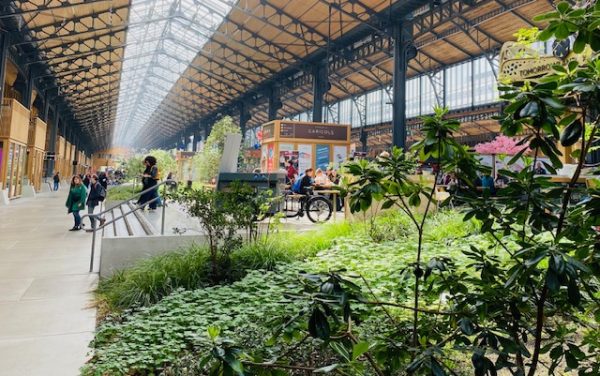
Causal Benefit Model
In the field of medicine we move more and more towards precision medicine. Previously, the term of personalized medicine was used which suggested to a certain degree that a personalization might be feasible. The budget constraints have forced us to change the term to avoid unrealistic, untenable promises. In the field of cardiology scientific advances advocate to shift from a risk-based model of treatment to a causal benefit model. (Kohli-Lynch et al. 2024 Link). Long-term benefits of a treatment are more promising, if the treatment addresses the causal mechanisms at work. It is wide spread practice to deal with general risk profiles as guidelines as the precision medicine based on a causal benefit model is far more laborious since to search the causal mechanism at work requires additional testing of hypotheses. This becomes immediately clear if genetic causes enter into consideration. Nevertheless, medical research advances more and more in this direction. Genetic testing has been shown to be useful in analyzing and treating issues like sudden cardiac arrest (in survivors). We are somehow aware that genetics may play a role here, but we shall need a lot of additional studies to make the causal benefit model a feasible option for widespread applications. Targeting research in this field will offer new avenues for precision medicine in the 2020s.

AI and PS
AI like in ChatGPT is guided by so-called prompts. After the entry of “what is AI” the machine returns a definition of itself. If you continue the chat with ChatGPT and enter: “Is it useful for public services” (PS), you receive an opinion of AI on its own usefulness (of course positive) and some examples in which AI in the public services have a good potential to improve the state of affairs. 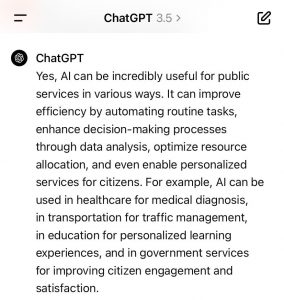 The AI ChatGPT is advocating AI for the PS for mainly 4 reasons: (1) efficiency purposes; (2) personalisation of services; (3) citizen engagement; (4) citizen satisfaction. (See image below). The perspective of employees of the public services is not really part of the answer by ChatGPT. This is a more ambiguous part of the answer and would probably need more space and additional explicit prompts to solicit an explicit answer on the issue. With all the know issues of concern of AI like gender bias or biased data as input, the introduction of AI in public services has to be accompanied by a thorough monitoring process. The legal limits to applications of AI are more severe in public services as the production of official documents is subject to additional security concerns.
This does certainly not preclude the use of AI in PS, but it requires more ample and rigorous testing of AI-applications in the PS. Such testing frameworks are still in development even in informatics as the sources of bias a manifold and sometimes tricky to detect even for experts in the field. Prior training with specific data sets (for example of thousands of possible prompts) has to be performed or sets of images for testing adapted to avoid bias. The task is big, but step by step building and testing promise useful results. It remains a challenge to find the right balance between the risks and the potentials of AI in PS.
AI by AI
It has become a common starting point to use electronic devices and online encyclopedias to search for definitions. Let us just do this for artificial intelligence. The open platform of Wikipedia returns on the query of “artificial intelligence” the following statement as a definition: “AI … is intelligence exhibited by machines, particularly computer systems …“. It is not like human intelligence, but tries to emulate it or even tries to improve on it. Part of any definition is also the range of applications of it in a broad range of scientific fields, economic sectors or public and private spheres of life. This shows the enormous scope of applications that keeps rapidly growing with the ease of access to software and applications of AI.
How does AI define itself? How is AI defined by AI? Putting the question to ChatGPT 3.5 in April 2024 I got the following fast return.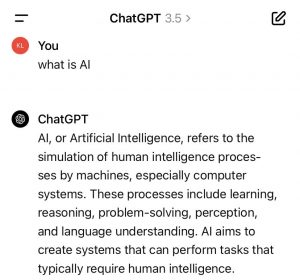 (See image). ChatGPT provides a more careful definition as the “crowd” or networked intelligence of Wikipedia. AI only “refers to the simulation” of HI processes by machines”. Examples of such HI processes include the solving of problems and understanding of language. In doing this AI creates systems and performs tasks that usually or until now required HI. There seems to be a technological openness embedded in the definition of AI by AI that is not bound to legal restrictions of its use. The learning systems approach might or might not allow to respect the restrictions set to the systems by HI. Or, do such systems also learn how to circumvent the restrictions set by HI systems to limit AI systems? For the time being we test the boundaries of such systems in multiple fields of application from autonomous driving systems, video surveillance, marketing tools or public services. Potentials as well as risks will be defined in more detail in this process of technological development. Society has to accompany this process with high priority since fundamental human rights are at issue. Potentials for assistance of humans are equally large. The balance will be crucial.
Wage Minimum
A wage at a minimum level is frequently lower than the minimum wage. Most EU countries have a legal minimum wage that should protect against poverty risks at low levels of wages. Over decades it has not yet been possible to raise all low wages to this level. Le Monde (Béatrice Madeline et Aline Leclerc) has published on April 3rd a comprehensive analysis of sectors and people concerned with this difficulty to make a decent living while earning the minimum wage. In France (La désmicardisation), as in many other countries, it is difficult to earn just a bit more as the minimum wage because both employers and employees may lose social benefits if they just earn some hundred € more than the legal minimum wage. For all those persons who do receive only a wage even below the minimum wage getting stuck in a poverty trap is very likely. The number of working hours is then often is the only option to make ends meet your needs. Put bluntly, you work additional hours and/or take a second job to complement the lack of earning a wage at the minimum level. Public procurement that makes the application of the minimum wage compulsory and controls this application effectively benefits society as a whole. Lots of infrastructure projects, urban and rural development receive public support. The conditionality to pay the minimum wage + X should be a „conditio sine qua non“. The millions of workers at the lower end of the wage distribution have a power at the ballot box, which continues to be underestimated in many European countries. The EP elections on June 9th will probably alert us about the lack of faith in a bettering of living and working conditions of those persons coping with wage minima.
Architecture Berlin
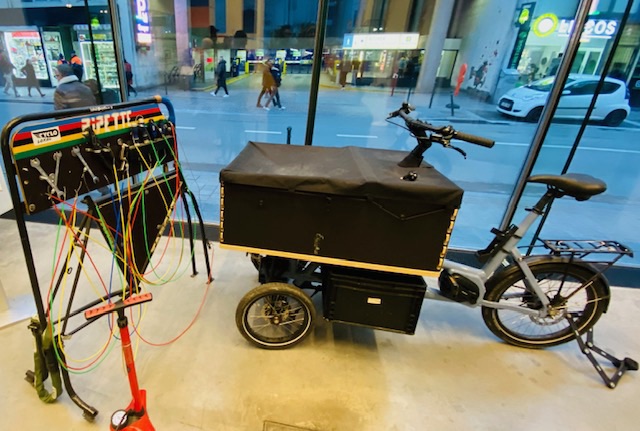
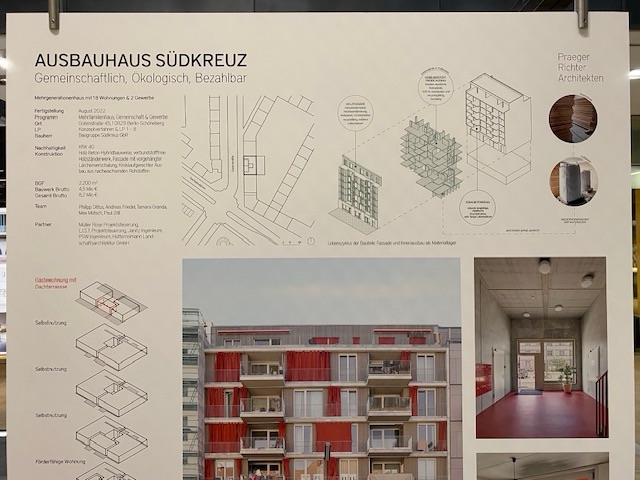
The annual exhibition of completed architecture projects in Berlin attracts people beyond the narrow circles of architects. You may take a walk through Berlin to view the actual realizations in 3D or 4D with people living, working or moving in these buildings. As social scientists we like talking or interviewing these people about their experiences. Urban planning and participation in urban development is important for city development in a democratic fashion. The combination of social, ecological, economic and technological concerns find compromises in urban renewal. The range of activities is remarkable. Living spaces have the most entries in the exhibition followed by offices and trade spaces. Education as well as public open spaces raise a lot of interest and funding currently. Climate change and adaptation to limited ecological resources ask for innovative solutions as well. Most projects in Berlin or by Berlin based architects deliver in this respect. The socio-ecological change needs a lot of actors to implement such changes and meet unprecedented challenges. The 60 projects represented for 2023 are the top of the iceberg but a lot remains to be accomplished in repairing old buildings and infrastructure as well. The DA! exhibition provides a democratic transparency of projects, which allows the public to learn about innovation and to make more informed judgments about what architecture can deliver for society.

Fertility Growth
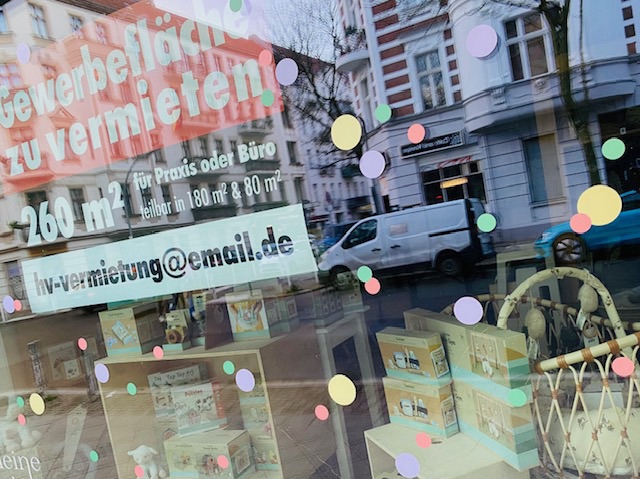
The first association of fertility and growth is likely the growing of fertility rates in a country or region. Only macro economists associate the growth or decline of fertility with the macroeconomic consequences of more or less economic growth. Countries with higher fertility rates in most cases have higher growth rates as parents spend more on food, clothes, mobility and education. Accommodations are changed, adapted and refurbished. Estimates of increased consumption per child by economists range from 500.000 to almost 1 million in the highest developed countries. Children are a country’s wealth, but they also cost a fortune in monetary terms. Good news for the economy if families keep spending independent of economic cycles. More children keeps dedicated shops running or even a whole sector of the economy. In recessions the downward pressure in this sector becomes an additional challenge not only for the families but with ripples-on effects for the whole economy and society. If you see shops closing which has sold furniture for children for the last 15 years then the realization of an economic downturn becomes also more real. Sometimes the parallels in the news of declining fertility and increases in pensions do not square well with the fitness for the future or the future orientation of a society. Democratic voting rights that give families more weight in elections could change this. It is not yet on the political agenda.
AI Sorting
Algorithms do the work behind AI systems. Therefore a basic understanding of how algorithms work is helpful to gauge the potential, risks and performance of such systems. The speed of computers determines the for example the amount of data you can sort at a reasonable time. Efficiency of the algorithm is an other factor. Here we go, we are already a bit absorbed into the the sorting as purely intellectual exercise. The website of Darryl Nester shows a playful programming exercise to sort numbers from 1 to 15 in a fast way (Link to play sorting). If you watch the sorting as it runs you realize that programs are much faster than us in such simple numeric tasks. Now think of applying this sorting routine or algorithm to a process of social sorting. The machine will sort social desirability scores of people’s behavior in the same simple fashion even for thousands of people. Whether proposed AI systems in human interaction or of human resource departments make use of such sorting algorithms we do not know. Sorting applicants is a computational task, but the data input of personal characteristics is derived from another more or less reliable source. Hence, the use of existing and newly available databases will create or eliminate bias. Watching sorting algorithms perform is an important learning experience to be able to critically assess what is likely to happen behind the curtains of AI.
Fertility BPS-SPB
Fertility is another example of the co-determination of the biological, psychological and societal spheres of life. The latest available data for Germany and Sweden in 2023 show a remarkable decline of 10% in the seasonally adjusted Total Fertility Rate (TFR) in both countries (Bujard, Andersson 2024). The TFR was at 1.3 in Germany and 1.5 in Sweden. This means both countries are well below their population replacement rate. In both countries the populations will shrink further. There are no easy answers to the question: why?
The co-determination of the biological, psychological and societal spheres of life seems to be combined driving force. The biological clocks are ticking for women who delayed birth. Maybe pollution of drinking water or PFAS, nanoparticles of plastics disturb fertility. Psychological reasons such as increased anxieties due to the Covid-19 pandemic, lock downs or closed schools have left parents without adequate support for 2 years. Isolation or loneliness could have delayed partnerships and fertility as a consequence. The social environment has also provided additional uncertainty as the cost of living has risen and affordable housing for families is scarce in both countries.
We have probably underestimated the effects of the “Zeitenwende” on people’s mind sets. Sweden has suddenly sought to join NATO to achieve a broader military safety net for its people. In Germany the experience of damages due to war or as a consequence of Russian occupied territory is very present in people’s mind. The war of Russia in Ukraine may have increased uncertainties, anxieties beyond the immediate effects of higher living costs, interest rates or prices for energy. At best fertility might only be delayed for some years, but the consequences of shrinking populations need to be taken seriously. Making societies more welcoming for children and their parents is part of the solution.