Just in the vicinity of the Potsdamer Platz in Berlin you’ll find the Deutsche Kinemathek, the museum movies, actors, actresses, directors and the history of cinema in Germany. There is a small specialized library in the Kinemathek that allows to dive not only into journals and books, but also video material, scenarios and accessories. Of course, you will find a lot of material on all sorts of movie stars (heroines) over more than a hundred years. The “Divas” of the industry take up a large part of the exhibition. “Marlene Dietrich” much more than “Hildegard Knef“, the former born and the latter lived for a long time in Berlin-Schöneberg (Berlin-Pretty-Hill as some locals call it nowadays). The 2 Divas probably caused the funny translation. Anyway, the hall in the Kinemathek which is exclusively devoted to Marlene Dietrich impresses with a lot of glamour and mirrors around.
For those with not only a biographical, but also life course interest in cinema cherish the public access to the library. The most impressive table there is the desk with access to the Ukrainian movies and about cinema in Ukraine. A list with QR-codes allows you to readily approach the recent developments before and during the Russian aggression on Ukraine (See image below). After all Potsdamer Platz in Berlin was a hot-spot of the cold war period in the divided Berlin. A little bit of a “Metropolis-atmosphere” can still be felt. The Kinemathek explains well what this is all about. 
Killing me softly
The problem with pollution is, it is killing you softly from inside. It is almost impossible to escape air pollution as it is pervasive in cities, but also in the countryside where you do not expect it that much. This is the result of the study by Kuzma et al. (2024) published in “The Lancet Regional Health Europe”. Based on a data set of 8 million persons from Eastern Poland the effects of air pollution on myocardial infarction incidence was analysed. The use of the “European Union’s Earth Observation Programme” contributed data on air pollutants like PMs, BaP (benzo(a)pyrene), SO2 and NO2 concentrations. The multi-level data of 5 voivodeships, 101 counties, and 709 communities in Poland allows to differentiate the effects of damage to the heart tissue on cardiovascular disease. The other well-known factors are arterial hypertension, diabetes, obesity, chronic kidney disease, hyperlipidaemia, and smoking as most of us know already. The effects of BaP (benzo(a)pyrene) is shown for rural areas despite the lower observed traffic density in these areas. The killing occurs softly from within our bodies by just breathing in and out, and in and out continuously. The disease burden in these regions is observed with “recorded 63,154 hospitalizations and 5921 in-hospital deaths (9.4%) due to STEMI; and 76,543 hospitalizations and 4079 (5%) in-hospital deaths due to NSTEMI”. In short, the need to reduce air pollution further is an urgent demand that saves lives eventually.
(Image from public domain wikipedia or “do-it-yourself” here).

Silent Pandemic
There is a pandemic that is silently spreading across countries and continents. It only indirectly related to the Covid-19 pandemic. The medical journal “The Lancet Respiratory Health” (2024) has an editorial about the inequities of asthma as they develop over the life course. The development of asthma has pre-natal, genetic, environmental, life-style and socio-economic co-determinants. The study of respiratory disease, therefore, is a multi-factorial issue, which needs to disentangle the specific influences. Smoking as well as obesity have an impact on asthma, instantaneously or with delayed time effects of sometimes many years. Hence, it is important to take the whole life course into account, if we want to address the rising disease burden of asthma. Air pollution and heating-up of the planet are important drivers of the silent asthma pandemic across the globe. The social distribution of people working in “asthma- prone” work environments and/or living in highly polluted urban, suburban or rural areas near high frequency traffic is another latent factor causing huge costs to persons and society as a whole. Health inequity is growing over the life course. This is not easy to tackle as policy target as the onset of the disease has no single trigger, but rather a combination of influences that contribute in varying amounts to the evolution of respiratory diseases. (Image air pollution https://aqicn.org/map/germany/de/)

Photos Exhibit
Our usual expectation of an exhibition of photography is to look at photos at a wall. Sometimes there is more it. The Exhibition Space at the “Haus am Kleistpark” features Michael Schäfer who attempts to go a bit beyond these traditional forms. In the works of photo cubes on water surfaces “2021_57”, or a dice floating on the waves of oceans, the video representation of his photographs takes the assembled images beyond their flat 2D surface. However, the 2D representation is at the origin, then transformed into a 3D dice, which then is animated as a 4D format. Moving beyond the flat screen image takes photography into the 21st century.
His work “Les acteurs 1-26” from 2007 is shown at the entry hall of the exhibition. It shows pupils of a class at an elite school who deem themselves in leadership roles in the near future. Is it acting? Is it projection into a future role they are likely to take on. They represent stereotypes, of course, but some are pretty convincing in these roles already. Some others still seem to reflect on what they are doing there. Even acting these roles, they are aware of the meaning of social rank and class in society. Without having read the sociologist Bourdieu, all are aware of the fine, little elements of distinction as they have evolved over time. We could teach an interesting sociology class in this exhibition. 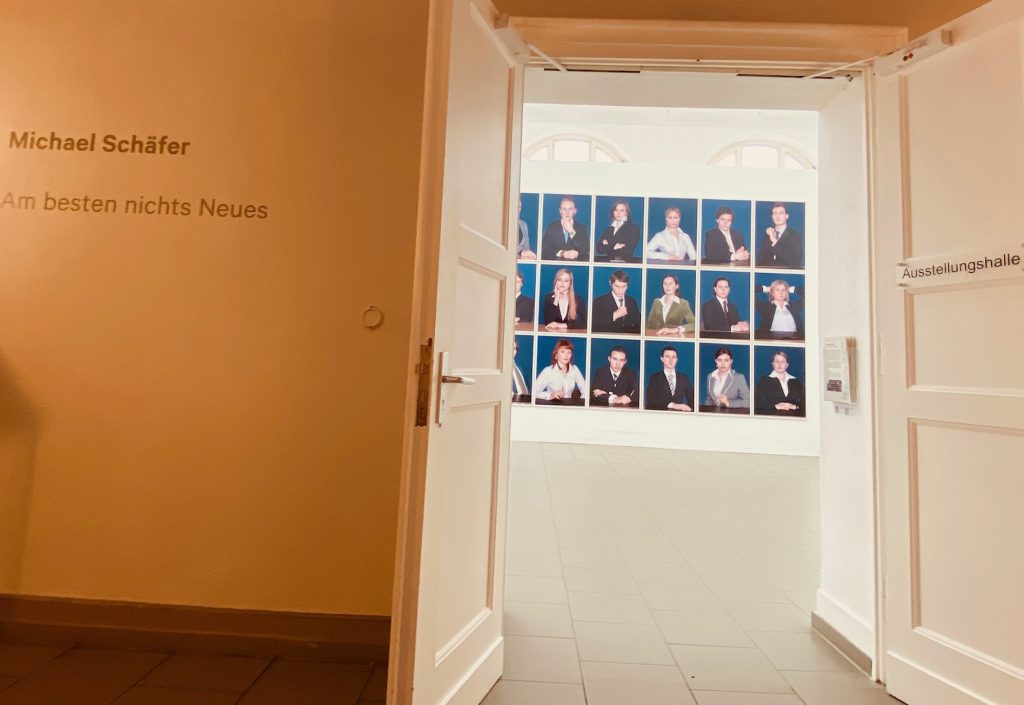
May 1st
More people take to the streets on the 1st of May in Germany. The costs-of-living crisis with high inflation has increased the claims for pay rises for workers and adjusted wages for employees. We all have observed “greedflation”, i.e. excessive company profits in several sectors. Additionally, “shrinkflation” has affected consumers in their daily shopping experience. Political efforts to curb inflation have taken a long time to come about and most initiatives have ended already (Energy sector). This spurred a new drive for trade unions to come out in huge numbers to protest and claim adequate wage increases to cover the increased costs of living. In Germany the DGB informed on the annual 1st of May demonstrations across the country about a strong new entry movement of members of 400.000 persons. It is higher than the loss of members of the large baby boomer cohorts who retire.
Through a broad and engaged membership the pressure on higher wage settlements will persist. Companies have used the crises to generate extra profits. It is only fair that those employees who largely contribute to the success of a company will claim their share as well.
For society as a whole it is important to consider that the discrepancy between managerial pay and shop floor wages do not increase further. The social fabric of societies is in danger if perceived injustices grow. More radical forces can all to easily exploit this causing a severe danger for democracies. Meeting people on the 1st of May and joining forces across sectors and trades ensures that a society continues to build and rely on solidarity. High inflation times are a great reminder of the economic basics of societies in history as well as today. 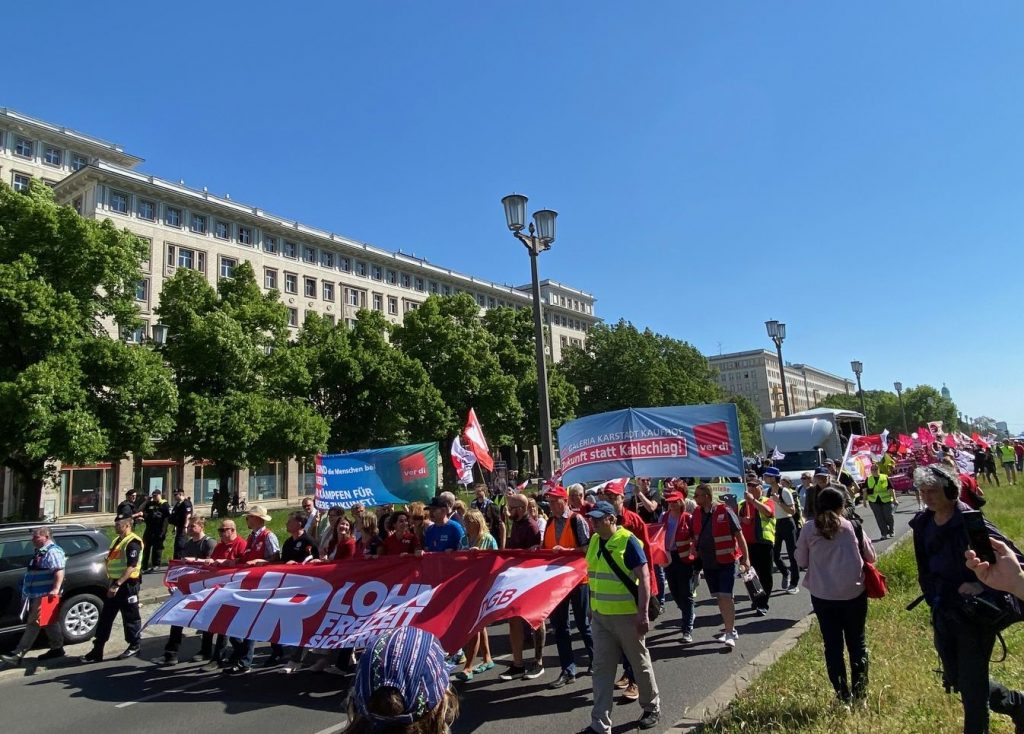
Find Trust
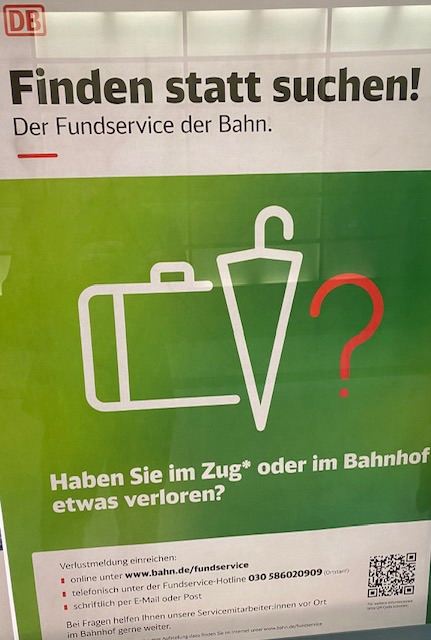
Societies have different levels of trust. Trust in politicians or political institutions has been researched a lot. Another example of trust is related to things lost and found. Losing an item on a train or a mobile phone somewhere are severe tests of the level of trust in a society. How likely is it that the item is going to be found and returned to you. We usually estimate the probability of the return of items as being rather low. The more we are surprised to find out that there are thousands of items found and returned. The Deutsche Bahn has a special service in operation to take care of lost items. Additionally, there are auctions of items found but nobody claimed the ownership of it in the following months. Not giving up on a lost item is the first step to find it again. It would be a nice test whether in high trust societies it is more likely to find something lost. If you have a higher trust that items will be returned you are also more likely to make the effort to claim the item back.
Hannover Fair
The annual science fair at Hannover is a kind of a show of things to touch and of those things that come to the public market in the near future. Most of the annual hype is about potentials of production. Rationalization, using few resources or innovative solutions of digitization are high on the agenda. Create your digital twin, save energy, make production more safe or cyber secured.
Robotics is another reason to visit the fair. Some 7 years ago I had my Sputnik experience there. The robotics company KUKA had demonstrated live the that assembling a car from pre-manufactured components takes just 10 minutes for the robots. Shortly afterwards the whole company was bought by Chinese investors. Roughly 5 years later we are swamped by cars from China. It was not that difficult to predict this at that time. Okay, we need to focus on more value added production and take our workforces (not only) in Europe along on the way. Reclaiming well-paid, unionized jobs in manufacturing, as Joe Biden does, will not be an easy task. Robots and their programming is expensive, but skilled workers, too. Hence, the solution is likely to be robot-assisted manufacturing as a kind of hybrid solution for cost-effective production systems.
Following the proceedings of the 2024 fair we are astonished to realize that visiting the fair is still a rather “physical exercise” walking through the halls. After the Covid-19 shock we expected a lot more “online content”. Instead we keep referring to webpages and newletters rather than virtual visits and tours. The preparation of the visit in advance remains a laborious adventure. However, the in-person networking activities in the industry are largely advanced by ease of exchanging virtual business cards and the “FEMWORX” activities.
This year’s Sputnik moment at Hannover is probably most likely related to the pervasive applications of AI across all areas of the industry and along the whole supply chain. Repairing and recycling have become mainstream activities (www.festo.com). Robotics for learning purposes can also be found to get you started with automating boring household tasks (www.igus.eu).
Visiting Hannover in person still involves lengthy road travel or expensive public transport (DB with ICE). Autonomous driving and ride sharing solutions might be a worthwhile topic for next year’s fair. Last year I thought we would meet in the “metaverse fair” rather than in Hannover 2024. Be prepared for another Sputnik moment next year, maybe.
(Image: Consumer’s Rest by Stiletto, Frank Schreiner, 1983) 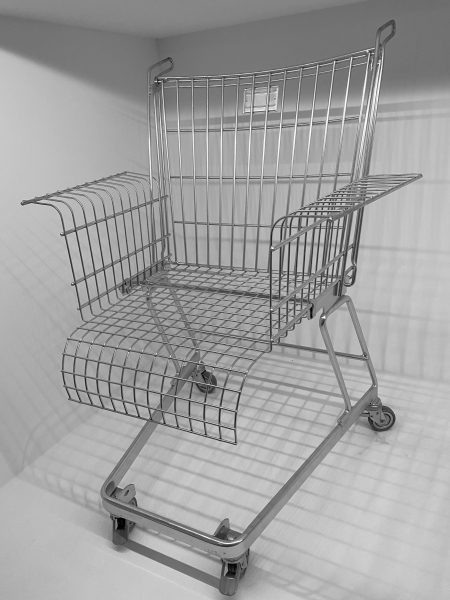
AI Defence
For those following the development in robotics we have been astonished by the progress of, for example, rescue robots. After an earthquake such robots could enter a building that is about to collapse and search the rooms for survivors. A recent article in “Foreign Affairs” by Michèle A. Flournoy has started its thinking about the use of AI in the military with a similar 20 year old example. A small drone flying through a building and inspecting the dangers of entering for persons or soldiers. Since then technology has advanced and the use of AI for automatic detection of dangers and “neutralising” it, is no longer science fiction. The wars of today are a testing ground for AI enhanced military strategies. It is about time that social scientists get involved as well.
Warfare left to robots and AI is unlikely to respect human values unless we implement such thoughts right from the be beginning into the new technology. An advanced comprehension of what algorithms do and what data they are trained on are crucial elements to watch out for. According to Flourney, AI will assist in planning as well as logistics of the military. Additionally, AI will allow a “better understanding of what its potential adversaries might be thinking”. Checking through hours of surveillance videos is also likely to be taken over by AI as the time consuming nature of the task binds a lot of staff, that may be put to work on other tasks. Training of people and the armed forces become a crucial part of any AI strategy. The chances to develop a “responsible AI” are high in the free world that cherishes human rights and democratic values. Raising curiosity about AI and an awareness of the dangers are two sides of the same coin or bullet. Both need to grow together.
(Image created by Dall-E Copilot Prompt: “5 Robots disguised as soldiers with dash cams on helmet encircle a small house where another robot is hiding” on 2024-4-23) 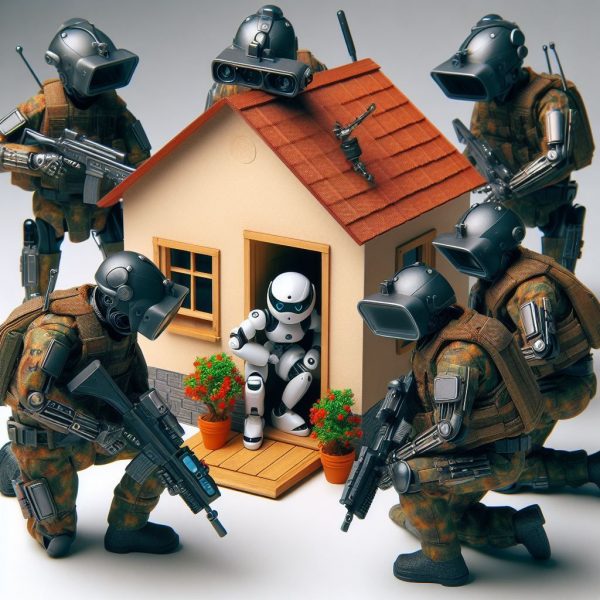
Electricity
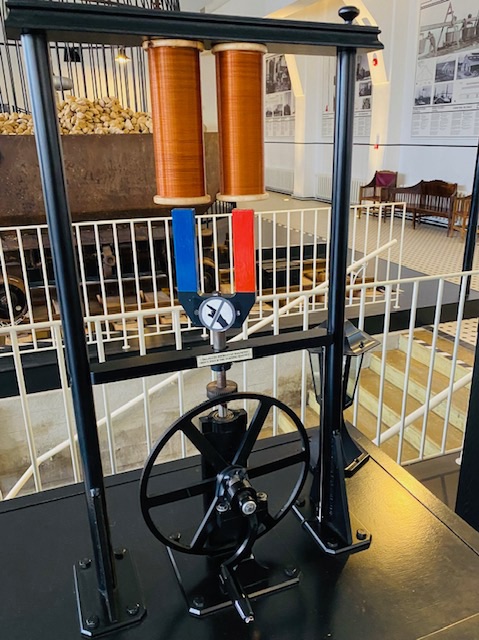
We all use electricity, not only daily but continuously. But do we really know or remember how it works? Surprisingly, we care very little about the energy provision or the physics behind it. Therefore, from time to time it is useful to dive into the details of generating electricity and thereby energy and how it arrives at our doorsteps or desks. In science museums you can literally walk through the history of power generation. A fine example is the Energy Discovery Centre in Tallinn, Estonia. Even for those you did all at school turning the handles of generators is a playful reminder of the basic principles of electric power generation. The efficient use of it, is a topic that needs to be covered as well. Searching the web for demonstration videos is fine as well, but the physical activity of moving induction coils and releasing sparks is difficult to rival. Opening up your mind for the physics of our lives yields a better grip on the challenges of electricity grids and local production of electricity. Are you already a prosumer? Combining electricity production and consumption in one household is surely a forward-looking strategy. Raising awareness for these topics concerns all generations. Take time for a power play, it is truly enlightening. For teaching professionals or want to be there are exciting programs out there, too. Just one suggestion for 2024 in Colorado, US.
Transparent Publishing
New technology pushes transparency of publishing, journalism and science to new levels. Through the hyperlink structure of texts it is easy to link back to the sources of a text. What used to be long lists of references at the end of a text or in footnotes has become directly accessible through weblinks. Only paywalls may or may not restrict the fast and easy access to original sources. In writing online, this is a major additional feature of publishing in the last few years. Some online journals allow this for quite some time now, but there are lots of printed versions that stick to the read and be stuck approach of publishing.
In teaching I have been an advocate of “read the original sources” as the basic source of inspiration for authors. The transparency of the thought process and the evidence provided in whatever form should be traceable. In publishing this transparency allows to exclude the copying of thoughts or unreflected referencing.
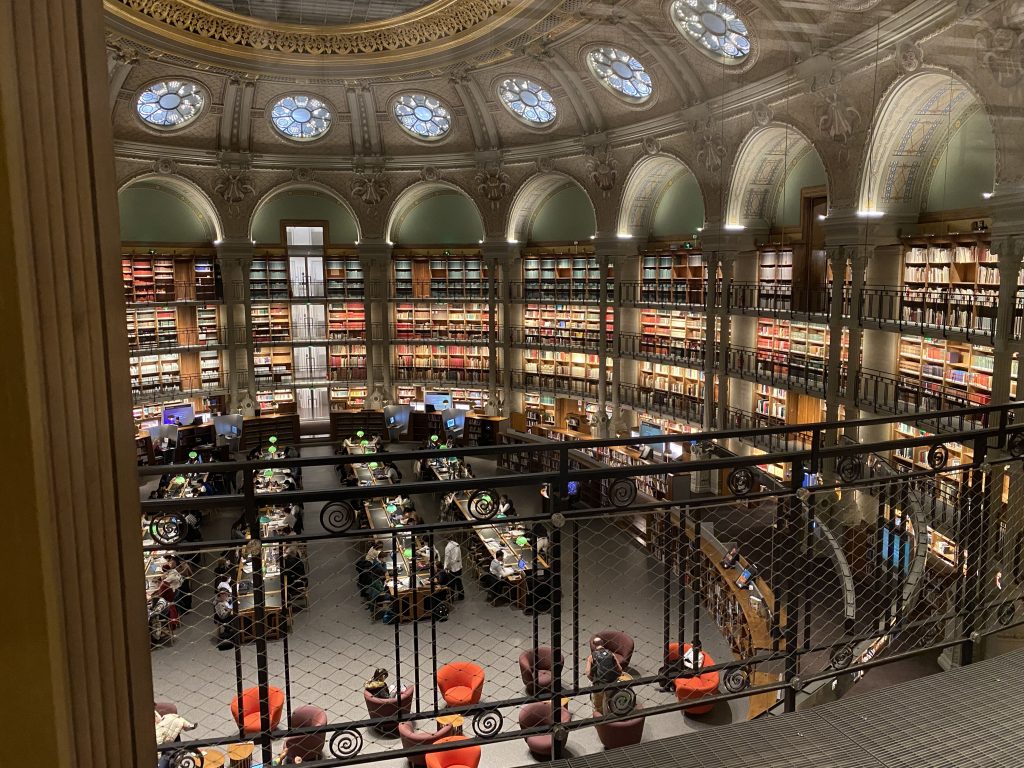
However, the task to check for the validity of weblinks and the updating is an additional task. 500+ blog entries with an average number of 2 weblinks per blog entry makes this a job of its own. Testing of 1000 weblinks is something you need a software or plugin which alerts you to “broken links”. The maintenance of a webpage, therefore, increases substantially as the content increases. Reorganisations of webpages make the follow-up of links sometimes quite hard. Projects like the general archives of the web and webpages are very important to ensure the transparency of publishing in the short, medium and long run. The archives of today look more like machine rooms than the splendid archives or libraries of the past and present.