The happy runner is a nice example of how hard it maybe to experience happiness through running. The so-called runner’s high is available to everybody, if you manage to run long enough already. Most predictions put the threshold distance at about a 1 hour run. The reward for this effort is a special feeling that exceeds the pain or it makes you forget or supress the pain at least temporarily. Special reinforcements can be achieved through the big city runs in exciting places with thousands of people cheering you on. This has become a big business as well. Training for such an event might raise your feeling of happiness substantially. The chemistry of the endogenous production of stimulants of happiness in our body has been enlightened substantially in recent years (partly as doping control). Most of the brain active drugs our body can produce itself, although this involves a lot of physical and mental effort. The rewards are pretty healthy for most runners contributing to their basic level of happiness. Running outside, has contributed more to happiness for me more than the same exercise on a treadmil. Maybe, the environment is part of the happy runner’s high effect. 
Own Insulin
People who suffer from type 1 diabetes do not produce enough insulin themselves. The World Health organization estimated that „in 2017 there were 9 million people with type 1 diabetes; the majority of them live in high-income countries“ (WHO 2023). The report on successful reprogramming of stem cells of a person to produce insulin again and subsequently transplanting these cells into the same person allowed to produce own insulin again for that same person (Mallapaty, 2024). The hope for millions of people with type 1 diabetes is high that eventually there will be a cure to the disease. Scientists caution that there are no data yet for how long the transplanted own stem cells will produce insulin. Hence, the hope is driving research forward on a promising way forward. The case of type 2 diabetes is very different as additionally the absorption of insulin in the body causes problems. We keep walking and building muscles to facilitate the insulin absorption in the body to guard against the onset of type 2 diabetes. Interaction of diabetes and aging is another topic that needs our attention as rapidly aging societies are at higher risks to face many more people with various forms of diabetes.

Buzzing free
It is always a chance to be in a city that bans cars for some time from streets and bicycles and pedestrians can walk freely in the city. On September 22nd 2024 this is the case in Brussels. In addition, the public transport system allows people to buzz around the city free of charge. Of course this is an invitation to get to know areas of the city where you normally don’t take the time to visit or mix with people. The police used the time to teach children how to cycle in a city in all security and respecting basic rules despite the enthusiasm for speed or going round in circles. Unfortunately, this happens only one Sunday out of 52 in a year. It is just amazing how the feeling of safety on the road changes again. The level of noise and pollution drops to levels of the countryside. Buses and trams pass the city easily and most people get around faster than they do on other days of the year. It is a bit like a coordinated health intervention for the stressed urban survivors. This experience is a modest reminder of how nice it was in Paris during the Olympic Games 2024 when prioritizing mobility beyond cars haa been effectively implemented for several weeks.

Walking Danger
Autumn brings color into nature. This is for some the bright side of life. However, the sun sets much earlier every day and many people begin to walk to school or work and back during the dark time of the day. Unfortunately, this entails an additional danger to those walking the cities as bad light conditions cause many accidents of pedestrians. The statistics provided by Destatis (2024) for Germany show a marked increase of walking accidents from September onwards and lasting throughout winter. Equip yourself with bright colors and reflectors to avoid being a walker in danger or a walking danger. On Sunday it is pretty safe to go for a stroll. City life is less stressful and professionals in a hurry usually take a rest on that day. The conclusion is to choose your track wisely in order to feel safe on weekdays.

Olympics for All
The Paris 2024 Olympic Games and the Paralympic Games have demonstrated the extraordinary competence, professionalism and competitiveness of all athletes. The television spectators and live participants in the events have been involved to a great deal.
After all this hype around sports let us consider the probability of getting involved in physical activities and sports. Additionally, it is of interest, whether people are encouraged to continue sports, maybe at higher ages as well through these sports events like Olympia.
High level athletes are most likely to continue their sports activities. In many countries the extraordinary athletes of the Paralympics faced tough challenges to pursue their sport interests and passion.
However, the public health challenge is the big unresolved issue of how to best raise an awareness for the pleasures and benefits of sport for the masses. (bibliography by BNF “Santé et activité physique). It is not only a matter of suitable infrastructure, but also the question of sports in your neighbourhood. This issue has implications for urban and rural communities and how they organize the practice of sports in an inclusive way. Each step may be a stepping stone into sports for all ages and pathologies.
The pleasure and benefit to walk or something simple as walking to or walking after work, are part of the solution to many public health issues.
The visitors of the Paris Olympics walked a lot.
This fun experience in an enthusiastic city will encourage many to continue the simple exercise without thinking about exercise. This will do the trick. Just do it, without thinking to much about it.

Paris Experiment
The Olympic Games 2024 were prepared years ago. Already the application procedures to prepare “un dossier” has to bring in lots of ideas and imagination what is desirable and feasible. Paris opted for a celebration of sustainability in a city proud of its medieval heritage and the Haussmann tradition of radical transformations of a city with large boulevards and representative buildings. From the “Arc de Triomphe” the major axes of communication between “arrondissements” become visible. 100 years ago the city had already been transformed according to this master plan. At that time sanitation of a city meant different things than today. The invasion of inner cities by Diesel-driven cars made life unhealthy again. Now, the Olympics gave reasons to restrict cars and lorries passing the inner city and the great boulevards. More tourists need more space and shall keep a much better memory of how pleasant Paris was during the Olympic Games. This could be a game changer for urban development in general. The proportion of pedestrians versus cars has to be shifted in favor of the walking population for many reasons. Tourists will flock to the city, if the overall and shopping experiences are great. Back to the future sounds crazy, but it has an interesting flavor to it for urban renewal and residents as well. (Image Paris 2024-8, b/w color filter applied, enlarge to see vasque)

Back pain
Most people know some form of back pain. This is understandable as an ever increasing share of people work in seated positions and spend additional leisure time in a similar position (gaming). Recurrent back pain is a frequent diagnosis. An Australien study has found a rather simple remedy for the widespread pain. The WalkBack experiment succeeded to significantly reduce recurrent lower back pain in study participants. Individualized and progressive walking accompanied by an education program did the trick. Keep on walking and try to extend the range of the exercise. It’s amazing to witness how the human body adapts to being challenged. Learning about the mechanics at work like the release of own personal “pain killers” hormones helps to trust in your body’s positive response to each dose of the challenge to pain. Do not walk too quickly too far. Stretching is a must and not an option. Go for it. Modern technology (in any smartphone) supports your efforts with counting your steps and measuring distances. Keeping track of a “pain diary” might give you guidance not to overdo the exercise and pause activities. Join a group of friends or people who are like-minded and get adequate shoes and clothes to feel comfortable while walking and afterwards as well.

Weight Stigma
The fashion industry has for a long time produced images of mostly women and men that did not correspond to the normal weight distribution of people. Skinny models were present across all media. The so-called social media of today amplify this trend further. The “Barbie hype” has reinforced the idea of low weight as a socially desirable norm. In scientific research the term coined for this phenomenon is “internalized weight stigma” (IWS). A study shows (Highes et al. 2024) it affects more women than men and more people who are described as socioeconomically disadvantaged adults. Pressure to lose weight originates from multiple sources and social media platforms have given rise to bullying. A major outcome of IWS is eating disorders as eating is often wrongly associated to be the only cause of higher weight. It is not. Many other factors contribute to the actual weight of a person. Even the overuse of the body mass index (BMI) as short hand version to define overweight or obesity is misleading for persons with strong muscles. Just fixing on one parameter of body shape or weight tends to reinforce weight stigma. “Keep walking” and a regular healthy diet, this avoids to internalize a weight stigma. Exercise is fun, the more you do it in a group, the easier it is to get going regularly. We ought to keep trying and eventually it will become a routine.
AI Travel
Playing around with AI it is nice to test take fun examples. Image you want to plan a vacation, then the use of AI is ready to suggest to you a couple of things to do. Of course, AI is eager to propose travelling services like transport or accommodation to you where it is likely to earn some commissions. So far, the use of the “Vacation Planer of Microsoft’s BING Copilot” is free of charge. In entering the time period and a region as well as some basic activities you’ll receive suggestions with quotes on the sources (webpages of public services from tourist offices mostly). It seems like trustworthy sources and the suggestions of D-Day activities in Normandy is a positive surprise to me. These are popular activities which attract huge international crowds every year.
Thinking further on the potentials it becomes evident that travel suggestions will be biased to those paying for ranking higher on the algorithms selection criteria, which are not disclosed. Entering into the chat with the AI you and AI can target more precisely locations and also hotels etc. You are disclosing more of your own preferences in the easy-going chat and probably next time you will be surprised to be recommended the same activities at another location again.
So far, I have bought travel guides or literature about locations to prepare vacations. This is likely to change. I complement my traditional search or planning with the “surprises” from AI for travelling. I rediscovered, for example, the public service of tourist offices and their publications ahead of the travel rather than the leaflets at the local tourist office. In order to plan ahead there is value in the augmented search and compilation capacities of AI. Drafting a letter in foreign languages is also no problem for AI. The evaluation of the usefulness of AI, however, can only be answered after the vacation. Outdated info or databases have a huge potential to spoil the fun parts as well. 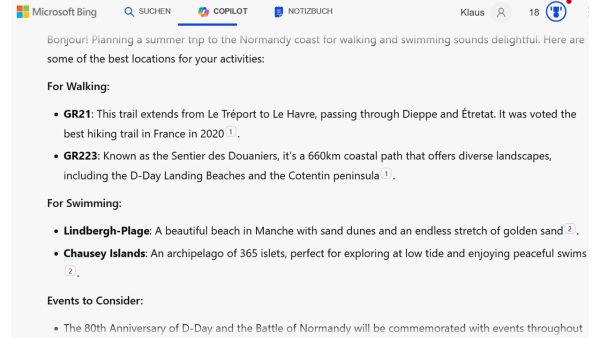
Stroke
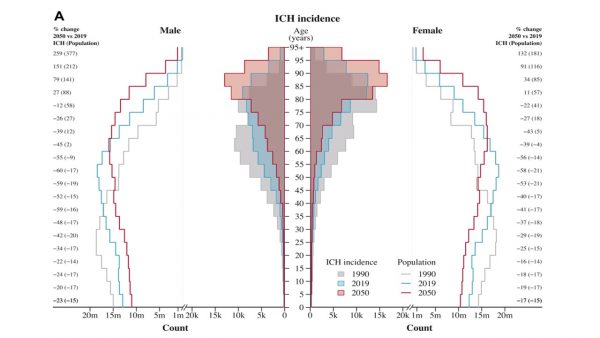
A stroke is a very serious medical incident. The NIH defines it in easy language as the the moment in which “blood flow to the brain is blocked or there is sudden bleeding in the brain“. Thanks to a European HORIZON project forecasting models are produced to estimate the likely incidence until the year 2050 by age and gender within Europe. The good news is major regional imbalances of incidence and mortality have been reduced and will likely be reduced across Europe. The challenge remains the aging of societies which necessitates to address the issue of strokes in each single region of the European Union. We know that the shorter the time to treat a stroke immediately after its occurrence, the better the survival chances and the better the prognosis for (partial) recovery.
In the US the widespread use of blood thinners which tripled over 30 years has not lead to the reduction of intracerebral hemorrhage (Link to studies). High blood pressure and arhythmic heart beat are major causes of this often disabling medical event. The study by Wafa et al. (2024) uses age-pyramids to demonstrate the effect that as European societies are aging the incidence of intracerebral haemorrhage occurs with increasing age and even more so for women than men of 80 years and older.
Prevention of high blood pressure through walking or careful endurance exercise seems even more indicated for an aging society.
Image below from Wafa et al. (2024), The Lancet Regional Health, Europe.