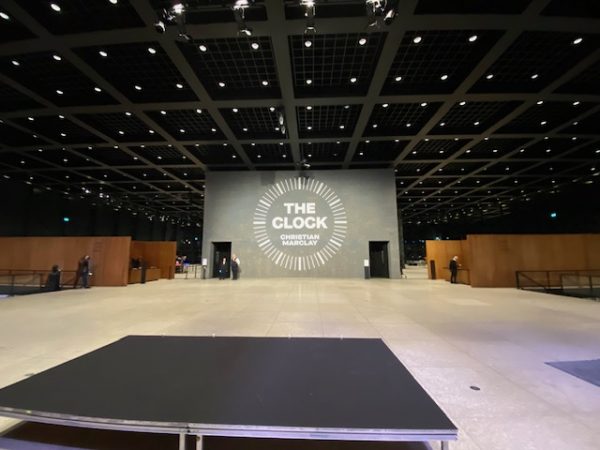
Time keeps puzzling us. The 24 hours of concatenated clips from well-known cinema films are a bit overwhelming or even lengthy. However, this spurs lots of time to reflect on time, on a kind of meta level. We see the clock or clocks ticking in all sorts of situations and environments. Nearly all emotional states can be interpreted relative to a time stamp provided by a clock. Christian Marclay’s oeuvre is screened at the Neue Nationalgalerie in Berlin at a time when we feel multiple clocks ticking at the same time. For the sociologist, there is time on the macro-societal level, like overall socioeconomic development, but also individual time. A single person or a single moment in time may have very different macro-social implications. The possibility to live through the cineastic interpretations of ten to, as opposed to, ten past the hour, are interpreted by us with very different meanings. In a longer or historical sense, the timing of time does not matter that much. Point in time or time as duration, that is the question. Art in cinema can play with this like rock around The Clock. Don’t ask me how much time I spent watching, thinking and feeling through time in this movie exhibition, Should we always measure time with a clock. Want it or not, we measured by our smartphones all the time and on multiple timelines.