

The “Musée Histoire de Paris Carnavalet” is the starting point for visitors of Paris and social scientists to better understand the making of this metropolitan city throughout centuries. The only common factor over the years is the astonishing determination to reinvent the city every 100 years whilst the best features of the previous periods are preserved. It is the concern for the very long-term time horizon that makes the city quite unique. Even a social revolution (1789) unlike most other countries managed to preserve most buildings, churches and royal palaces. Restorations are undertaken with a careful approach to shield its architectural and social heritage. Even the radical transformation by Haussmann over almost 20 years until 1870 to build large corridors in the city is subject to revision in modern visions of the future of Paris. The app of the museum is very helpful to learn more details about each chosen object of the permanent exhibition. The social fabric of the city can be studied further through app’s feature when representatives of local social organizations speak about their personal piece within the huge collection on display. The larger the “fundus”, the more the rationale for selecting pieces becomes an issue. (Image: Musée Histoire de Paris Carnavalet inner court 2025). 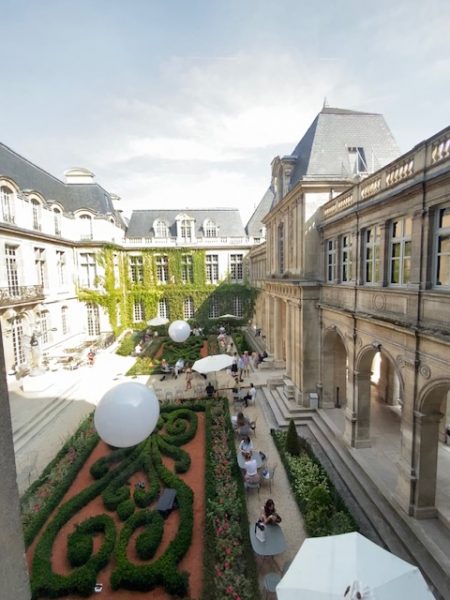
Photographe engagée
Marie-Laure de Decker is featured in the “Musée européenne de la photographie” (MEP) as a photographer committed to capture truth in situations of conflict. She started her career with documentary photos from the Vietnam war. Rather than searching for spectacular scenes, she succeeded in her attempt to capture the more emotional and, therefore, relatable moments for her various audiences. With a firm commitment to the human in her work, the photos by Marie-Laure de Decker reach a level of extraordinary sensitivity to what it means to stay human in violent situations and even military conflict. The portraits of politicians, workers, professions and famous actors applied the same approach. Rather than days or weeks Marie-Laure de Decker spent months or years in the regions of her documentary photo series ranging from Vietnam, South Africa throughout the apartheid regime, Pinochet years of dictatorship in Chile, the 2 parts of Yemen to a prolonged stay in Chad.
The exhibition in the MEP in Paris curated by Victoria Aresheva raises awareness to the additional fact that photo journalism became an affordable profession only after specialized agencies were created that granted authorship rights to photographers, which ensured later use of their work in edited volumes as well as working for several newspapers or magazines. (Image: Marie-Laure de Decker, self-portraits, MEP Paris exhibits 2025-8).

Emotional history
The making of emotional memories of a city is an art in itself. Many cities have professional photographers who accompany all major events in a city over years. Paris has had the chance that artist photographers and film makers have contributed greatly to the emotional history of the city. Agnès Varda was such a formidable person whose images and movies moved people and allowed to share emotions about the city’s busy and diverse neighborhoods. The « Musée Histoire de Paris Carnavalet » combines an autobiographic perspective with the emotional depiction of live in Paris from the 1950s onwards into the late 20th century. (Image: Agnès Varda, 1950 self-portrait, MEP Paris).

Gentileschi Heroine
The choice of a woman as heroine in a painting beyond religious topics was innovative in the early 17th century. Artemisia Gentileschi chose Cleopatra as her character in the ultimate scene of Cleopatra‘s life. The heroic act of guiding the poisonous snake to bite her under her arm is the ultimate act of Cleopatra to have served her country and people. As history books are full of male heros Artemisia Gentileschi succeeded in drawing attention to the biased gender stereotypes in art and art history beyond the 17th century.

Gentileschi Selfie
Today the production of „selfies“ is all around us. Selfies are shot almost instantaneously and several times a day by use of modern smartphones. About 400 years ago the first woman to produce a selfie was Artemisia Gentileschi. As (one of) the first female painter in art history to have created a painted image of herself (which is transmitted today) Artemisia Gentileschi made history. Her unique biography, style and craftsmanship of the early 17th century in Italy made herself a renowned painter. Her choice to depict herself rather than somebody nobel or rich was quite unusual for the time. The audacious choice of herself as her „sujet“ became even her trademark. Later paintings by her with biblical topics were also subject to her reinterpretation based on herself as the female character in the narrative and image. In this respect her work appears so much ahead of her time that her impressive work speaks to all generations today. (Image: extract of Jael and Sisera by Artemisia Gentileschi 1620, Musée Jaquemart André“ in Paris 2025-8)

Gentileschi Iconologia
Ever since the publication of Cesare Ripa’s „Iconologia“ (1593) the codes of art had become subject of a coded production and interpretation of art. Attributes of power or wealth like palms, scepters or crowns, decorated with gold and diamonds spoke a language easily understood by onlookers irrespective of time periods. Orazio and his daughter Artemisia applied this Iconologia throughout their work. The apparently simple depiction of bad weather became a sign of trouble ahead in a person‘s life, office or reign. From the success of Caravaggio‘s paintings, the application of light and shadow became another stylistic feature of especially Artemisia‘s work. Whereas the application of these techniques is a sign of craftsmanship, the own contributions like a more emotional and emancipatory repertoire of Artemisia make her an artist of her own kind. (Image Artemisia Gentileschi, Madelaine pénitante 1625, Musée Jacquemart André“ in Paris 2025-8)

Women artists
The history of art has been dominated in public opinion for centuries by men. However, recently art historians have drawn our attention to the numerous works of women who took Centre stage with their art during the last 500 years. Flavia Frigeri (2019, 2024) begins her history of women artists with Lavinia Fontana (1552-1614) followed by Artemisia Gentileschi (1593-1652). Both painters produced extraordinary paintings which brought their own touch to the paintings at a time when an independent expression through art was still largely reserved for men. The subjects of Gentileschi were greatly influenced by her experiences as a woman in a male dominated society in the 17th century in Europe. Her choice of subjects for her paintings added a female vision and depiction of biblical and historical narratives that were unique. The „Musée Jacquemart André“ in Paris featured a great retrospective of her art work in 2025. The catalog of the exhibition allows to enter into the art and wit of this early woman artist.

Zadkine museum
In the middle of Paris you will find a small former atelier of Zadkine. Transformed into a museum, the place is a cosy place to learn about sculpture and the different materials used. The preparations in form of designs or smaller trials with other materials are common practice to arrive at the sometimes monumental pieces. The visit of the permanent collection is even free of charge. A splendid experience in a surprising spot of silence next to buzzing city streets. Depicting musicians and musical instruments has been Zadkine’s shared passion with Valentine Prax. Great that he managed to reach the USA in time before the Nazi persecution could reach him. However, exile often means hardship as well.

Zadkine Prax
Ossip Zadkine and Valentine Prax once had their atelier next door to each other at art school. This established a lasting link between the 2. Whereas Zadkine became best known for his sculptures, Prax became famous as a painter. It appears that influences from one to the other are present in the works and several sculptures or preparations for sculptures were collected by Prax and found their way into the permanent exhibition of the museum. Intertwined biographies of artists are an inspiring reminder that art is not created only within a single mind, but many references or inspirations come from joint conversations or just working next to each other for some time. The social part of creating art is visible in this exceptional exhibition. Valentine Prax is honored with a presence in the Zadkine museum as well.
Image: Valentine Prax 
Water fountain
The design of water fountains is a bit of technology and a lot of art work. The provision of water for larger basins in castles was pioneered by garden architect Le Notre in France as early as the 17th century. He took ideas from Italian designers to integrate them in his French squared designs and surprising perspectives. Vaux le Vicomte is a splendid example and a source of inspiration for many even centuries later. Listening and watching the water fall from level to level downwards calms the spirit. Worth exploring yourself.
