Paris has lots of museums to visit. At times, this can lead to a kind of mental overload. The ” Musée Marmottan Monet, in Paris allows to take home a digital and printed copy of your preferred, your own curated collection of images from the museum. This is a great learning experience. You scan the number of the item you want to include and a specialized application retrieves the image of the painting or object from their database into the App. After the visit you take a break in the café in the garden and sort your collection and if you like have it printed within a couple of minutes after you paid for the print or digital version. Upon special request I was told that I am allowed to share the link to the small booklet even on the web (Link to pdf below).
Since the visit to the Musée Marmottan Monet we have come back to the digital and printed versions several times and reading of accompanying texts and perfect quotations of origin make learning about art a fun experience. Going back to lived experiences makes more lasting impressions on our memories. Knowledge coupled with emotions is a powerful way to memorize. Sharing the experience with other persons like the readers of this blog is an additional advantage. Attentive readers of the blog entries will find references to many of the themes dealt with over the years in this series of blog entries. Such topics are: gender and art, technology and society, reflections on time, life courses, inequality, art history, funding of artists, lifelong learning or beauty.
(Booklet below in German LINK-pdf of 6MB. The app allows many language versions. You can produce those yourself from you collection within the App) 
Olympic Democracy
It is interesting to follow how the Olympic Games follow a moderate version of how to run a democracy. Paris 2024 takes pride in making this a little bit more visible. It is the people in democracies who decide whether to host Olympic games in their country and the many executive branches of governments have to coordinate their actions, budgets and planning accordingly. The National Assembly in Paris 2024 is showing its commitment to the Games in front of the building as well. Beyond the ancient discipline of archery, new disciplines like surfing is turned into a piece of art like a statue honoring the athletes. The IOC follows the division of powers with an assembly of states, an executive and the judiciary. In each discipline it is evident that without a well established and accepted independent judges the Games would become a farce and would no longer attract such huge crowds. It is a steep challenge to ensure that doping and other illegal activities do not destroy the peaceful spirit of the Olympic Games. Science has a role to play in advancing and controlling the athletes and their teams acting under cover. All in all, we find democracy in a nutshell including the necessary trust in institutions to ensure a fair running of the Games in Paris 2024.

Artists Robots
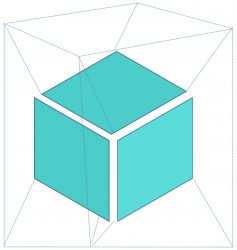
We know that the scientific and artistic dealings with robots have a long tradition. Whereas art of impressionism took up the challenge to paint the world outside the studio and embellished technological achievements like bridges and trains post hoc, modern extensions of science fiction to the world of robotics has extrapolated from the present. Artists became forerunners of technical evolution and thereby contributed to the acceptance of artificial intelligence to broader audiences. In 2018 The “Grand Palais” in Paris hosted an exhibition on “Artists & Robots” (Pdf booklet). Jérôme Neuters contributed an essay to the catalog of the exhibition on “L’imagination artificielle” which identified a additional role for artists in combination with AI. Some of the early adopters of the new possibilities of robots assisting artists, Nicolas Schoeffer is quoted to state: “l’artiste ne crée plus une oeuvre, il crée la création”. Like an invention of painting techniques or light or perspective in painting, robots allow a new way of representation of emotions or space. (Image Manfred Mohr, 1974 video Cubic Limit, Artists & Robots p.92-93)

Chapelles Sportifs
In Paris the “Chapelle Notre Dame des Sportifs” was benedicted in 2023 in view of the Olympic Games 2024 in France. The catholic church is following the popular Olympics to call for “Holy Games” with subtitle “L’évangile c’est sport”. The chapel can be visited in the splendid church “La Madeleine” in the middle of Paris. You can buy candles with inscriptions like “the last ones, will come first (Mt 20,16)” or other citations from the bible. On Friday 2024-7-19 a special ceremony was held where you could jointly pray to win in your discipline or, of course, for other noble causes. The whole service was recorded with multiple cameras from a professional television team for a worldwide dissemination. It remains an open question, whether the church sponsors athletes as well or whether the athletes sponsor the church through their followers on social media. in any case it is a bigger media event accompanying the Olympic games in Paris.

Credit donations
“credit” stems from the original latin word “cedere”. In the 1st person you write “credo”, which means I believe. If said in a religious building or church you show with this pronunciation that you believe tbe narrative of the religious community. In the 3rd person “credit” stand for s/he/it believes. In the financial sense it is the receiver of money from your credit card who believes or trusts you that you made an honest payment. Now, banks take commissions from each of these exchanges of trust. You are credit worthy or not. In some churches you now make donations using your credit card to facilitate business. Credit card companies also charge you on your donation. Win win situation we call this. I keep asking myself, whether I still “believe in angles” or only business angles. (Image Église Notre Dame des Victoires Brussels 2024-7)

Webpage Analytics
I do not collect data of detailed webpage analytics. Therefore, I thought I do not know anything and do not want to know anything about webpage visits of this webpage. However, the most basic information of how many times the webpage is visited per months is given by the hosting service of the webpage. The previous jump beyond 20.000 visits/month had the implication to move the security level of the webpage for me and all visitors to a higher level. Additional information of how many seconds an “internaut” is staying on the webpage tells, maybe a little bit about the interest in the content or image of a specific entry. Reaching 84.000 visitors/month was a surprise that asks for an explanation. Apparently, the most visited page is the blog entry on “geo-politics”. The longest time people stayed on a page or blog entry is a recent entry on “nutrition policy”.
Other statistics show that people who visited an entry on “find trust”, trusted in the webpage to click on many other entries or pages on “www.schoemann.org”.
I do not collect data or statistics on where visitors go after a visit. The hosting service, however, measures the so-called “jump-off” rate. This indicates the importance of the webpage as spring board to jump to other pages on the internet. It is usually = 1, just showing that you left somewhere. For some pages this reaches higher levels according to the number of links you offer on a blog entry, for example. It gives an indication whether you manage to lead on readers to explore the topic further. This is a usual evaluation question of lectures and seminars given at universities.
Last but not least, even without collecting any “real data” about visitors, it is part of the minimum information your browser transmits is the “operating system” used for access. Your smartphone provides the information on IOS, Android, Linux, or Windows versions used. These technical purposes remind me that there are still vast amounts of users of what we believe are outdated operating systems. Windows 7 and Windows 10 are still heavily in use across the globe. The hype around the latest operating system and smartphone is most likely only a phenomenon of the rich and wealthy in the rich parts of the western world. This reminds me to include images, which are small in data size to allow fast downloads in all parts of the world. We should embrace this as an important topic of geo-political relevance. 
Nutrition Competence
Nutrition is a good example of how a long lasting disregard in education and learning systems has led to huge medical costs for individuals and societies nowadays. The obesity pandemic calls for urgent action and policy changes in the field of nutrition policies and learning goals for children and adults. Medical doctors have mostly discarded that it is also their responsibility to provide medical guidance on nutrition, as this is highly controversial at times and asks for behavioural changes of the patient. School teachers see little scope to act on the issue due to increasing demands in fields of literacy, numeracy, problem-solving, digital and communication skills. Hence, the hope is to fill the instruction and learning gaps with a hybrid approach of nurses taking on both roles and communicate with children as well as adults alike. This is a tough challenge for these persons, but hopes a high that they can make a significant improvement to the nutrition competences of individuals, pupils, their parents and specific target groups.
The starting point is to recognize that there is an issue with nutrition. The next to establish the best evidence and based on this to develop a curriculum for the nurses to be well-prepared for the challenge in the field. Even with the differentiation of different levels of competences, the learning has to be rather encompassing several related fields as well. Individual, behavioural as well as society-level factors like biology, technology, religious beliefs, economic and social factors determine nutritional choices and consumption. Just because there are so many factors to consider does not justify to keep nutrition out of school curricula for example. Nutrition is a fine example of a topic which links disciplines across a broad range. It is a tasty, at times spicy mixture of issues to learn and apply. The former is the beginning, the latter the real challenge which needs ample and repeated guidance or coaching. (Image: Extrait of Abraham Mignon, 1640-1679, Undergrowth with flowers, animals and insects, MRBA Brussels) 
Nutrition Policy
The evidence on nutrition policies has accumulated a series of policy recommendations based on the best available evidence. The German Institute of Human Nutrition has presented these results repeatedly not only to the scientific community, but also to the interested public at the Science Week or the Long Night of Science. Their leaflet on the tools to improve our human nutrition in market economies highlights “nutrition competence” as a key component of a broad strategy to improve our food and subsequently health. Nutrition goes beyond the biological ingredients of food to include basic understandings of human metabolism including the times and timing of meals. This competence has to be transmitted to preschoolers, pupils as well as adults to stem the waves of obesity (ARTE Docu). Learning how to manage your own nutrition is a crucial competence to strive and survive. In schools it can have substantial impacts on performance and inequality of opportunities as well.
The science-based policy recommendations propose to alter the structure of costs, for example via tax reductions, in favor of healthy food. Plain water should be substantially cheaper than sweet beverages or alcoholic drinks. Nuts and proteins from vegetables fall in the same category as plain water. It is in the longer term interest of all of us that schools, canteens at work places or homes for the elderly offer also healthy nutrition at least as a daily option. More sustainability in food production is last, but not least part of nutrition policies. A lot to chew on to improve nutrition.

Science Transparent
Every year there is only one special big event (Lange Nacht der Wissenschaften) to make science more transparent to the population at large. Mostly hidden behind impressive walls and buildings guarded by porters,
science is not as transparent for the large public as it would like to be. In general people are rather intimidated or feel quickly out of place if scientist start to “explain” in lengthy formats their topics, ideas, questions and intermediate solutions. Even if the distributed open science fair is running only from 5 p.m to midnight, there are lots of things to learn and look into.
The website lists 1500+ sessions, 230 are in English language. You have to be selective or spread your interest over several years. I chose to start with, maybe, the toughest choice the Weierstrass-Institute near the Naturkundemuseum. Several projects of applied mathematics and stochastic processes were exposed and explained in more or less transparent and/or understandable form to the audiences. The talk by Julian Kern “Why chance doesn’t happen by chance” had a nice interactive format with “Kahoot-quizzes” and gave a good introduction, why it is useful to understand, statistics and stochastic processes in fields from biology, physics to social phenomena. The White board replaced already the black board and chalk.
The open doors policy, at least one day per year, raises interests and awareness for topics few people would only think that they existed already. The volume “Mathematics and Society” (Wolfgang König ed. 2016) is something I shall follow up on eventually. There are lots of applications of mathematics to social phenomena (time seen from the perspective of generations for example, image below from talk), which we have a hard time to come to grips with without the aid of mathematicians. 
Violence Potential
The book (editor Sabrow 2023) and the exhibition “Gewalt gegen Weimar. Zerreißproben der frühen Republik 1918-1923” need a broad European audience. The violence, which in the medium term destroyed the newly founded democracy of the Weimar Republic in Germany, is linked to the immediate aftermath of the 1st world war. The relatively calm abolition of monarchy in Germany did in no way prevent the eruption of violence within the new democracy. Extreme forces prepared in organized ways (Organisation Consul) and some in open public discourses the potential for the use of violence. Armaments left over from war equipped the Freikorps Movements and the potential to use the weapons was present at all times in the aftermath of WW1 in Germany. The contributions to the volume provide a detailed account of these 5 crucial years when democracy was able to defend itself against all odds. The strategies to take control of the country were built on a violent rhetoric which prepared the ground to put violent talk into action later on. This spiral of violence is hard to de-escalate once started. However, democracies have to foster ways to calm the spirits in periods of high potential violence. Elections as well as the campaigns before are the arms of democratic change. They should be used as such to pave the way to compromise.
