Tether thy liver

There are few of us who take our liver seriously. Yet, this big organ plays a central role in our body to regulate metabolism. The obesity pandemic in western countries increases health risks, just as excessive alcohol consumption increases risks of liver dysfunction. Additionally, viruses increase the risk of failure of this organ.
Each of these risks as well as any combination of one of the risks with another one have led to rising public health risks. Several studies since 2020 have highlighted these increased risks for populations in general. The risks, however, have an unequal spread across subgroups of society. A recent comment based on the research of the INSERM U955 team in “The Lancet Regional Health” by Brustia et al. “Liver-related mortality strikes hardest where deprivation is greatest.” Health inequities consist in the lack of income available to buy healthy food or in untreated alcohol addiction, both more common in poor people.
In order to tackle the inequity, the team of medical doctors call for a shift in awareness. Structural reasons like diagnostic delay, remoteness or health literacy are just as important as individual predilections like nutrition or lifestyles. Inequality in access to health and ability to afford a healthy lifestyle have become serious drivers of social inequality in the 21st century.


Popular Sociology

Sociology, like other social science disciplines, has often difficulties in reaching bigger audiences. However, in combination with a museum which specializes in the history of a big city like Paris, the insights can suddenly become very popular. The “Musée Carnavalet of the history of Paris” has mounted an exhibition, which builds on the population censuses of 1926,1931 and 1936. The access to the complete original records of 3x about 2 millions of people has become a national treasure for social scientists and the public at large.
People flock to the exhibition. Some do it to learn about the past of their districts or streets. Others to learn about historical facts, which are sometimes linked to the family anecdotes and broader historical narratives. Out of this interest grows an understanding of macro- and micro-level social processes, which makes use of basic statistics.
People ask themselves: Is your (family) story unique or is it part of a more general pattern or social process like urbanization or social mobility.
(Image: original census recording sheet – Paris)

Digital Social Networks

Social networks have become the place to be. The need to distinguish the digital social networks from the social networks of people in the analog or “real” world is important, as we realize that many young persons seem to suffer from loneliness despite a hundred personal links in the digital social networks. This paradox of digital and non-digital social networks needs careful attention of researchers because of the opportunities and risks involved in the transferability of contacts from one network to another.
There is s a kind of “conversion rate” of digital contacts into face-to-face contacts and even purchases for marketing purposes in the world of business. The sociology of the virtual has to deal with these paradoxical social relationships and study the increasing phenomenon of being «alone together». Increasingly we are alone, but together. Over the life course this phenomenon and the digital social network paradox change as well.
To research such a topic we need rather intrusive, personal data and access to the digital traces of people as they construct and deconstruct either form of social networks. 

Unity is key

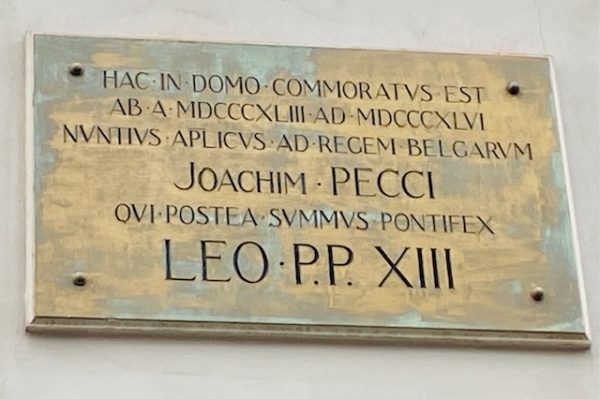
The choice of the motto “In illo uno unum” by the new Pope Leo XIV of the catholic church in 2025  highlights his choice to devote his efforts to the unity of all christian churches on earth. This is a centuries old dream of the diversified interpretations and practices within the christian beliefs and traditions. The inaugural sermon of a Pope therefore takes the form of a high stakes announcement for the coming years (Link). The next document from Leo XIV speaks to the importance to preserve the earth as the creation of God with all its diversity as a whole as well as in its parts. We might translate this back into “In illa uno unum”, where in illa stands for the earth, as a female and nature-turned version of the Pope’s chosen Motto. The choice of the tradition of Popes named Leo, like Leo XIII previously was another matter of signalling to his followers that he is firmly embedded into the Augustine tradition of Christian beliefs and traditions and practice. A concern for unity is necessarily bound to bring together peoples from all corners of the planet on the foundation of equality and a sharing and preservation of the riches of the world. (Image in Brussels, Joachim Pecci as ambassador of Vatican in Belgium before he became Pope Leo XIII). 

Inclusive images

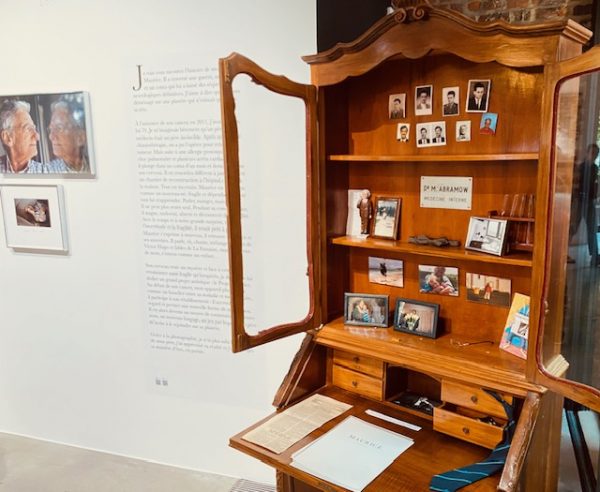
In the last 2 decades we can observe a strong concern among photographers to broaden the spectrum covered by images beyond well established imagery of non-binary gender. Diversity in imagery has taken a broader scope to extend, for example, the age range of people who are portrayed as central topic of exhibitions. The topic of mental diversity is more recent and needs a similar or even increased sensitivity to do justice to the whole spectrum of people. The photography of people with mental challenges necessitates a much more careful approach to the persons and complex personalities the photographer intends to portray. Trust and the development of trust of more vulnerable persons is a time sensitive process. The work by Charlotte Abramow “Maurice, Tristesse et rigolade” is a fine example of a photographer who portrayed over a long time of taking care of her father, previously a medical doctor, The years of the final stages of the life course of her father have been the subject over many years as the survivor of an extended medical coma had to struggle with the tough challenge of re-learning basic life skills again.
Abramow portrays her father as an actor of his “second life”, where the borders between reality, reconfigurations of his memories,   and “mise en scene” to co-produce the images. The images go far beyond the portrayal of aging and mental challenges as a deficit of persons. Yes, it is an integral part of these persons, but there is so much fun and positive emotions that derive from the intensive collaboration of actor, father and photographer that the images stick with us for a longer time. The presentation of props along with the photos creates an immersive installation, which strengthens the emotional bonding with the inclusive images of the later phase of the life course of Maurice.

Sink / Rise

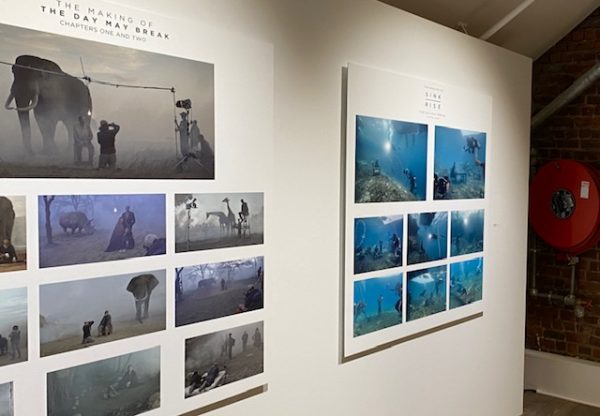
Nick Brandt presented his engaged photographic projects “The day may break” in Brussels at the Hangar Gallery space in Brussels (2025-9-21). The photographic work spans the globe to document and tell the story of a an endangered planet. The environmental and social fabric is at risk of an unprecented scale in the 21st century. Rather than producing hours of documentation, Nick Brandt focuses on images that stick. His “mise en scene” is meant to haunt us. And it succeeds in it. In the best sense of a tradition of a “photographe engagé” he intends to convey messages, even whole narratives to us about and from people in remote places, who are endangered through our inaction or paralysis in front of the challenges posed by global warming and climate change as well as the social and societal consequences.
We can save people from drowning in floods and rising sea levels. The chapter Sink / Rise of this project was produced with people from the Fiji islands who participated in the futuristic scenario of a sunk island. Without accusations, these people question us. Why? How? What for? Where to? – without speaking a word. They spend time in on a sunk island, surrounded, submerged by beautiful, but morbid, turquoise water and the graveyard-like remainders of a broken coral reef. These are photographs not of these people, but about them, about their likely fate, and (very important) produced with them as empowered actors. May they have a chance to rise like a phoenix from the ashes from these photos.
The documentation on the “Making of …” (image below) as part of the same exhibition allows transparency and additional insights into the artist’s work and proceedings.
(Image: Hangar Gallery, Brussels 2025-9-21, On the making of Sink / Rise by Nick Brandt)


Marc Aurel critics

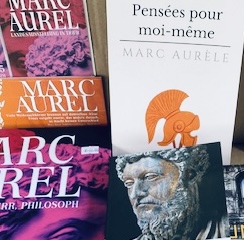
In the literature on and about Marc Aurel (Brenan 1882, pp. 484) the end of the ancient world is mentioned frequently. This refers to the beginning of the end of the Roman empire and the rise of Christianity to be become more influential. What caused the decline? The nepotism in the governance structure through the placement of family members to influential positions and as successor alienated many followers who previously believed in the high moral standards advocated by Marc Aurel.
Justifications of superiority by social origin are standard at the time of writing, but Marc Aurel did not see the potential of a more equitable distribution of offices. Women were relegated to subordinate or no public positions and are not mentioned with respect to  the importance of reasoning or social competence either, none but one in his acknowledgements (Book 1). The discrepancy between the formulation of virtues as well as ideal standards versus own practices of hierarchical leadership, recourse to slavery and brutal upholding of the empire should not go unmentioned.

AI earnings effects

In the first few years of wider adoption of AI in an economy, there is the expectation that this might lead to substantial productivity gains for enterprises which use it as well as for employees who are early adopters of the relatively new technology. The study by the Stanford Digital Economy Lab by  Chen, Chandar and Brynjolfsson (2025) showed that so far there are no significant earnings effects for employees. Based on millions of recent payroll data from US companies productivity gains have not trickled through to the paycheck in terms of monthly salaries. Participation of staff in a company’s overall turnover or profit might change this as time evolves. For civil servants the adoption of AI might mean increases in cases dealt with as some tasks can be executes faster than before with the use of AI.
The evidence points to employment effects of AI rather than earnings effects so far. A hypothesis is yet unresolved: senior employees using AI might employ fewer junior workers at entry positions, if these “hallucinating” young professionals can be replaced by hallucinating AI. In science the hallucination has sometimes lead to disruptive new approaches and findings. It is a tough choice to pick the young entrants with high productivity potential and eventually high remuneration for this in terms of labor earnings.

AI employment effects

The first robust empirical evidence about employment effects of AI in the USA has been published by the Stanford Digital Economy Lab by  Chen, Chandar and Brynjolfsson (2025). A previous paper by Wang and Wang (2025) highlighted the comparative advantage of persons who use AI in their work compared to others and the authors coined the term “learning by using technology”.  The prediction of the model was that there might be job losses of more than 20% in the long run and half of this already in the first 5 years of the introduction of the technology. The Stanford economists have estimated with real world data these effects in the USA and find quite surprisingly that the negative employment effects of AI have the strongest impact on young labor market entrants with few years of labor market experience. Middle-aged and more senior employees seem to benefit from “tacit knowledge” about the work, which is more difficult to replace with AI, at least for the time being of the early days of AI. This evidence is based on recent payroll data from the largest payroll processing firm “ADP” in the USA which has firms overrepresented from the manufacturing and services industries as reported in another paper  (Firm size maybe another source of bias).  However, the effect that youth 22-25 years of age suffered the most calls into question the common belief that older workers are more likely to suffer the consequences as during in the rise of the digital economy around the year 2000. (AI Image created with Canva)

Vacation time

According to statistics from INSEE about 20% of the French population reported in 2024 that they could not not go on vacation due to financial reasons. Another additional 20% did not go on vacation for other reasons based on another survey mentioning other reasons, like psychological or logistical issues as being of overriding importance.
Openness to new experiences is a well researched concept of psychology and vacations can be a challenging time for established convictions. Meeting people from other cultures particularly allows to reflect on one’s own values and behavior. Some people may just want to avoid being challenged or even potentially destabilized. Destination time and place involve choices and decision making often within families or with friends.
The topic of vacation is much like an evolutionary process. Towards the end or some time after the vacation time, there is” evaluation time” and the preparation of the next experience.