Marc Aurel Book 8-9

In book 7 paragraph 38 the stoic wisdom is exemplified in the the the short phrase „If you have sharp sight, use it: but, as the poet says, add wise judgment“. Being sharp in your reasoning or data collection is only part of the human endeavor. A wise judgement is, however, an ambitious aim as judgments have different short term and long term consequences. Intergenerational considerations as for climate change ask for respect of other species, biodiversity and to take into account very long time horizons.  The quote from book 8 paragraph 5 appears very modern or post-modern in this context. „There can often be wrongs of omission as well as commission.“ (both citations from Penguin Classics edition) Not acting on behalf of future generations and disappearing species is the most crying omission of our time.

Chatbot Me

Chatbots are helpful to allow queries to larger data sets like the blog entries here. So here is a try of a Chatbot to query all entries on AI using ChatGPT to create a Chatbot that uses and references it source from www.schoemann.org/tag/ai and the AI reader in pdf-format.
Please send me an email if the hallucinations of this Chatbot 1.0 on AI from a social science perspective are giving strange results. I’ll get back to you. Please use at your own risk as I cannot guarantee for all answers. The usual disclaimer applies here.

ChatGPT proposed the following set of Questions and Answers on the blog for an entry into the chat: Example Q&A with the chatbot

Q: What are the social science concerns with AI?
A: Bias in results, job shifts, democracy risks, privacy, and new inequalities.

Q: What does the text say about reinforcement learning?
A: It’s seen as the next step for AI: focusing on learning and reasoning, not just predicting text. It also uses fewer resources.

Q: How are robots described in the document?
A: Robots are mostly assistants. They can follow people or carry small items, but more complex tasks need sensors and AI training.

Q: What about biased results?
A: Studies can be misleading if control groups are flawed. AI faces the same challenge — social scientists warn: “handle with care”.

Q: What is Schoemann’s blog view on AI?
A: He links AI to energy use, fairness, and its role in the “all-electric society” — stressing efficiency and responsibility.

More on the chatbot (in testing phase) and the Link to the coding help received from ChatGPT on this mini-test-project :
https://chatgpt.com/share/68c1d160-0cc0-8003-bf04-991b9e7c3b24

 

AI Podcasting Me

Content producers have lots of tools at their disposal to get their content across to very different audiences. For some time the traditional media of newspapers, radio and TV were the prime outlets for content distribution. Social media have changed this to many more senders of content than before.
In the 21st century, AI allows to automate media productions. In a trial run I just used Google’s NetbookLM to generate 3 podcasts based on my own writings on AI over more than a year by now. The result is available and using artificial voices it is possible to broadcast yourself without revealing your own personal voice. I am not done with the evaluation of the outcome(s) yet, but the first impression is an interesting other form to spread content.
More tests are necessary to check for hallucinations as well.
Here are the links to my virtual podcasts:
AI, intimacy and insecurity

AI, Society and the Human Spirit

AI and the Human Mosaic: Navigating Our Interconnected Future

Former Crypto currency

The rationale behind a Crypto currency is quite an ancient idea. In the absence of a central bank or in addition to it, people may choose to establish their own currency or currencies. The central idea is to secure assets (currently and in the future) as well as to enable an exchange between a community of people. The Museum of the National Bank of Belgium (image below) has a “Yap stone” on display which originates from the Pacific Yap Islands. Even very heavy and big stones served as wealth storage. The idealistic value of a particular stone conveyed additional value. In the true value of the word these people were banking on stone money in a way not to distant from what Crypto currency embodies today.

Paris Olympics history

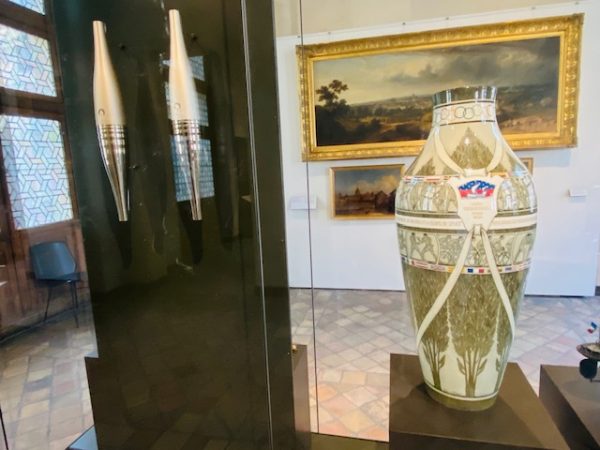
The 2024 Paris Olympic Games will go down in history as the event that has achieved to put Olympic Games and Paralympic Games on an equal footing. At least this is the message the  museum of the history of Paris tries to transmit. In the “Musée Histoire de Paris Carnavalet” we find a vase from the Games from 1924 in Paris next to the 2 Olympic torches, one for the Paralympics and one for the Olympics 2024. Both torches are the same only a different logo on them, same message, same spirit. The impact of these games is likely to set an example for many years to come and other hosts of the Games will be measured against this benchmark. Making history is one thing, taking care of the posterior image another one. Paris has taken of this as well.

Electric Fun

The 60s, 70s and 80s have been fantastic precursors of the “All electric society” because of the electric music 🎶 industry that became a mass phenomenon. First of all the electric guitar allowed a wave of new music to take hold of a whole generation and probably keeps its adepts until today. E-pianos, keyboards, drum machines and synthesizers made music playing more accessible as well. You just need to plug in your instrument and you were able to produce an overwhelming sound. Other electric pleasures might include water pumps for water heaters and sprinklers. Electronic games and gadgets soon took over in children’s rooms. Of course, calculators as precursors of mobile phones and computers were another step in the progress towards the “All electric society”. Electronics are about to govern large parts of our lives and society. We better take a serious look at what we gain and what we might lose. 

Climate Awareness

The Musée d’Orsay has prepared a wonderful walk through its permanent exhibition of late 19th and early 20th century installations to reflect upon climate and climate change. Raising awareness about the treasures lost and those we are about to lose in the next few years. Impressionist painters have depicted landscapes, cities and monuments covered in snow, which the next generations will no longer be able to enjoy the same way. The roofs of Paris covered with snow has become a feature of a distant past. Additionally, the impression of the massive steam trains crossing metal bridges appear as the daunting future of technical progress. Mixed feelings of fascination and risk associated with those machines were captured by those painters’ eyes. Nowadays we are aware of the consequences of this technical progress for our planet. The walk through museum with a focus on climate related paintings is eye opening indeed. (Image: Extract of Éduard Veuillard, Le jardin des Tuileries, Musée d’Orsay, Paris) 

Geo-politics of Electricity

Think of a society only based on electric energy. In the 21st century this energy stems from photovoltaic cells, wind and water turbines as well as geothermal energy sources. Each region of the globe and even within a country has its own kind of access to electric power specifically originating in the geographic and geologic context. This means we are returning to a phase in which “natural monopolies” of power generation have their comeback. Rather than nation wide power monopolies, the regional specificity becomes important again. Of course, this raises a lot of geopolitical issues and maybe tensions. Local economies will develop their own electricity provision. Larger and smaller companies can reorganize their power provision themselves. Energy monopolies become outdated if the infrastructure and legal frameworks are adapted to the potential of the “All electric society” conditional on new forms of “power” sharing. Electric and political power sharing will be key in the geo-politics of electricity.

Electrifying Jobs

The transition to the “all electric society” necessitates to prepare the labor force for the upcoming challenge. The knowledge about electricity and electric appliances constitutes the basics of the knowledge base of the future. This goes far beyond the basics of physics and electrical engineering. There many processes like sharing of electric infrastructure in households, cities, in and beyond countries that have to be delt with. Investment calculations and legal issues to address the different risks involved are another area to cover in the process to prepare society for the “all electric society”.
However, the skills of professions with more direct links to the fossil fuel based technologies have a role in the phasing out of the heavy reliance on fossil fuels. Reverse engineering of such engines and heating will need people still knowledgeable of the past, when younger generations set their focus primarily on professions with links to electricity. Even using a solar powered heat pump in a home requires pipes to the existing network of radiators, for example. This will most likely be a gradual shift of the job structure and occupational requirements over at least a decade, but the shift has started already. Some might argue we need a well functioning “transitional labour market”, labour market policies and social security system for this to happen smoothly.


All electric now

The shift over to the “All electric society” is easiest in sunny states like California in the USA, Africa or Southern Europe. For other regions of the globe not only the production of energy through the sun is a bit less abundant, but the storage of the sun’s energy production for deferred use is the next challenge. Countries of the globe near the equator have to balance 12 hours daylight with 12 hours night, countries far from the equator have to balance additionally more long-term between short winter days and long summer light.
Different energy storage solutions have to be envisaged.
On a daily basis or even weekly basis, battery energy storage systems (BESS) can do the trick. These systems become more costly for high capacity, longer duration storage. Battery size and price quickly become an issue. The number of electric vehicles (EVs) that have this more intelligent BESS is rising. This makes it possible to eventually use this storage capacity, if your car is sitting around your home or office for most of the time anyway. To make the “all electric society” function 24 hours, energy storage has to be planned at the same time as production and consumption patterns. The all electric prosumer will be the de-central “pro-store-sumer” in the 21st century.