Notre-Dame de Paris Visit

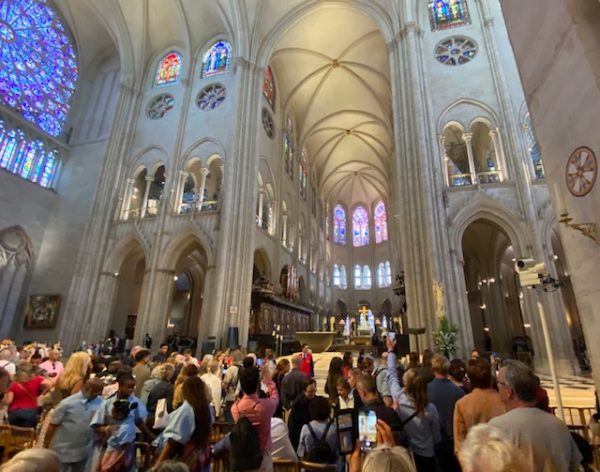
We are used to pay for visits of historic monuments. For a family with 2 children 15+ years old, 40 € is to be expected. Historic Places of Worship which still serve as such, mostly refrain from such commercialization. Notre-Dame de Paris is proud to state that they have been doing so for 860 years. After the fire, the reconstruction was expensive and it could be considered a fair deal if tourists pay for visits. The visit by Pope Leo 14 in 2026-9 and television coverage could also contribute quite significantly to the maintenance of the cathedral. The orchestration of such a visit as if a pop-star was staying in Paris in a splendid location attracts huge crowds, most of them with a certain willingness to pay for participation (maybe as donation, tax refundable). The choice to keep the place accessible to all underscores the prominent place the cathedral can play as a meeting point of many visitors with different or no religious beliefs. The role to unite various Christian beliefs and practices was remarkable in 2026-8 and a message to the upcoming visit by Pope Leo XIV who shares this vision and efforts. 
Notre-Dame de Paris Visit 2026-8

Gothic Paris

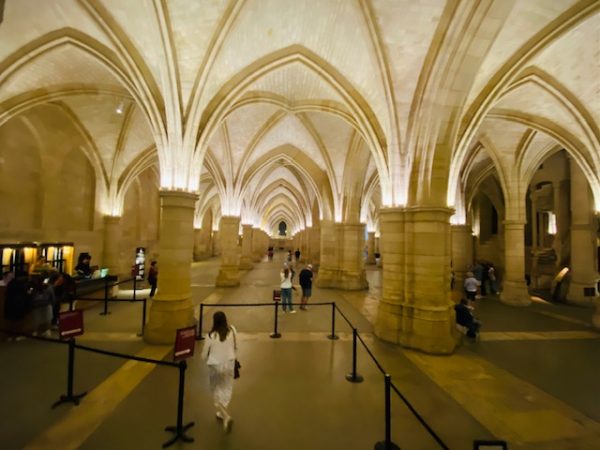
At the “Conciergerie” in Paris you can really and virtually dive into the early medieval period. The royal meeting room and the huge kitchen with 4 impressive stoves brings to life what a royal feast had been like. A guide with virtual reality adds to the lively experience of history of French royalty. Some might like the later functions of some rooms in the annex, where prisoners of the “Palais de justice” where held. During the French Revolution even a Member of the Royal family was imprisoned and later executed there. A long evolution of historical facts is captured in a relatively small space. The weight and violence of history is an almost overwhelming experience there. The modern lighting is definitely more healthy and the smell of cooking next door is also just happening in our imagination or the animation on the tablet.

Conciergerie Paris 2026-8

Swimming Paris

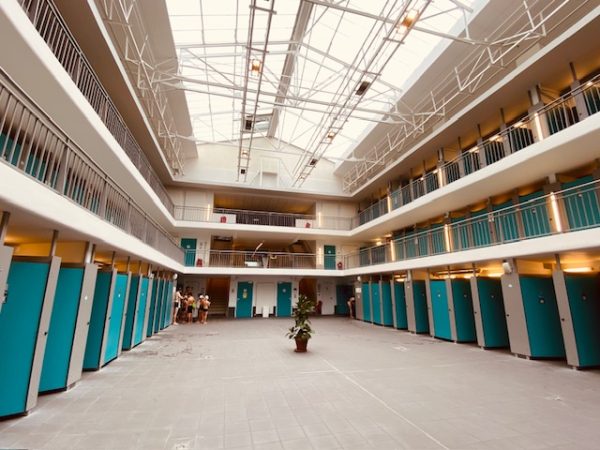
Swimmingpools are rarely on the to-do-list of tourists in Paris. This is good news for all those who go to a Swimmingpool for real exercise. In Paris you can enjoy the almost a century old public pool for swimming exercises with 50m lengths. In the entry hall you have literally a hundred doors where you change and, previously, you kept your clothes while swimming. Light by design welcomes you to do something good for you, physically and mentally. The “Piscine Blomet” (Paris 15th arrondisement) preserves a bit of the charm of the early 1930s Art-deco style in Paris. Sports deserved to be performed and exercised in fine architecture not just functional concrete. It is quite a challenge to preserve such architectural treasures including their original function. It is not all just business and tourism in Paris.

Blomet piscine Paris 2026-8

Healthy intervention

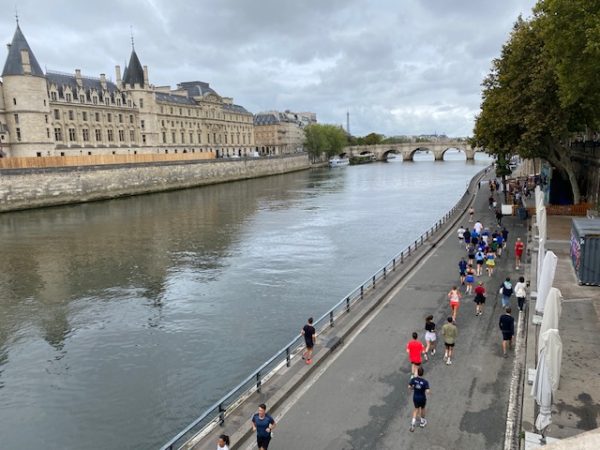
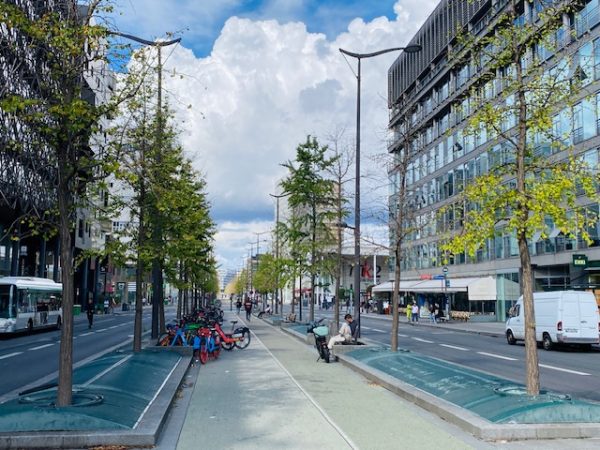
The shift back from a city which favors mobility on wheels to a city where more people move using on their feet is healthy intervention. Paris has succeeded in many inner city areas to improve the „walkability“. On Sundays joggers pass in groups where previously cars were rushing across the city. Noise levels and pollution have been reduced which attracts even more tourists. Many more than the city could handle with too much space occupied by cars and trucks. Security levels are increased by restrictions to car access to some roads and people feel safe and relaxed even in the city center of a metropolitan city. Besides the effect that more tourists come to enjoy this atmosphere, those living and working in Paris feel less forced to leave the city over weekends due to unhealthy pollution levels. Access from suburbs by public transport runs at high frequencies also on weekends. This brings people into the center for events, shopping and event shopping.

Palais de Justice Paris Seine 2026-8

Paris Room with a view

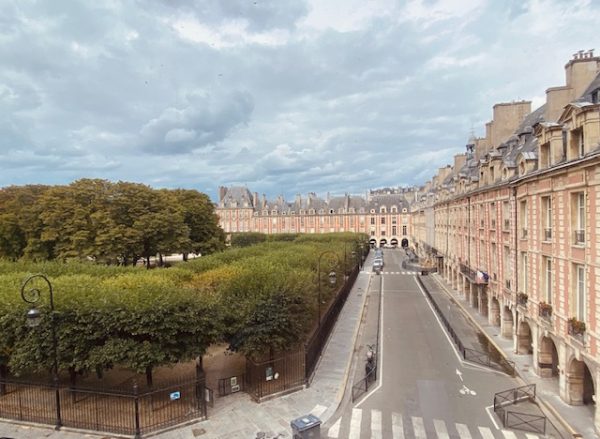
The home of Victor Hugo in Paris offers a splendid view of the Place des Vosges. The image taken from the 1st floor of the building and his living room allows to see a bit like what Hugo saw every day for some time. A small park, probably a lively street with arcades full of shops and people. Lots of inspiration and observation which may come from actual life. The actual time of writing, however, needs also retreat from the busy daily surroundings to focus one’s mind. All this hasn’t changed since Hugo lived in Paris at this address. Writer in residence programs of today allow authors to focus on their work beyond daily tasks. Cultural advances heavily rely on such programs nowadays to be able to have at least temporarily “A room with a view”. 

Hugo home Paris room view through window

Fleeting memories

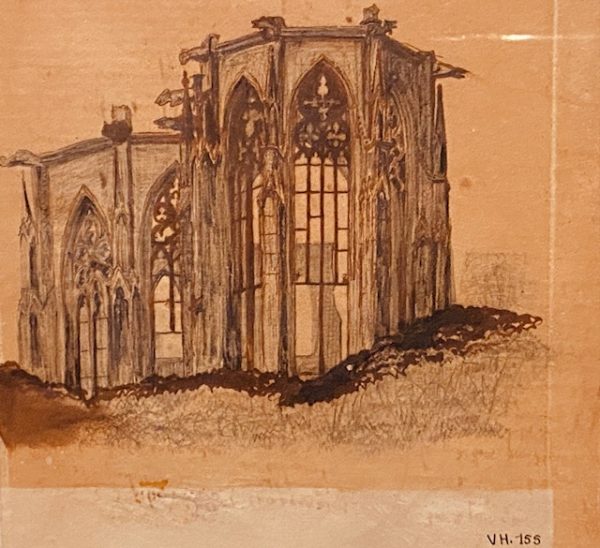
Our memory function is challenged once we travel. There are so many new impressions that ask for prime time in memory, but our capacities to safely store every detail of it is rather limited. On his voluntary travels, less when going into exile, Victor Hugo drew places with astonishing architectural detail and made literary descriptions on the back of the copy. The ruins of a gothic church in Bacharach (Germany) on the banks of the Rhine are a great example of his attempts to beat the fleeting memory. The ink and graphite pencil drawing date back to 1840. The imagery of the abandoned church, itself rich in memories of conflict by way of drawing details inscribes deeply into his own memory. A description in words on the back of this piece reinforces this effect beyond the mental exercise of precision versus dramatic blurriness. Repeating this exercise months later would reveal our fleeting memories when traveling. A great technique which is still valuable 186 years later. 

Church ruins at Bacharach by Victor Hugo 1840 exhibt at Maison de Victor Hugo Paris

Hugo voyage

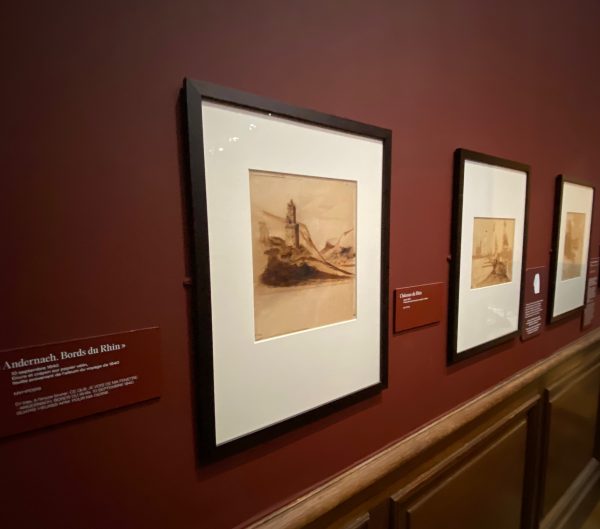
Victor Hugo traveled for inspiration to neighboring countries. He has been attracted to o mysterious places and its people. In his booklets of such inspirational journeys he drew images of several architecturally interesting places. “Burg” meaning castle was a recurrent subject trying to capture the mysteries about such medieval places and their surroundings. The rivers “Rhein”,”Nahe” and “Mosel” in Germany were a great source of inspiration for him. The images drawn of “Burg Eltz” as well as others (Andernach from 1840, image below left) testify to this. The Home of Victor Hugo in Paris, Place des Vosges features in 2026-8 his drawings which seem to have served him as studies in architecture and sometimes as idea of maybe a scenery for his theatre pieces. Of course, his drawings of cathedrals similar to “Notre Dame” in Paris are also among those ink sketches. To get scared a bit, traveling might suffice and then write it down and sketch it. Franco-German influences can be found in many European artists of the 19th century as well as today.  

Victor Hugo home in Paris exhibition on his drawings of architecture 2026-8

Gone sailing

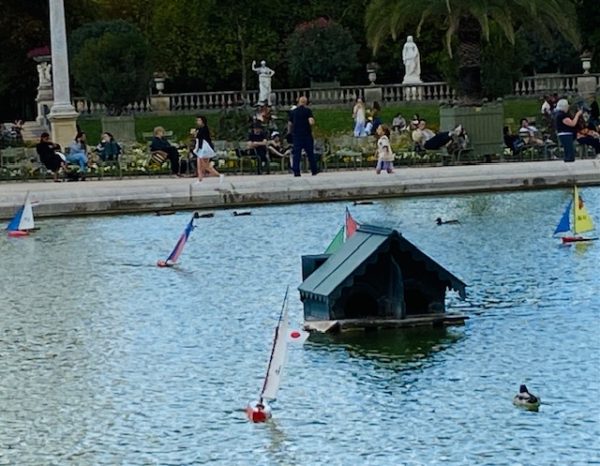
There are numerous ways to spend a nice vacation and take off your mind from daily routines. Sailing is certainly one of those leisure activities which ask for full concentration. Steady winds are more the exception than the rule and the skipper is asked to adapt rapidly to changing wind directions and other conditions. Waves and other sailing boats may of course ask you additionally to adapt your course to unforeseen circumstances. All this is a great training to keep on track even in stormy weather conditions around you. Team work helps to set sails as well as in manoeuvers to enter into ports. The Paris Jardin de Luxembourg (image below) allows training of parts of these competencies from an early age on and into old age as well. The physics of power and capsizing are part and parcel of sailing as well just as much as rules for crossing course, of course. 

Gay science 2026

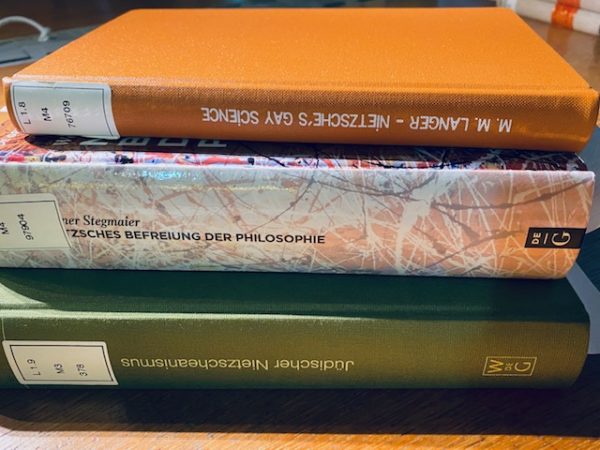
This is an intended test of the translation and contextual interpretation competence of various AI-systems in the year 2026. The Anglo-American translation of the “Fröhliche Wissenschaft“ with Gay science could nicely be interpreted as being in line with the original intention by Nietzsche of ambiguity in his aphorisms. Langer (2010) had chosen this translation knowing that in the 21st century the term gay as adjective had shifted from primarily being meaning cheerful, showy, bright or careless to the noun of gay ( mostly men) as a community. In her introduction Langer (2010) discusses the Aphorisms of gay science beyond the simple view of “postcard-like” ephemeral thoughts of a traveler. Whereas Allison (2001) reads the aphorisms as a “dynamic play of multiple and continually changing appearances”. Langer is more inclined to follow Schacht’s (1988) perspective that “we have much more than the disjointed collection of reflections and aphorisms which it may at first glance appear to be”. The art in Nietzsche’s writing is the “surface disorderliness” which “conceals its fundamental coherence” (cited after Langer 2010, pp. xiii-xiv). The contextual interpretation à la Stegmaier (2012) of only the 5th book of the Gay science spans 646 pages in text plus very informative name and concept registers as a blending of mind maps of Nietzsche’s as well as Stegmaier’s contextual and conceptual thinking. Both Stegmaier and Krochmalnik (1997) have contributed individually and jointly to a “rehabilitation” attempt of Nietzsche towards the end of the 20th century and a lasting continuation of “gay science”.

Reading on Nietzsche in 2026 to better understand Gay science

“what” and “how” in consulting

The scope of both “what” and “how” to consult have been considerably enlarged in the 2020s. The rise of the internet and digital formats in consulting have put an indigestible amount of mostly well-intended advice to the public at large. Language barriers are coming down in the digestion of ever broader as well as more interdisciplinary forms of knowledge. The “what” in consulting seems to be endless and yet the expectations on advanced expertise have risen as well. The calls for easy language summaries, as provided and popular with generative AI, pose a challenge to consulting on more interrelated or “messy” problems. The broad availability of AI in our pockets, watches or glasses amplify the potential to address really tough issues in consulting leaving the easy advice to the machines repairing other machines. Consulting may then focus on human interaction which needs to fix norms and guidelines in moral and practical matters. Consulting might take much more the form of interpretation and contextualization of information beyond simple information gathering. The “how” in consulting is conditional on “what” is the issue in question. From the antique dialog over (medieval) confessions (Stegmaier, Fuerst 1993) and book writing, we have moved to digital formats with textual, vocal and visual formats (Image and video). Hybrid formats enrich the consulting experience for the persons asking for advice as well as those offering it. (Image: Consulting on what and how to plant in city streets 2026-8 Paris)

Consulting on what and how to plant in city streets 2026-8 Paris