Emotions in Politics

Rage or even hate count among the high emotional states in psychology. The presence in politics of these more extreme emotional states has been on the rise since the times of Covid-19 due to the necessary restrictions of the fundamental right of free mobility. A cost of living crisis might lead to similar emotional states as “Angst” about homes, commuting and heating put many people in existential crises. The rise of extreme right parties has gained on the basis of this basic social mechanism using hate speech and a continued rage as driving force. Established political parties across Europe and the Americas have been very slow to react to this. Just providing accurate information and correcting fake news is not enough. More emotions are called upon to counter such aggressive strategies used by political opponents, unfortunately. In the podcast “The 2nd thought” (Der zweite Gedanke in German!) Natscha Freundel together with Justus Bender and Heike Klüver we learn that an emotional response to rise of the extreme right is asked for. It is interesting to witness that 144 years after “Die fröhliche Wissenschaft” we still have not learned the lesson from Book 1 entry 38 by Friedrich Nietzsche: “with reason alone, thou shalt not convince those explosive minds” (own interpretative translation).
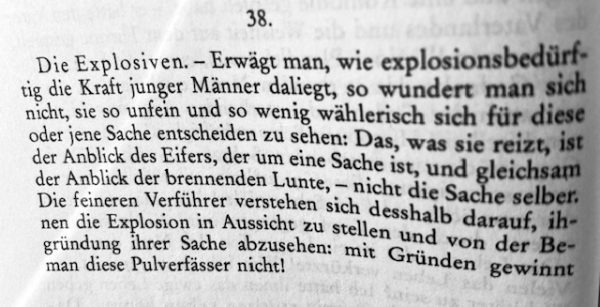
Quotation from Nietzsche Book1 Nr.38: Mit Gründen gewinnt man diese Pulverfässer nicht!

Taking positions

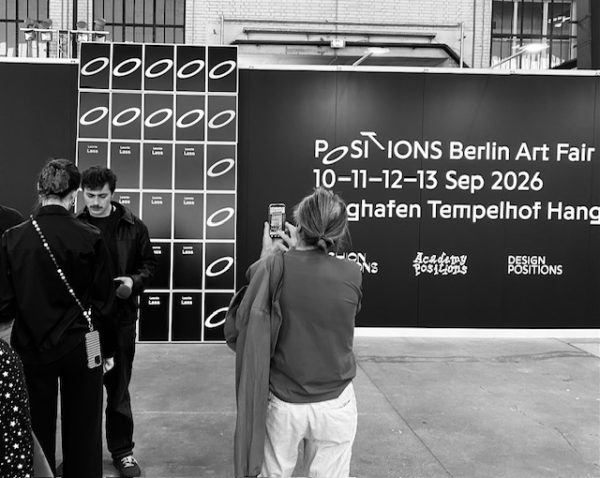
In the arts, positions are taken through the choice of topics, materials, an own perspective or approach. For the young artists, taking a position is quite a defining moment, usually after experimenting with several ones before. That point of view is probably a bit biased by a galerist’s perspective or when studying the market of art. Related to the Berlin Art Week, the Positions Berlin Art Fair offers an interesting overview of what is on the market. The section entitled Academy gives space and attention to young entrants into the art market.
The exchange of artists with the audience allows to understand in more detail what position is taken, how it is taken and worked out in detail. The  backgrounds of artists are quite broad compared to other metropolitan Art Fairs in this start-up atmosphere at the Hangar 5+6 of former Tempelhof Airport in Berlin. If we look at other perspectives, we shall not only get inspired, but we shall most likely question our own position(s) as well. Great learning experiences for all.

Culture goes Europe

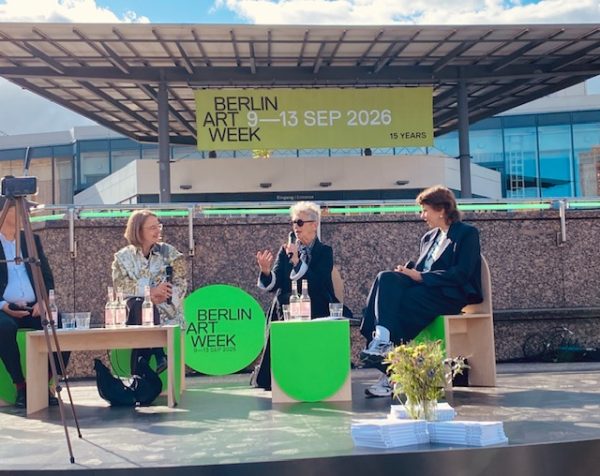
Culture has always travelled Europe. Not only the very famous artists have travelled themselves or their art has travelled, but students of art have joined masters in other countries to learn or become inspired. There are, of cause, some artists who paint themselves in their home and do not care much about the world around them. This is fine, too. The Berlin Art Week has taken a refreshing pro-European perspective in the talk entitled “Empowering Europe”. Culture can build many sustainable bridges across borders, which often start with language acquisition (Gitte Zschoch). Foundations assist with funding (Stephan Muschick). Curators initiate cooperations and lending across borders to challenge traditional cultures and practices (Anda Rottenberg). And the media ensure a wide distribution of cultural information and organise a society-wide discourse (Elke Buhr) about cultural diversity, heritage and innovation. All this is needed to avoid a self-referential cultural perspective of the MAGA-type in Europe. This is not a nice-to-have, but an essential part of the European power of resilience.

Monopol talk Berlin Art Week 2026-9

Human gravity

Long before the establishment of Newton’s theory of gravity, humans have been fascinated by gravity. Elevation from earth, after all, has figured prominently in religious imagery. Mankind’s dream to fly has become so popular that it contributes substantially to ruin the blue planet. Defying gravity as much as feeling the amplified force of it have become a continuous challenge. In sports we adore the bouncing on a trampoline and classical dance derives a lot of its charm from the suspended moments in air. Beware the landing and get accompanied in your first steps.
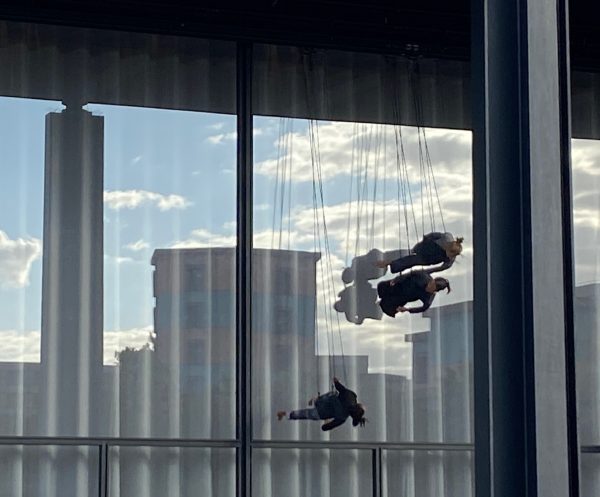
Modern Dance is equally creative in the challenge to defy human gravity. Trisha Brown (1971) suspended dancers horizontally so that they could walk in space at least along fixed lines and perpendicular to the surface. The physics of our body change in this bird-like position. Dancing in equilibrium on a horizontally suspended line leaves the audience amazed. The spectacular setting and performance at the “Neue Nationalgalerie” transforms the architecture again into a playing ground for choreographers. Suspension from human gravity is hard work, beyond “¾ Walzer” rhythm and, of course, it takes 2 to tango to feel the suspension.

Trisha Brown horizontal suspended Dance Berlin 2026-9

Glass wall

A glass wall remains a wall even if it is transparent. The glass and steel construction of the Neue Nationalgalerie by Mies van der Rohe has large windows which allow light to flow into the building and create an illusion of transparency as well as openness. However, for most exhibitions “paywalls” are erected to limit access. The Cattelan installation in the gallery erected another light barrier before the official opening in form of the ribbon barring entrance. For those who had experienced the real wall in front of or behind the Brandenburger Tor”, a certain allergy against walls is probably a leftover from those days or years. Hence, Klaus Biesenbach and Maurizio Cattelan tear that wall down!
Thanks go to the Volkswagen Group “Art-4-All” sponsorship which allows free entry on Thursday evenings already. Public-private partnerships are way forward and “Mäzene” can accompany such journeys in multiple ways. 

Cattelan Maurizio at Neue Nationalgalerie Berlin 2026-9

Modern Cathedral

For a long time we have argued here that museums are the cathedrals of modernity. Maurizio Cattelan has taken this claim literally. In a bit of a cheeky way, he turned the “Neue Nationalgalerie” into a cathedral of German modernity. Who are the Gods then? Our cultural heritage comprises beyond our German language classics, the novel “Die Blechtrommel” by praised and then disgraced Günter Grass. The figure serves as the “campanile” sitting above the entry. Well, the small scale “Brandenburger Tor” serves as the entry portal into a wide open space, with past pieces of adoration in a transfigured sense. This modern cathedral holds pieces of art similar to small chapels in a cathedral dealing or inviting to remember historic events or eminent persons. The modern aspect consists in its temporality. The show must not go on forever. Like surrounding every cathedral, lots of immortalised pigeons accompany our visit, just sitting around. There is no longer just one “holy spirit” or “peace dove” but so many. Welcome to the temporary modern cathedral in Berlin.

Cattelan-Berlin-2026-9-Neue-Nationalgalerie

VCs shun SA

Venture Capitalists have an eye on long-term safety of investments. Political upheavals, unrest or instability can deter investments as much as risks to the safety of the workforce. The abbreviation “SA” in Germany has at least 2 meanings. (1) Historically, it refers to the “Sturmabteilung”, which was important in the rise of the Fascist movement and Nazi-terror in the 1920s, 1930s. Foreign investors were right to shun away from investments during the rise of the Fascists in Germany as a total loss of the investment was to be expected. (2) In 2026-8 the abbreviation “SA” in Germany stands also for “Saxony-Anhalt”, one of the Federal States of Eastern Germany, formerly the GDR between 1949-1990.
The “Wallstreet Journal”, which is read by many international investors showed on its title page of WSJ 2026-9-7 a report by Bertrand Benoit on the disastrous election in Saxony-Anhalt giving the extreme right-wing party AfD close to an absolute majority of votes. The abandoned investment by Intel into a chip-production near the capital of SA, Magdeburg, has been in retrospect a rather wise investment decision. The internationality of the employees, who build and operate such plants, might have contributed to them feeling rather unsafe in a hostile environment towards foreign workers.

intel processor logo

Heat Health Protection

The heat waves of 2026 had serious health impacts in Europe and beyond. Hence, it is urgent to propose better protections to shield people from negative heat exposure which worsened the health of millions of people. Digital tools which work to personalize heat warnings and increase preventive strategies like drinking water or reduce physical activity outside during the hottest times of the day. Sounds simple, but thousands of people continue to put themselves at risk to suffer seriously from heat exposure. The macro-level general population warning’s could be much more specific if they included additionally the relevant medical conditions of an individual (Du et al. 2026). Prior health conditions affect the general preparedness to cope with heat. We have an obvious case of bi-directional causality. A worsening heat health spiral could be at the origin of so many premature deaths during heat waves. Search for “cool locations” should be considered very seriously for heat-health protection.

Notre Dame Paris 2026-8

Notre-Dame Organ

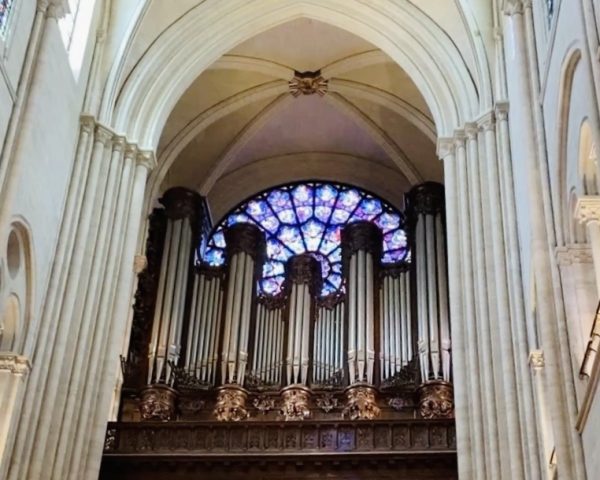
Paris, particularly Notre-Dame de Paris, is a great place to listen to pipe organs. It just needs a little preparation to find out time and place of a concerts. There are actually surprisingly many. At times of official services you might also get an impression of the capacity of organs and organists knowing how to make the pipes sound from soft, melodic to broad, majestic, even overwhelming. In Notre-Dame de Paris the original organ was built by Aristide Cavaillé-Coll and accomplished in 1868. An “electric blower” (1924) certainly enhanced and prolonged the sound capacities of the already rich orchestration features. Despite the electric enhancement the mechanics remain the primary features of the sound of pipe organs. Olivier Latry at Notre-Dame manages to the audiences into the 21st century’s sound spectrum based on traditional, but adapted variations of classical compositions. Bringing in new talent, like at the “Konzerthaus“, will guarantee that future generations can still enjoy the many worlds of sound that organs open up for us. Short sound impression Notre-Dame de Paris organ play 2026-8.

Notre-Dame de Paris Visit

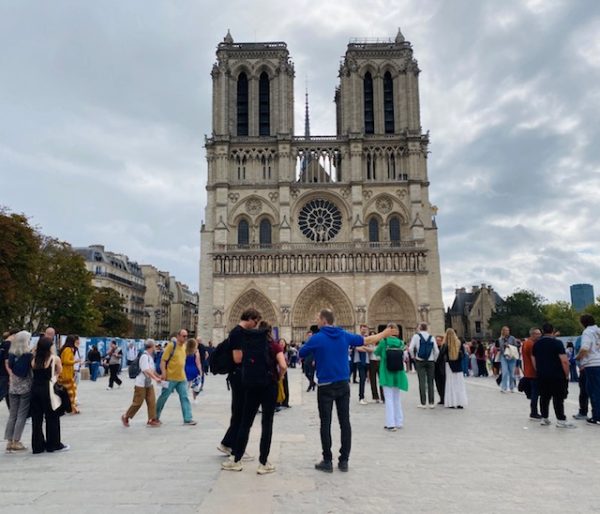
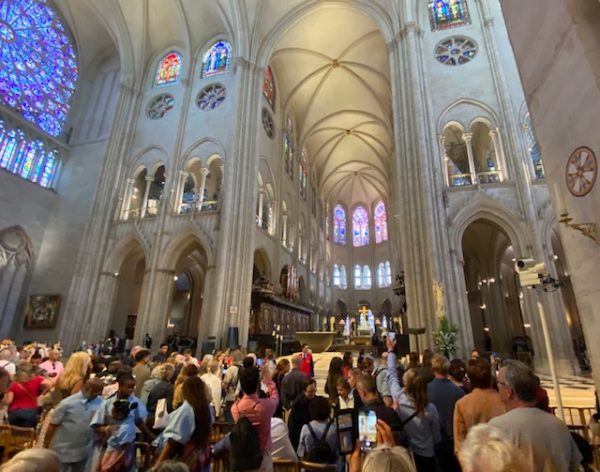
We are used to pay for visits of historic monuments. For a family with 2 children 15+ years old, 40 € is to be expected. Historic Places of Worship which still serve as such, mostly refrain from such commercialization. Notre-Dame de Paris is proud to state that they have been doing so for 860 years. After the fire, the reconstruction was expensive and it could be considered a fair deal if tourists pay for visits. The visit by Pope Leo 14 in 2026-9 and television coverage could also contribute quite significantly to the maintenance of the cathedral. The orchestration of such a visit as if a pop-star was staying in Paris in a splendid location attracts huge crowds, most of them with a certain willingness to pay for participation (maybe as donation, tax refundable). The choice to keep the place accessible to all underscores the prominent place the cathedral can play as a meeting point of many visitors with different or no religious beliefs. The role to unite various Christian beliefs and practices was remarkable in 2026-8 and a message to the upcoming visit by Pope Leo XIV who shares this vision and efforts. 

Notre-Dame de Paris Visit 2026-8