
In the middle of the hype around AI it is useful to take stock of the reflection and evolution of AI. In my own analyses and writings on AI it evident that a narrowing of focus has taken place. Whereas before 2022 the writing dealt more with digital technologies in general. The links to the literature on the social construction of technologies was obvious. Algorithms and AI was a part of the broader topic of society and technology.
This has changed. The public debate is focused on “everything AI now”. We look at technological developments largely through the lens of AI now. Hence, my focus of assessments of technology from a societal perspective follows this trend. In a collection of blog entries on AI we try to demonstrate the far reaching changes that have started to have an impact on us. In the last few months the all encompassing concern about AI’s effect on us needs full attention of social scientists, policy makers, companies and the public at large. We can no longer leave this topic to the software engineers alone. By the way, they themselves ask us to get involved and take the latest advances in AI more seriously.
As a “flipbook” the online reading is rather comfortable (Link to flipbook publisher MPL). The pdf or epub files of the blog entries allow to directly follow the links to sources in webpages or other publications (AI and Society 2p 2024-4-18). The cycles of analyses and comments have become faster. Traditional book writing suffers from time lags that risk to make pubications outdated rather quickly. Dynamic ebook writing might bridge the gap between time to reflect and speed to publish or inform the wider public. The first update as .pdf-file is available here: AI and Society(2).


AI Travel
Playing around with AI it is nice to test take fun examples. Image you want to plan a vacation, then the use of AI is ready to suggest to you a couple of things to do. Of course, AI is eager to propose travelling services like transport or accommodation to you where it is likely to earn some commissions. So far, the use of the “Vacation Planer of Microsoft’s BING Copilot” is free of charge. In entering the time period and a region as well as some basic activities you’ll receive suggestions with quotes on the sources (webpages of public services from tourist offices mostly). It seems like trustworthy sources and the suggestions of D-Day activities in Normandy is a positive surprise to me. These are popular activities which attract huge international crowds every year.
Thinking further on the potentials it becomes evident that travel suggestions will be biased to those paying for ranking higher on the algorithms selection criteria, which are not disclosed. Entering into the chat with the AI you and AI can target more precisely locations and also hotels etc. You are disclosing more of your own preferences in the easy-going chat and probably next time you will be surprised to be recommended the same activities at another location again.
So far, I have bought travel guides or literature about locations to prepare vacations. This is likely to change. I complement my traditional search or planning with the “surprises” from AI for travelling. I rediscovered, for example, the public service of tourist offices and their publications ahead of the travel rather than the leaflets at the local tourist office. In order to plan ahead there is value in the augmented search and compilation capacities of AI. Drafting a letter in foreign languages is also no problem for AI. The evaluation of the usefulness of AI, however, can only be answered after the vacation. Outdated info or databases have a huge potential to spoil the fun parts as well. 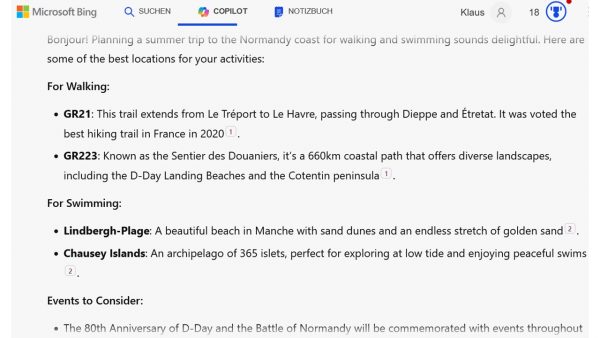
Theory Literature
There still is a lively debate at the margins of literature and the commerce around it about theories of literature. Even if the best of years of theories about literature have passed, in 2024 we see several revivals of theoretical perspectives on literature. Travelling in Europe we celebrate, for example, the 100 years of Belgian and international surrealism in Brussels. The French artist and theorist André Breton was preparing in his thoughts the art and literature of surrealist inspiration. Of course, we think of Magritte as one of the eminent figures of the painted surrealism. Franz Kafka, who died relatively young in 1924, was the author in the spirit of the surrealist movement. The powerful impact of literary theory and theory of art to form communities of practice have had lasting effects, which fascinates large audiences in 2024. Exhibitions across Europe reflect the importance of these art movements to understand European culture, inspirations and aspirations.
Not least through this revival of the surrealist artists in the broadest sense we are returning to a more theory-driven view of literature a bit like 100 years ago. I find it remarkable to read in “Le Monde Livre” of 2024-4-12 the article on “Défense de la théorie” by Tiphaine Smoyault (p.8 see quote below) with a comment on the book by Florent Coste on the usefulness of a theory of literature to understand the world around us. Reworking of language is the contemporary concern of literature: pluri-linguistic experiences, re-discovering oral performances, irony in language and digging into archives are the major strands of contemporary literature. Theory of literature reflects on the past and allows to synthesize the present. For some it also enables to project into the near future of what is going to be published. In any case the theory of literature provides orientation in a huge ocean of published oeuvres. Writing or painting with ideas ahead of your time has been a painful experience for most of these artists. Some artists or authors are lucky to become famous during their lifetime, but lots have struggled for years or never learned that their contributions advanced humanity for more than a hundred years. 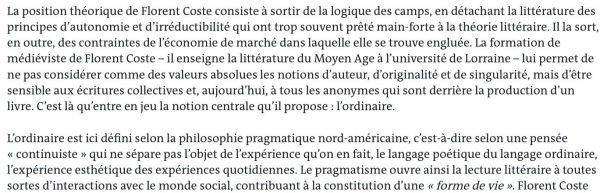
Repair Building
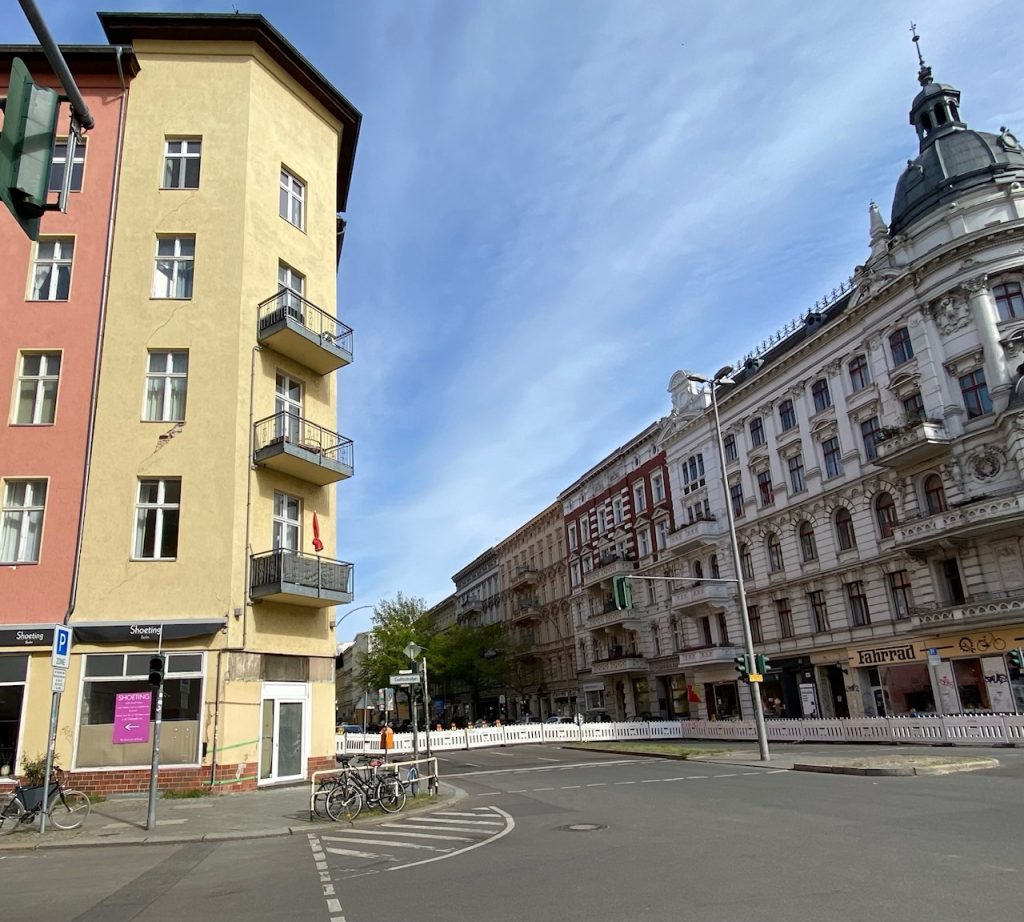
All buildings need repairs from time to time. For most of them the basic structure is solid enough so that isolation or maintenance will do. However, 100 years old buildings that have lived through 2 wars might have deep rooted deficiencies that are not visible at first glance. This can be observed in Berlin near the city center in a popular neighborhood with many visitors in „Schöneberg“ sometimes translated as „pretty hill“. The building at the crossroads seems to have been renovated only a few years ago, but the static of the building is so unstable that the city council has decided to block the whole crossing for circulation due to the danger of an imminent collapse of the building. The neighborhood has mixed feelings. It is great that the danger has been identified in time and blocking the road reduces the nuisance of traffic in the surroundings full of restaurants and cafes. The cover up of the repairs and renovation at the building is shocking as there appears to be just paint over basic structural faults. Construction work has failed to detect and prevent the static risks. An inspectorate that acts promptly to avoid bigger disasters is a societal asset.
Citizens Gardens
There are multiple ways to link citizens to gardens. Most people would link citizens to the property of their own garden. This is more the perspective of people from the countryside. The aim of citizens who can afford it have a garden, many others wish to have one and all of them enjoy public garden spaces. An intermediate version of the public versus private property of citizens’ garden is the joint ownership of groups of like-minded people to work together in the shared property or rented garden space. The recreational and health effects are well documented, if care is exercised with utensils etc. Spring is the ideal time to join projects again as the results of a little bit of gardening will be visible and enjoyable for several months afterwards. Gardens are also meeting points for people of all walks of life as in the vicinity of the European Parliament in Brussels. The Citizens’ Garden has a different function to people gardening there. When you puzzled about Europe after a visit to the Parliament or the Museum of the History of Europe, then it is time for a stroll and relax in the garden nearby.
Alternatively, the Exhibition Centre of Tour & Taxis in Brussels not too far away from the North train station has an impressive indoor garden for the times of rough weather conditions. At the time of the book fair culture in the indoor garden made a splendid combination. There is a green version of Europe. It is like a small plant. It needs a lot of time and care to grow. 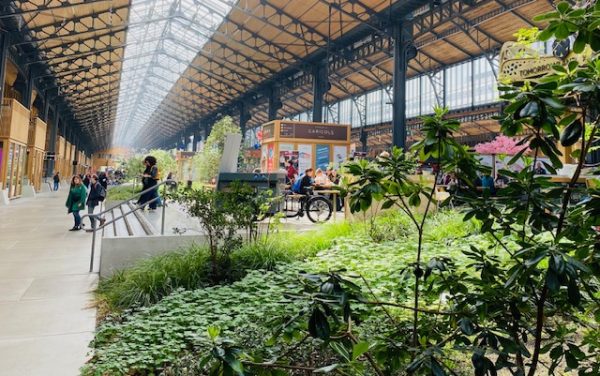
Forest Management
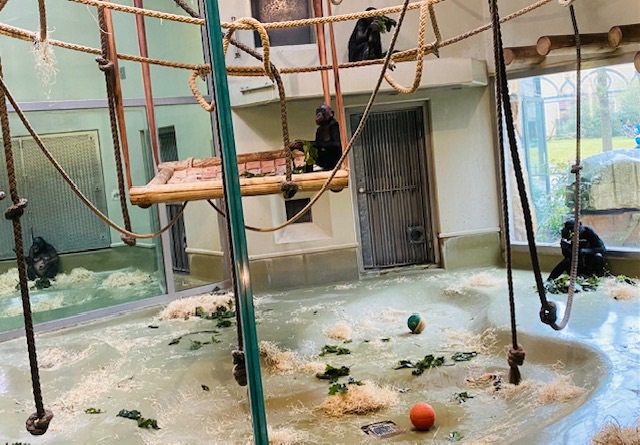
Responsible forest management is key. To safeguard against the loss of biodiversity the management of forests can achieve a great deal as the study in Nature of 2024-4-10 has demonstrated. Reducing hunting by humans in dense tropical forests allows bigger species to survive and thrive compared to forests with easy access by roads. FSC certification of forests helps significantly to protect wildlife. The ability to ameliorate biodiversity of forests is assisted by the Forest Stewardship Council (FSC) through the responsible management, preservation and limitation of access to wild forests. This is an important message that in fact it is still possible to preserve wildlife also of larger species if we only really commit to the cause. It is well worth to support such initiatives and monitor the progress. Of course, any such success attracts new hunters and a continuation of the FSC efforts is needed for the benefit of the whole biodiversity on our planet as there is no planet B.
Causal Benefit Model
In the field of medicine we move more and more towards precision medicine. Previously, the term of personalized medicine was used which suggested to a certain degree that a personalization might be feasible. The budget constraints have forced us to change the term to avoid unrealistic, untenable promises. In the field of cardiology scientific advances advocate to shift from a risk-based model of treatment to a causal benefit model. (Kohli-Lynch et al. 2024 Link). Long-term benefits of a treatment are more promising, if the treatment addresses the causal mechanisms at work. It is wide spread practice to deal with general risk profiles as guidelines as the precision medicine based on a causal benefit model is far more laborious since to search the causal mechanism at work requires additional testing of hypotheses. This becomes immediately clear if genetic causes enter into consideration. Nevertheless, medical research advances more and more in this direction. Genetic testing has been shown to be useful in analyzing and treating issues like sudden cardiac arrest (in survivors). We are somehow aware that genetics may play a role here, but we shall need a lot of additional studies to make the causal benefit model a feasible option for widespread applications. Targeting research in this field will offer new avenues for precision medicine in the 2020s.

Ne pas rire
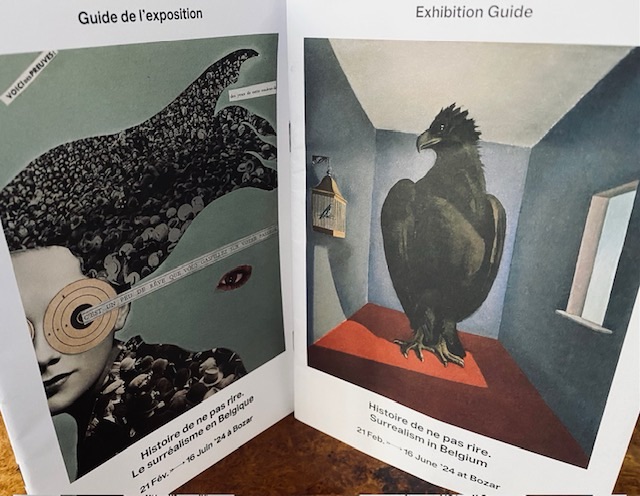
The exhibition of surrealism in Belgium at Bozar has the inviting title “Histoire de ne pas rire”. Even the booklet of the exhibition guide does not translate this into English assuming everybody has at least that much of interest in French and the willingness to learn about these 5 words that are a reference to the understanding of the surrealist art movement. You are explicitly invited to allow yourself to laugh when looking at the images. Reflection comes second. Caught by surprise and making new connections of seemingly unrelated images and words, that’s the essence of it. The comparison of the 2 versions of the exhibition guide teaches language and translations beyond the simple words. Sometimes it is best to not translate the text as in the title of the exhibition guide.
Series Evaluation
The monitoring of TV series is a serious science. The evaluation of so-called binch viewing has redrawn attention to the field of media studies again. We observe a bit across Europe, following the US experience, the change of TV productions into series that may run over several years. The successful format of a TV series draws advertising to the relatively constant audience. Most series have a particular age group as their target group. Viewing behavior determines time slots allocated. Each group has its own prime time. The publisher of books had their successes with similar series of for example children’s picture books or cartoons. Asterix, Martine and similar book series have basically applied the same “serial” mechanism before. Popular success creates its own dynamics. Therefore the evaluation of such serial productions should stay on our research agenda of the social sciences as well.
In a radio discussion “France Culture” has juxtaposed the 2 currents of series evaluation in a concise way. One current of assessment holds the view that rather than high versus low culture, the debate should take popular culture seriously. It augments the set of experiences as the characters in a TV series live through a kind of “experimental setting” each time anew. The variety of experiences is catching popular attention as they are beyond the scope of the spectator’s usual life settings and thereby a learning opportunity. This highlights the value of the content in the evaluation. This requires a thorough scrutiny of that content to evaluate an emancipatory value of viewing it (Sandra Lauglier, 2023).
An opposing view is defended by Bertrand Cochard (2024) with reference to the conflict about one’ use of free time available to us and how we spend it. His criticism takes issue with the amount of time “lost” by viewers of series. Time is not spent twice. The loss of time alone or side by side rather than spending it with other persons or physically active constitutes a major risk to the social fabric of society.The jury is still out on the issue. We likely see the start of a series of entries on this topic as well.
Heroines
In youth we are open for a wide range of influences. Heroines in children’s literature, picture book or cartoons look back on a long history as successful influencers. Creation, transmission and criticism of stereotypes are all part of the scientific reflection on heroines and heros. Nowadays, influencers have taken over picture books through the use of more compelling videos.
In the 1950s,1960s and 1970s picture books or cartoons dominated the influences before mass media like television became more absorbing, addictive and powerful influencers. Children’s books are passed on from one generation to next generation. The French-speaking world (and beyond BBC reference) has witnessed the success of the illustrated booklets of the young “Caroline” (Hachette) and “Martine” (Casterman) exploring the world. Parents passed on their collection to children and had their own parents read the stories to their grand children.
Well, that’s how intergenerational transmission of cultural heritage has worked for a long time. It describes the basic social mechanism. Nevertheless, new forms of influencing emerged with new technologies. Successful illustrated narratives like “Caroline” and “Martine“ were adapted as television series as well. In France you could chose your side of either explorations with Caroline and her group of animals or the adventures of Martine.
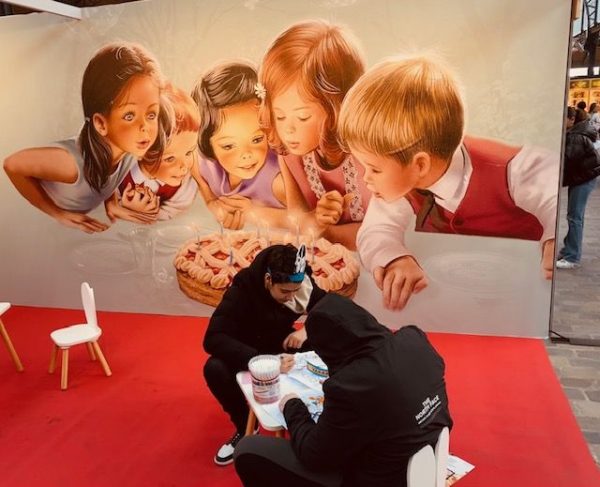
Ideally it would be an occasion for the families and friends to discuss pros and cons of each character and, thereby, become aware of what is a stereotype, at least at a later stage of the life course. Gender stereotypes have evolved and to observe 2 boys colouring Martine images in public (Brussels book fair 2024, image below) was a positive surprise. It almost felt like a real world experience of the AI-enabled Barbie explorations.