
Surrealist 100

Belgium celebrates 100 years of surrealism with a special exhibition in Brussels at Bozar in 2024. The arts movement has much more to offer than just paintings from Magritte. Many other painters and intellectuals that were instrumental to create and perpetuate the movement are represented there. The French philosopher Breton as spiritus rector of the movement contributed innovative ideas and challenged the artists to do further and further on their journey to explore freedom of expression and freedom of association. The exhibition is centered around the surrealist idea to explore the association of words and images. This time the words are on the walls of the rooms and the images put up in the rooms as kind of obstacles on your journey. Keep challenging, keep questioning the sense of things and our imagination. The journey goes on and there are many artists who are still influenced by surrealism, for example Folon. The texts and images take you along on the journey into the surrealists’ world. If you want to challenge your own way to see things and the associative world, this is the place or catalog to refer to.
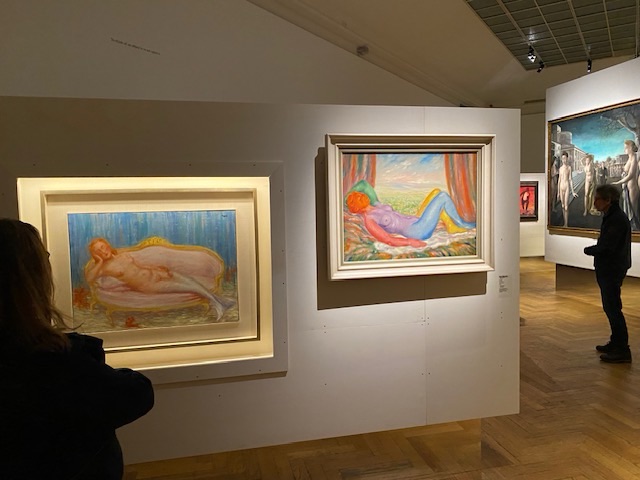
Bozar, 2024 100 years of surrealism

AI and languages

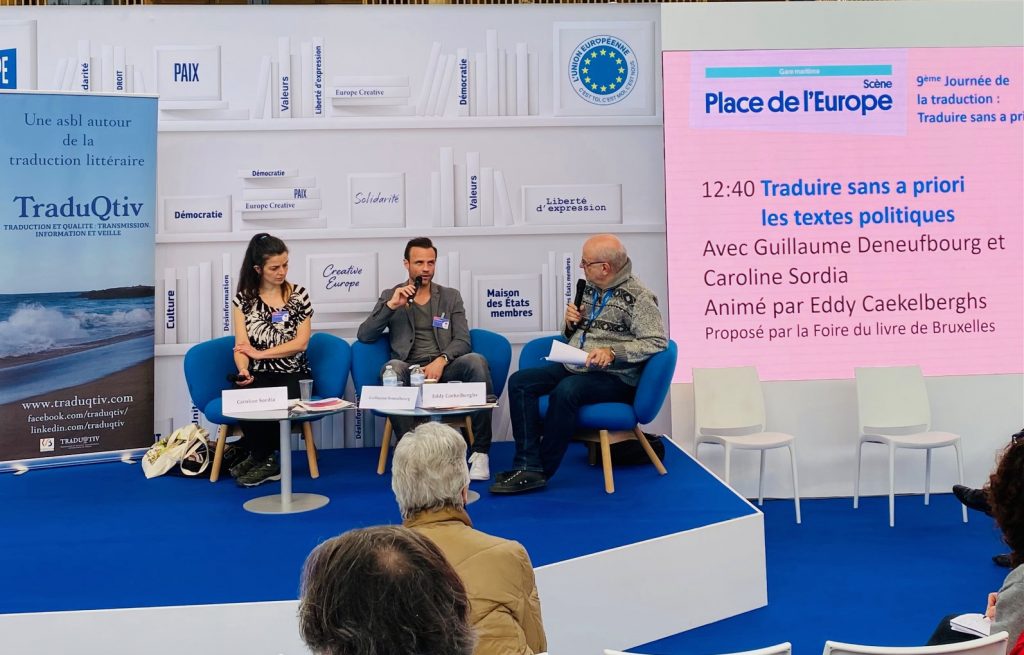
A big potential of AI is in the field of languages. Translations have been an expert domain and a pain for pupils at school. In professional settings translations are an expensive extra service for some or a good source of revenue. AI has shifted the translation game to a new level. In terms of speed of translating large amounts of written text AI is hard to beat. In terms of quality the battle of translaters against AI is still on. For chess players the battle against AI has been lost some years ago already. It remains an open question whether translators can still outperform AI or just adapt to using the technology themselves to improve both speed and quality of translations. The European Union with its many languages and commitment to cultural diversity can serve even more language communities with documents in their own language than before at marginally higher costs. A panel on the 9th day of translations at the „foire du livre de Bruxelles” 2024 expressed their reservations with regard to the use of AI in translation of political text or speech. Misunderstanding and misinterpretation will be the rule rather than the exception with potentially harmful consequences. Checking the correctness of translations is a permanent challenge for translators and can be very time consuming. There is room for an AI-assisted translation, but similar to other fields of application of AI, relying exclusively on AI bears high risks as well. We should not underestimate the creative part of translators to do full justice to a text or speech.

www.flb.be 2024 Translation

AI and PS

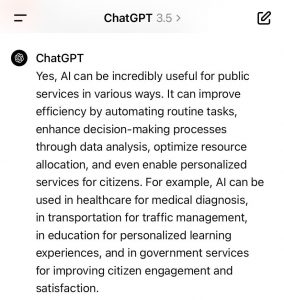
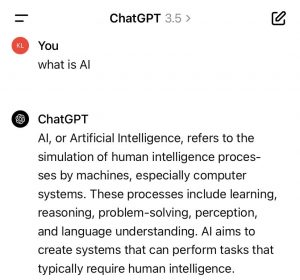
AI like in ChatGPT is guided by so-called prompts. After the entry of “what is AI” the machine returns a definition of itself. If you continue the chat with ChatGPT and enter: “Is it useful for public services” (PS), you receive an opinion of AI on its own usefulness (of course positive) and some examples in which AI in the public services have a good potential to improve the state of affairs. The AI ChatGPT is advocating AI for the PS for mainly 4 reasons: (1) efficiency purposes; (2) personalisation of services; (3) citizen engagement; (4) citizen satisfaction. (See image below). The perspective of employees of the public services is not really part of the answer by ChatGPT. This is a more ambiguous part of the answer and would probably need more space and additional explicit prompts to solicit an explicit answer on the issue. With all the know issues of concern of AI like gender bias or biased data as input, the introduction of AI in public services has to be accompanied by a thorough monitoring process. The legal limits to applications of AI are more severe in public services as the production of official documents is subject to additional security concerns.
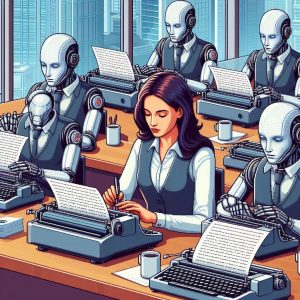
This does certainly not preclude the use of AI in PS, but it requires more ample and rigorous testing of AI-applications in the PS. Such testing frameworks are still in development even in informatics as the sources of bias a manifold and sometimes tricky to detect even for experts in the field. Prior training with specific data sets (for example of thousands of possible prompts) has to be performed or sets of images for testing adapted to avoid bias. The task is big, but step by step building and testing promise useful results. It remains a challenge to find the right balance between the risks and the potentials of AI in PS.

AI and text

The performance of large language models (LLMs) with respect to text recognition and drafting texts is impressive. All those professions that draft a lot of texts have often decades of experience with using word-processing software. The assistance of software in the field of texts ranges from immediate typo corrections to suggestions of synonyms or grammatical corrections in previous word-processing software.
The improvement of AI stems for example from the potential to suggest alternative drafts of the text according to predefined styles. A very useful style is the “use of easy language”. This rewriting of texts simplifies texts in the sense that longer and more structured sentences are split into shorter ones, lesser-known words or acronyms are replaced by more common or simpler words. Some languages like German have a particular need to use easy language when it comes to administrative regulations and procedures. Public services that aim for inclusiveness of for example older persons or youth can become much more accessible if the use of easy language is spread more widely. Just keep in mind the large numbers of so-called “functional illiterates” (OECD study “PIAAC”) in all OCED countries.
AI can do a great job in assisting to reach a broader public with texts adapted to their level of literacy and numeracy competences. Webpage Designers have made use of Search Engine Optimization (SEO) for years now. The most common way is to use frequently searched keywords more often on your website in order to be found more often by search engines like GOOGLE et al. Additionally, AI allows to explain keywords, sentences or even jokes to you (Spriestersbach 2023 p.111). This may help in situations when cross-cultural understanding is important.
We have made use of optical character recognition (OCR) for a long time now in public services as well as firms and for private archives. AI is taking this “learning experience” to the next level by making use of the content of the recognized text. Predicting the following word or suggesting the next sentence was only the beginning of AI with respect to texts. AI can draft your speech to plead guilty or not guilty in a court. But we shall have to live with the consequences of making exclusive use of it rather than referring back to experts in the field. AI please shorten this entry, please!

AI by AI

It has become a common starting point to use electronic devices and online encyclopedias to search for definitions. Let us just do this for artificial intelligence. The open platform of Wikipedia returns on the query of “artificial intelligence” the following statement as a definition: “AI … is intelligence exhibited by machines, particularly computer systems …“. It is not like human intelligence, but tries to emulate it or even tries to improve on it. Part of any definition is also the range of applications of it in a broad range of scientific fields, economic sectors or public and private spheres of life. This shows the enormous scope of applications that keeps rapidly growing with the ease of access to software and applications of AI.
How does AI define itself? How is AI defined by AI? Putting the question to ChatGPT 3.5 in April 2024 I got the following fast return. (See image). ChatGPT provides a more careful definition as the “crowd” or networked intelligence of Wikipedia. AI only “refers to the simulation” of HI processes by machines”. Examples of such HI processes include the solving of problems and understanding of language. In doing this AI creates systems and performs tasks that usually or until now required HI. There seems to be a technological openness embedded in the definition of AI by AI that is not bound to legal restrictions of its use. The learning systems approach might or might not allow to respect the restrictions set to the systems by HI. Or, do such systems also learn how to circumvent the restrictions set by HI systems to limit AI systems? For the time being we test the boundaries of such systems in multiple fields of application from autonomous driving systems, video surveillance, marketing tools or public services. Potentials as well as risks will be defined in more detail in this process of technological development. Society has to accompany this process with high priority since fundamental human rights are at issue. Potentials for assistance of humans are equally large. The balance will be crucial.
Wage Minimum

A wage at a minimum level is frequently lower than the minimum wage. Most EU countries have a legal minimum wage that should protect against poverty risks at low levels of wages. Over decades it has not yet been possible to raise all low wages to this level. Le Monde (Béatrice Madeline et Aline Leclerc) has published on April 3rd a comprehensive analysis of sectors and people concerned with this difficulty to make a decent living while earning the minimum wage. In France (La désmicardisation), as in many other countries, it is difficult to earn just a bit more as the minimum wage because both employers and employees may lose social benefits if they just earn some hundred € more than the legal minimum wage. For all those persons who do receive only a wage even below the minimum wage getting stuck in a poverty trap is very likely. The number of working hours is then often is the only option to make ends meet your needs. Put bluntly, you work additional hours and/or take a second job to complement the lack of earning a wage at the minimum level. Public procurement that makes the application of the minimum wage compulsory and controls this application effectively benefits society as a whole. Lots of infrastructure projects, urban and rural development receive public support. The conditionality to pay the minimum wage + X should be a „conditio sine qua non“. The millions of workers at the lower end of the wage distribution have a power at the ballot box, which continues to be underestimated in many European countries. The EP elections on June 9th will probably alert us about the lack of faith in a bettering of living and working conditions of those persons coping with wage minima.

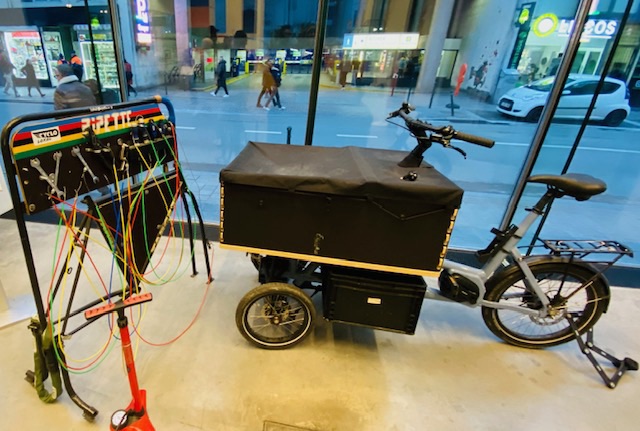
Home Delivery of everything ! Working Conditions

Architecture Berlin

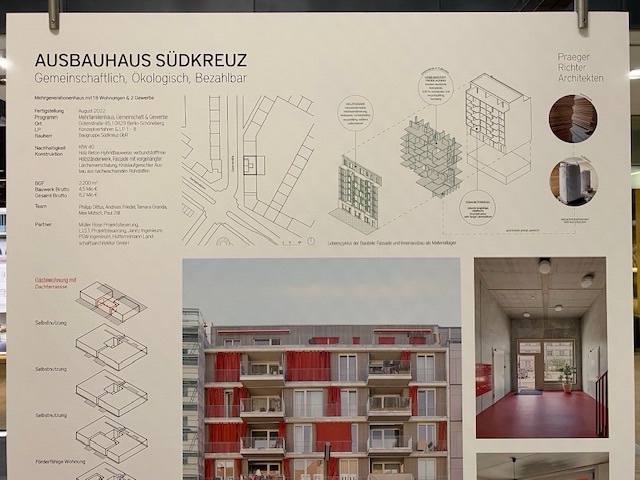
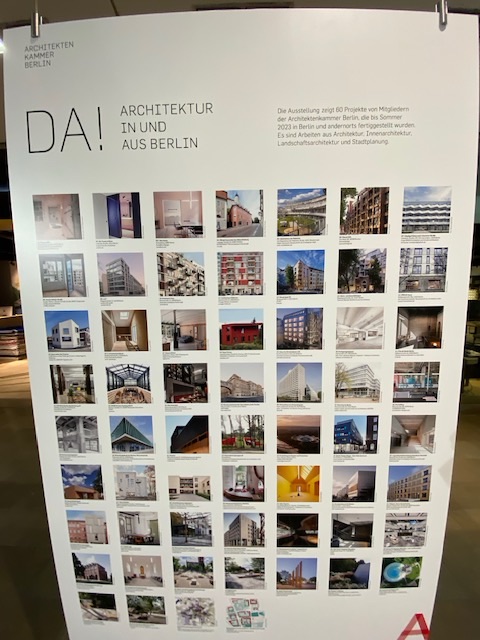
The annual exhibition of completed architecture projects in Berlin attracts people beyond the narrow circles of architects. You may take a walk through Berlin to view the actual realizations in 3D or 4D with people living, working or moving in these buildings. As social scientists we like talking or interviewing these people about their experiences. Urban planning and participation in urban development is important for city development in a democratic fashion. The combination of social, ecological, economic and technological concerns find compromises in urban renewal. The range of activities is remarkable. Living spaces have the most entries in the exhibition followed by offices and trade spaces. Education as well as public open spaces raise a lot of interest and funding currently. Climate change and adaptation to limited ecological resources ask for innovative solutions as well. Most projects in Berlin or by Berlin based architects deliver in this respect. The socio-ecological change needs a lot of actors to implement such changes and meet unprecedented challenges. The 60 projects represented for 2023 are the top of the iceberg but a lot remains to be accomplished in repairing old buildings and infrastructure as well. The DA! exhibition provides a democratic transparency of projects, which allows the public to learn about innovation and to make more informed judgments about what architecture can deliver for society.

DA! Exhibition Berlin 2024

Cinema D

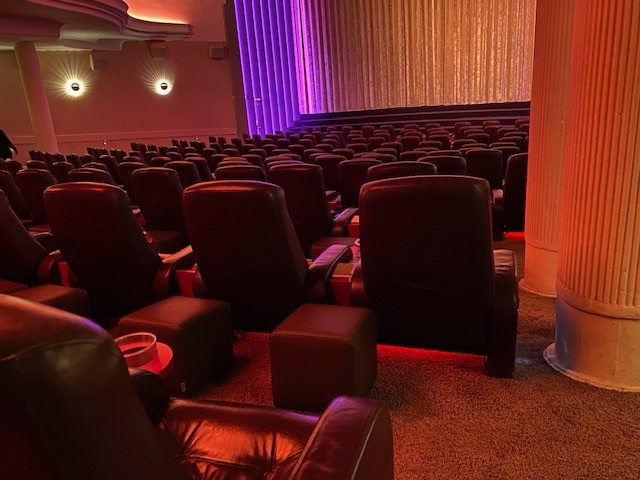
In terms of statistics cinemas are almost back to the pre Covid levels of spectators. The sector is worth in Germany close to 1 billion € in 2023. The price level has risen as well but many cinemas have upgraded their cinema experience as well in terms of comfort, audio and visual quality. Traditional houses provide chairs that compare well with home comfort and for a little more you can put up your feet as well after a long workday. Drinks and food may be served directly at your seats so the time to relax is guaranteed. However, this depends a lot on what type of movie you have chosen. The movie industry has adapted to modern technology and comfort. The turnover of a movie theatre is supported a lot by the consumption of beverages on site and they make huge efforts to prolong the visit beyond the screening of the movie. The competition for the time and money of the consumer is intense. The quality of the whole experience will determine the survival of the cinema. It is worth much more than a second best solution for rainy days or the cold season.

Fertility Growth

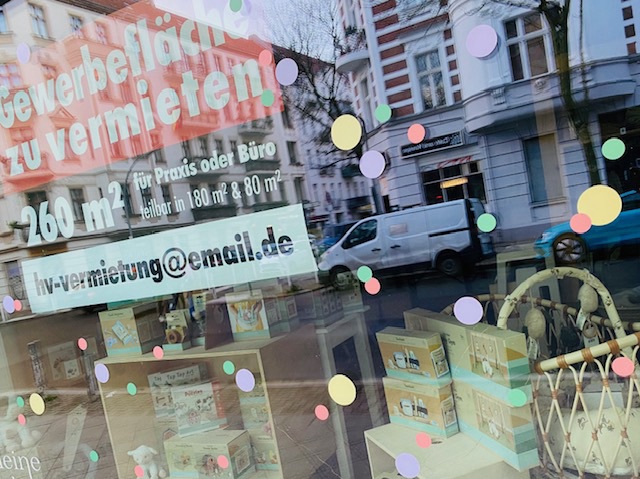
The first association of fertility and growth is likely the growing of fertility rates in a country or region. Only macro economists associate the growth or decline of fertility with the macroeconomic consequences of more or less economic growth. Countries with higher fertility rates in most cases have higher growth rates as parents spend more on food, clothes, mobility and education. Accommodations are changed, adapted and refurbished. Estimates of increased consumption per child by economists range from 500.000 to almost 1 million in the highest developed countries. Children are a country’s wealth, but they also cost a fortune in monetary terms. Good news for the economy if families keep spending independent of economic cycles. More children keeps dedicated shops running or even a whole sector of the economy. In recessions the downward pressure in this sector becomes an additional challenge not only for the families but with ripples-on effects for the whole economy and society. If you see shops closing which has sold furniture for children for the last 15 years then the realization of an economic downturn becomes also more real. Sometimes the parallels in the news of declining fertility and increases in pensions do not square well with the fitness for the future or the future orientation of a society. Democratic voting rights that give families more weight in elections could change this. It is not yet on the political agenda.

L’Albatros

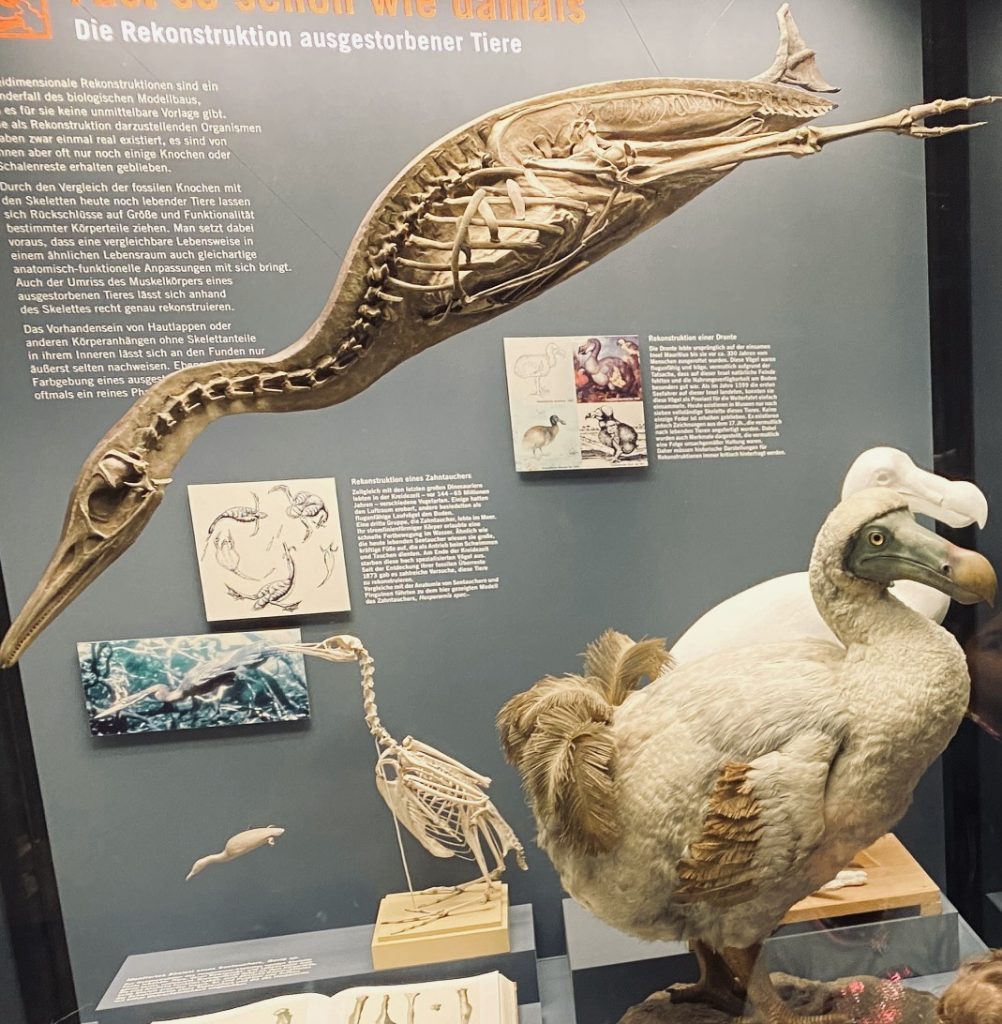
Charles Baudelaire has immortalized the albatross in his poem entitled “L’Albatros”. For me it appears like a poem about the beauty of the sea and sea life. The marvelous creatures that populate the sea and its surroundings sometimes seem strange to us. The albatross with its large wings unable to move properly on earth is one of these special animals. They are threatened by human beings in their very survival up to extinction even. A dedicated website to “Les fleurs du mal” with multiple English translations of the same poem may give us the impression that all those who translated the poem wanted to feel this little moment of sublimation like a poet just forgetting for a little while the weight of our earthly existence. The gospel tells us a similar story of life up in the air. It must be so much better to be free and not to be bound to restrictions of gravity. As gods would prefer to stay away from earth just somewhere up in space. The albatross and the sea keep teaching us lessons beyond their physical appearance. (Image bird “dodo” now extinct, model in Berlin Natural History Museum 2024)