Silence revisited

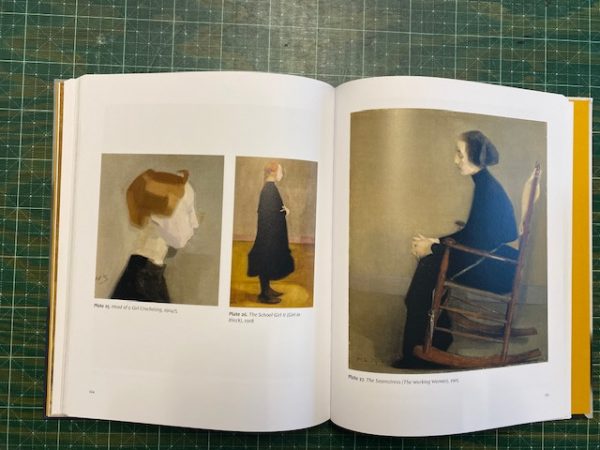
In most cultures, particularly western ones, we are less and less used to silence. Keeping silent for 1 hour is almost framed as an exercise of meditation. In the presence of other persons silence is often misinterpreted as not being interested or even intelligent enough to contribute to the conversation or discussion. Therefore, the title of the exhibition “Seeing silence”, which rediscovers and honors the paintings of Helen Schjerfbeck. Her Finish, Swedish speaking roots, with a broad European training in the arts, made her an accomplished painter in the impressionist’s tradition with a focus on painting portraits. The catalog from the exhibition (THE MET 2025) gives a great overview of her paintings when silence of her models tell stories. Portraits of women are particularly powerful examples of tranquility, and reading, but also uneasy silence in rocking chairs. The biographical sketch of Helen Schjerfbeck by Dita Amory sums up the vocation as “All I desire to do is paint” (p. 15). Towards the end of the 19th century and the 1st half of the 20th century this meant work in silence and she chose to work on silence as well.  (Image: catalog in library Brussels 2026-2) 
Bulimia Capitalism

Each time a wave and speculative bubble in the economy is building up or even bursting there are thousands of people who become drawn into chaos. Let us quickly review: Oil bubbles in the 70s, financial crisis and  subprime lending in housing markets, 1st internet bubble and the year 2000 bugs, AI excesses in 2025. These boom and bust cycles resemble the medical and psychological patterns of a bulimia nervosa. The overly optimistic outlook for AI companies’ future profits and shifts in the size of office space needed for companies announce bulimic behavior when at the same time vomiting by the same companies occurs with regard to investments in nuclear energy plants even in the sites like Fukushima in Japan or Three Mile Island in the USA. Bulimia Capitalism seems to be eating its own children. The upcoming year 2026 will be full of revelations in this respect. (Image: collection of about a hundred barbies exposed on a flea market in Brussels on 5 levels).

Surrealism Networks

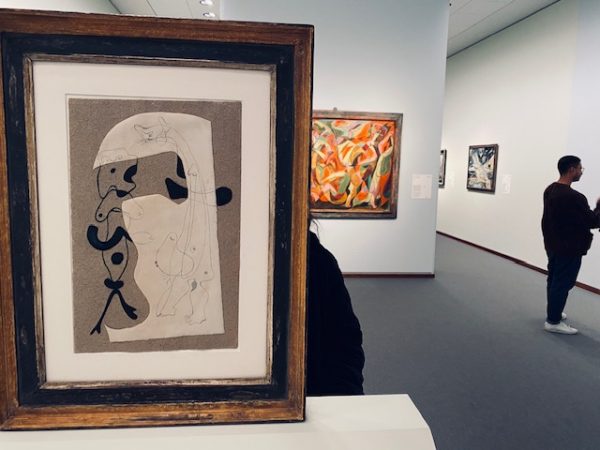
The research project on the networks of artists in the group of surrealism ranges from the male proponents Breton, Ernst, Magritte, Miró to female painters like Lenora Carrington and Dorothea Tanning. The collection of Ulla und Heiner Pietzsch, donated to the Neue Nationalgalerie in Berlin, excels not only in the depth and breadth of the collection of surrealism, but also in the way it contributes to our understanding of artistic movements and network dynamics. For those familiar with the theoretical and literary underpinnings of surrealism by André Breton, the collection allows to follow the traces of ideas into artworks. Interdependent inspiration in multiple ways becomes visible in this exceptional exhibition. The special concern and concept to honor provenance of the artworks makes the trajectories of each artwork explicit. Thereby, the geographic dimension, importance of collectors, galleries and personal relationships to gallerists become tangible. Additionally, the seizure of the 2WW heightened the need to have contacts to survive Nazi-terror. You find it all condensed into just one room at the Neue Nationalgalerie Berlin thanks also go to the Zentralarchiv to facilitate and participate in the research and documentation. (Image: Miró Collage, Berlin Neue Nationalgalerie 2025)

Polyartist Colette

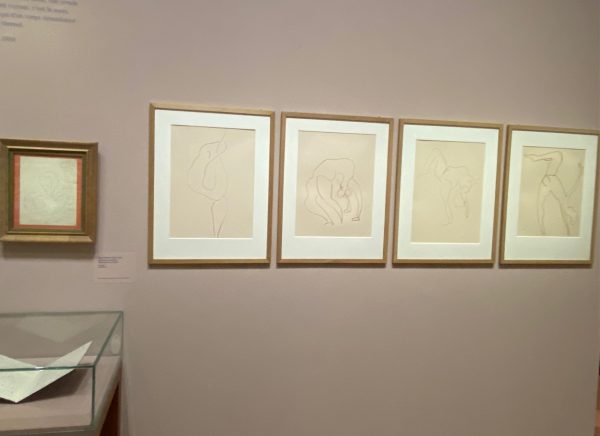
It is a complex task to do justice to a polyartist like Colette. The curators of the exhibition “Les mondes de Colette” (BNF 2025) Bouvard, Dimerman, Le Bras do a great job to present the biography of Colette, the writer, journalist, dancer in music halls, model (for Matisse) and entrepreneur in all facets of her activities. The role model of an emancipated women as early as the 1910s, 1920s and 1930s. The struggle of women artists in the early years of the 20th century to make a living from art is well documented already. To make a living of writing has always been a challenge if you do cherish your independence and liberty of expression. Versatility in artistic production is one escape route. Colette made a strength of this in diving into different forms of art and professional activities close to the artistic and creative world. In a quite unique way, she became her own muse for her own artistic work; and a character and inspiration exploring many facets of live. The economic misfortune experienced her parents became a source and force of inspiration.
Contrary to the expectations of the market of arts and literature, she did not feel like sticking to just one activity. Her most lasting achievements, probably, were her literary accomplishments for most people, although Matisse immortalized her in his specific style of abstraction.
Polyartists just like Polymaths, make more comprehensive contributions to our experiences.
(Image:Lithographie by Henri Matisse of Colette, exhibition Colette at BNF 2025).

Satie Popular

Erik Satie has been quite involved with the surrealist and Dada movement of his time. He personally knew the main proponents ranging from Breton to Magritte. He became one of the major figures applying the ideas of surrealism to music. His early compositions like the Gnossienne (extract of Nr. 1 below) are admired for their simplicity. They became popular only years later and have entered popular music repertoire through many retakes of the original tune in various styles ranging from jazz to rap. Many of Satie’s formative years he spent playing and performing popular music in the animated cafés, bars and shows of Montmartre in Paris. The making of a living based on music can be a challenge. Satie had to bear the full risk of a life in poverty at times to reserve sufficient time for his creative work.
He remained very much connected to the working class as his later membership of the Communist party after the Great War testifies. Composing for children and transmitting music to the next generation was equally close to his heart and mind, especially in his later years.
For him, popular music constituted a fountain of original tunes and a test with an intuitive audience rather than the academic circles. Maybe, with this attitude, he followed the footsteps of Flotow, Offenbach, Ravel and many others later on until pop music became the vastly dominant music in the late 20th and 21st centuries.

Tariffs Trade Deficits

US Tariffs target the US trade deficits across the globe. For a start on the topic it is helpful to take a look at the data. The US bureau of census publishes this time series regularly. Currently, you can compare monthly or annual data across countries from 1985 to 2025. The worsening of the trade balance is obvious just looking into some examples like trade with the EU, China, Japan, South Korea or Switzerland. we might calculate some rough indicators of trade deficits of the US with countries by the size of the country, which would make Switzerland look really bad relative to many much more populous countries. This probably explains why Switzerland is threatened by higher tariffs than the EU. However, this hints towards the “hidden” agenda of tariffs on countries. The major targets are multinational companies that produce in countries outside the US and particularly in those with low corporate taxes, like Ireland and Switzerland. Importing products from such countries worsened the US trade balance over decades.

Another factor to study more precisely is the sectoral pattern driving the trade deficits with countries. Exports in for example health-related products have soared due to Covid-19 pandemic starting in 2019. Where did the US buy face masks, ventilators, medicines and pharmaceuticals?  These countries will now also be penalized by higher tariffs. The tariffs topic is a complex interconnected business issue, which is not solved by blunt measures. The real danger is that with each month trust in US will erode further. For decades this has been an underestimated currency of international business. Eroding trust is likely to be the major fallout of the tariff and trade deficit nexus. It takes decades to build, but can be destroyed within a few days or weeks. (Image: Mont des arts Brussels February 2024, celebration of surrealism).


Shoa Memorial

In the neighborhood of the Paris City Town Hall you find the Mémorial de la Shoa. There is a constant flux of visitors and pupils with their teachers passing through the rooms. They all continue to be really moved by the shocking images and their efforts to try to understand the full extent of the Shoa and the terrible effects it had even on survivors of the concentration camps. The continuation of the memory of the memories of those survivors by young people is one of the strong points of this exhibition. The transmission of memories finds many new ambassadors against the tendency to forget or downplay the horrors committed by the Nazis. 

Of course it is overwhelming as an experience, but it all the more necessary to keep memories alive and guard against each tendency of denial. In the age of fake news and historical deep fakes, it will be all the more important to immunize people against any attempts of manipulation of historic truths. The availability of the information online and through youtube-videos is an indispensable next step in the preservation and dissemination of the documentaries. The Mémorial of the Shoa in Paris is an essential part of this commemoration as 76.000 Jewish persons were deported to concentration camps from France as well.(Image: Mémorial de la Shoa, Paris 2025)

Ukraine Poets

Difficult times have a long history in Ukraine. However, literature and poetry have flourished since the Ukrainian independence from the Soviet domination in 1991. Periods of hunger under Stalin, Nazi crimes in the 2nd World War, Tschernobyl radiation, Annexation of Crimea and now Russian war on Ukrainian territories, the endurance of hardship is part of Ukrainian culture and society. This has created a strength of resistance and resilience which is exemplary for all countries. The democratic countries stand firmly on Ukraine‘s side and support not only military defense efforts, but also artists and poets in such difficult times.
A collection of translated poems from Ukrainian into English has been published in 2027/2018, showing the horrors of the large scale war that was to come a few years later. In fact from the Ukrainian perspective the annexation of Crimea was the first war initiated by Russia although the Western world did not want to see this as a brutal aggression, which it was. The poems in the anthology are available online for everyone to read and understand that war changes personalities. Suddenly, dying of old age becomes a blessing as many young soldiers and people die on the battlefields (Died of Old Age, by Lyuba Yakimchuk translation by Anatoly Kudryavitsky) .
7 years after the translations where published the poems have kept their sorrow and the reminder for us to continue our support for Ukraine‘s fight for democracy, independence and freedom of speech and the arts. (Image: Front: from War Diaries, Brussels 2025, shown in Gallery of Katarzyna Napiorkowska).

Searching Beauty

The search for beauty is an endless story of humanity. We have searched for it almost everywhere. Depicting beauty is probably the oldest form of artistic endeavors. We have invented numerous ways to find and represent beauty in a rather restless manner. We tend to find it in other persons of the same or other gender. The challenge is to keep trying to see the beauty in persons when others don’t, or don’t admit to it. Andy Warhol made this search for beauty his primary aim in his life as well as for his artistic work. The “Neue Nationalgalerie” in Berlin presents the, at times controversial, perspectives on beauty through the eyes and artwork of this exceptional artist. Beauty is at times a holistic concept or a detail by detail, piece by piece approach. Being open to other visions and versions of beauty is the major thrust of Warhol’s work. There is so much beauty around we just have to bother to focus on it. If not satisfied design it yourself. Start with a tour of exhibitions and experience the endless scope of imagination through the eyes of artists. (Image from Warhol exhibition in Berlin 2024 Neue Nationalgalerie, series „Ladies and Gentlemen“ 1975)

1Person Nation

One single person can stand for a whole country. At least that’s what mass media have tried to make us believe. Whole countries or even empires have been associated with single personalities. Maybe for simplicity we start with Caesar, Cleopatra and the like. These personalities reach historic status through the literature that has reported on their achievements and fame. Mass media of today copy that strategy to create fame out of images. The American journal “Cineaste” has recently exemplified the making of an idol with the popular actor “Jean Gabin”, who happened to be the representative not only of French cinema, but the image of France across countries and even continents. Identification with an actor or the projected image of a person are common goals in politics as well. The actor Ronald Reagan became elected as president of the USA. Zelensky in Ukraine has followed a similar trajectory. The examples are manifold, but the underlying mechanism remain pretty similar. Before we had the concept of influencers, not influenza, popular spreading of messages is key. Only the technology changed. New ways to prepare a 1person nation have been added over time. Followers are the new political currency. Beware of signs “Follow Me”, even if it is the police asking you to do so. (Image: Deutsche Kinemathek Exhibition 2024)