Gas light

Even if it sounds crazy from today‘s perspective gas lights once were the symbol of progress. In the middle of the 19th century gas lights started to lighten and brighten the boulevards of major cities in Europe. The historic evolution of the various designs can still be followed in Berlin in the open space museum of gas light in the Tiergarten area near Zoologischer Garten. These gas lights were brighter than candles or petroleum lights and needed less maintenance. The CO2 footprint was no concern at that time and also safety concerns have been tolerated. Mechanical maintenance was relatively easy and sufficiently qualified personnel still abundant. All this has changed and the lamp posts powered by gas are mostly a part of industrial history now. The image below shows a fine example from Amsterdam. The solid construction shows nice ornaments on steel. The rounded shape remained quite unique.
Unfortunately, the accessibility of the museum has contributed to the loss of many nice examples of gas light designs. Many were destroyed during the football world cup in Berlin in 2006. Let’s hope the Tiergarten survives the Euro2024 better than the previous huge football events and Love parades. Serious precautions have been taken with quite solid fences to protect the inner city wild life.

Berlin Gas Light Museum

Broken Promises

In a library catalogue, the entry of « broken promises «  returns more than 3000 times that the title has been used. « Promises kept » is almost as popular. A rapid inspection of titles reveals that the former titles suggest more factual analyses, whereas the latter is frequently used in the form of an imperative in combination with “should be kept”. The book by Fritz Bartel “The Triumph of Boken Promises …” (2022) demonstrates the importance of the concept of broken promises in the social sciences. The rivalry between socialism, capitalism and the rise of neoliberalism is strongly influenced by the way they handle the breaking of promises made to their respective societies. The promises of increasing wealth and wellbeing have been part of all political regimes. To keep these promises is a completely different story. Especially since the first and second oil crises and many other kinds of crises, it has become much harder to keep these promises. Working hours, retirement ages or minimum wages are all at risk to no longer live up to the promises made in earlier periods. This has put welfare states under pressure that millions of voters perceive politics as a “game” of broken promises. Socialist political regimes like Russia are ready to use physical violence to shut up people that remind leaders of these broken promises. In democracies the ballot box is often used to sanction governments that do not live up to expectations of previous promises. A lot is about public infrastructure which is failing people. Migration, education, social and labor reforms are on top of the political agenda if it comes down to broken promises. The elections of the European Parliament gave many a chance to express their discontent about various broken promises. Maybe democracy is better in providing forms of letting off steam early and protracted protests rather than the Russian way to suppress any critical analysis, let alone opposition movements. Just like the move from industrial production to services as production models, with AI we are likely to see similar problems and probably also broken promises. The challenge is huge and promises should be made with an eye of what promises could be kept.

Public swimming pool closed for reconstruction 2024

Schostakowitsch Revival

Je mehr Putin sich unablässig in seinem Angriffskrieg gegen die Ukraine und gegen seine eigenen Leute versteift, umso mehr werden die musikalischen Werke von Dmitri Schostakowitsch aktuell. Schostakowitsch hatte viel unter Stalin zu leiden. Sein Werk konnte kaum Gefallen bei der stalinistischen Führung finden, aber dennoch haben voele der Russen seine Werke geliebt. Insbesondere die sogenannte „Leningrader“ Symphonie, die das Volk einte vor den Radioempfängern, selbst mitten im Krieg gegen Nazi-Deutschland. Die Berliner Symphoniker haben diesem Werk eine neuere Ehre erwiesen mit einer Aufführung in Berlin 2024-5. Das Interview dazu mit dem Dirigenten Yannick Nézet-Séguin wurde geführt von Matthew Hunter, Bratschist der Berliner Philharmoniker. Es beschreibt diese eindrückliche Auswahl hervorragend. Die Berliner Philharmoniker haben eine lange Tradition, Werke von Schostakowitsch aufzuführen und einzuspielen. Die Digital Concerthall hat eine umfangreiche Sammlung mit Werken von Schostakowitsch. Oftmals etwas schwere Kost, aber durch das Ausspielen des ganzen dynamischen Spektrums von pp bis ff nie langweilig. Eine kleine Filmmusik „Volksfest“ (Sylvesterkonzert 2022) ist leicht beschwingt oder gar etwas beschwipst. Der musikalische Nachwuchs hat die Tiefe der Werke erkannt und gewinnt international anerkannte Preise mit Vorträgen von Werken Schostakowitschs. So geschehen zum Beispiel beim „Concours de la Reine Elisabeth in Brüssel 2024-5. Der Ukrainer Dmytro Udovychenko würdigte Schostakowitschs Leben und Werk inklusive des Existenzkampfes und gleichzeitig seine Heimat die Ukraine mit dem Belgischen Nationalorchester mitten in Europa. 

Example Audio Playlist on Spotify or Videos on DCH

Puccini Media

In honor of Giacomo Puccini the Media enterprise Bertelsmann features one of its treasures. In cooperation with the “Archivio Storico Ricordi” of Milano, Italy, 100 years of Puccini’s oeuvre is celebrated with this exhibition. Fans of Puccini’s operas will have to visit the archives but the interest of this small exhibition lies in the impressive success story of Puccini and his publisher (part of Bertelsmann). Continuous innovation and adaptation to new media, like disks, accompanied an extraordinary marketing campaign throughout the 100 years. Even today there are cycling tours around Puccini’s hometown for the modern eco friendly tourists. We learn a lot about how the media industry functioned in the 20th century. It was absolutely vital to fighting for the rights of authors, composers and rights to receive royalties for performances as well as for the publishing on media. The exhibition in “Unter den Linden 1” is just next door to the Staatsoper which also gave honor to Puccini’s “Madame Butterfly” in 2024. His uncompleted Opera Turandot closes the exhibition with his rough sketches of the final scene. Merchandising is not an invention of the 21st century, but almost a century old tradition. This exhibition is a great testimony for this. It remains an important effort to allow authors and composers to gain a comfortable living during their lifetime. The gains for humanity as a whole are enormous.

Bertelsmann, Berlin 2024 Puccini.

Ne pas rire

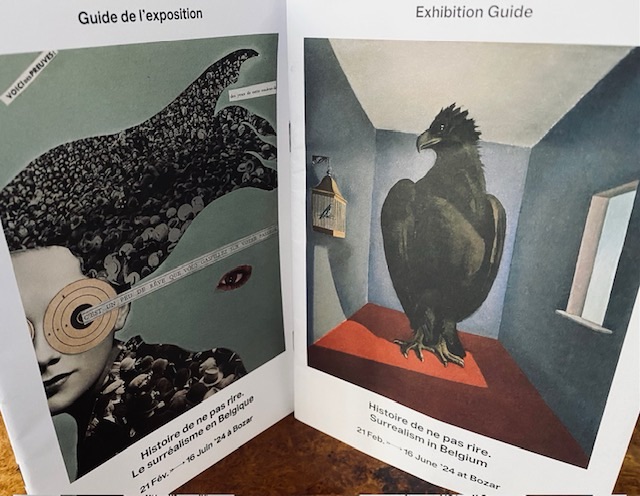
The exhibition of surrealism in Belgium at Bozar has the inviting title “Histoire de ne pas rire”. Even the booklet of the exhibition guide does not translate this into English assuming everybody has at least that much of interest in French and the willingness to learn about these 5 words that are a reference to the understanding of the surrealist art movement. You are explicitly invited to allow yourself to laugh when looking at the images. Reflection comes second. Caught by surprise and making new connections of seemingly unrelated images and words, that’s the essence of it. The comparison of the 2 versions of the exhibition guide teaches language and translations beyond the simple words. Sometimes it is best to not translate the text as in the title of the exhibition guide.

Folon Magritte

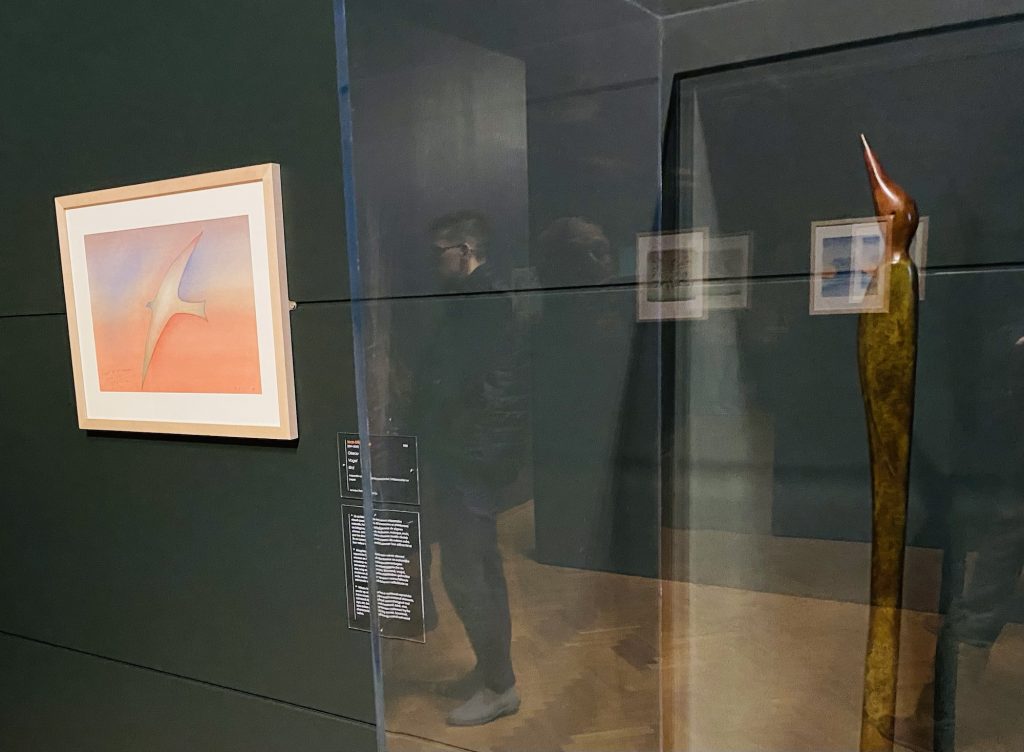
The exposition in Brussels on Folon and Magritte demonstrates the impact the latter had on the former artist. Both developed an iconic style of painting. Folon paintings apply pastel colors on paper. This style transforms images through the softened sometimes slightly blurred representations near a dream like realization. On the contrary in his sculptural work he uses hard materials to stimulate imagination and abstraction from reality. The side by side representations of Magritte and Folon is more a study in tracing influences and motifs across decades. The honor is just as much to Magritte as it is flattering Folon. Magritte had changed the life of Folon with his paintings and perspective on life beyond realism. Magritte‘s legacy lived on and Folon developed surrealism into a widely recognizable style with his paintings as well as sculptures. In walking around Brussels in 2024 you will inevitably come across some of the sculptures reflecting the work of Folon. The Folon foundation is continuing the pedagogical journey of the surrealist art movement well into today and tomorrow.

Folon Magritte Exposition Brussels MRBA 2024

Postmodernism

The grand narratives of the modern world, like modernism itself, are under serious criticism. Deconstruction of the modern way of thinking has become philosophical mainstream. Economics as a science is in the middle of the behavioural shift and changing or at least complementing its narratives. Sociology has embraced postmodern thinking in theoretical as well as empirical forms (Mirchandani, 2005). The empirical measurement focuses a lot on the groups and people who hold postmodern beliefs and values. The discussion in the social and literary sciences continue. In the arts reading on modernism and postmodernism is a must in order to understand much of contemporary art or art from the 19th and 20th century.
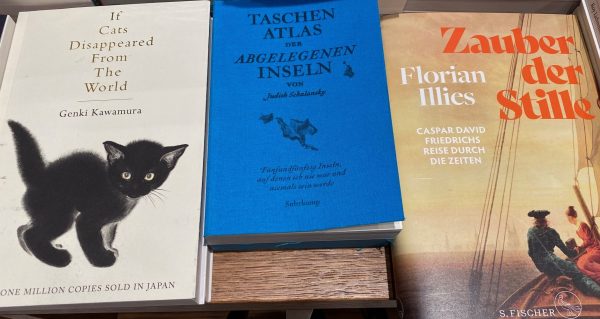
Bookstores in art galleries that cover long spells of history can make surprising links between historical periods of art. Books of postmodernism appear next to books on romanticism. A lot of the ideation of postmodernism rejoins romantic depiction about nature, re-naturalizing or the emotional connotations of wildlife, isolated places and stillness.
On the other hand, we are confronted with the brutal world of war, drugs and crime. Classical warfare and strategies are back in Europe with tanks and rockets killing like in previous wars. The Russian empire of a specific version of modernism strikes back as if it were to stop the postmodern turn of the 21st century. Neo-fascism tries to build on the losers of the transitions to the socio-ecological economy and society. There are manifold backlashes of modernism, but the postmodern world is under continuous construction, most of in our mindsets.

Zwang durch Terror

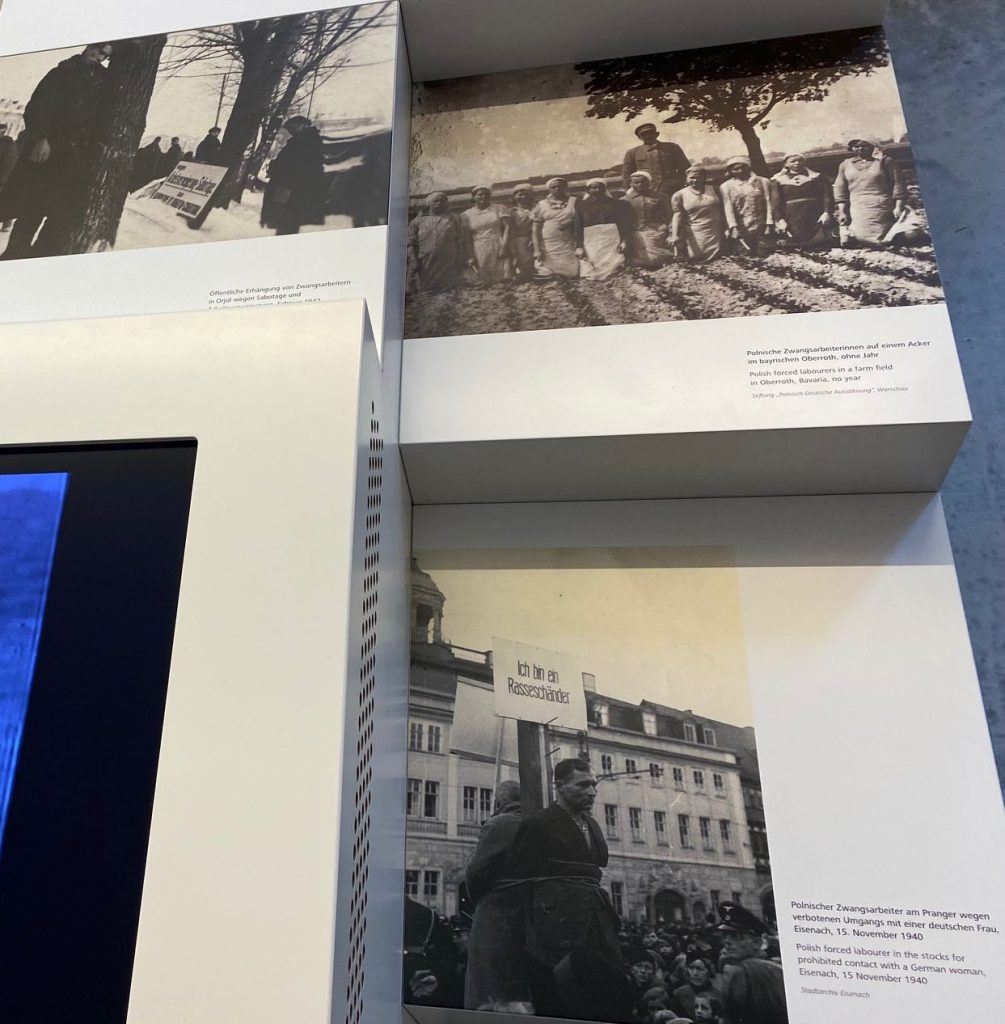
Durch den Terror der Willkürherrschaft mit rassistischer Doktrin wurde aus Zwangsarbeit eine lebensgefährliche Arbeit. Überzogene Sanktionen bei Diebstahl, Plünderung oder Sabotage wurden von den Nazis mit öffentlichen Hinrichtungen (Erhängen, Gruppenerschießung oder Guillotine) geahndet (siehe Katalog zur Ausstellung Alltag Zwangsarbeit S.44-45). Straflager und Verlegung in Konzentrationslager gehörten ebenfalls zur regelmäßigen Erfahrung.
Die Zwangslage der dort zur Arbeit gezwungenen Menschen ist kaum vorstellbar und fassbar in unserem System der Beschreibung von Arbeit. Totale Subordination kann vielleicht in Ansätzen verdeutlichen wie diese Situation auf die Personen gewirkt haben muss. Fluchtversuche waren fast ausgeschlossen. Selbst die Verbindung zu den meist deutschen Frauen in Fabriken war unter hohe Strafe gestellt und intime Verhältnisse (bezeichnet als Rassenschändung) wurden für beide Seiten lebensbedrohlich oder endeten für die Zwangsarbeiter oft tödlich. Der Terror in dieser Zeit bestand in der kontinuierlichen Gefahr und Angst tatsächlich oder vermeintlich eine Anklage zu erhalten, die unkontrollierbare, weil selbstherrliche, Strafen nach sich ziehen konnte.
Image: Ausstellung Alltag Zwangsarbeit 2024-1 in Dokumentationszentrum NS-Zwangsarbeit, Berlin Schöneweide. 

On Justice

Justice is a topic a bit like democracy. Most people deem it possible to simply state something is just or unjust, democratic or undemocratic, black or white. Rather than such a binary perspective it is often more helpful to take the pains to differentiate the many facets of each term and the complexity to categorize or to subsume a case under one or the other label.
Additionally, there is an evolutionary perspective on these topics. Individual cases evolve in form of trajectories. The binary view of justice or no justice might become more clear or more blurred. The exhibition of the “Topography of Terror” in Berlin offers a well established and documented view of the NS-terror during the years 1933-1945. The examples of horrific injustices throughout the exhibition are abundant. To perform justice is a much more difficult exercise and encounters lots of impediments.
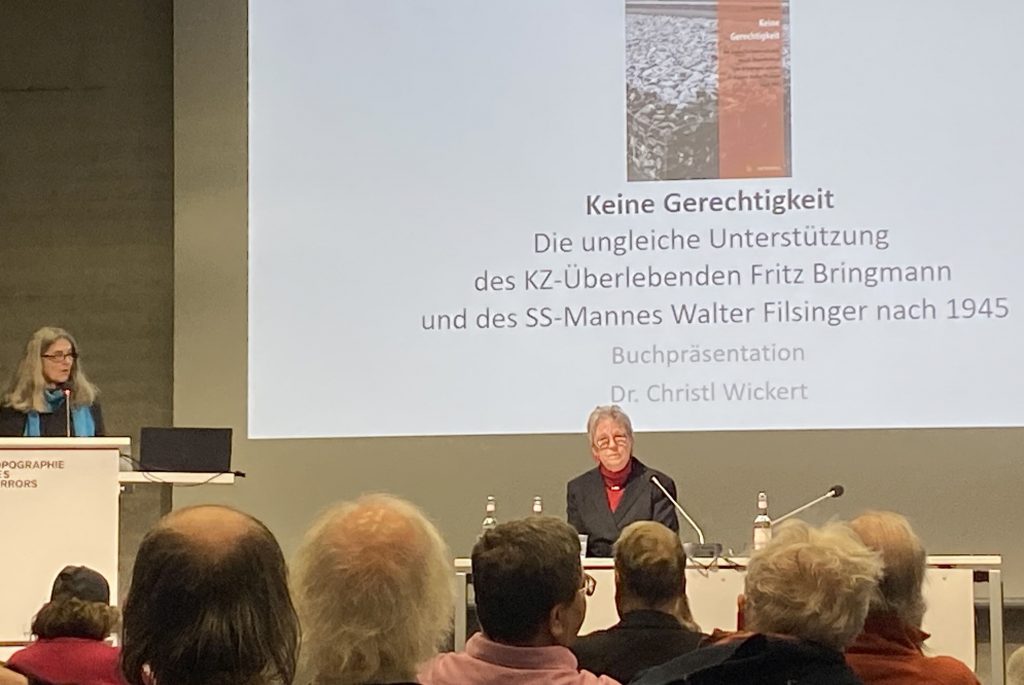
In January 2024 Christl Wickert presented her extensive research in archives which she published in the Metropol Verlag 2022 under the title “Keine Gerechtigkeit. Die ungleiche Unterstützung des KZ-Überlebenden Fritz Bringmann und des SS-Mannes Walter Filsinger nach 1945”. (engl. title and image below). Christl Wickert follows the life courses of the young Fritz Bringmann, prisoner in KZ Sachsenhausen and Neuengamme as of 17 years of age, and the life course of the SS member as of 17 years of age and SS soldier Walter Filsinger. Their life courses crossed at the concentration camp Neuengamme near Hamburg and perhaps later again in Hamburg Bergedorf. Whereas Fritz Bringmann had to struggle to get compensation for his injuries during imprisonment, Walter Filsinger managed through multiple manipulations of documents and dubious support from administrators as well as medical doctors to obtain war victim benefits.
From life course research we know that early disadvantages are hard to compensate throughout the following decades. This juxtaposition of 2 cases localised in the neighbourhood of Hamburg demonstrates this with full force. Injustice at the early stage of the life course is not compensated but rather magnified through the handling of each case through the proceedings of “administrative justice” in the institution building in the first few decades of the Federal Republic of Germany. The “thick description” as a scientific method is a lesson in unfolding as well as later on unravelling injustice.

Richter

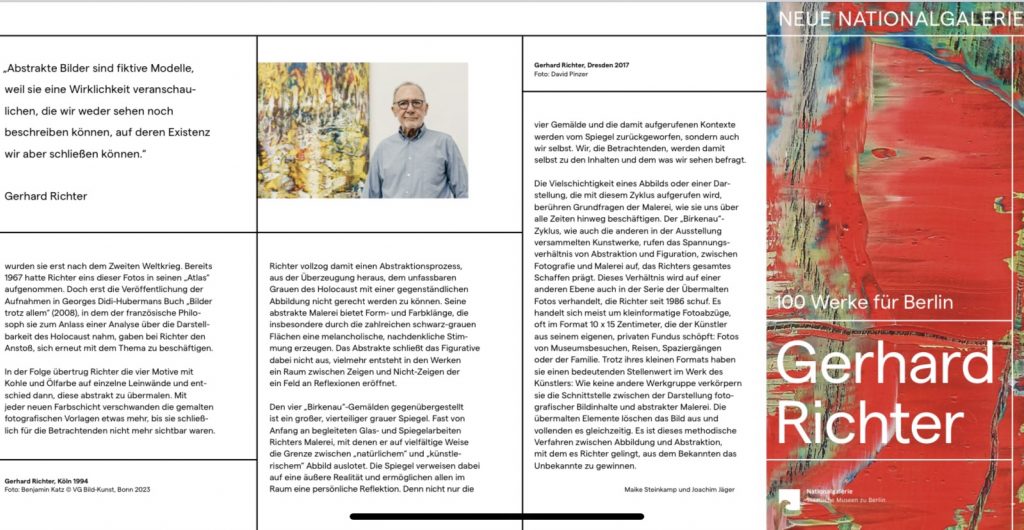
Gerhard Richter ist kein Richter. The painter Gerhard Richter is of cause not a judge. But somehow he is. In the representation of his 100 works for Berlin in the Neue Nationalgalerie he judges the horror beyond imagination of the Nazi concentration camps, reflects on the role of his own family in this and finds his own way to deal with it. Colors cover the black and white documentary fotos as if a new imaginary has to grow again to overcome the painful memories. He deals with the most difficult kind of confrontation with evil in an astonishing way. The horror as underlying fact remains present in our mind and at the same time we open up to light at the end of the tunnel and abundance of colors. Color is the way forward. Underneath, we tend to or like to forget about the many killing fields. Scratch a bit on the surface and you’ll find lots of unresolved issues again. All those fancy colors might just cover up the demons of the past and present. Maybe this is a grossly biased interpretation of his Auschwitz Buchenwald series of paintings, but only time will tell if we are successful in 2024+ to stem the tide of right wing extremism (again).

Neue Nationalgalerie Berlin 2024-1