Healing in museum

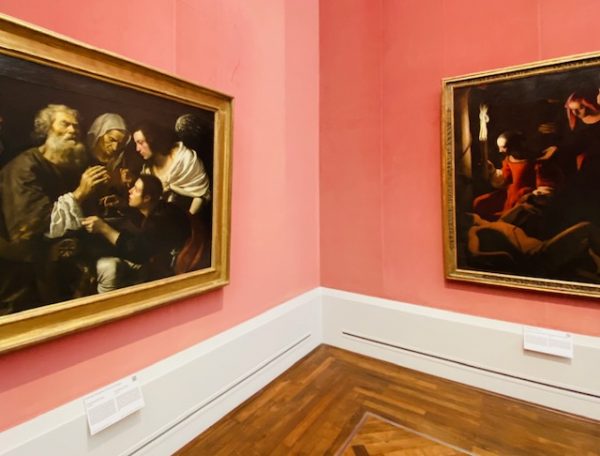
The topic of healing has a long tradition in museums. For example, in the Paintings Gallery (Gemäldegalerie) in Berlin “The healing of Tobit” (1630) by a follower of Caravaggio depicts the healing of eyesight with the aid of angel Raphael (extract of image below). The Bode museum also in Berlin in the vicinity of the Charité hospital proposed workshops to test or experience the healing through meditation techniques in the museum sitting on cushions while focusing on a statue for a while. Guided mindfulness workshops or own meditation sessions could be held during the visit. Museums can work as healing places to calm anxiety or release from stress.
Waste reduction

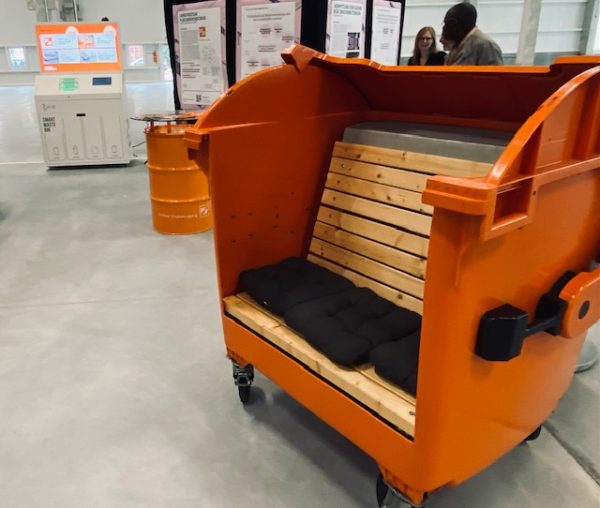
The challenge has been to reduce waste and emissions for decades without really reaching more advanced targets. In Berlin the local waste collection and treatment has presented new ideas how to proceed in future. Digital technology allows to identify the kind of waste (containing metals) and can separate waste accordingly. The digital waste container is, however, still a bit expensive and would have to undergo additional AI training in my opinion. The nice waste container transformed into a backyard bench might encourage people to think about an alternative use of the space reserved for waste containers and waste reduction, recycling and reuse in general. Taking a break is no wasted time.

Berlin moves it

Yes, we like to move it. Investment in infrastructure follows a long-term economic rationale. In urban areas space is a scarce and, therefore, an expensive resource. In order to use the current space for mobility more efficiently, the use of a longer tram or train is an effective way to increase capacities. Rather than to increase the frequency, which is no longer possible without safety risks, a longer vehicle allows to bring more, and more diverse, passengers on board (kinderwagen and wheelchairs included).
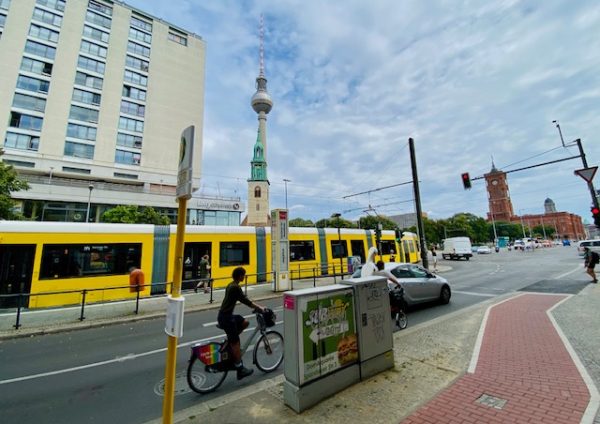
It is a long-term objective to make urban areas liveable for all ages. Tramways which allow a low or, better, no barrier to entry is a necessary condition in this respect. The new “Urbanliner” in Berlin (image below) offers such essentials of access and urban mobility. A single tram is 50m long with 88 seats and 215 standing persons in larger corridors. 300 tram passengers can be compared to about 12 average length cars with at best 15-20 passengers.
A consensus of “how best to move it” in cities pays off in the long-term. Planning has to start about a decade before delivery and needs to survive political cycles going back and forth.

Berlin Futures

The city of Berlin is projecting itself into the future. Two long-term goals, Olympic Games 2036 or an Expo organization 2035, are potentially looming and all actors have to project themselves as to what role they want to play in such processes. Trades and industries have an essential role to play to realize any vision of the future, at the same time, local trades and industries ask for amenable conditions to do business in the necessarily restricted city space.
There is competition between housing projects and business parks across each metropolitan area as any form of growth needs space to grow in. The “1. Berlin Future Day of business parks” highlighted this potential source of conflict and business leaders exchanged their experiences and strategies how to arrive at manageable comprises.
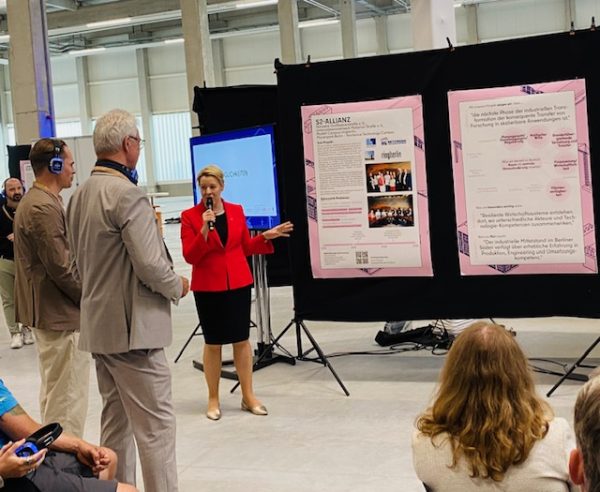
There are several Win-Win constellations in which for example an additional stop on a metropolitan “S-Bahn” line benefits the business area and all those (future) employees going to and back from work. Infrastructure like transport, mobility, energy, internet speed and security, all play key roles in such visions of future. If networks of organizations address policy makers with well-defined requirements, politicians can act as facilitators to ease sometimes lengthy bureaucratic impediments. The call for public infrastructure investments by private business initiatives is a reminder of the need for public-private partnerships to create promising Berlin Futures. (Image: 1. Future Day of Business areas in Berlin, Senator Franziska Giffey 2026-7-15)

Realist Democracy

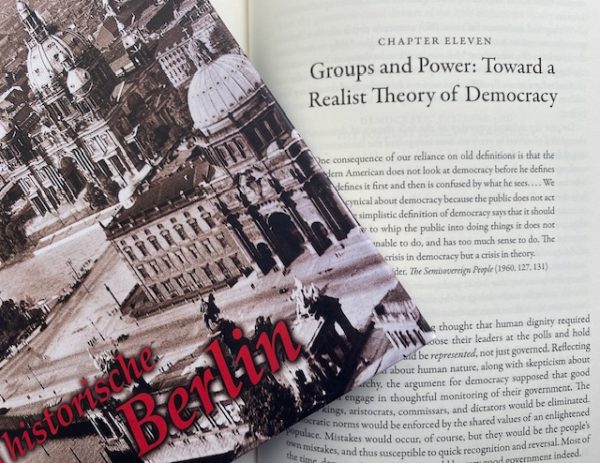
2000 years after the “invention” of and first attempts to develop a theory of democracy, we have come round to seriously think about “a realist theory of democracy” (Achen & Bartels, 2016). The ideals formulated in constitutions deviate sometimes substantially from the practice. Therefore, we have courts, (ideally) independent judiciaries, journalists and scientists. All these well-established safe-guards to ensure well-functioning democratic structures continue to be challenged. In each democratic country we can cite “derailing” of political leaders that try to bypass democratic institutions. The latest example in 2026 is the Mayor of Berlin Kai Wegner. He deceived, some claim he lied, repeatedly before his own party base refuted him as their representative when lies were uncovered. There have been several other politicians who have covered up his misinformation of the public about his handling of an urgency, which affected 100.000 people sitting without electricity during winter days. It took 6 months to uncover the truth about the handling of the crisis. However, eventually the truth and the lying to the media and the public became uncovered. The merit of this occurrence in Berlin is the hope that democratic ideals can be upheld even in rather hierarchic organizations and so-called head-fast leadership.

Cool shelters

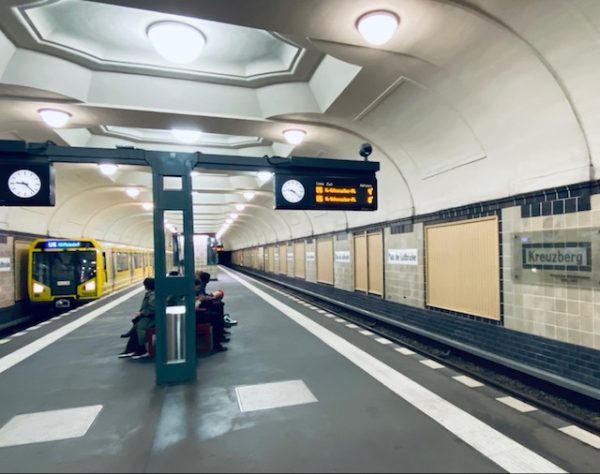
In many big cities the metro lines and particularly some of the stations can provide cool shelters during hot days. Reducing the speed of traffic reduces the airflow and heat of acceleration and braking. More home office work if employees have adequate cooling at home reduces emissions additionally. The historic Kreuzberg-Metro-Station, nowadays called “Platz der Luftbrücke” is big enough to accommodate many people who are in need of shelter for whatever purpose. Underground you do not even hear much from the busy traffic above. More efforts to brighten up the station could create an urban space which invites to rest in hot days rather than rush around the city. Climate change will ask us to come up with many innovative and unorthodox solutions as part of public health initiatives.

Hybrid art

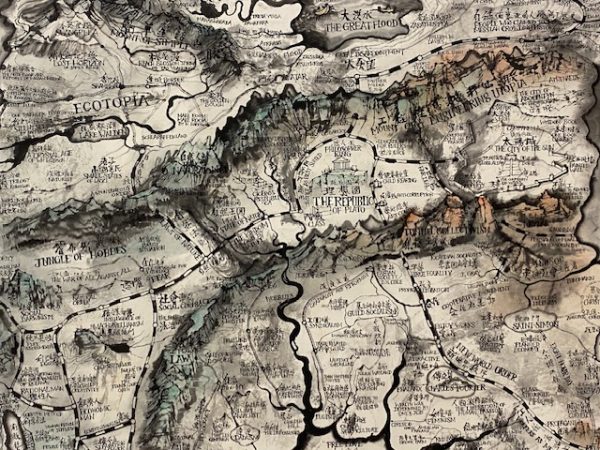
Bringing together 2 kinds of art makes hybrid art. Just as other fields of art have combined for example music with text to create the art form of songs as of the medieval ages, for example, the emancipation of another form of hybrid art is gaining prominence, text incorporated into or in cooperation with painting. The incorporation of text into paintings, sculptures or installations represents a drive to ise multiple channels of communication with an audience. Each might be sensitive to a specific word or sound, which creates an entry to gain attention or enlarge awareness for some cause. The “Palais Populaire” in Berlin displays the combination of the collection of the Deutsche Bank Art collection and the “Written Art Collection” to make this point with some forceful pieces of hybrid art focusing on text in art. (Image: Extract from “Map of utopia” by Qiu Zhijie, shown at “Seeing words, reading imagesSeeing words, reading images” at the Palais Populaire” in Berlin 2026-5). 

Latent social structure

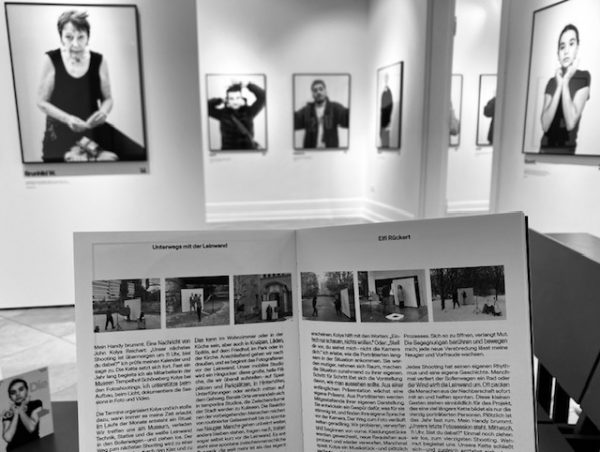
In empirical approaches to sociology we occasionally apply “latent variables analyses”. The aim is to uncover links between data that are not obvious in standard analyses of data. We are pretty convinced by evidence that age correlates with the probability of death. However, most tragedies are created around exceptional counter examples to this “rational expectation”. We also somehow have an intuition about the positive effect of social networks or the social fabric in a more general sense on living and survival. In some of those latent variable models we find evidence for an underlying factor without being able to properly name or frame it. Hence, as social scientists we continue to be interested in ways to make latent social structures more visible. With such an approach in mind I visited the exhibition by author and photographer “John Kolya Reichart” in the “Schöneberg Museum” entitled “Die Kette” (The Chain, 2026-5). The start of the chain is a familiar person in your neighborhood who leads you to the next person and so on. It is explicitly a non-random procedure, which complements proceedings of strictly random sample selection of survey methodologies. The sources for bias outcomes are multiple, however, an underlying or latent social fabric of a friendship and support mechanisms can be shown. Besides the b/w portraits and audios, giving a justification for the choice, the documentation of the process of production gives more insights into the risks and potentials of this form of insights into latent social structures.
(Image: Schoeneberg Museum, “Die Kette” by John Kolya Reichart)

Nothing changed

It reads like an entry into a personal diary. The poem “Darmstadt, 4. Januar” by Renate Schmidgall (2025, p. 24) reflects on the obsession with change. The sky shows traces of airplanes, which have passed some time ago. Trees age slowly, a pigeon sets off. “Nichts ist anders als gestern,” (Nothing is different from yesterday, then suddenly a poem finds again its space in me, …). Nothing changed, and yet, suddenly, all is different again. Motivation sets in and time appears rather short.
In “Donnerstag” (Thursday) Schmidgall (2026, p.30) notes a daily routine and the planning of today, even the day after tomorrow. Emptying her paper basket, she finds a quotation from Bruno Schulz she noted previously. “An allem schuld ist der schnelle Zerfall der Zeit.” (The fault of everything is the rapid dissolution of time).
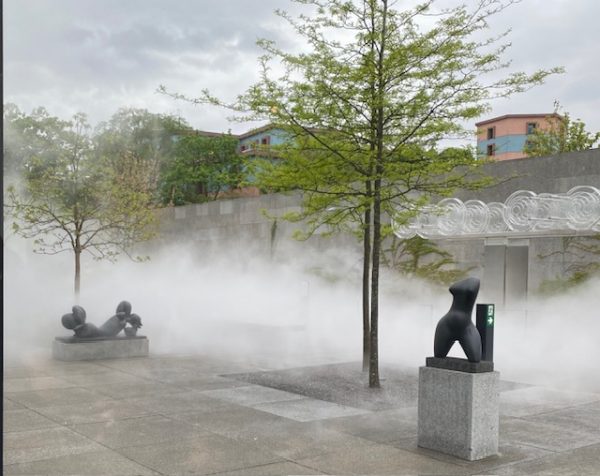
Time is portrait in these two poems as both a moment-specific personal experience as well as the short-cut description of a society-wide trend. Just, as if time was the driving force of change on both levels, even if we know it is not time in itself, but other forces are at work. “O tempora, o mores” as Cicero stated, appears to be still valid summary claim. (Image: Neue Nationalgalerie Front – WZB (Stirling architecture) in background, Fog installation in sculpture garden 2026-5).

Taking a break

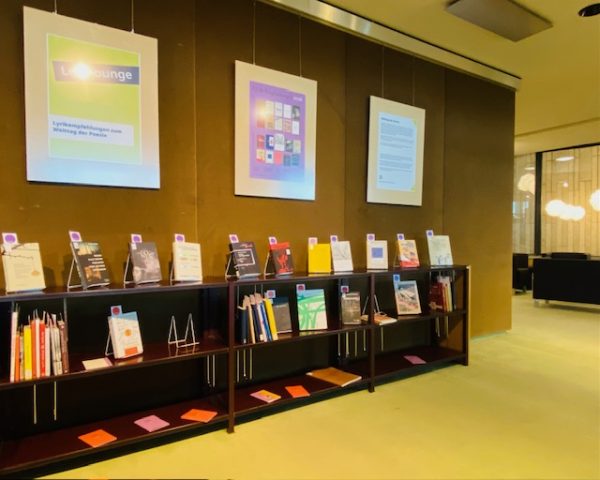
The time a researcher spends reading is still above average, I suppose. Even in times of AI doing astonishing summaries of documents and texts in general, we still need to check the output by reading as well. Taking a break from data compilation and writing, it’s time to do other reading. The Staatsbibliothek tries to lure people studying and researching there into their „Reading Lounge“. In 2026-5 the proposed reading is poetry. Based on the recommendations by an expert group 10 titles of German and 10 translations of poetry are available with direct access for onsite reading. The shift from on screen reading to paper based reading gives your eyesight a break. Your mind wonders off to something else. Much better concentration and new synapses afterwards. Why is still so difficult to take a break this way? We are working on it.