Citizen Services

In addition to public services there are many citizen initiatives that pick up common interests of citizens. These range from long-term infrastructure projects to daily care and provision in small neighborhoods. Such efforts build on volunteers and the organization of volunteering as an integral part of community life and services. To facilitate these organizational tasks online tools can make a real difference. However, the trust in specific tools beyond the general platforms known for their sketchy treatment of data privacy and protection is low. Therefore it is necessary to rely on trustworthy open source software to support local communities and networks of volunteers in their work and efforts. Secure e-tools for collaboration have an important role to play to reward volunteers with e-learning and being part of or even driver of new digital services. The software „wechange“ offers a platform with several tools for e-organization and communication small communities can set up themselves. Bottom up organizing in addition to the more top down public services complement each other. Going digital is the way forward in both domains.

Gov Tech

For many years we have believed that technology is something for experts and a special sector of the economy. Private sector companies have taken the lead and innovative applications of e-solutions or web-based applications have moved online to attract huge crowds. Some 20 years later, the scope to move public services online are on top of the agenda as well. Not only in security, defence, infrastructure management and health e-solutions are drivers of innovation and improve the reach out to persons in remote places, where it is hard to keep up equal provision of services otherwise. This is where “Gov Tech” comes into play. Government Technologies I would define as all technolgies that are needed to service your current citizens, past and future citizens as well as “want to be citizens”. This needs a whole of government approach, since there are many cross-cutting issues involved like cyber security and data protection.  “Gov Tech” is no longer just nice to have. It has become a “sine qua non” condition of government. The expectations of people have been shaped by private use and habituation to online access and amenities that government and public services have to follow suit in order to be perceived as similarly close and accessible for people. Besides the technological aspects of hardware and software solutions for gov tech there is the huge issue of taking people with you on that e-journey. Even social policies and social inequality are subject to the e-volution of gov tech. There is a potential to reach more people with the same number of administrators by use of new gov tech solutions. At the same time, the risks to loose people who choose to remain off-line or have no access to online services increases as well. Gov Tech poses multiple challenges as well as interesting solutions. Great to see many regions and states taking these issues very seriously.
(Image: SCCON, Berlin 2024-10).

Digital Zebra

It is a difficult task in all countries to bridge the digital divide in a society. On the one hand, there are so-called digital natives, those who have grown up with smartphones and notebooks all around them all the time. On the other hand, there are many persons who have not kept track of the digital turn and feel rather lost or are afraid of making mistakes using digital tools. As public services are also moving online, the need for a society-wide comprehensive mastering of digital information and tools have become a sheer necessity. It is much more than just nice to have.
As public services move online like registrations, payments or tax declarations, the need for training and/or assistance of millions of people in a country become a real challenge. This is where the innovative project “digital zebra” in Berlin comes into play. Through the network of public libraries you can get support in person to master your digital challenges.
The name of the project refers to the “zebra crossing” of a road, which assists persons to move from one side to the other side, just like crossing the digital divide. We shall need a lot of those guides and other multiplyers who can assist people to move safely online. Only through this form of taking people with you on the move towards online public services we shall close the gap of the digital divide. It is probably going to widen before we can narrow it again, unless we breeding digital zebras in a rapid way.
(Image: SCCON 2024-10, Berlin)

Digital Museum

Paris has lots of museums to visit. At times, this can lead to a kind of mental overload. The ” Musée Marmottan Monet, in Paris allows to take home a digital and printed copy of your preferred, your own curated collection of images from the museum. This is a great learning experience. You scan the number of the item you want to include and a specialized application retrieves the image of the painting or object from their database into the App. After the visit you take a break in the café in the garden and sort your collection and if you like have it printed within a couple of minutes after you paid for the print or digital version. Upon special request I was told that I am allowed to share the link to the small booklet even on the web (Link to pdf below).
Since the visit to the Musée Marmottan Monet we have come back to the digital and printed versions several times and reading of accompanying texts and perfect quotations of origin make learning about art a fun experience. Going back to lived experiences makes more lasting impressions on our memories. Knowledge coupled with emotions is a powerful way to memorize. Sharing the experience with other persons like the readers of this blog is an additional advantage. Attentive readers of the blog entries will find references to many of the themes dealt with over the years in this series of blog entries. Such topics are: gender and art, technology and society, reflections on time, life courses, inequality, art history, funding of artists, lifelong learning or beauty.
(Booklet below in German LINK-pdf of 6MB.  The app allows many language versions. You can produce those yourself from you collection within the App) 

Page Turner

Modern digital technologies turn pages for you. Just with one touch.
Search functions that are implemented in the software allow you to search for any keyword you are keen to follow-up on. These are valuable advantages of digital versions of books or other content. Once you adapt the brightness of the screen you can scroll comfortably through hundreds of pages. These books are called flipbooks and there are a number of editors specialised on these versions.
In combination with a blog format of publishing online first and then transforming content into flipbooks or even printed versions, www.MPL-publisher.com  offers a nice feature to host such flipbooks. It is comfortable to know that the content has a unique address on the web, which you can share freely and use from all sorts of devices including your smartphone, tablet, desktop or notebook. The collection of my images I even watch sometimes on an even larger TV-screen or a beamer for teaching purposes.
Yes, we can (!) teach from a smartphone. Learners have opted for the small screens a long time ago. -“hey – teachers, leave us kids alone. We don’t need no education, we don’t need no thought control“. Flipbooks combine the classic form and feeling to turn a page as accomplished progress with the fast access to keywords that spread over several pages of the book.
My latest version of blog entries from 1st of January to 30th of June 2024 is at your fingertip now. (here, allow for a really long download time!). A screenshot is provided below of page 114 of a total of 390 (OMG) on a notebook screen. The search list is shown for the keyword “wage” as an example.
A shorter reader on “Society and AI” is available here as flipbook (29 pages).

Library Search

Libraries have not only lots of books on shelves and in storage places, but scientific research makes use of lots of scientific journals as well. The direct access to these journals shortens the search for information. We tend to focus on certain sets of journals, which we follow regularly as well as some random choices. Libraries like the Staatsbibliothek in Berlin have the advantage of access to multiple scientific disciplines under the same roof. This facilitates cross-disciplinary research with access to the best available knowledge. This resembles university libraries where also a broad spectrum of disciplines is taught.

Moving from paper-based publishing to electronic publishing, it is obvious that libraries are part of this move. Printed journals disappear and the electronic versions are made available to the readers. 2 issues arise: (1) adapt your search strategy to e-search and reading on screens and (2) accept that your research leaves traces (and potential tracking of your activities) of what information is really used. User statistics are likely to have consequences in the medium term. All libraries want to know who are my readers and what kind of search strategies do they apply. Similar to some of the best scientific results that are an outcome of by chance findings the search in libraries is enriched through „random effects“ of search. On-shelf access to printed copies allows a rapid overview of a whole year of issues beyond the abstracts always available online anyway. It is so much faster than the online search that we shall miss the paper-based issues of journals for quite some time. At the time of artificial intelligence everywhere reading and writing might be overvalued as economists might say. Our search algorithms and use of libraries is evolving at the same time. The by-chance or random inspiration might move to other places.

library shelf with empty journals‘ stock

Digital Estonia

The progress of Estonia in going digital is quite advanced. The electronic identity card which allows data to be linked to health data and accounts or banking gives an impression of how far-reaching digitalization may go. Great steps have been taken to guide the population on the way to move towards the digital (only) world. Learning and coaching of a huge amount need to take place so that people do not abandon or get lost on the path towards “everything digital”. For the so-called digital natives, who have grown up with the sound of their smartphone at the bedside all the time, this move feels “natural”. Some experienced or silver workers got on track, if they were accompanied in suitable forms. The 65+ population might find it harder to adapt to the permanent use of digital devices for not only getting around in your city, but also to do your tax declaration, pay your dues and vote in elections.
Digitalization is not a goal in itself. It has advantages to reach communities in remote places or islands, but it might alienate older persons that have no other person around to assist them in the digital only world. An easy way to get some social science data to inform the debate is to refer to Eurostat and the surveys with information about the “overall life satisfaction” of people (EU-SILC). Checking for some major countries of the EU and neighbours of Estonia with less digitalization the differences are rather small. In terms of overall life satisfaction (16+ years old) Estonia has been catching up to the EU-average mainly between 2013 and 2021. Since then, stagnation at the EU-average is what the data tell. A quick testing of the hypothesis that the older persons (65+) might not see the past evolution as rosy is reflected in the EU-data as well. Good pensions seem to drive the “happiness” of older persons in the EU more than good digitalization. Eventually the two features of a society will have to go hand in hand to improve life satisfaction to higher levels. (Image: Data Eurostat EU-SILC Life satisfaction 65+, selected countries 2013-2023, retrieved on 2024-4-23, comparison with table all ages here, Data source)

AI Reader

In the middle of the hype around AI it is useful to take stock of the reflection and evolution of AI. In my own analyses and writings on AI it evident that a narrowing of focus has taken place. Whereas before 2022 the writing dealt more with digital technologies in general. The links to the literature on the social construction of technologies was obvious. Algorithms and AI was a part of the broader topic of society and technology.
This has changed. The public debate is focused on “everything AI now”. We look at technological developments largely through the lens of AI now. Hence, my focus of assessments of technology from a societal perspective follows this trend. In a collection of blog entries on AI we try to demonstrate the far reaching changes that have started to have an impact on us. In the last few months the all encompassing concern about AI’s effect on us needs full attention of social scientists, policy makers, companies and the public at large. We can no longer leave this topic to the software engineers alone. By the way, they themselves ask us to get involved and take the latest advances in AI more seriously.
As a “flipbook” the online reading is rather comfortable (Link to flipbook publisher MPL). The pdf or epub files of the blog entries allow to directly follow the links to sources in webpages or other publications (AI and Society 2p 2024-4-18). The cycles of analyses and comments have become faster. Traditional book writing suffers from time lags that risk to make pubications outdated rather quickly. Dynamic ebook writing might bridge the gap between time to reflect and speed to publish or inform the wider public. The first update as .pdf-file is available here: AI and Society(2).

AI by AI

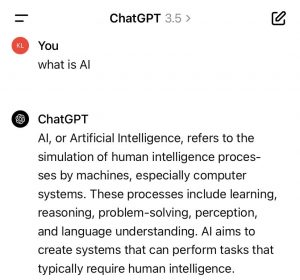
It has become a common starting point to use electronic devices and online encyclopedias to search for definitions. Let us just do this for artificial intelligence. The open platform of Wikipedia returns on the query of “artificial intelligence” the following statement as a definition: “AI … is intelligence exhibited by machines, particularly computer systems …“. It is not like human intelligence, but tries to emulate it or even tries to improve on it. Part of any definition is also the range of applications of it in a broad range of scientific fields, economic sectors or public and private spheres of life. This shows the enormous scope of applications that keeps rapidly growing with the ease of access to software and applications of AI.
How does AI define itself? How is AI defined by AI? Putting the question to ChatGPT 3.5 in April 2024 I got the following fast return. (See image). ChatGPT provides a more careful definition as the “crowd” or networked intelligence of Wikipedia. AI only “refers to the simulation” of HI processes by machines”. Examples of such HI processes include the solving of problems and understanding of language. In doing this AI creates systems and performs tasks that usually or until now required HI. There seems to be a technological openness embedded in the definition of AI by AI that is not bound to legal restrictions of its use. The learning systems approach might or might not allow to respect the restrictions set to the systems by HI. Or, do such systems also learn how to circumvent the restrictions set by HI systems to limit AI systems? For the time being we test the boundaries of such systems in multiple fields of application from autonomous driving systems, video surveillance, marketing tools or public services. Potentials as well as risks will be defined in more detail in this process of technological development. Society has to accompany this process with high priority since fundamental human rights are at issue. Potentials for assistance of humans are equally large. The balance will be crucial.

AI Collusion

In most applications of AI there is one system of AI, for example a specialized service, that performs in isolation from other services. More powerful systems, however, allow for the combination of AI services. This may be useful in case of integrating services focusing on specialized sensors to gain a more complete impression of the performance of a system. As soon as two and more AI systems become integrated the risk of unwanted or illegal collusion may occur.
Collusion is defined in the realm of economic theory as the secret, undocumented, often illegal, restriction of competition originating from at least two otherwise rival competitors. In the realm of AI collusion has been defined by Motwani et al. (2024) as “teams of communicating generative AI agents solve joint tasks”. The cooperation of agents as well as the sharing of of previously exclusive information increase the risks of violation of rights of privacy or security. The AI related risks consist also in the dilution of responsibility. It becomes more difficult to identify the origin of fraudulent use of data like personal information or contacts. Just imagine using Alexa and Siri talking to each other to develop another integrated service as a simplified example.
The use of steganography techniques, i.e. the secret embedding of code into an AI system or image distribution, can protect authorship as well as open doors for fraudulent applications. The collusion of AI systems will blur legal borders and create multiple new issues to resolve in the construction and implementation of AI agents. New issues of trust in technologies will arise if no common standards and regulations will be defined. We seem to be just at the entry of the new brave world or 1984 in 2024.
(Image: KI MS-Copilot: Three smartphones in form of different robots stand upright on a desk in a circle. Each displays text on a computer image.)