Considerations about Space

As is true for most architects, for example Le Corbusier, they are mostly remembered for their actual realizations (Scharoun, Mies van der Rohe), rather than the grand designs prepared for an architecture competition. Henri Gaudin has not only left concrete implementations of his ideas, but also several books on his perception and ideas about “concepts of space” (“Considérations  sur l’espace”), which comprises architectural ideas about “empty spaces“. Additional sources of inspiration were a relentless pursuit of drawing and designing what he saw, for example while travelling.  The BNF has received the extraordinary donation of the journals of Henri Gaudin, which allow to trace his continuous search for innovative representations of what creates a space, the impression of space and the relationship between spaces.
His travels with the TGV in France filled a complete “carnet” (booklet). Architecture is surely not about concrete. In the best cases there is a lot of research happening “backstage”, sometimes in small spontaneous sketches that can have a very lasting impact on many people’s perception of space later on. His own landscape drawings were an interesting inspiration for his architectural work as well. “Image: Landscape drawings by Henri Gaudin, BNF Paris 2026-6, Galérie des Donateurs).

Electricity generation

On a global scale, electricity generation based on wind and solar has been growing quite fast since the year 2010-2024. Wind and solar have outpaced nuclear energy production as well as the stagnant sector of water based energy production. The Global Electricity Review by EMBER provides the statistical evidence for this evolution in 2025.
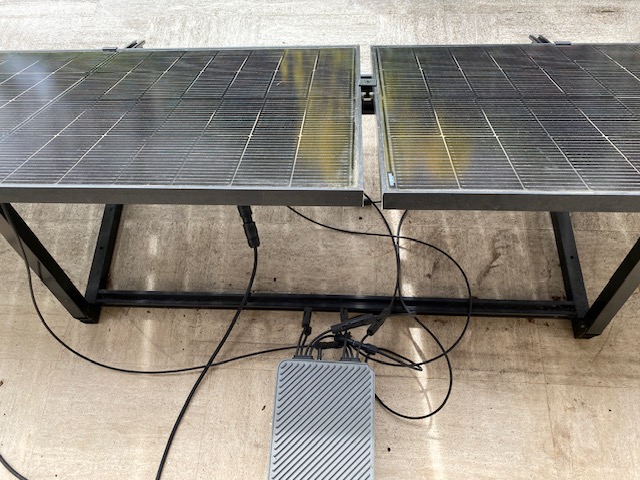
The interesting evolution arises mainly because countries with a lower level of GDP have invested heavily in solar and wind energy as this form of decentralized energy production does not need heavy investments in network infrastructure. Countries with larger population growth can keep up with electricity generation according to local needs. Local production and consumption become a key in strategies of local development. The finding that households in low-income countries use on average only 1 kWh per day is an amount that 2 small solar panels can already cater for (example image below).
Countries next to the equator have relatively constant days of 12 hours daylight across a whole year. The feasibility of no-carbon sustainable energy production is driving global growth in this sector.

Pervasive waste

From time to time waste from so-called highly developed countries is making headlines and then it is forgotten again. Huge amounts of plastic waste gets shipped for example from the USA to Malaysia in containers regularly (NYT 2025-7-1). The dumping of waste in other countries where it is cheaper to waste the waste is a cynical practice. Not only is the potential for reuse and a circular economy disregard, the little control that is exercised how the waste is treated afterwards is neglected. Some might just end up in our oceans later on or find its way in our food chains. The recent discovery of lots of nuclear waste at 5000 m depth in the sea in another extreme example of this practice to dump waste affecting all of is when profits have been accumulated inn the hands of a few enterprises and states. Such external effects as they are called in economic theory are part of the standard economic thinking. The challenge is to detect such behavior, persecute or better prevent it. This calls on countries who produce the waste to check for the contamination potential and treat their own waste. Fukushima has lots of barrels of nuclear waste waiting. The pervasive nature of this waste will make it last for thousands of years. “Beggar thy neighbor” with your waste is a major default of our current economic and social model. It remains an unresolved puzzle why mankind continues to work towards its own extinction. (Image: Le grisou, Constantin Meunier, MRBAB, Brussels). 

Warming continues

The global warming continues to change our landscapes. Heat waves, droughts and flooding become more often. Average temperatures keep rising. The evidence from meteorological data is showing this beyond doubt. Our forest take the toll and reports document the worsening situation for many trees (Germany and Switzerland). An adaptation will take years if not decades. In the region around Paris some home owners have started or been forced to adapt their gardens to the warming weather conditions. Trees that do not support the consequences of warming die and we witness the changing of the landscape. Palm trees near Paris have survive for years by now near Paris and can grow rather tall.
Like it or not, the visual landscape will change despite the many great initiatives launched by the city of Paris to stop the warming of the city.

Rainwater Use

The use of rainwater is fairly easy to realize. Most homes in Europe and beyond have a roof drainage system in place. However, for decades the only concern was to get rid of the water as soon as possible. Nowadays, we think twice about it. The recovery and storage of rainwater for a separate use in a household has become a substantial cost saving exercise. In the Paris region in France you can expect on average 650 liters of rainwater per year per square meter. For a roof size of, for example, 70 m2 this yields about 45.000 liters per year. If you take a shower using 40 liters this allows you and your household to take 1125 showers or 3 persons almost one shower every day. Average household consumption in Paris is 120L/day, which adds up to about 44.000 liters per year for washing and toilet use. On a monthly basis with a storage capacity of 4000 liters of rainwater per adult person you should be able to manage your own consumption with your own roof drainage system. It is a rather simple use case. Maybe during dry summer months the calculation is a bit too optimistic, but the potential for a water autonomy of households in Europe is an option. In addition to the dry January, the no mow May, we shall have the no shower July next. 

Warming consequences

The live of honey bees is rather busy and well organized. Global warming necessitates new risks and new opportunities for honey bees. The flowering season starts earlier in Europe and bees start earlier ro their collection of nectar and their service of pollination to other flowers. In early April 2025 in France near Paris we observe wild bees already in their daily routine. However, the risk of cold nights is still there, albeit those building their homes below the surface are a bit less at risk during a frosty night. Seeking a clever shelter is a good strategy for survival particularly at times of global warming. Some kinds of wild bees seem to sense this already changing homes from one season to next one. Humans remain their toughest enemies as they restrict their choices quite severely. Man-made pollution and herbicides are beyond bees’ control and cause havoc in the ecosystem of bees. Apiculture is an interesting science also for social scientists as this forerunner species of the matriarchy has evolved into a well-organized productive society. They are a bit harsh to each other and communication is rather unidirectional, but an interesting social cosmos of its own kind.

More eCooking

Cooking powered by electricity rather than fossil fuels like gas is an efficient and smart solution. Through the daily cooking activities over the course of a year the savings due to eCooking add up quite a bit. Even compared to an ordinary electric stove the eCooking by induction technology saves almost an additional 10+ percentage of energy as you heat the pot or pan directly rather than an in-between metallic element, which stores heat even after you have switched it off already for a while. In private kitchens the induction option is straightforward. In professional settings the change to induction eCooking needs careful planning. The health aspect of no burnt gas emissions in the kitchen is, however, a strong argument in favor of eCooking as well.
If we apply this logic to low-income countries and cooking in schools or other institutions as well as companies, the environmental and economic benefits add up quickly. In rural areas where no electricity grid is available or stable enough, the decentralized provision of electricity through for example solar energy creates a cost-effective alternative. In urban areas with high levels of various kinds of pollution the “clean” alternative could make a considerable difference as well.
The eCooking evidence is another pillar of the “all electric society” of the 21st century.
(Image: Rirkrit Tiravanija, untitled (Café Deutschland) and extract from “Freiheit kann man nicht simulieren“, Berlin Martin Gropius Bau, 2024-2025)

January Spring

The early signs of spring in Europe usually show up in March. The monthly data from the Copernicus Climate Change Service (C3S) show that „average temperature over European land for January 2025 was 1.80°C, 2.51°C above the 1991-2020 average for January,“ (Link). The warming throughout January has several consequences. Vegetation starts into spring earlier. This means that people with allergies of early flowering suffer earlier during a year. Winter rest in animal lives will be shorter. The risks of droughts in some regions combined with floods in other regions is increased as well. Rockslides in the Alps and flooding in Italy and the Baltic states add to the costs of climate change. 

Western Europe, witnessed a relatively „dry January“, even for those who kept drinking alcohol throughout the month. Heating and heating costs came down a bit and friends of gardening were surprised by some early showings of flowers of spring even in Paris neighborhoods (image below) as early as the first few days in February 2025! Strange new world. It all seems to happen a bit faster than most scientists expected. Time for adaptive behavior is shortened as well.

Sociolegal Circularity

At times legal systems feel like going round in circles. Legal procedures move from one stage to the next and they may get referred back to the previous instance to resolve a particular issue or restart the procedure. This has good reasons with the aim of “doing justice”. Sociolegal circularity, however, begins before the, right at the beginning and negotiation of legislation on which all legal systems are based in democracies, that is. Hence, the legal definition of waste, recycling as part of the circular economy and society is rather crucial.
Circularity is a complex sociolegal issue as the example of PFAS in plastics demonstrate. In economic theory the existence of externalities invites profit seeking of the kind like: “the sea in large part is owned by us all and there is no price attached to the (ab)use of it. Dumb PFAS into the sea, because the costs of cleaning up will be shared by all of us”. In order to limit the extent of this economic logic, we have to rely on sociolegal processes. The precise definition of property rights and liabilities beyond the PFAS issue have to be well-defined. It is an intergenerational topic as well, not only in view of deferred payments.
Parliaments have to be rather competent to look through all the complex issues of producing and recycling of materials to make sound provisions in law including future generations. Going round in circles in parliament is yet another element of necessary condition of circularity in a rather broad sense.
The air we breathe and the water we drink have become part of this “economic externality”, which is a very internal, inside of our body kind of sociolegal affair. Who is responsible for the bad air we breathe and the contaminated water we drink? Air and water have for a long time become marketable products. The more your local water is polluted, the more we are forced to buy water. The more the air in inner cities is filled with fine dust particles, the more medical doctors, hospitals and rehabilitation facilities we need to construct.
For GDP calculations these are win-win-win situations, although they make us all worse off. Society and politics are in charge to define and redefine (yes, circles again) the legal basis with a lot of precision and scientific detail. Sociolegal circularity is key. You just have to turn it in the right direction.
(Image, Palais de Justice, Brussels view from Forest district).

Socioeconomic Circularity

Some sectors of the economy receive a lot of attention, for example sectors selling fancy cars. Other sectors, like the ones regrouped under the name of circular economy, receive much less attention and show up little in headlines. In fact, the circular economy is a great example of this. There are thousands of waste and rubbish collection, sorting and recycling centers, several hundreds of waste-to-energy plants, composting sites across the European Union. Of course, there is also a European Federation of the sector (FEAD). On the last FEAD conference in Brussels 2024 it became clear that Europe is finally waking up to the challenge of recycling costly raw materials.
The narrative concerning the sector needs to change further: what used to be subsumed as costly nuisance is in fact a potential profit center for companies and society at large. We do no longer want to import lots of raw materials from countries with dubious social and environmental records as part of our supply chains for raw materials. Time to act. This, however, is a rather complex socioeconomic challenge of circularity. The price mechanisms are not fully functional in most Member States, let alone across the EU. Additionally, the social practice to recycle varies greatly between countries. Distributional issues matter as well. It is rather obvious that dumping waste from one region/country in another one has huge implications (nuclear waste), but if one country values waste more than another one, due to innovative recycling techniques, the matter takes a marketable turn. Regulation should carefully distinguish categories of materials as we do for hazardous materials in production, consumption and for health and safety purposes of employees.
Metal, battery, cement, plastic and wood recycling pose challenges, but also opportunities to improve the European material import/export balance sheets. However, first in the circle of circularity is the use of materials. There we are clear that “less is better”. Less input of raw materials, most of which we import in the EU, reduces our dependence on other countries. This is the tricky social question of circularity. Mainstreaming of more conscious use and reuse of resources is a huge social issue, which we tend to relegate to a task for the education system. The awareness that supposed waste is also a valuable resource is spreading and the growth of the sector a business and employment opportunity for many. Circularity is the new sexy sector of the 21st century.
What have you recycled today? and myself? Well, scientific online publications. Now think of ChatGPT and the AI gold mines of 2024. There is lots of value in recycling.
(Image FEAD conference Brussels, 2024)