

We have not inherited the earth from our ancestors; we are borrowing it from our descendants. (native American saying). Adeline Johns-Putra (2019) states this early in her book on “Climate change and the novel.” Her concern is how to think and write about the ethics of posterity. Approaches of ethics in the sense of parental care (for the planet) or motherhood environmentalism do not suffice in view of overpopulation of our planet. Shifting our identity away from toxic production and consumption is advocated in many novels. Science and science fiction offer many dystopian examples.
De Shalit (1995) wrote early on why posterity matters. It is not the standard of living of contemporaries that matters but we should consider ourselves as a part of a transgenerational community. The time horizon of our decisions matters. In pursuing arguments by John Rawls who re-established a contractionalist perspective on justice, we have to include future generations into our contractual obligations. Following this approach we might arrive at Brundtland’s perspective on the ethics of posterity which is called sufficientarianism in opposition to simple utilitarianism. In sufficientarianism we owe future generations a just and decent living or at least the possibility to have similar starting conditions. Shifting beyond the apocalyptic view of environmental disasters Adeline Johns-Putra (2019) brings to the forefront that we have to substantially lengthen our time horizon both for consequences of climate change and for dealing with it, albeit the fact that most destructive practices operate much faster than the re-establishing of greater biodiversity.
P.S.:Thanks to the curators of the Lese Lounge Staatsbibliothek Berlin for ease of access to the literature.
(Image: Natur & Kultur in “Extreme tension: Art between Politics and Society” Collection of the Nationalgalerie 1945-2000“. 2024-1) 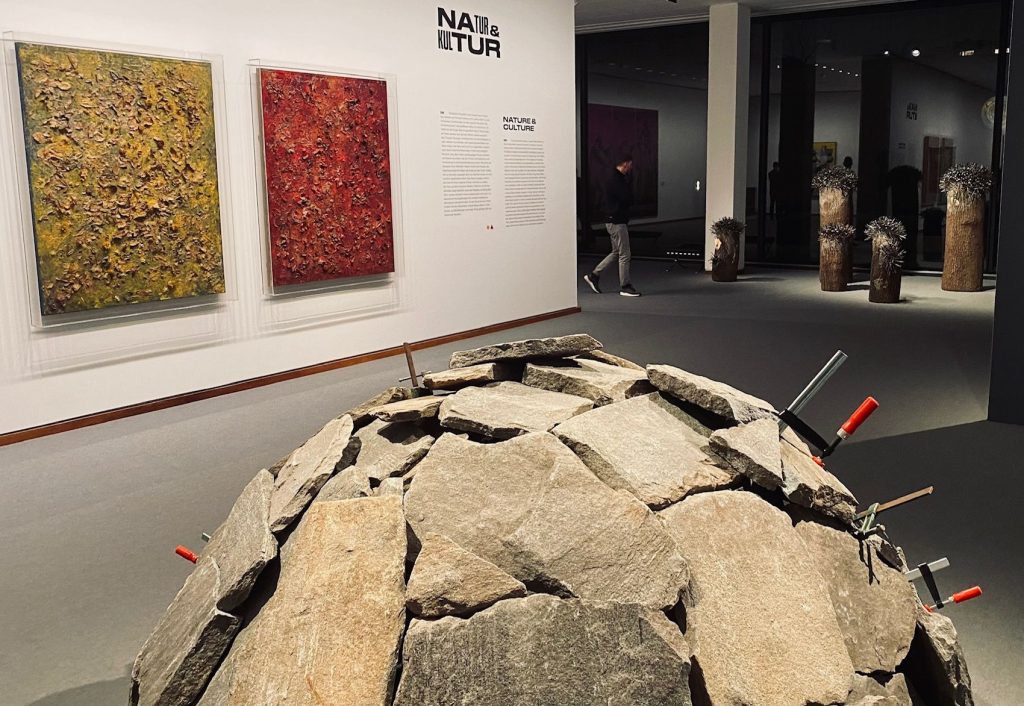
Time6
Time that has passed, is subject to evalution and re-evaluation. Our memories work continuously on various representations of time in our mind. Memory management is one such example. Artist have also coined a phrase for a particular form of time management. “The assault of the present on the rest of time” Alexander Kluge had chosen this as the title of a movie on film-making and Katya Inozemtseva had chosen this as the title for the exhibition in Berlin 2023-24. Pieces of art may serve as evidence in court as testimony for war crimes. This is one of the challenging issues of this exhibition. The present uses evidence from the past to illustrate what happened. Re-interpretations are part of this process as well. It is not too rare, that in the present a reframing of the past may occur. Some try to alter the representation of the past (crimes committed long ago) as of minor importance. Such intentional misrepresentations represent the assault of the present on the past. It may eqaually be attempted to limit the scope of future options. The diesel engine is not the best technical solution for mobility of 8 billion people living on this planet in 2024. The reflection on time needs to take care of the “back shadow” and “forward shadow” of the present. On the individual level, today’s action might be largely determined by past events, experiences and transitions, but they pre-determine to some extent also future events.
Conditionalities shall occur and accumulate, for some more than for others. Some call this scar-effects, others the narrowing down of options. Life reviews may apply a reframing exercise, sometimes even to liberate yourself from the boundaries of the past to open up new or more future options. The time-space subject which ranges from experience to fiction is the matter of literature and cinema. Some people seem to choose to live in a fictional world for whatever reasons. Rather than a linear concept of time, the artists appear to imagine time in some form of a spiral: from the present you turn backwards in time to project yourself into the future. Maybe, we are caught up in some unresolved narration of the past, to try another projection into a different future. We see one or many movies grow out of this fictionalisation of the present.
The study of the life course remains a formidable challenge. Testing the reliability of sources to separate fact from fiction has overriding importance. Biographies derived from facebook or instagram entries over decades have to deal with this fictionalisation of the self even more than we were used to from other data sources. The basic challenge of the representation of time throughout the life course, however, remains the same.
Source: Kluge, A., Evans, T., & Liebman, S. (1990). The Assault of the Present on the Rest of Time. New German Critique, 49, 11–22. https://doi.org/10.2307/488371 (Image: Exhibition Brücke Museum, Lea Grundig, Unterm Hakenkreuz: die Hexe 1935, Zentrum für verfolgte Künste, Solingen). 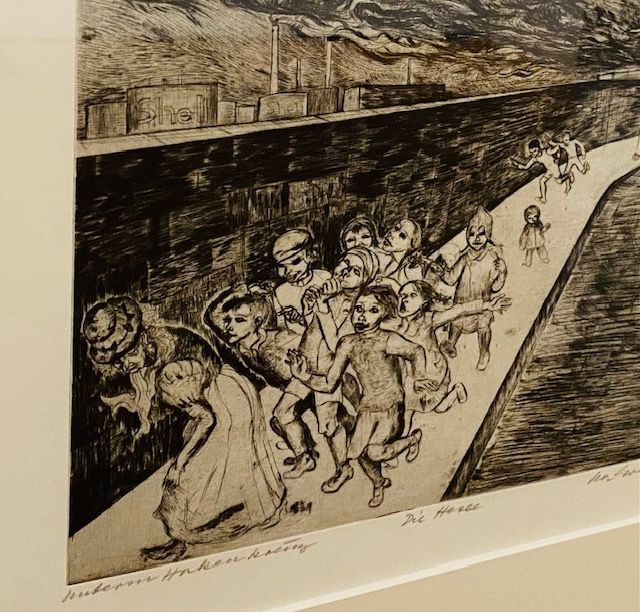
Renewables
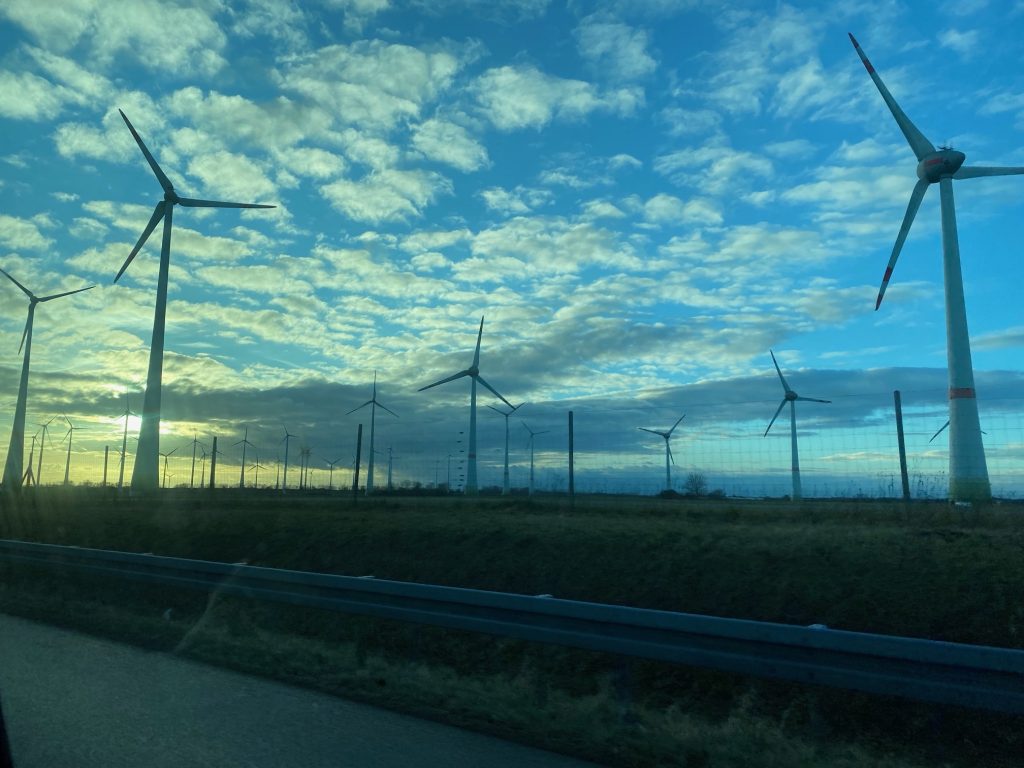
Renewable energy has reached for the 1sr time a share of more than 50% in Spain and Germany in 2023. This is an astonishing milestone in the energy transition of both countries. For Spain a report from Red Energy Espanola attributes the Spanish success story to the expansion of mainly wind energy (Link). The increase of renewable energy in Germany is due to a more rapid expansion of solar energy (Link). In any case a continued expansion of both forms of renewables allows to reduce the share of fossil fuel even more rapidly than previously estimated. Good news for the planet particularly to phase out energy from coal due to its highly polluting side effect. Countries with faster trajectories shall serve as examples that it is feasible to manage the energy transition also for large countries. Political instability might be a price worth paying considering the positive effects for future generations. Managing the transition in a just way which means to assist poorer households, ensures the respect of social policy targets at the same time. With this in mind the energy transition can be perceived by all as an opportunity rather than a threat to their welfare and wellbeing.
Memory Management
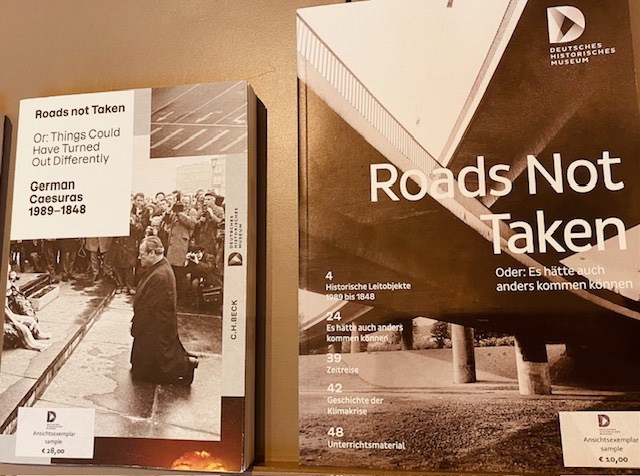
It seems a strange combination of words: memory management. In computing it has the function to allocate sufficient memory to specific tasks and has substantial implications for software performance (Yves Younan et al. 2010). It is also a security issue as what is stored somewhere might get accessed from other persons or programs with harmful intentions. Historians have a completely different approach to the issue. Individual as well as collective memories are frequently subject to memory management and manipulation. Therefore, it is necessary to critically deal with neglect and purposeful management of collective memories. In Germany we had numerous incidents of rectifying collective memories about the role of diplomats or the Wehrmacht during the Nazi period. Huge efforts were necessary to correct wrong representations of professions during and immediately after the 2WW. They are still necessary today. All children have to learn the concept of time, the past times and the concept of future. Periods after wars particularly generate a narrow focus on the present and the bare necessities of survival in societies. Dealing with and reworking the past and cherished memories is rarely attempted. It appears to be a paradox that without a coherent concept of the past the imagination about the potentials of the future are narrowed down. ‘Burned fingers’ cause additional restrictions. Literature for children and young adults has an important role to open up fictional spaces or laboratories for imagination. Freeing yourself from past restrictions while being aware of responsibilities due to the past allows a conscious way forward and human development. Sebastian Bernhardt (JuLit 3/2023) emphasised this and the Deutsches Historisches Museum had an exposition on this topic as well. Memory Management is a bit about the past but much more about the future. This is why we have to address it.
Work Subordination
One of the defining principles besides the job description, working time, working place, remuneration of a work contract is the subordination to a superior. The employment contract entails some more or less strictly executed form of direction, but a right of direction nevertheless. This element of subordination has become a major issue in the definition of whether you are effectively an employee or a self-employed person. The digital revolution had enlarged the kinds of subordination. Platforms and algorithms, that distribute work among several employees (but named platform workers) disguised the subordination to a superior level of management to the platform and its seemingly anonymous algorithm. Many young riders were saying, I don’t like bosses, but I am willing to accept a “technical” platform that distributes work tasks only seemingly in a non-discriminatory way. Due to a failure of labour legislation to regulate early enough a thriving model of fake self-employment developed throughout Europe and beyond. Labour Courts have contributed a lot to correct the disguised subordination. Even Uber is advertising that they only operate as a broker of tasks, but have no subordinated employees. The related issue of subordination remains largely the same. Subordination to an algorithm of the distribution of tasks is the end result.
Many start-up enterprises use Kanban boards to facilitate project and team management. Shifting tasks between employees, introducing new tasks and self-selection of tasks are potentially subordination-free allocation of tasks (example software). Flat hierarchies seem more manageable through the use of such tools. The number of tools that integrate other office functions is impressive. When testing such tools, that become more popular also in the distribution of household tasks, beware of the data-hungry nature of such tools. For example, https://trello.com/ warns correctly in the small print that for its full functionality it would need to have permission to use “your” camera, microphone, contacts, photo library, calendar etc.
This demonstrates that subordination, nowadays, is complemented by the algorithmic use of a lot of privacy, we would never have agreed to a boss in person should even ask for. The new and old subordinators have powerful tools at hand, the subordinated will have to get their act together and limit the amount of subordination they are willing to accept.
Again, this is a generational topic. The low threshold to accept technical subordination in younger generations, your autonomous level-5 car is breaking earlier than you even perceive a risk, is confronted with the higher threshold to accept personal subordination for youth. Interestingly, for older generations the obverse is true. All in all, we have ample reason to rethink and re-define also in legal terms the manifold, disguised and new forms of subordination related to work.