Sponge Mofs

Many people might have come across “SpongeBob” as a TV-series. Well, in 2025 it is time for an update. The Nobel Committee has awarded the Chemistry prize not to SpongeBob, but the research linked to the sponge-like Mofs, i.e. metal-organic frameworks to Kitagawa, Robson, Yaghi. These Mofs have in fact properties  similar to a sponge or cages in some applications. They consist of porous materials, which have large surface areas in relation to their apparent volume. Due to the modelling of network structures the surface of a grid can be expanded drastically.
Due to the application of such modelling techniques, the combinations of materials/organics and, thereby, the applications to modern technological challenges have increased tremendously. The exponential growth of research papers based on these foundations largely justify this honourable award. Not only the potential of carbon capture, but also the storage capacity of batteries as well as medical applications might benefit from this basic research and findings, eventually.
Playing around with a sponge, doing your dishes – also for men, or watching Spongebob might be considered differently from now on. Maybe, just start with a virtual visit of the Nobel museum for further inspiration.
Chatbot Me

Chatbots are helpful to allow queries to larger data sets like the blog entries here. So here is a try of a Chatbot to query all entries on AI using ChatGPT to create a Chatbot that uses and references it source from www.schoemann.org/tag/ai and the AI reader in pdf-format.
Please send me an email if the hallucinations of this Chatbot 1.0 on AI from a social science perspective are giving strange results. I’ll get back to you. Please use at your own risk as I cannot guarantee for all answers. The usual disclaimer applies here.

ChatGPT proposed the following set of Questions and Answers on the blog for an entry into the chat: Example Q&A with the chatbot

Q: What are the social science concerns with AI?
A: Bias in results, job shifts, democracy risks, privacy, and new inequalities.

Q: What does the text say about reinforcement learning?
A: It’s seen as the next step for AI: focusing on learning and reasoning, not just predicting text. It also uses fewer resources.

Q: How are robots described in the document?
A: Robots are mostly assistants. They can follow people or carry small items, but more complex tasks need sensors and AI training.

Q: What about biased results?
A: Studies can be misleading if control groups are flawed. AI faces the same challenge — social scientists warn: “handle with care”.

Q: What is Schoemann’s blog view on AI?
A: He links AI to energy use, fairness, and its role in the “all-electric society” — stressing efficiency and responsibility.

More on the chatbot (in testing phase) and the Link to the coding help received from ChatGPT on this mini-test-project :
https://chatgpt.com/share/68c1d160-0cc0-8003-bf04-991b9e7c3b24


Video Doku by AI

Based on my own blog on this webpage “schoemann.org” Google NotebookLM creates a video of about 7 minutes. Using Microsoft Clipchamp automatic subtitles with a slightly different storyline are produced based on the video data. In the end, the blog entries are re-modelled into something like a lecture on “AI in a wider social context” (see and play below). No voice layover so far, read by yourselves. A podcast format is another option.
It feels like walking across landscapes in my own mind. Content creators of today or the past never imagined the impact they might have through the powerful tools of AI. The only caveat, jokes I incorporated into the texts cannot really be handled by AI tools unless they are explicitly designated as such. These AI tools take me much more seriously as I do myself. This is serious.

Former Crypto currency

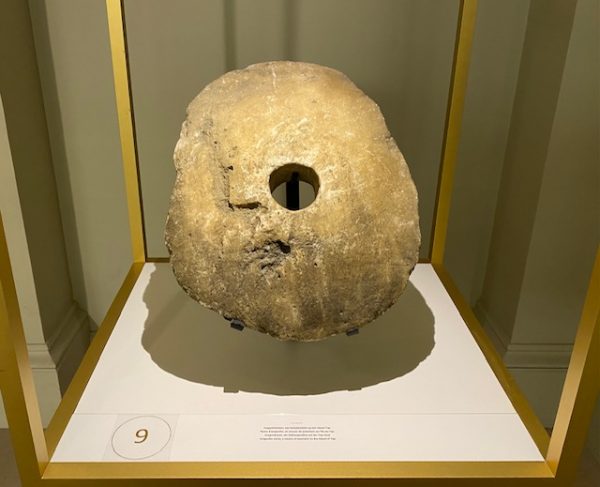
The rationale behind a Crypto currency is quite an ancient idea. In the absence of a central bank or in addition to it, people may choose to establish their own currency or currencies. The central idea is to secure assets (currently and in the future) as well as to enable an exchange between a community of people. The Museum of the National Bank of Belgium (image below) has a “Yap stone” on display which originates from the Pacific Yap Islands. Even very heavy and big stones served as wealth storage. The idealistic value of a particular stone conveyed additional value. In the true value of the word these people were banking on stone money in a way not to distant from what Crypto currency embodies today.

Paris History

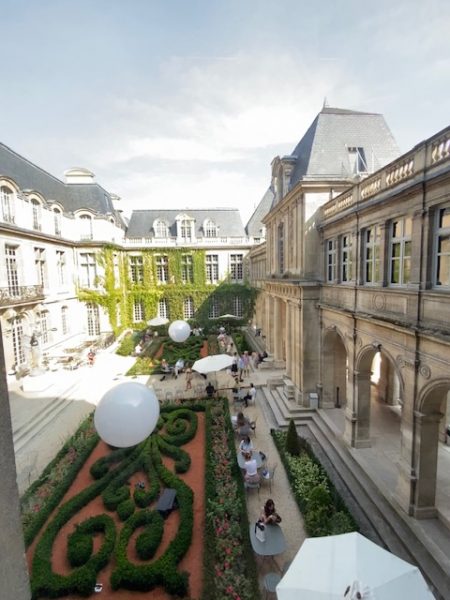
The “Musée Histoire de Paris Carnavalet” is the starting point for visitors of Paris and social scientists to better understand the making of this metropolitan city throughout centuries. The only common factor over the years is the astonishing determination to reinvent the city every 100 years whilst the best features of the previous periods are preserved. It is the concern for the very long-term time horizon that makes the city quite unique. Even a social revolution (1789) unlike most other countries managed to preserve most buildings, churches and royal palaces. Restorations are undertaken with a careful approach to shield its architectural and social heritage. Even the radical transformation by Haussmann over almost 20 years until 1870 to build large corridors in the city is subject to revision in modern visions of the future of Paris. The app of the museum is very helpful to learn more details about each chosen object of the permanent exhibition. The social fabric of the city can be studied further through app’s feature when representatives of local social organizations speak about their personal piece within the huge collection on display. The larger the “fundus”, the more the rationale for selecting pieces becomes an issue. (Image: Musée Histoire de Paris Carnavalet inner court 2025).

Science and Fiction

We associate with science and fiction the extrapolation of scientific trends into some futuristic settings. The most striking examples of science fiction in novels or video use some scientific findings (dinosaurs, genetic engineering) and project this knowledge into another fictional setting. The usual personal relationships follow rather predictable plots of romance, deception, violence or war.
The novel “Wellness” (Hill 2024) is also a kind of science fiction as it is based on social science evidence and builds its fictional plot firmly embedded into the social and psychological research. The attachment of references (and defending the print of those in translation) underlines the commitment to write a new type of “social science fiction”.
In this innovative style the scientific basis of psychology and sociology is then extrapolated into a fictional arrangement. Research on subjective well-being with the U-shaped form over the life course and the extrapolation of the placebo effect, which is instrumentalized for a business, derive from key topics in the social sciences. In fact, the novel and the background scientific literature in the bibliography could well figure in a social science course at university entry level. These readings constitute a 360-degree-view on personal development and social structures. Of course, social sciences move on and add new evidence on an almost daily basis, but the selection and arrangement of the characters create an innovative social science fiction, without some unrealistic technological extrapolation.
It strangely feels like we are already part of this social science fiction (compare “Klara and the sun” by Ishiguro) as politicians advocate and campaign with placebo topics in elections and project us into some more happy past or future.
The social science fiction of Nathan Hill resembles for me the great utopian novel by George Orwell “1984” published in 1948. A title “2032” instead of “Wellness” could have worked quite well, as the first edition of Nathan Hill’s social science fiction was published already in 2023. (Image: Extract of: Lo Spagnolo, 1665-1747, Hecuba makes Polymnestor blind, MRBAB).

Lost Objects

Project yourself into the future more than a hundred years from today, maybe even more than a thousand years from today. Some archaeologists will work on the planet earth to uncover the story behind the disappearance of the once very advanced species of homo erectus. They start drilling near some of the mystical sites of this civilization, the cities where mass celebrations were held called Olympic Games. These archaeologists use huge drilling machines to take samples at previous Olympic sites and uncover the remains of the thought to be modern civilizations on earth. Amongst all these samples they find all sorts of artifacts and layers left over. Plastics and metal structures appear in the samples as well as other forms of „artificializations“, transformations of earth’s principal „natural“ raw materials. The inhabitants of earth apparently lost or destroyed the planet‘s capabilities of CO2 storage and eventually became extinct. After fighting for survival on another planet the archeological expedition on earth saved this block of the remains of a doomed civilization. All this is pure science fiction, yet the specimen sample is exposed on the roof of the futuristic Fondation Louis Vuitton building near the Jardin d‘Acclimatation in Neuilly sur Seine. (Image of „Where the slaves live“ of Adrian Villar Rochas, 2014).

Knowledge Work

In the social sciences the term knowledge work defines the group of professions that deal with and deal in knowledge. Most of them are in academia, but there are many other professions like ICT professionals or lawyers that used to shuffle paper who now work all digital. Hence the relatively new addition to the sociological vocabulary is “mobile knowledge work”. We, and yes I am part of this group, can do our job from almost any place with a stable internet connection. Breda Gray et al. (2020, Made to work: Mobilising contemporary worklives.) highlight the importance of gender considerations when we study these new forms of work. Similarly, social class and cultures of more or less trust are thriving for independence. This will play a role in who choses these new forms of work. The digital technology enterprises, media and social media workers are and will be the forerunners of this change. The education sector and academics in general have followed suit.

The issue of autonomy has also received some attention by the authors and this is likely to be a big challenge to standard work relationships as we knew them before the digital turn and the Covid-19 pandemic. The mobile knowledge workers were the first to insist on change of work practices, there will be other professions that will strive for greater autonomy of various kinds.

Forced Labor 2024

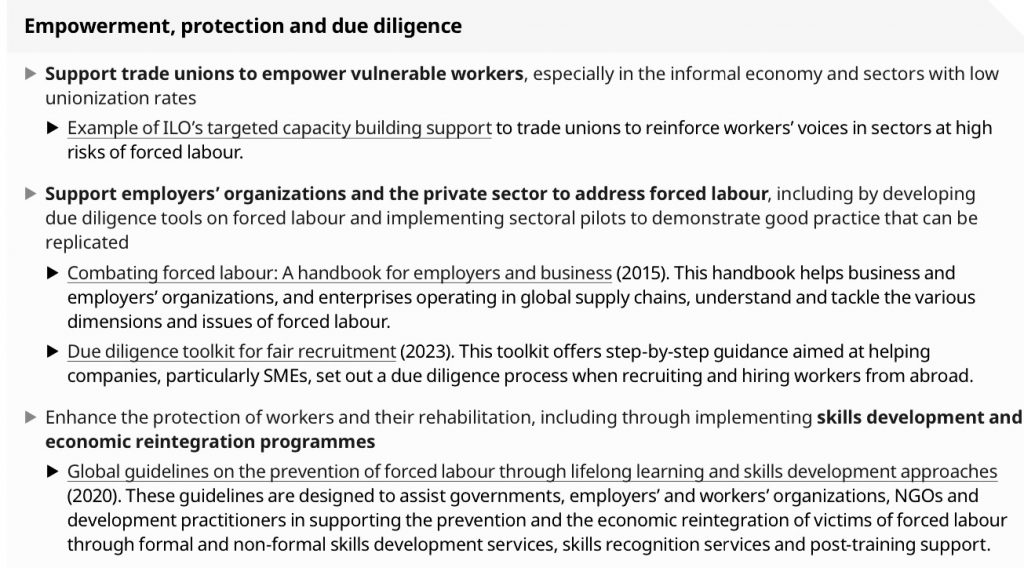
Thanks to the ILO we have recent data on forced labor across the globe. At the time when the EU struggles to tighten the rules on decent supply chains, it is important to draw attention to the already reversed trend that worldwide forced labor is on the rise again. According to latest report by the ILO 27.6 million women, men and children were in forced labor at any day of the year 2021. This is even about 10% more than 5 years before in 2016. The fact sheet from ILO highlights the region that are practicing it the most but mentions at the same time that no region in the world has completely wiped out this criminal activity. Despite the SDGs containing a goal to eradicate forced labor by 2025 for children there is little hope that this will be reached. Controlling supply chains of the rich countries could be an important factor in identifying the states or companies which built their production model on forced labor. The fight against this practice is an enduring challenge. We cannot allow to shun away from the thorny issue. The price for labor is only one argument in the reasons for the persistence of forced labor, migration is also a force at work. This asks for specific solutions to country-specific or sector-specific problems. It is a global responsibility but needs partnerships across continents to reach better outcomes in the interests of humanity. Some countries like Germany have a historical debt to invest more than others.

ILO recommendations 2024-1

Skill loss

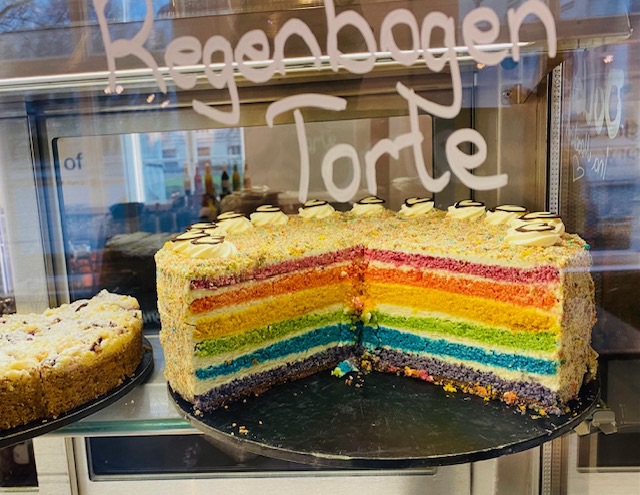
There is a sense of skill loss in watching the trends to increase comfort. We all use washing machines and maybe dishwashers. Households can save a lot of time by using those machines. Some porcelain and clothes should not be left to the machines. The need to organize traditional washing routines is almost forgotten after 1-2 generations. The same holds for many technical skills. Bicycle and car repairs or small repairs of electrical appliances are delegated to specialized repair shops. Not using or having learned these skills puts you in a form of dependency and at the risk to pay a price for specializing on other skills. Find out and focus on what you are best at. This has been the mantra of economic theory since Adam Smith. The potential value of satisfaction with an own production rather than a bought product is frequently acknowledged for baking cakes yourself rather than simply buying one in a shop. The same rationale holds for many other skills. Autonomy of own production with possibility to improve or repair are forgotten values. The have become a luxury item or a necessity for persons lacking financial spending power to buy products from others. Many skills will be lost rapidly because products have become so cheap to replace or order for home delivery. Industrial production is desperately searching for skilled persons but losing skills is pervasive at the same time. Public schools and academic curricula will not be able to stand the tide of pervasive skill loss.