École buissonnière

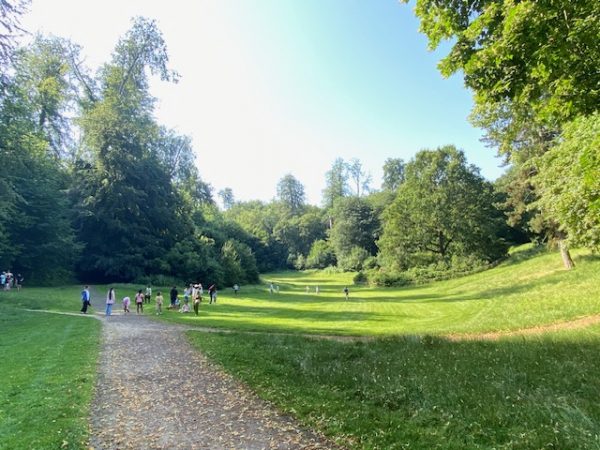
In 2026 the “École buissonnière“, the outdoor schooling has become a viable alternative to the schools that are overly hot during summer. But far beyond being an alternative out of necessity, schools as well as kindergardens adopt a form of schooling close to and in nature. It can be so much more than a simple interlude or excursion. Learning from nature is a precursor of bionics as well as compassion. After all nature offers ample examples of diversity and coping mechanisms. It is an option not only for learning purposes restricted to the young, but it is underexploited in continuous learning and lifewide experiences as well. There have been abuses also in history, most notably by Nazis in Germany for purposes of indoctrination. The learning opportunities to encourage a critical perspective of our modern, technology- and screen-dominated learning and life, are huge. They just need experienced guidance on the way of discovery, comparisons and collective experiences. Children open up and have fun, the more the pressure of classrooms is alleviated.  Learning about the importance of biodiversity from different angles is a very human value and includes our responsibility for other species.
Dronification

In a long row from californication, gentrification, desertification and electrification, not to mention quantification, juridification or enshittification,  we have arrived at “dronification” in the 2020s. Spurred by the extremely successful use of drones by the Ukrainian army to o bring to a halt the illegal invasion of Ukraine by Putin’s Russia,  conventional weapons like tanks and artillery lost out to the widespread use of drones. Few military observers, even experts of military equipment, thought prior to 2020 this would be possible. The lower costs involved, precision targeting and different skill sets needed for the orchestration of a drone based defense and attack, have made a strong case for the dronification of warfare.
As with many innovations, there are dual-use potentials. In this case the civilian use of drones received a considerable push in technology and acceptance. Rescue robots or delivery of provisions to frontline positions are part of the “everything-drone-thinking” during war. The surveillance of frontiers and territory is applicable to agriculture, properties and urban planning. Droughts and other environmental impacts on a large scale can be monitored in a  timely fashion as well. 4D imaging becomes more feasible as well in many domains. The potential in architecture is vast as well. Public infrastructure and distribution of frequency ranges is a crucial precondition to ensure an  orderly coexistence of military, security and civilian use cases.
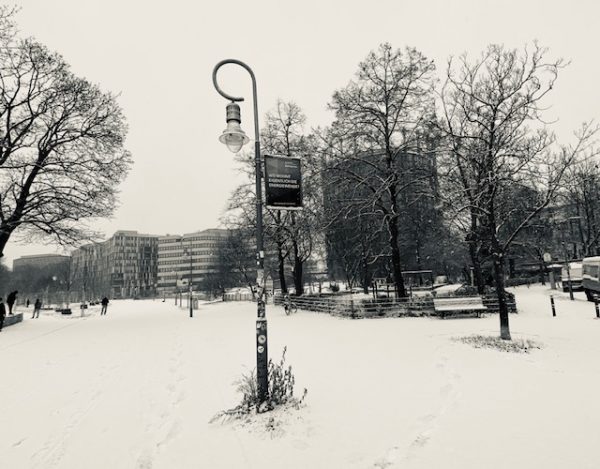
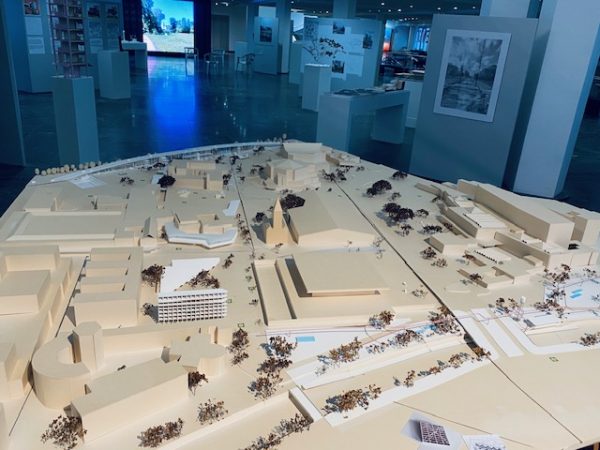
(Image: Exhibition: atelier le balto, Die Kunst des Gartens VI: FREI(B)AUM at Kulturforum Berlin 2026-1)

Mobile Web Search

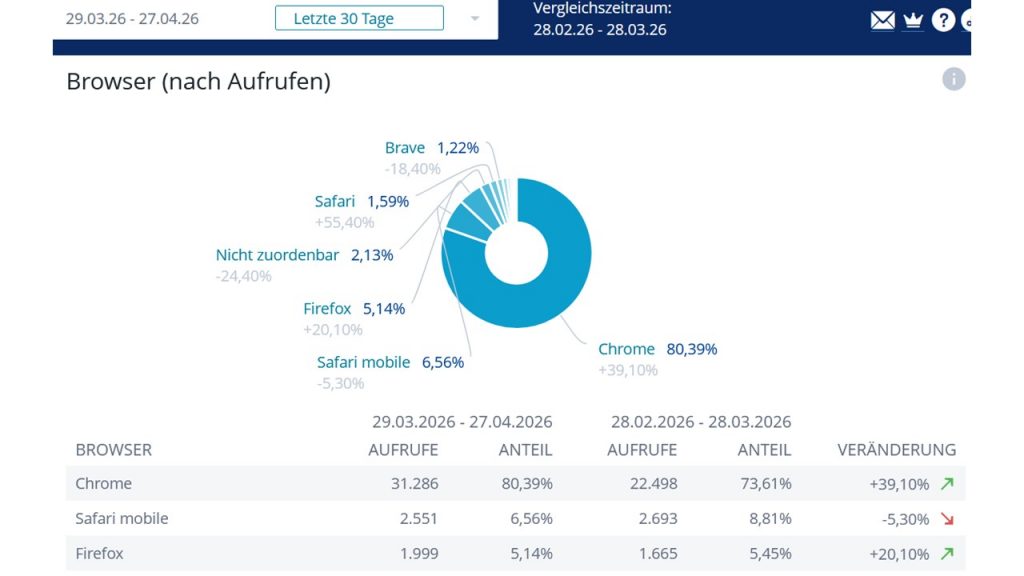
The smartphone is ruling the internet. This is probably a well-known wisdom in 2026. Just looking at the basic statistics of which browser people use to contact this webpage, it is evident that Chrome is vastly dominating search on the internet. Even the mobile version of Safari outnumbers the desktop browser access. Information gathering, viewing and reading have all moved from the desktop to the handheld smartphone, and maybe our glasses or wristwatches in the near future. For those still programming or designing webpages, the choice of “mobile access and functionality first” is an obvious choice for business, and even more so, for leisure purposes, like it or not.
Some parts of this evolution of search behavior are quite obvious, as we are more erring around cities like Paris, Berlin or Brussels than searching in front of our desktops or notebooks.

Disaster tourism

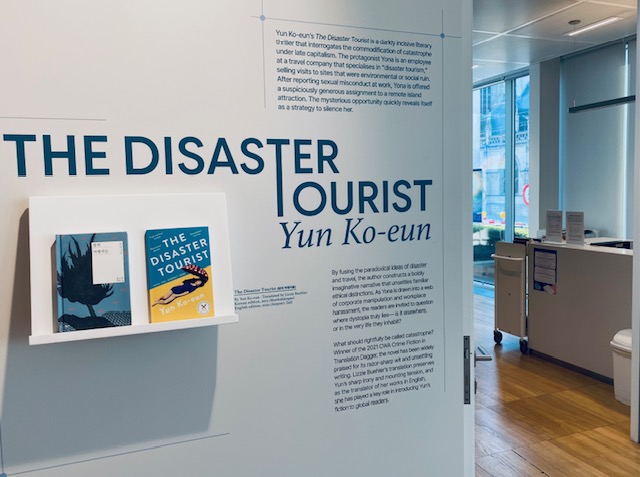
My personal background gave me lots of personal experience with almost annual next to a small river bed. Since I left the region for studies, the flooding has increased and several times have reached the scale of disasters. Therefore, I am very sensitive and have mixed feeling to the issue of disaster tourism. Such tourism is a nuisance at the time of the disaster, but cash through tourism helps the hard hit region and residents to overcome the losses faster. Would I travel to Tschernobyl or Fukushima for that reason? Probably not, but the intentional war disasters and crimes caused by Nazi-terror.  The Korean novelist Yun Ko-eun did not shun away from writing about a guide who takes tourists to places of environmental disasters until being sent involuntarily to such a site herself. This is not about the “K-Chicken belt”, a series of places with famous chicken dishes, nor about the potential consequences of repeated K-pop events of the famous BTS-boy group in Seoul in 2026. So glad to see that Korean youth has a chance to thrive under democratic rule. (Image: Exhibition in Korean cultural center Brussels 2026-3) 

Quantum battery

The first prototype of a Quantum battery has been successfully tested. The Commonwealth Scientific and Industrial Research Organisation CSIRO with corresponding author James Q. Quach published the paper on the “quantum battery tuned for strong light–matter coupling” (Kieran Hymas et al. 2026) open access. Although there have been close to 20 papers on the theory behind quantum charging already, the demonstration as a proof of concept (in business terminology) has been missing so far. The superextensive charging with photons builds upon “a laser pump pulse with bandwidth ~31 nm and resonant with the LP branch induces excitations in the quantum battery” (Kieran Hymas et al. 2026 p.3). Since batteries need not only be charged, but also discharged in a safe and fast way, the prototype demonstrated also this additional functionality.
This is a huge step towards the feasibility of the “All electric society” as the efficient storage which includes fast charging and discharging beyond storage have been a bottleneck in the wider adoption of the “All electric society”.
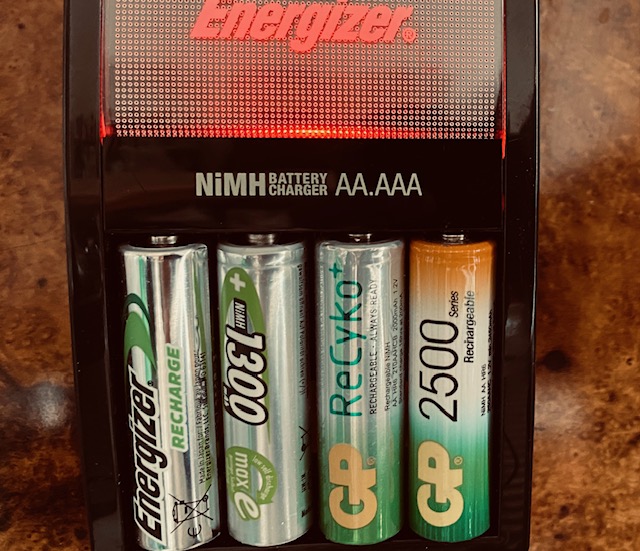
(Image: old fashioned NiMH battery charging at home)

Art Utopia

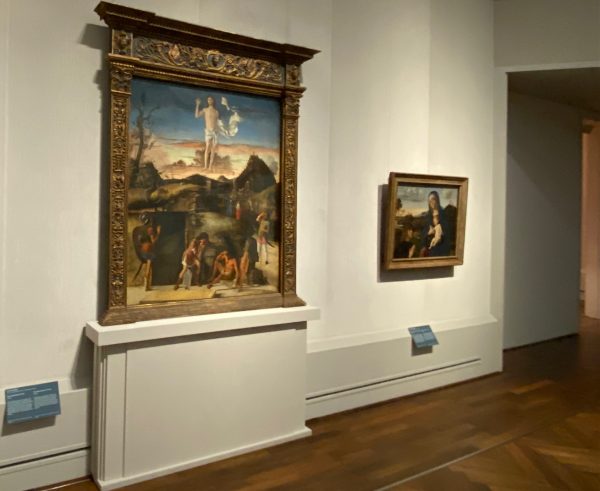
Not all art is utopia, but a lot of it. A series of talks on the issue of utopia in art  (BNF) reminds us on the utopian projects many artists have pursued in the history of art. From a non-believer’s point of view, religious depictions belong to some form of utopian art. Much later art movements proposed to bring art closer to people’s lives by spreading decorative art to objects of the daily lives, like furniture, dresses, jewelry. Different forms of experimentation with materials or art styles reveal a taste for freedom of expression, sometimes of a utopian kind, at least at the time of experimenting. Abstract art opens up thought spaces which may appear like verylong shots into a very distant future. Science-fiction is of course a well known form of dealing with and representing utopian ideas to larger audiences. Maybe it is this curated space of utopia which many people seek when going to exhibitions and galleries. (Image: Giovanni Bellini, Resurrection of Christ, Gemäldegalerie Berlin). 

Futures for Amazonia

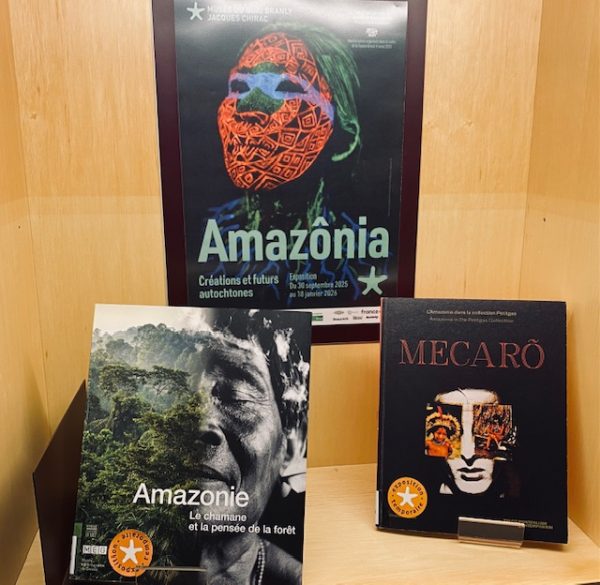
Diversity is the treasure of humanity. This was and remains a permanent challenge as thinking in multiple perspectives is taxing our minds. Simplicity can be a value in science or mathematical proofs, but cybernetics teach is also about the usefulness of a “requisite variety”. The exhibition Amazonia at the Quai Branly in Paris takes us on a journey through richness of the Amazonas, its people, biodiversity and landscapes. First of all the curators Varison and Baniwa manage to accompany us in opening up our minds to non-western concepts, which have for centuries been considered as less developed, but only from a western point of view or imagined sort of cultural superiority. Even nowadays the West seems to be convinced that for the liberation of, for example Venezuela, only a western power can achieve this. The 300 different indigenous peoples of Amazonia have lived through hundreds of years of threats to preserve their cultures. They have managed and they have inherited and still develop multiple ideas about “futures” of the Amazonas region. In just 100 days this exhibition has reached more than 100.000 visitors. Most of them will be convinced of a future and, yes, futures for Amazonia. 

Saint-Simon Utopia

Towards the end of the 18th century and during the early 19th century, the early signs of what the industrial revolution would mean for the working people became visible. Saint-Simon had lived through the ups and downs of the French revolution himself and had been to the Americas with La Fayette before he developed his utopian socialist vision of a unified class of working people, which for him included blue as well as white collar workers. At the advent of the 2nd industrial revolution through general and agentic Artificial Intelligence (AI) in 2025, we shall most likely witness a renewed interest in utopian scenarios and grand ideas of what the future of technology, society and humanity might be like. In 2026 we shall re-read Saint-Simon quite a bit in order to learn about ways to make sense of arising trends and how to come up with a positive utopia that can motivate people to thrive again for more equality within and between societies. 

Positive negative Utopia

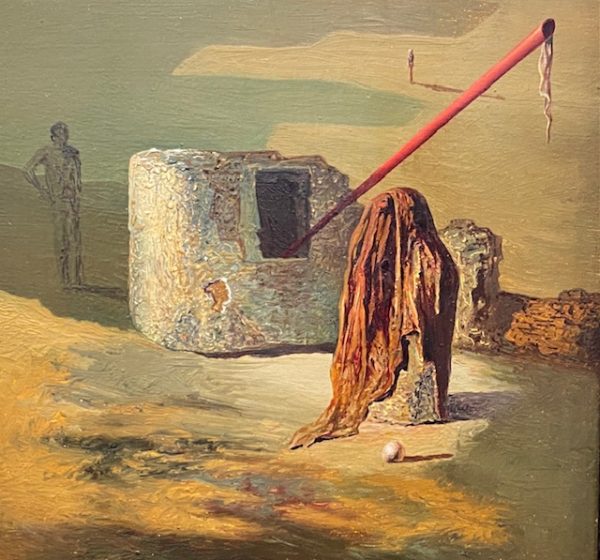
We have been used to distinguish between a positive or a negative utopia. The idea of a paradise is usually associated with a positive utopia, however, from the perspective of mankind being unable to live together without the idea of God being the ultimate arbitrator, this is more like a negative utopia. The industrial revolution and communism as the utopia to spread wealth equally across generations and all people, have been turned into negative utopia by dictatorships and authoritarian regimes. The fascist ideas of superiority of a race has also turned into negative horror and Nazi-terror. Hence, skepticism is in order, if either form of utopia is advocated. There are numerous examples of unintended or not explicitly stated consequences that have to be considered as well. (Image: Extract from Salvador Dali, Looming Danger Alarm, 1934, Neue Nationalgalerie, Stiftung Pietzsch)  

Future of work

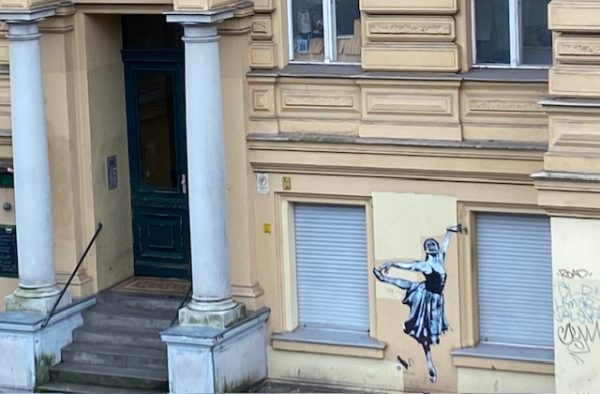
The beginning of the 3rd millennium has brought about several fundamental changes of work and employment. What had previously been thought of as utopian in the realm of work, has become a normal feature of work. Just like in the historically grounded, utopian perspective described by Bernard Gazier “Tous sublimes” (2003) we have a growing group of employees and self-employed persons who enjoy privileged positions on the labor market with sufficiently high salaries and access to mobility on the labor market at their own discretion. In addition to these examples described in Gazier’s utopian perspective, the 2020s added permission of remote work from anywhere and use of AI-assisted technology and robotics. A previously utopian view of the future of work has become a reality for many more people nowadays. The utopian element no longer is the how this world of work might look like, but how many people will enjoy the benefits of the technological progress. With a substantial increase of the efficiency and productivity of work, the distribution and sharing of the fruits shall become even more important. We have entered into a new phase of “the brave new world” of work as of 2025. (Image: Graffiti Berlin 2025-12).