Paris has lots of museums to visit. At times, this can lead to a kind of mental overload. The ” Musée Marmottan Monet, in Paris allows to take home a digital and printed copy of your preferred, your own curated collection of images from the museum. This is a great learning experience. You scan the number of the item you want to include and a specialized application retrieves the image of the painting or object from their database into the App. After the visit you take a break in the café in the garden and sort your collection and if you like have it printed within a couple of minutes after you paid for the print or digital version. Upon special request I was told that I am allowed to share the link to the small booklet even on the web (Link to pdf below).
Since the visit to the Musée Marmottan Monet we have come back to the digital and printed versions several times and reading of accompanying texts and perfect quotations of origin make learning about art a fun experience. Going back to lived experiences makes more lasting impressions on our memories. Knowledge coupled with emotions is a powerful way to memorize. Sharing the experience with other persons like the readers of this blog is an additional advantage. Attentive readers of the blog entries will find references to many of the themes dealt with over the years in this series of blog entries. Such topics are: gender and art, technology and society, reflections on time, life courses, inequality, art history, funding of artists, lifelong learning or beauty.
(Booklet below in German LINK-pdf of 6MB. The app allows many language versions. You can produce those yourself from you collection within the App) 
Sports International
Beyond the Olympic Games the practice of sport has been widely spread across cultures. The meeting of cultures through athletes is also a worldwide phenomenon. The “Musée du Quai Branly” offers an opportunity to delve into the different cultures of the world. With abundant water resources Oceania has developed boats that ensured survival, work, art and leisure. The image below is a fine piece of art which is exposed in the permanent exhibition of Oceania. Even a turtle appears to be rowing next to the others. Most other depictions or objects with reference to sports have fighting as a feature or refer to it. The Olympic games have similar historical depictions. Martial practices, sometimes also called martial arts, have been the source of decorations and special designs in all cultures. The ethnographic collections of this museum offer a glimpse into the rich cultural heritage of all continents. We have so much in common across continents that it is still hard to see mankind captured in many wars across the world. Paris 2024 Games with the “Musée du Quai Branly Jacques Chirac” give hope that sustainable development (70% of the museum is green space!) and peaceful living together is feasible with a focus on joint cultural heritage with enriching diversity.

Sports Beauty
Since the days of ancient Greece the combination of sports and the ideals of beauty has been praised. The many representations of mainly sportsmen at the time were copied by many artists to represent ideal forms of bodies and beauty. Only more than 2000 years later the female sportspersons find equal admiration in sports and the imagery of beauty. The Académie des beaux-arts in Paris 2024 has chosen this as a topic to guide visitors of the Olympic Games through the vast collections at the Musée Orsay (imaga below). The depiction of Hercules, for example, has idealized the strength of men. The beauty of sports movements reaches levels of dance or ballet. The precision of performances highlights the not only the physical qualities, but also the beauty of the body in motion. The popular appeal of performance and perfection contribute to the admiration of ideals. Reaching these ideals is a completely different story. The training and preparation may take years mostly invisible to the one time spectators. However, the glory stays for decades or until a closer match to the ideal is achieved by another athlete or another person. Even ideals are time dependent and rarely eternal.

Impressionism 150
How many impressions made impressionism? Too many to be expressed in a single number. 150 years after the movement started with a spectacular exhibition in Paris the admiration of the paintings still attracts huge crowds. As a kind of revolutionary movement the artists mounted their own exhibition as they were not allowed to expose their paintings in the official exhibition of the Academy of arts in 1874. They accumulated a sufficiently large group of artists to form their own distinctive style of paintings. Painting outside in the countryside was a joint predilection. The regions, nowadays in the suburbs of Paris where many people daily commute to Paris has discovered the attraction to review the original scenario of the paintings as well as their living environments. Yerres, for example, hosts in 2024 an exhibition to show paintings from Claude Monet and Gustave Caillebotte which highlights the inspiration both painters took from the surroundings. Nowadays it is also interesting to see that the agglomeration makes efforts to make more people aware of the treasures to see in their own surroundings. Even if conservation of nature is hard to achieve the parks of yesterday have remained visible today. For us to transmit the cultural heritage and landscape to future generations as well. An affordable booklet that documents the cultural heritage allows people to dig deeper into the subject also for those who live in the region only because of a job nearby in Paris or Orly airport.

Aussensicht Innensicht
Die Sicht vom Skulpturengarten der Neuen Nationalgalerie auf die laufende Ausstellung „Zerreissprobe…“ erlaubt einen tiefen historischen Einblick in die 1980er Jahre. Die Sammlung von Postern des Künstlers Klaus Staeck zeigen die bewegenden Themen der achtziger Jahre. Frauenrechte, Umweltschutz, Sicherheit sowie Medienwirtschaft. 40 Jahre später beschäftigen uns weiterhin, Lösungen für die plakatierten Themen zu finden. Images können Themen so zuspitzen, dass Anklagen daraus werden. Texte sind im Vergleich zu der Eindrücklichkeit der Bilder ein vergleichsweise stumpfes Schwert. Es ist aber gerade die Verbindung von Bild und Text, die Eindrücke verstärkt. „Meme“ Creators sind ein standard tool das die Kommerzialisierung und die Promotion weiter befördert haben. Kunstformen hatten diesen Trend bereits vorweggenommen.

Paper and Pastel
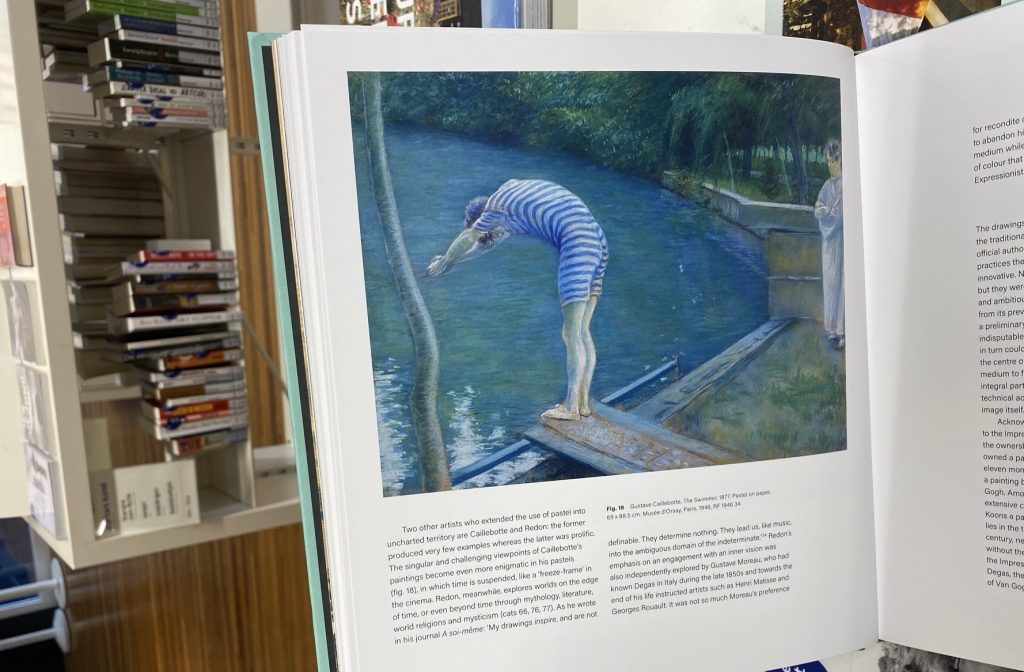
Sometimes the art is in the material. At least this could be a rapid conclusion of the exhibition presented in London at the Royal Academy of Art in 2024-1. From the informative Catalogue the importance of material is demonstrated. The ease of taking your equipment with you, like a sketchbook and out into nature have been an important feature of the impressionists’ movement. With artists challenging traditional techniques of painting and paintings as such even the apparently less noble material as paper had become a statement of being different from the established art academies making use of more noble materials. The impressionists made a convincing point with their additional use of materials accessible to all. Capture the moment and capture your very own impression of it. This is one way to immortalize the emotion and essence of the scene. In the catalogue of the exhibition I spotted “The Swimmer” drawn by Caillebotte with pastel on paper. Freezing the moment, freezing the motion and emotion is evident here, too. Testing different materials is part of the journey to find your artistic impression, expression or materialization of imagination. The ways and means are manifold.
Memory Flashes
The title of the exhibition in the Museum of Photography in Berlin was “Flashes of Memory”. The collaboration of the Kunstbibliothek with the “Yad Vashem – The World Holocaust Remembrance Center” prepared a photographic memorial of the murder of 6 million of human beings with Jewish origin or family ties. The images represented in the exhibition constitute a carefully curated selection of the photos taken as part of Nazi propaganda, the secretly produced photos by inmates and the Sowjet and American soldiers who prepared documentation of the horrors. It becomes clear throughout the different sections of the exhibition that the motivation of the photographer introduces more than just an individual perspective on the scene.
In the age of fake news and fake images it becomes more and more important to be able to read and interpret photos, taking into account the motivation of the photographer and its influence on the photo taken. In order to limit the spread of mischievous representation of the past, it is good to know that the use of AI as image creation does not allow with simple prompts to produce false documentation. It needs more sophistication and more human intervention to trick the algorithms. Additional use of photoshop will, however, increase the risks of abuses. Hence, it will be more important as of now to be able to differentiate images according to sources and authors. Our trust in photos has been shattered, and this is an important lesson in itself. It is a huge task for schools and adult learning to re-build the competence to distrust photos and images at first, then deconstruct the messages and motivations.
“Flashes of memory” is in some way linked to the “struggle of memory” exhibition. Both, obviously deal with the way historical events are and have to be present in our “collective” memory. Memories come back in flashes, sometimes, certainly for victims. Conscious and unconscious selections of images might come back at times and haunt victims for years. The correction of biased messages, is an important task for historians, social scientists and artists alike. It is all too easy and common to forget (Luhmann, 1996 Reality of mass media) and the difference between “Documentation” and “Decoration” (Lewis, 2001) or simply illustration needs to be scrutinised always anew. “Bildung” has some common roots (only four letters really) with “Bilder” in German language. It may be “une liaison dangereuse”, but the spurious link can also be turned into an educational or learning approach.
A permanent exhibition based on the material used in the exhibition would be a real asset to accompany and learn about the flashes of memory. A reading list of literature was also available at the exhibition (see image below) encouraging to dig deeper into this immensely important topic. 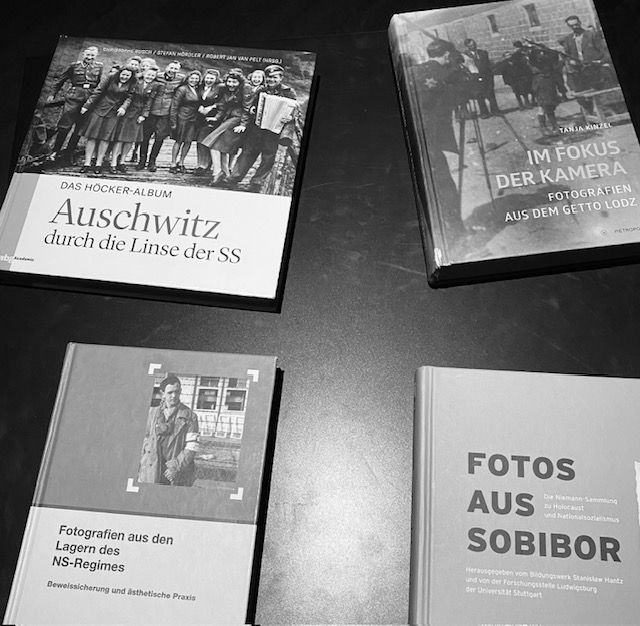
Flotow CH
Noch 20 Jahre nach seinem Tod wurde Friedrich von Flotow recht prominent aufgeführt. Im Stadt- und Aktien- Theater der Stadt St. Gallen stand seine Oper “Martha” an einem Mittwoch 26.4.1905 auf dem Programm (Anfang 8 Uhr präzis), gefolgt von Mozarts Zauberflöte 2 Tage später. Was für eine Konkurrenz. Das Plakat zur Aufführung ist in der Digitalen Bibliothek der Kunstbibliothek in Berlin anzusehen (Link).
Die Geschichte des Theaters in St. Gallen ist aus ökonomischen, gesellschaftlichen und architektonischen Gründen interessant. Das Tagblatt berichtete in 2007 über den Abriss der historischen Städte und den sehr verspäteten Neubau einer moderneren, größeren und wirtschaftlicheren Spielstätte. Damals zu Beginn des 20. Jahrhunderts schon standen populäre Werke wie die Martha und die Zauberflöte auf dem Spielplan. Die Aktionäre des Stadt- und Aktien- Theaters der Stadt St. Gallen haben wohl schon immer etwas mehr auf das Geld geschaut, auch wenn es um Kunst geht. Mehr Zuschauende und Zuhörende ist demokratisch und nebenbei gut für’s Geschäft. Der Abriss war beklagenswerter Weise im Jahr 1971. Ein Neubau an anderem Ort startete bereits 1968. Dieser Bau musste ebenfalls nach 40 Jahren Spielzeit grundsaniert oder abgerissen werden. Heute findet sich darin ein lebhaftes Programm mit Musicals als ausgezeichnetem Schwerpunkt und beispielsweise des Theaterstücks „Gott“ von Ferdinand von Schirach . Die Stadt und die Aktionäre sind wohl aus der finanziellen Verantwortung, aber das Kanton St.Gallen und der Lotteriefond sind eingesprungen. 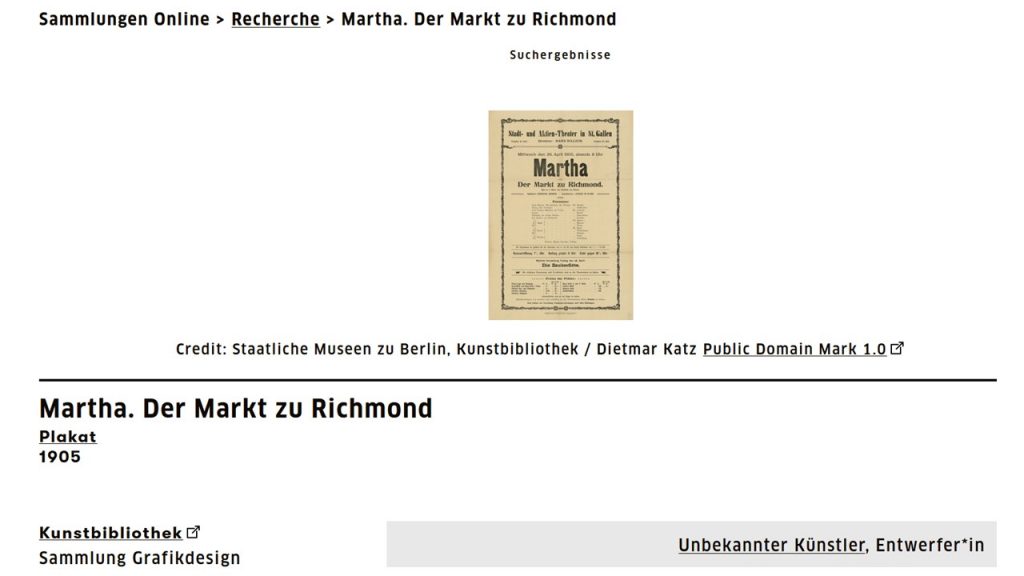 Bildquelle und Großansicht Kunstbibliothek SPK Berlin.
Museum Orga
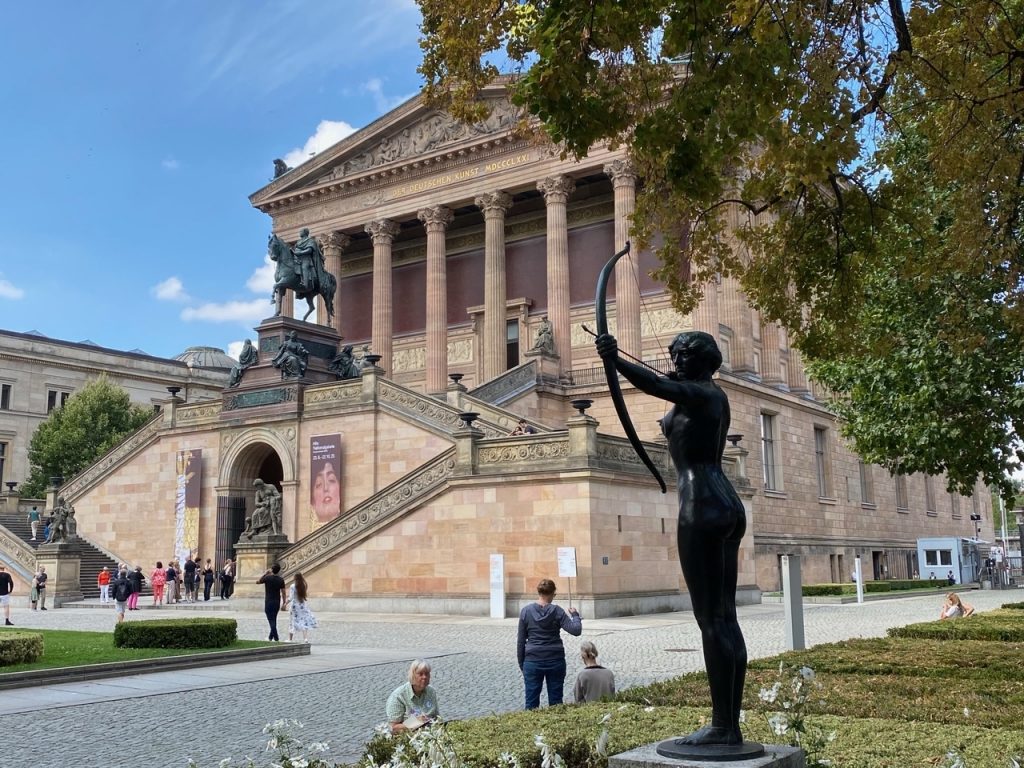
The cathedrals of modernity are under permanent scrutiny. The discussion in Germany was sparked by a recommendation of the scientific advisory council to the federal government (Wissenschaftsrat) to separate the Prussian heritage museums and institutions (SPK) in Berlin into separate entities that have higher autonomy to shape their individual profiles. Too much hierarchy blocks innovation and openness to new approaches that might not fit an overriding instance of decision making. The arts and sciences as well as their libraries need substantial degrees of freedom to flourish in their specific cultural and societal environment. The same discussion is currently occupying Paris and France, since overall the visitors after the Covid-19 crises have not yet come back to the same levels. Digitalization has opened up new opportunities and potentials to reach new audiences. This needed new resources even at a time of budget constraints. Museums have started to take their social functions more seriously besides their role to preserve the cultural heritage. Economic thinking in terms of scarcity of art works, competition between museums and cities or countries for tourism have entered the stages as well. Prices of entry and quantities of visitors have become additional concerns in the organization of the museum landscape. A lot to cope with and to balance multiple policy targets. Accessibility of those treasures is key. Opening up to broader audiences is costly but crucial to provide the justification of the public funds allocated. Great to see more complementary private investment in this exciting field. The prominent archers in front of the Berlin museums have moved ahead into a new round of competition in the organization of museums.
Technik Museum
Wir müssen die preisgekrönten Bauprojekte von Berlin nicht alle mögen. Die „schwangere Auster“ (Haus der Kulturen der Welt) war anfangs auch nicht beliebt, aber trotz Einsturz, haben wir sie lieben gelernt. Neben die Neue Nationalgalerie geplant von Mies van der Rohe und der Berliner Philharmonie von Hans Scharoun reiht sich bald die sogenannte „Scheune“. Ja ,eine multifunktionelle Verbindung der Museen ist im Bau. Nicht viel weiter werden wir vielleicht schon bald wieder eine kleine Erinnerung an die Berliner Mauer bestaunen können. Unweit vom Kulturforum stehen einige unverbundene Solitäre, die zusammen das Deutsche Technik Museum formen. Das ist bisher nur wenigen Touristen im Vorbeifahren auf der Ost-West-Achse in Berlin aufgefallen. Daher braucht es jetzt eine „instagram-able“, gemeinsame und verbindende Häuserfront, vielleicht so etwas wie die Pyramide (Pei-Bau) mitten im Louvre.
Die Einreichungen zum ausgeschriebene Realisierungswettbewerb (Link zu pdf-file) mit ziemlich konkreten (technischen) Vorgaben können noch in 2023-12 in einer kleinen Ausstellung eingesehen werden. Das gab es auch vorher schon anlässlich des Wettbewerbs für die Scheune. Wir hatten also keine großen Erwartungen, aber es hätte doch dieses Mal anders kommen können.
Der Blick auf die Pläne, Modelle und beschreibenden Texte hätte durchaus mit etwas Mut der Jury anders ausfallen können. So werden wir wohl mit dem 1. Preis des Realisierungsvorschlags leben lernen müssen. Mit etwas Abstand als virtueller Besucher im Modell kam mir direkt die Assoziation ich stehe vor einer Mauer. Diese ist aber im 21. Jahrhundert aus Holz und mit Solarzellen bestückt. Die „Deutschen Baumeister & Architekten“ erlauben auf ihrem Blog eine Vogelperspektive auf den prämierten Vorschlag. Die Pressemeldung der www.bim-berlin.de erläutert umfänglicher die Ausschreibung und die Begründung der Jury (Link).
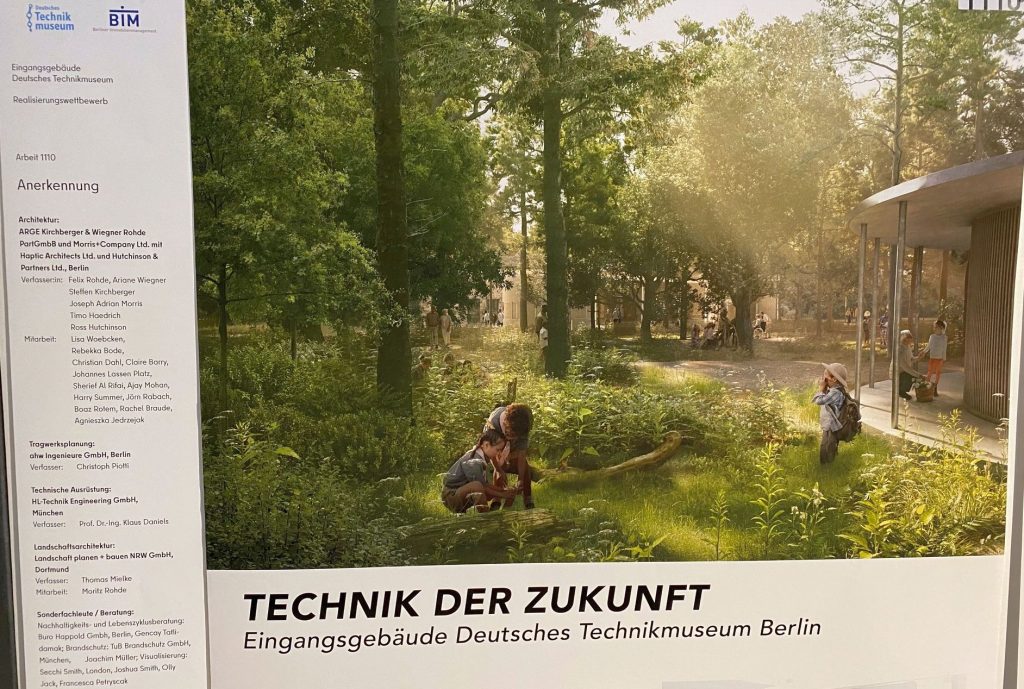
Neben den 3 Preisen wurde noch 2 Anerkennungen mit Preisgeld ausgesprochen.  Die Nr. 1110 imaginierte eine naturbetonte Umsetzung, die die Technik visuell in den Hintergrund verschiebt. Sie setzt einen wichtigen Kontrapunkt zur Technikverliebtheit in den Nachbargebäuden. Worum geht es bei der Technik? Richtig, letztlich um den Menschen und seine Lebenswelten. „Bionik“ beispielsweise ist Technik, die die Natur zu Rate gezogen hat. Das ist in der Forschung und Entwicklung von Technik ein riesengroßes Thema. Aber wir können dafür doch wieder ein eigenes Museum bauen. Bisweilen können wir und alte Computer und Telefone im Technik Museum ansehen. Klar Autos gibt es auch. Die Spannung Natur und Technik wird uns sicherlich noch einige Generationen lang beschäftigen.
(Image: Auszug aus Unterlage und Würdigung des Anerkennungspreises BIM, 2023)