

Autonomous Robot

We have been used to computers beating the average chess player and even the best players. In 2026-4 the journal “Nature” published the documentation of an autonomous robot (Ace) winning the occasional game against top-level Japanese table tennis players. Peter Dürr et al. (2026) described the robotics challenge as constructing a robot that can match the human capability and reaction time of “fast, precise and adversarial interactions near obstacles”. The high speed perception of movement is coupled with event-based vision and builds on AI-algorithms like reinforcement learning. The step ahead is remarkable.
About 50 years ago, as coach in table tennis we used a machine or robot throwing balls towards us which moved from left to right in timed routine, for example. These simple robots we used to train humans. Now the robot is reactive and even interactive, learning from strategies and tactical moves. Technology can outperform us in most singular tasks in 2026. The combination of several of these skills is still quite unique to humans, but the clock is ticking for human singularity in technical matters. What was considered a “false good idea” in the Paris exhibition “Flops” at the Musée Arts et Metiers (see image below), might be an interesting response to challenge the new generation of autonomous robots.
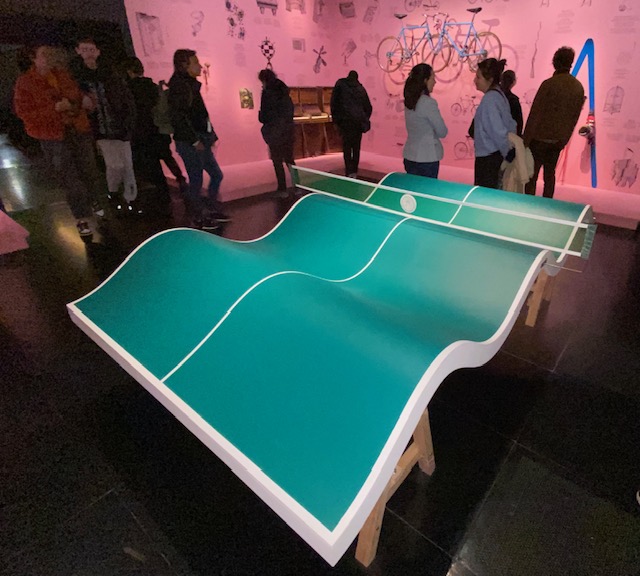
Paris Olympics history

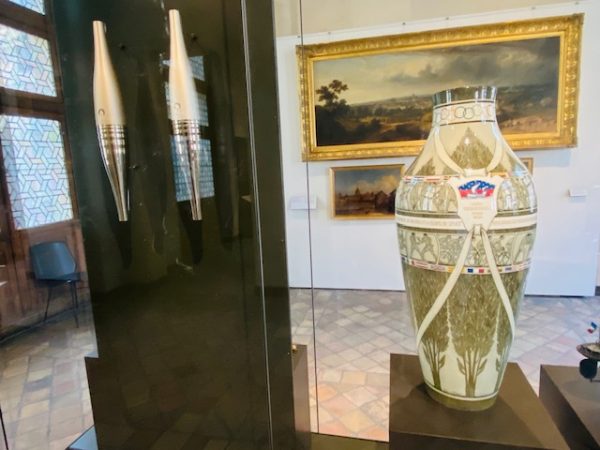
The 2024 Paris Olympic Games will go down in history as the event that has achieved to put Olympic Games and Paralympic Games on an equal footing. At least this is the message the  museum of the history of Paris tries to transmit. In the “Musée Histoire de Paris Carnavalet” we find a vase from the Games from 1924 in Paris next to the 2 Olympic torches, one for the Paralympics and one for the Olympics 2024. Both torches are the same only a different logo on them, same message, same spirit. The impact of these games is likely to set an example for many years to come and other hosts of the Games will be measured against this benchmark. Making history is one thing, taking care of the posterior image another one. Paris has taken of this as well.

Paris 2024+1

Urban Planning has to deal with the medium and long term time horizon. This is a challenge in a world of short term preferences of financial markets and creditors. The Paris Olympic Games of 2024 demonstrate in an impressive fashion that a balance between these different time horizons can be achieved. The whole of France debates 1 year after the opening of the olympic games what has remained of the investment and the exceptional achievements for the country and its population. The newspaper “Le Figaro” of 2025-7-26 p.12 has published an interview with Tony Estanguet, one of the main organizers concerning the subject. The best of the Paris games 2024 for him was “to see the whole country work together”. The united spirit to make these Paris games a success remains a special experience in an often very divided society. In 2025-7 the “vasque” has survived in “Les Tuilleries” after some debate once the games were over. Therefore, a bit of the Olympic spirit can still be experienced in the center of Paris where the games have become a part of French history. 

Law and Legality

Some persons consider themselves to stand above the law or push all interpretations of regulations beyond usual understanding of it. Even after a person has been dealing with pharmaceuticals or drugs used also for doping purposes, the conviction of such a person may take several years if not decades. In France, Mr Bernard Sainz seems to be a good example of such a relentless case of practicing para-medical consultations to assist mainly cyclists in endeavors to win championships or professional status. Le Monde  and Cash investigation have raised awareness of the public for such dubious practices. The “French Federation du cyclisme” and medical doctors association fight a continued legal battle against this persons exercising illegally such doping assistance. 

With apparently 56 legal procedures in connection with this person, the legal system has to bear the majority of costs of such illegal practices.

The reach of such dubious practices might be extended if the systems beyond doping, but for assisted euthanasia cannot be controlled effectively. Hence, the precursor cases of positive stimuli like doping pose similar challenges to the legal system as “negative stimuli” weakening persons as assistance to die. The end of a life course is not only a medical issue. Society-wide debates need to take place in order to organize a large consensus on the implications more liberal practices shall entail. 

(Image: Palais de Justice, Paris 2025)

Mind Paris

I have been asking myself what it may mean “to be in a Paris state of mind”. After a creative sabbatical spent around and about Paris I am happy to present the flipbook of entries on Paris in 2024 and the Olympic Games. My perspective is a social scientist’s view of public affairs. It builds on the many brillant minds and organizers who managed to make Paris a very special experience in 2024. Beyond the fabulous distraction of the sports events, which received sufficient attention, there were and there are so many exciting experiences that it is well worth speaking of a “Paris state of mind”. It happens in the quiet places of Paris, the museums, libraries, churches, parks and in the pedestrian areas. The 21st century has begun and Paris wants to remain in the top locations for modern experiences.

My flipbook for you to enjoy:  Paris and Olympics 2024.

also as versions: size 16 MB Pdf-Version, best to read in even spread format over two pages on one larger screen (text left side, image right side), just as a suggestion.
Some prefer already the epub3 format (EPUB3) to jump from topic to topic and follow links in a comfortable way, but please do not print to save paper. THANKS, feedback welcome. 

Innovation Painting

Innovations have fascinated painters just as much as photographers. The impressionists have painted trains and steel bridges as well as modern city life. Innovations change the atmosphere of a situation and new forms of transportation have been admired for many decades. Artists and painters have dealt with this phenomenon in various ways. Either the innovations have puzzled the normal vision of people or things or the artists hinted at curiosities or incompatibilities. Gustave Courbet has depicted in a unique style (Realism), as early as 1865, a seated woman with a paddle on something similar to a catamaran. It is maybe surprising that the modern form of stand-up paddling looks a little bit like the „podoscaphe“ painted by Courbet. Innovations in sports continue to evolve and become part of Olympic Games as well. Some disciplines make it into the Olympic canon rapidly, others never make it. The exhibition of „Artists and Sport“ gave ample opportunities to reflect on the the relationship of artists and innovations as well. (Image Musée Marmottan Monet, Paris 2024, Extrait de Gustave Courbet, Femme au Podoscaphe. 1865)

Games over

All nice things eventually come to an end. So do the Paris 2024 Olympics and Paralympics.
The images have been impressive of both events and the millions of spectators give a good testimony in this respect. The cultural by-program of the Games was equally remarkable. The live performances of dancers not only on the opening and closing ceremonies attracted big audiences. Many well-known sites of Paris prepared their own events and inspired as well as entertained the visitors.
On the small stage in front of the “Marie de Paris”, the city hall (Image below), ballet performances (video) were staged to hint at the possibility to see more artistic performances throughout the year in Paris opera houses and other stages.
Showcasing many forms of cultural, inspiring and entertaining events gave a valuable additional flavour to the Paris Olympics. Many good reasons to come back and renew unique moments in Paris beyond 2024. Paris hotels will be more accessible again for moderate budgets and waiting times for entries should come down to normal levels as well. Back to a new normal for Paris. Well, maybe. The millions of spectators who followed the Games on television and social media might eventually decide to rank Paris higher in the “cities you have to go to at least once in your lifetime”.

Olympic Criticism

The Olympic Games are, like every international organization, subject to criticism. In democracies this is part of the DNA of democracies that you can voice your criticisms openly without being threatened by persecution or arrest. The Olympic Games have since its beginning in ancient or modern times favored sport disciplines that have a link to warfare. The spectrum of disciplines has been extended recently to blur a bit this belligerent image of the Games. However even the break dance is performed in a kind of battle or competition between two adversaries. This is the reason why totalitarian states have (had) a predilection to show off their state sponsored warriors in the Olympic Games. Nazi Germany and the Berlin 1936 Games were the worst example of how the Games can get abused only to demonstrate a country’s force through athletes. Dictatorships of our times are not much different in this regard. Showing how many successful athletes (soldiers) you are able to produce is somehow an indicator of your professional training system of elite performance. Now, add to it the top performance in the Paralympic Games like Paris 2024 and you can even demonstrate how well you are able to care for and train potentially even also for mutilated warriors. Criticism of preparations of warriors and war masked through sport competitions are maybe unfair or utterly displaced here. It is, nevertheless, much better to compete on the sports-field rather than with loaded weapons. Only in retrospect, we often understand, why some nations made such enormous efforts to demonstrate a commitment to win as much as possible. With a growing enthusiasm for the Olympic Games the critical reflections rise as well.

Paralympic Counting

The classification system of the Paralympic disciplines is well worked out. This ensures that competitions are on a more equal footing. The counting of medals, points and penalties is an easy task. It is more difficult to keep track of equipment and infrastructure and the adaptation status of it to Paralympic needs in a country or region. Statistics and monitoring of installations is one important step in preparing for participation and success in Paralympic disciplines. On an European open data platform we find the regional data set of “Parasportive equipment in clubs and committees of the Pays de la Loire”, for example. Transparency of structures is a first step in improving access to it. For Paralympic athletes it is the same process to gain access to sport equipment as for all other athletes. The monitoring of infrastructure and equipment is a laborious task, but the documentation of helps people on their way to obtain access. Paralympic counting, therefore, is much more than counting medals and trophies even if they are really nice looking.

Olympic Medals

The distribution of Olympic medals across continents reveals the persistent inequality of rewards across the globe. The first African country in the overall ranking of countries by Olympic medals is Kenya on 17th place. All 11 medals including 4 gold medals were obtained in athletics and in running disciplines 800m and more. The financial resources needed to practice running as high level sport are probably the lowest one of all disciplines. Ethiopia is another African country with this tradition of high level long distance runners on the African continent. Equipment and coaching in other disciplines than athletics involves more infrastructure and becomes more costly and the possibility to reserve infrastructure for elite athletes of a country is more difficult if the infrastructure for the population at large is rather limited compared to the population size. Therefore, the Olympic tradition has to confront the challenge of unequal access to many disciplines of the Olympic Games also in Paris 2024. Being a very good athlete is just not enough if you lack the coaches, training and facilities to be able to compete with the well-equipped countries. The knowledge about the best details of a specific technique or optimization potentials are part of the Olympic challenges as well. The Americas, Europe and Asia might be confronted with new forms or another criticism of imperialist strategies, this time in the domain of sport. The winner or medalists take all. Country rankings appear a bit like the football device “money buys goals”. (Image, Fondation Louis Vuitton, Paris, Extrait of Omar Victor Diop “Diaspora” 2014-2015).