Taking positions

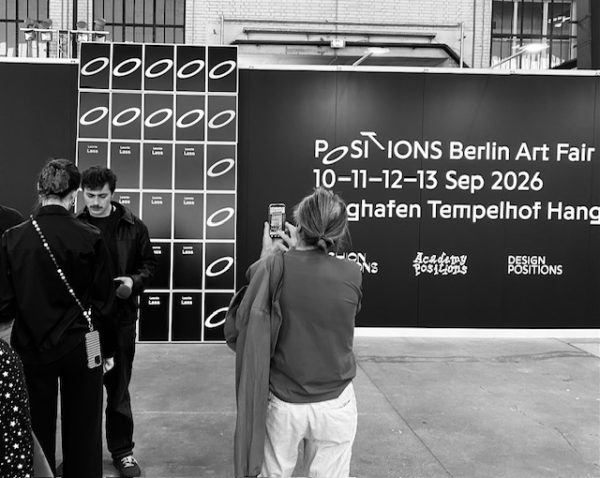
In the arts, positions are taken through the choice of topics, materials, an own perspective or approach. For the young artists, taking a position is quite a defining moment, usually after experimenting with several ones before. That point of view is probably a bit biased by a galerist’s perspective or when studying the market of art. Related to the Berlin Art Week, the Positions Berlin Art Fair offers an interesting overview of what is on the market. The section entitled Academy gives space and attention to young entrants into the art market.
The exchange of artists with the audience allows to understand in more detail what position is taken, how it is taken and worked out in detail. The  backgrounds of artists are quite broad compared to other metropolitan Art Fairs in this start-up atmosphere at the Hangar 5+6 of former Tempelhof Airport in Berlin. If we look at other perspectives, we shall not only get inspired, but we shall most likely question our own position(s) as well. Great learning experiences for all.
Time and power

Who commands our time? Who commands your time? Both macro- and micro-level analyses of power relationships related to time need to be investigated. Time policies are most obvious when it comes to regulations of working time, permissions of business hours or so-called bank holidays. On the micro or individual level, it is often the question of who spends more time on work, care and repair. Hourly wage rates have been claimed by economists to guide or decide societal time spent on one or the other activity. An extension of this rationale with an overriding objective of happiness might considerably change the impact of power relationships on time. Longer time perspectives on health shall also shift the view of how power impacts the time spent on various activities. Time sovereignty is a precious value in its own right.
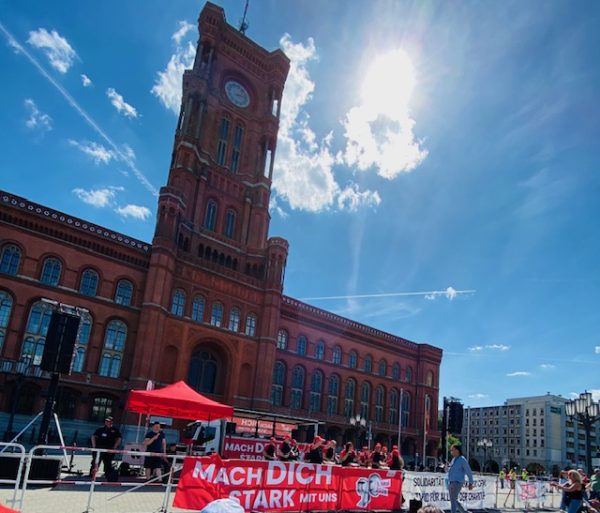
The power play between employers and employees keeps shifting the balance, albeit the overall trend over the last 100 years has been towards a reduction of working time and increased time sovereignty of employees as a form of democratization of working life. This constitutes one form to share the benefits of productivity gains over decades as well. (Image clock on Berlin City Council building on labor day 2025).


Sink / Rise

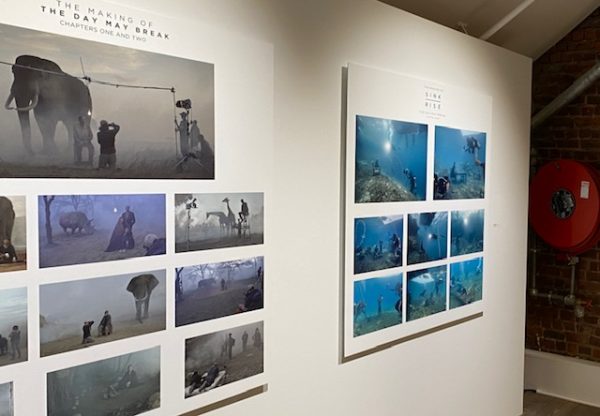
Nick Brandt presented his engaged photographic projects “The day may break” in Brussels at the Hangar Gallery space in Brussels (2025-9-21). The photographic work spans the globe to document and tell the story of a an endangered planet. The environmental and social fabric is at risk of an unprecented scale in the 21st century. Rather than producing hours of documentation, Nick Brandt focuses on images that stick. His “mise en scene” is meant to haunt us. And it succeeds in it. In the best sense of a tradition of a “photographe engagé” he intends to convey messages, even whole narratives to us about and from people in remote places, who are endangered through our inaction or paralysis in front of the challenges posed by global warming and climate change as well as the social and societal consequences.
We can save people from drowning in floods and rising sea levels. The chapter Sink / Rise of this project was produced with people from the Fiji islands who participated in the futuristic scenario of a sunk island. Without accusations, these people question us. Why? How? What for? Where to? – without speaking a word. They spend time in on a sunk island, surrounded, submerged by beautiful, but morbid, turquoise water and the graveyard-like remainders of a broken coral reef. These are photographs not of these people, but about them, about their likely fate, and (very important) produced with them as empowered actors. May they have a chance to rise like a phoenix from the ashes from these photos.
The documentation on the “Making of …” (image below) as part of the same exhibition allows transparency and additional insights into the artist’s work and proceedings.
(Image: Hangar Gallery, Brussels 2025-9-21, On the making of Sink / Rise by Nick Brandt)


Dream together

„Dream together“ is the title of the exhibition of Yoko Ono at the „Neue Nationalgalerie“ in Berlin 2025. The title is an invitation or even an incitement to dream jointly with others. We need to dream of peace on all sides or parties in a war. Start with the dream and then move on to working together on it. The participatory art projects of Yoko Ono are a recurring event in Berlin and at the Neue Nationalgalerie (Cut piece). The installation „Wish Tree for Berlin“ in front of the gallery is popular with visitors who leave hundreds of written wishes to the windy spring days. Origami folding, stone assembling or a simultaneous chessboard playing with all white pieces and fields encourage to imagine a world differently, beyond the treaded belligerent paths. For more inspiration and imagination just continue to the Martin Gropiusbau for more artworks from Ono or just watch the clouds pass by changing the lighting of the olive tree carrying lots of wishes.

Kids Space

Political claims to reserve more space for kids in cities have a tough time. Kindergardens or child care in general are scarce and the lobby for kids is often limited in time and extent, since it is the parents that usually are the ones to advocate while their children are small. Jointly parents and children of young age experience the tough atmosphere to find, preserve or extend the space for kids.
The Gropius Bau in Berlin has opened up an exhibition space reserved to children 3+ as part of an art project “BauBau” designed by Kertin Brätsch 2024. A colorful room and installations as “loose parts” are the starting point to delve into a real/fantastic world were kids reign. There are a few so-called “playworkers”, who accompany the endeavours, if need be. At the end of the day the room was still in pretty good shape I would say assuming that “children set the tone and decide what happens in this place”. Safe and supportive environments for children are scarce and parents are always challenges in their attention to watch out for risks of all sorts in public city spaces.
Even if the “play space” is free of charge, it takes parents or kindergarden managers to reserve the space.
An early experience of a museum from the inside is likely to have lasting effects on children and the parents. They might have fond memories of a museum as an exciting space also for them. It constitutes a nice continuation of the outdoor “radical playground” project during summer 2024.

String Quartets

There is a plural form of Quartet. Philip Glass has composed a piece for 3 string quartets. Thanks to the Kronos Quartet performing and celebrating in Brussels, modern compositions are continuously added to the repertoire written for and performed by string quartets. Contrary to received wisdom the tradition of string quartets is still alive and kicking. At Bozar (Brussels) the marathon performance of 27 quartets, not all at once, but spread over a day and several locations, afforded a great free-of-charge opportunity to wipe off the dust from the sometimes rather introverted form of string quartets. Despite the high share of young musicians who performed well at the occasion, the afternoon focused more on new compositions. Concerning the audience, however, there is still an older age bias in listeners, more the standard Bozar clientele so far.
The afternoon reminded me on listening CDs entitled: “I don’t like classic music, but this one I do”. Many people came for art exhibitions at Bozar, but then (re-)discovered on the sideline the atmosphere of chamber music at this occasion. Closing the age and social gap in classical music is quite a challenge. It is surely more like a marathon than just a few sprints here and there. The new format at Bozar in cooperation with the Kronos Fifty for the Future Marathon will sooner or later find extended audiences beyond the happy few this time. I would recommend listening to string quartet music more often until the “Transcranial direct current stimulation (tDCS)” will be the new hype.

Gov Tech

For many years we have believed that technology is something for experts and a special sector of the economy. Private sector companies have taken the lead and innovative applications of e-solutions or web-based applications have moved online to attract huge crowds. Some 20 years later, the scope to move public services online are on top of the agenda as well. Not only in security, defence, infrastructure management and health e-solutions are drivers of innovation and improve the reach out to persons in remote places, where it is hard to keep up equal provision of services otherwise. This is where “Gov Tech” comes into play. Government Technologies I would define as all technolgies that are needed to service your current citizens, past and future citizens as well as “want to be citizens”. This needs a whole of government approach, since there are many cross-cutting issues involved like cyber security and data protection.  “Gov Tech” is no longer just nice to have. It has become a “sine qua non” condition of government. The expectations of people have been shaped by private use and habituation to online access and amenities that government and public services have to follow suit in order to be perceived as similarly close and accessible for people. Besides the technological aspects of hardware and software solutions for gov tech there is the huge issue of taking people with you on that e-journey. Even social policies and social inequality are subject to the e-volution of gov tech. There is a potential to reach more people with the same number of administrators by use of new gov tech solutions. At the same time, the risks to loose people who choose to remain off-line or have no access to online services increases as well. Gov Tech poses multiple challenges as well as interesting solutions. Great to see many regions and states taking these issues very seriously.
(Image: SCCON, Berlin 2024-10).

Digital public management

Countries with large public sectors also have specialized research called administrative science. More than 25 years ago the whole discipline has been hooked on the idea of so-called “new public management”, which introduced “management by objectives” and “benchmarking” as new tools into the field of public sector management. In Germany Naschold and Bogumil (2000) have been publishing extensively on the topic.  In 2024 the new public management is well established and the now new challenge is “digital public management”. Berlin just hosted a fair on this topic (SCCON 2024). This allows to speed up administrative procedures, increase the reach of public administration into remote areas and creates new challenges to counter the digital divide of society. The modern public sector may shift from being pushed by private sector companies in terms of digitalization to being a forerunner of digital provision of services. Tax declarations in Germany are a good example, where for many years it is a widespread practice to rely on digital forms of declaration and communication between the tax office and its clients.
Other countries, like Estonia, have taken already many more far reaching forms of digital public management and digital provision of services. The scope of such reforms is huge and the administration of persons in remote areas and aging societies give additional reasons to push ahead with digital public management.
At the time when even emails become outdated among youth, some administrations are proud to feature their latest innovation in digitalization. A machine is opening physical letters and scans the documents automatically and stores them in a secured cloud for example. It is indeed an important “bridging technology” for administrations dealing with a generation of older persons who are used to this form of communicationd by (snail)mail.
Many interesting new digital solutions (hard and software) were on display at the SCCON 2024 and many more are in the pipeline or pilots have been implemented already, well worth studying in more detail.

Swimming Pool

Summer time is the time to enjoy outdoors. Hiking, biking, climbing as well as swimming are high on the agenda. With the Olympic games 2024 around the corner we rise to the challenge and get started again with more sports activities. Swimming has many health advantages. Most people think of cardiovascular training and relieve of back pain. Exercise without carrying your body weight is great for your joints and ligaments. The benefits for psychological wellbeing have long been underestimated. Diving into silence under water even if it is only for some seconds or a minute calms your spirit. The water pressure holds you tight without restricting your movements. Breath control is an almost meditative experience. Everyone can do it, again and again. Childhood memories, good and bad, are associated with swimming. Choose your style, costume and pool. The summer break is an ideal occasion to test the marvelous experience again of cold or warm water. The cold water bucket challenge of everyday life takes a break. Time to find your pool again. (Image extract from Susanne Hay, Swimming Pool II, 1996 in private collection, exhibition in Yerres, summer 2023)

European Voters

Elections of the European Parliament are more about a learning and participation experience than about crucial political influence. This seems to be the lesson learned from the relatively low voter turnout in many countries in 2024-6. Belgium reached by far the highest percentage (90%) of participants, but it had federal and regional elections at the same time. Croatian voters could not be bothered with these elections with just 21% of turnout. Many countries hovered around the 50% participation mark like France, Spain, Italy, Ireland and Sweden. Germany reached almost 65% which is relatively high, but due to its population size, it sends the most MEPs to Brussels later on. The most surprising result is the extremely low turnout in the former Eastern, Southern Eastern and Baltic states of the European Union. Apparently, the voters in these countries care little about their political option to vote for MEPs. This should worry all other parts of Europe profoundly as we invest billions in infrastructure and social cohesion to keep the European Union an open house for all East and West, South and North. The challenges for the next 5 years are huge. The expectations are high, but the commitment to democratic procedures like voting and decisions through the ballot box are not to be taken for granted throughout Europe. (Image European Parliament 2024-6-11)