

Organics are the new hype. Organics are everywhere. It is true in organic chemistry, biochemistry or pharmaceutical biochemistry we start from organic compounds as the basis for various forms of classification systems, structures and reaction chains. A search for organics brings you to Organic Farming and to lots of other applications of organic production as well as organic design.
The extended definitions highlight the foundation in biology and chemistry to then include any processes which integrate cyclical reproduction or resources and conservation of biodiversity. Based on the plurality of forms and connectivity of organic compounds this leads to a vast and diversified basis of carbon- and hydrogen-based life on earth. The ensuing complexity (variety of species) has been the basis for mankind to come into being. It is likely to determine also our survival in the long run. Organics is based on open as well as closed forms and therefore has an encompassing nature. Depending on time and space constellations (temporality) evolution has taken one or the other path. We are certainly not at the end of this evolution, although we through the loss of biodiversity we narrow down new potentials in an unprecedented way. Rethinking life on earth from a cell-based perspective of plastics and chloroplasts is a challenge, but it will lead us on towards the “organic turn” in the 21st century. 
On Temporality
Time is passing, or is it? We tend to confound time, with passing of time or an occurrence at a specific point in time. Time has a static use, which refers to a date of birth or date of death. Time refers to durations like the lifetime or time in office of a person or a political leader. In most such cases time is considered as a continuous and linear process. The concept of temporality questions these common perspectives on time to allow additional time perspectives in the description and understanding of time.
Temporality is linked to a more flexible view on the periodization of history. The time before and after the 12 years of Nazi-terror will then be part of the extended periodization of the Nazi-Regime in Germany and Europe. Similarly, temporality widens the perspective on social phenomena by linking historical events to the time before and maybe even to what follows, seen as a consequence of the temporal and spacial co-evolution.
A deviation from the static view of time and a rigid periodization of fascism allows to study the Russian male dominated political authoritarianism as a new wave of fascism in Europe, which negates the right of existence of the state of Ukraine in its neighborhood.
Temporality expresses the need to go beyond a simplel periodization to include a spacial dimension in the defintion of time, much like modern physics does in relativity theory. Temporality, therefore, opens up a “thought space” beyond just the timing of events, which may challenge many of our day-to-day experiences. Cultures with a different understanding of time or the pace of time become a “sound board” for our way of considering and being captured in a time space. Probably many artists are forerunners in playing with time and the way time is “treating” them. Most of them face(d) hardship during their lifetime, but have an extended “after life” in terms of reputation. Some contribute to the perodization in the arts and of their time. They all shape(d) temporality.
(Image: extract from Hans Bol, 1593 Ring Jousing in front of a pond inan imaginary city, MRBAB, Brussels)

Beckett by Beckett
There is an interesting discourse in literature about how to define irony. This really begins with Plato commenting on Sokrates who makes use of the term “eirôneia”. In the history of the idea of irony comes next the philosopher Kierkegaard with his not-ironic treatise “The Concept of Irony. With Constant Reference to Socrates”. Reading philosophy can be really entertaining. It is, therefore, no surprise to find a publication entitled “Ironic Samuel Beckett” (Pol Popovic Karic, 2009). Following Karic there are 3 defining elements of irony: (1) “The message should be intentionally created, …(2) The meaning of an ironic message needs to be “covert”,… (3) During the analysis of a stable irony, the reader can assume that the first interpretation of the ironic message is correct.” (Pol Popovic Karic, 2009 p.49).
Additionally, to understand irony it might be necessary to know more about the context of the statement. Sometimes the ironic statement can only be interpreted as such if you have additional knowledge about the biography of the author (p.47). To understand Beckett better it is advisable to read about his life course in the many biographies available nowadays.
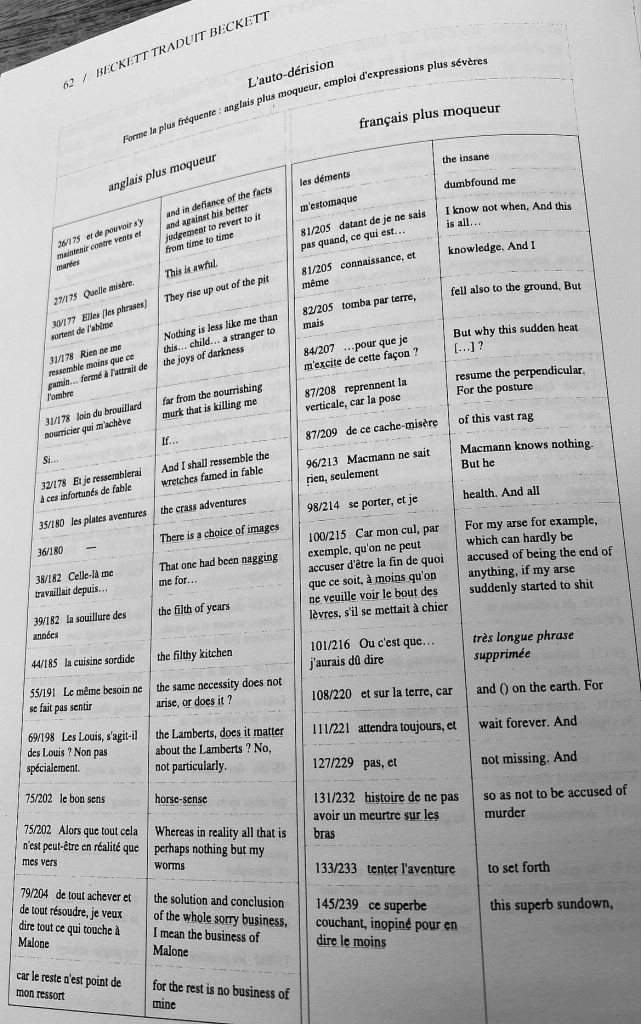
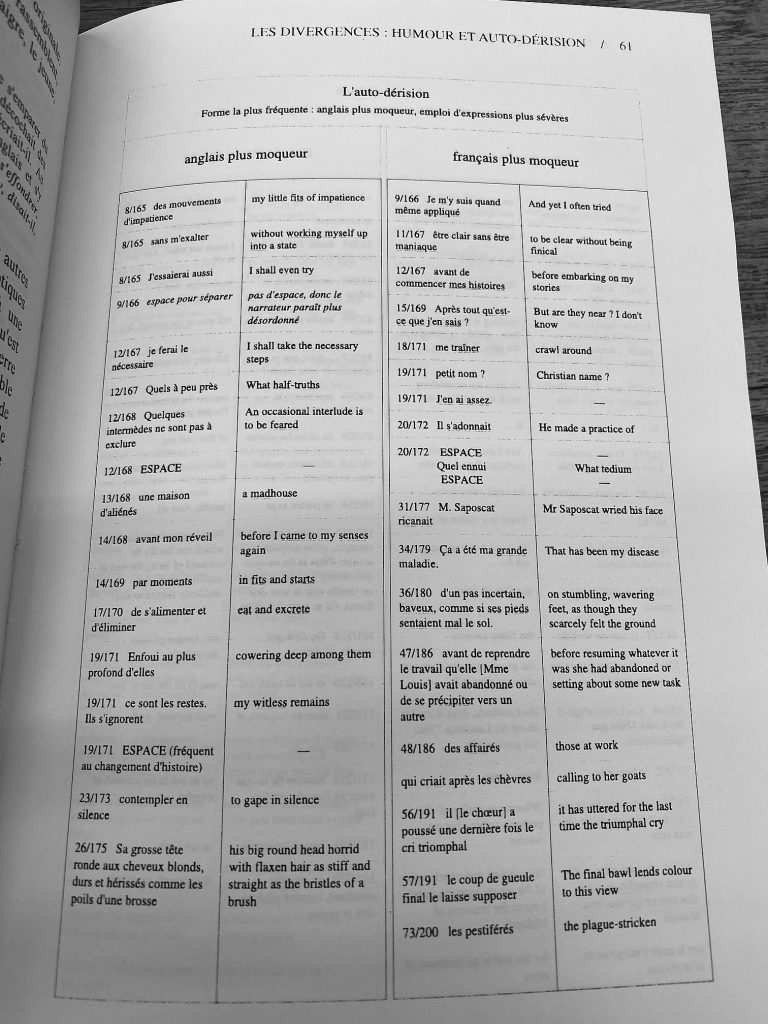
Beckett by Beckett, meaning the translation of Beckett by Beckett himself yields many fruitful insights into his kind of irony and constant reflection and laughing about himself as his very own form of irony. This becomes most evident in the many helpful tables Linda Collinge (2000) presents in her book on “Beckett traduit Beckett”. Translating irony is a tricky endeavour. Many of the translations do not seem to be straightforward at all and can only be understood from the perspective of the whole translation of a piece and the underlying “Haltung”, ironic attitude of the author to his own work. Beckett by Beckett remains a master piece for translaters beyond those from French to English. (Images: Linda Collinge, 2000, p.61-2).
Beckett and philosophy
Beckett and philosophy is the title of challenging read of usually unconnected literatures. Richard Lane embarks on the challenge “theorising Beckett and Philosophy” in Part 1 of the book. This is followed by 2 other parts on “Beckett and French thought” and “Beckett and German thought”. The whole book constitutes an attempt to identify the links between seemingly unrelated work. Sometimes spurred by tiny citations, the importance of influences becomes apparent.
Beckett like Rousseau favours speech over writing. Speech giving access to nature. This, Beckett has taken from French thought traditions. Redefining philosophy after the 2nd world war links Beckett to the thoughts of Adorno and Habermas (early writings). Posing Nietzsche’s thoughts as a post-modern project of endless questioning, Beckett himself enters into a kind of Socratic dialogue with Nietzsche. Spoken words become writing, the written word resembles an unspeakable void. The borders between void and silence, between spoken and written, become blurred. The essence is the world in-between.
It appears like irony and yet it is our very existence. We probably need somebody to translate Beckett for us in order to better understand his philosophical stance. “Beckett translates Beckett” is such a book title. It invites us to study Beckett’s own efforts to translate himself, at least from one language to the other. 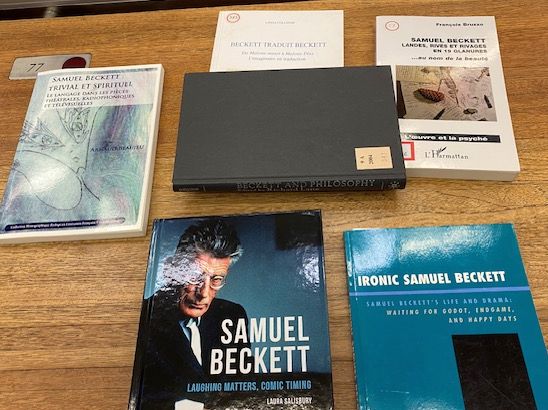
Geben und Nehmen
Gedanken aus Anlass des Weihnachtsfestes.
Zum Schenken gehören immer 2 Parteien. Gerade Weihnachten ist ein Geben und Nehmen. Dazu gab es in der letzten Adventswoche eine interessante Sendung von 5 x 10 Minuten im Deutschlandfunk von Mechthild Klein. Hier erstmal die Links.
Judentum Kleine Geschenke vollenden die Schöpfung
Buddhismus Reich ist, wer teilen kann
Atheismus Schenken mit Hintergedanken
Christentum Früher war weniger Lametta
Islam Großzügigkeit – die Tugend des Propheten
Selbst mit dem Wissen über die kulturellen Bräuche beginnt erst die multikulturelle oder interkulturelle Herausforderung. Als College Master im Krupp college hatten wir für solche Feierlichkeiten ein festliches Essen mit kleinen Geschenken und Livemusik abgehalten. Das fand ungeteilte Zustimmung. Interkulturelle Kompetenz lehren und dabei lernen war uns immer ein Vergnügen.
Frohes Geben und Nehmen wünschen wir in der Post-Covid19-Zeit wieder!