Sponge Mofs

Many people might have come across “SpongeBob” as a TV-series. Well, in 2025 it is time for an update. The Nobel Committee has awarded the Chemistry prize not to SpongeBob, but the research linked to the sponge-like Mofs, i.e. metal-organic frameworks to Kitagawa, Robson, Yaghi. These Mofs have in fact properties  similar to a sponge or cages in some applications. They consist of porous materials, which have large surface areas in relation to their apparent volume. Due to the modelling of network structures the surface of a grid can be expanded drastically.
Due to the application of such modelling techniques, the combinations of materials/organics and, thereby, the applications to modern technological challenges have increased tremendously. The exponential growth of research papers based on these foundations largely justify this honourable award. Not only the potential of carbon capture, but also the storage capacity of batteries as well as medical applications might benefit from this basic research and findings, eventually.
Playing around with a sponge, doing your dishes – also for men, or watching Spongebob might be considered differently from now on. Maybe, just start with a virtual visit of the Nobel museum for further inspiration.


Passing barriers

In quantum physics the real trick is not the rebound of electrons like the rebound of droplets, but the passing of electrons of an insulating barrier. The experiment of the ”Josephson junction” has set a precedent to research the surprising macro-effect of “quantum tunnelling”. The 2025 Nobel Prize has been awarded to Clarke, Devoret and Martinis who observed these effects on a macroscopic scale. The applications in the most advanced quantum computers of today shows the enormous potential of this demonstration in pushing computing speed boundaries. The international competition to develop such, ever faster computers, based on quantum physics, is running on high development speed. In combination with the artificial intelligence (AI) developments, these types of combined machines are likely to outpace the development of human-based intelligence. It becomes even more important to define the limits for those machines by us. Subsequently, we shall have to make sure that such combined machines stick to the rules, we define(d).

Marc Aurel Book 7

In paragraph 63 Marc Aurel refers to Plato as one of his sources: “No soul”, says Plato, “likes to be robbed of truth” ( and continues himself) “– and the same holds of justice, moderation, kindness, and all such virtues. Essential that you should keep this constantly in your mind: this will make you more gentle to all.” The remarkable reasoning is to transform the own generalized experience into a behavioural recommendation. It may be argued that Marc Aurel starts from a kind of Aristotelian empirical study of persons in different life domains to derive an empirical fact. Based on this he develops a more Plato inspired “idealistic picture of mankind”. He is very much preoccupied with the philosophical question, how is a good life for all possible. In a previous paragraph (55) he outlined his 3 guiding fundamentals: (1) “The main principles in a man’s constitution is the social; (2)… resistance to the promptings of the flesh, like impulses; (3) judgement unhurried and undeceived”.
With such a claim for a “rational constitution” of man, he puts himself into the footsteps of previous philosophers of the ancient Greek tradition and, therefore, his writing in Greek rather than Latin is also a homage to this philosophical heritage.
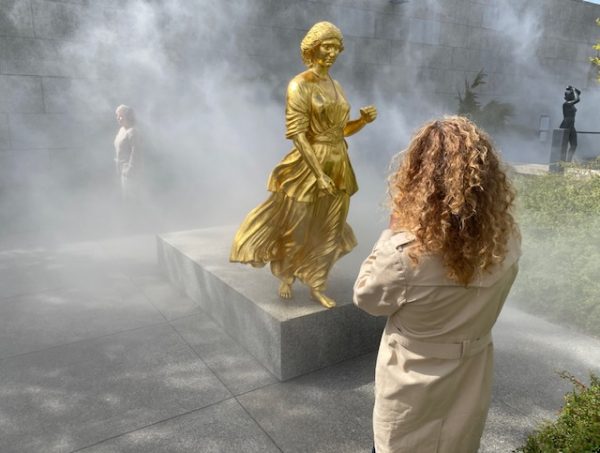
(Image: parts of Installation by Fujiko Nakaya in Neue Nationalgalerie Berlin 2025)

Marc Aurel Book 2-5

There are several translations of Marc Aurel. In the Shakespeare English translation from the Greek original of the Meditations a passage (Book 5 paragraph XXIII) describes or idealises humans as a “reasonable and sociable creature, regulated and directed.” The same short quote of this paragraph in the English translation by Martin Hammond (Penguin Classics p.43) reads: “…my wish is to follow the nature of a rational and social being.” Of course, both translations are pretty similar at first glance, but the difference of “reasonable” versus “rational” and “sociable” versus social” mark very important differences that had and have different impacts throughout the following centuries up to today. As in many other instances going back to the original version in Greek (book link) might clarify the issue, however, the entry barrier is access to the bilingual version and use of an ancient Greek dictionary.
With almost 2000 years of advances in rational approaches and its tools like mathematics, the scope of the rational is huge and the behavioural turn in the social sciences demonstrates the limitations of human’s use of rationality (λογικός) in decision-making. Reasonable seems to come closer in today’s “post-enlightenment” world.
There is also quite a divergent connotation in the simply “sociable” (κοινωνικός) being or the “social” being, which has a wider scope attached to it. Hence, lets be aware of the implicit interpretations of translations. For a start the parallel reading of translation and original (Link) might enhance our understanding and spur even new translations and interpretations, which speak with the classic originals to today’s audiences (with or without AI).
A witty joinder of both previous translations is “And my will is the will of a reasonable and social being”. (Link Book V, paragraph 29 bottom).
From the Greek to French in book V (Link)  with an even broader understanding of the social as “la société universelle”.

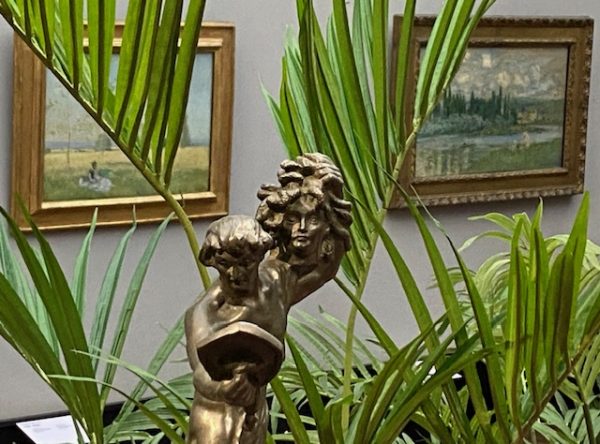
(Image: Camille Claudel 1905: “Persée et la Gorgone, Lucile Audouy collection Paris, exhibited in Berlin 2025, Alte Nationalgalerie)

AI Podcasting Me

Content producers have lots of tools at their disposal to get their content across to very different audiences. For some time the traditional media of newspapers, radio and TV were the prime outlets for content distribution. Social media have changed this to many more senders of content than before.
In the 21st century, AI allows to automate media productions. In a trial run I just used Google’s NetbookLM to generate 3 podcasts based on my own writings on AI over more than a year by now. The result is available and using artificial voices it is possible to broadcast yourself without revealing your own personal voice. I am not done with the evaluation of the outcome(s) yet, but the first impression is an interesting other form to spread content.
More tests are necessary to check for hallucinations as well.
Here are the links to my virtual podcasts:
AI, intimacy and insecurity

AI, Society and the Human Spirit

AI and the Human Mosaic: Navigating Our Interconnected Future

Mind Map Me

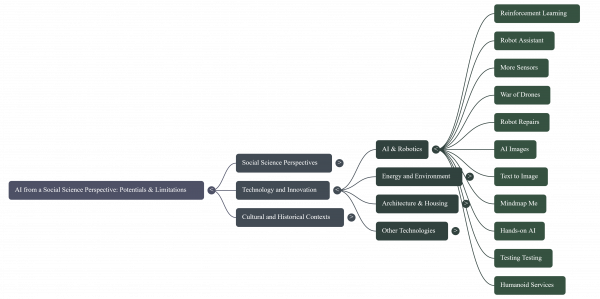
AI tools are great to assist learners in the task to get more structure into larger documents or books. It is up to the teachers or lecturers to use the tools themselves to pre-structure content they want other persons to learn. Mind maps are useful to summarise larger content and offer a tree-like structure to a text moving from the general to more specific content and then into details by at the same time not loosing sight of the overall structure of the content. Basics can be provided by Google’s NotebookLM and you may rework this basic structure yourself linking the mind map to the detailed content. Learning may start with a comprehensive mind map at the beginning to move on to details. Alternative versions of a mind map are equally feasible to come up with new combinations of subjects. This can be done using the tags of the blog entries in addition to the categories and fast search keywords.
It is a fascinating way to mind map yourself based on longer texts written by yourself. This clarifies a bit what potential readers or learners are likely to retain from reading your document(s) or blog entries.
Its worth trying, as others will most likely use these tools from now onwards anyway, whether we like it or not.
Image: Google NotebookLM Mind Map of my AI blog entries 2025-9-9.

Own AI related entries

The digital drafting of blog posts facilitates the publishing of volumes based on a selection of entries. Pdf-files, or EPUB formats are quite common. The choice of a flipbook is more suitable for larger screens of tablets or notebooks. It also serves as a rapid stock taking of entries and missing topics to cover a broader field. In some fields AI is not yet popular, for example in agentic home applications, whereas in other fields text, translation or image production AI has grown into a threat to professional fields. Even computer languages are a major field of application with substantial negative employment effects.
Hence, enjoy the latest comments on AI towards the end of my latest Flipbook.
Just click here.

ChatGPT provides a summary of my AI-reader as follows:

From the uploaded text AI from a Social Science Perspective (Dr. Klaus Schoemann), social science concerns with AI focus on potentials and limitations of how AI interacts with society:

  • Labour and employment: AI impacts jobs, but adjustment processes are slow. For example, there’s a shortage of engineers and care workers, while robots are still limited to simple assistant tasks. This raises concerns about who benefits and who is left behind.
  • Bias and fairness: The book highlights issues of biased results in research and decision-making. When AI systems rely on incomplete or selective samples, results can be misleading — a challenge also familiar to social scientists.
  • Democracy and accountability: Journalists and scientists are framed as part of a “checks and balances” system. AI adds complexity here, as the fast spread of information without accountability can weaken democratic processes.
  • Human–machine relations: Topics like intimacy, housing, and memory are re-thought in the context of AI and digitalization, raising questions about privacy, social norms, and cultural heritage.
  • War and security: AI-driven technologies like drones change the nature of warfare, raising ethical and political questions.

On his blog, Schoemann also stresses the energy and resource costs of large AI models and how reinforcement learning offers a more efficient alternative. He warns that AI should be understood not just technically, but as part of an “all-electric society” where social sciences help assess risks, inequalities, and long-term consequences.

👉 In short: AI raises social science concerns about equity, bias, democracy, labour, cultural shifts, and global risks.

Vacation Waves

One of the most popular choices for a vacation is in connection with waves. There seems to be something mystical or romantic related to waves, which touches many people irrespective of their background and across continents. This goes much beyond what we know about waves from physics or maths and this is already a fascinating scientific story in itself. Sailing adepts will be able to tell marvellous tales about waves, too. Coming back from a vacation near the sea or a lake, you surely may add another story to the already rich inventory of waves in art or literature. The imagery about waves started early as well, ever since sailors started to conquer the world.

Paris Sorbonne

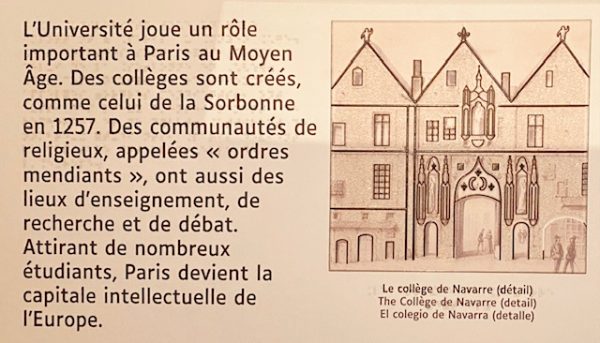
The history of the university on the left bank of “La Seine” dates back to 1257 when Robert de Sorbon an advisor to Louis IX was asked to create a unifying structure of several colleges which provided room and board already. The location on the left bank in Paris allowed these colleges to escape the religious doctrines and archbishop who dominated the right bank. The choice of the name of the advisor rather than the King was already showing early signs of independence which was cherished by generations of students and professors. The Colleges had individual names like “Collège des Bernardins” or “Collège de Navarre” and operated under the title of “La Sobonne”. The “Musée Histoire de Paris Carnavalet” shows an early design of the Collège de Navarre. Independent thinkers and writers were formed there who became very influential later on in their careers. Thomas d’Aquin was one of them.

Scienceploitation

Science can be exploited to make unjustified profits from referring incorrectly to it. Social sciences, like economics may be used by banks to sell you products that refer to science only as part of their arguments if the science based inference fits their purpose. Scienceploitation is very common in the field of para-medicine and para-pharmaceutical products. Health promises sell. The time until an ineffective treatment reveals the unrealistic promise to be unachievable considerable profits have accumulated on the side of the selling company. Science has a hard time to counter the perils of scienceploitation. Advanced knowledge can be used and abused as any other method of convincing people to buy or subscribe to a product. The responsibility of the scientific community consists also in finding ever new ways to counter scienceploitation. AI will pose additional challenges as well as opportunities.