
More BRICS

The move towards a multipolar world order is in full swing. With the USA retreating from a primordial international role discarding UN institutions and the defense of major elements in the fight for individual freedom, the diplomatic order of the last 80 years has changed. The liberation of the concentration camps in Germany and the 80 years of the end of the 2nd World War on 1945-5-9 had forged an alliance in which the common enemy was defeated and the the next major confrontation in Europe or on the globe had to be warded against. 

The evolution of peace in Europe has been marked by the Cold War and a bipolar world order which confronted the USA and Russia at various places. The rollback of Russia has seen its high time with the Northern and Eastern extension of the EU and NATO. This goal of US strategic interests has been largely accomplished. 

In the shadow of this bipolar relationship the BRICS have moved towards greater economic power and therefore influence in the international arena. Economic data on the biggest economies in the world over the last years show the rise of the BRICS, bit mainly China and India. Their population sizes create enormous and largely shut off internal markets. All these developments create new challenges to the previously relatively stable world order. Technological advances have been narrowing more rapidly than before since the access to the best available knowledge spreads fast and more equally across the globe through the internet. 

The ugly face pf imperialism is returning front stage and attempts to change the previous versions of imperialism into a new hegemonic world oder. Updated views of economic power and influence zones let us look with a rational perspective on the new power play. Due to the containment of Russian influence, the USA has China as the major power to confront, a major shift as of the 2020s. The China-driven Silk road project with strategic landing points across the globe has „trumped“ American efforts to align BRICS to human rights values over the last decades. European diplomacy will have to recognize that we entered another phase of „Realpolitik“ due to major economic shifts over several decades. (Image: extract from Max Klinger, The walkers, ambush, 1878 in Berlin SPK).

Space Missions

As we realize that critical infrastructure on earth is not safe in times of military conflict, space missions have become an additional form of competition between countries, continents and alliances. India has accomplished in January 2025 the coupling of 2 space satellites. The level of technological knowledge to achieve the coupling and decoupling of satellites included among other competences the mastering of algorithms that control sensors and propulsion. Beyond the communication cables on earth, satellites can assure telecommunication services, if other networks are interrupted.
The Indian Space Research Organisation (ISPO) has announced the successful “space docking experiment” (SpaDeX) and joins the other 3 countries US., Russia and China as the 4th country to achieve this. The race in space and to space beyond earthly competition shifts attention also to the additional category of a race to technological innovation and applications of those. Since the war of Russia in Ukraine we know about the “dual use” factor (civil and military) of satellite technology. Satellite images of your own country are helpful in many respects ranging from weather forecasts, rain, draughts and habitat changes or population movements. Early warnings of flooding are surely important civil applications. Movements of military equipment by potential enemies are much needed early information, which increases warning time spans. With more satellites in space the good as well as the dangerous potential is expanding. Sovereignty in the 21st century certainly has a technological dimension. Therefore, the demonstration of satellite coupling in space accomplishes not only a dual use achievement, but also fulfils a triple use or ambition. The 3rd one is political. Hey, look we are also watching you, or might do so.
(Image: Robert Indiana “Imperial Love” 1966/2006 in Berlin Neue Nationalgalerie)

More Battles

In 2025 we continue with the same battles as in the previous year. However, the way armies fight military battles has evolved. New types of weapons like drones have entered the stage. These precision weapons (Horowitz, 2024) have the advantage to be not only less costly than other heavy mass and costly artillery, they can also be guided in swarms to their targets. A further advantage is the steering of drones needs differently qualified persons rather than advancing with heavy armored vehicles on battlefields. Upskilling of defense forces is an important side effect. Jamming technology of radio frequencies was applied before, nowadays this has turned into a crucial defense strategy to intercept and derail drones and rockets off their intended targets.
Other than heavy weight arms, even laser beams enter the arsenal of weapons, if targets are sufficiently static in nature. These high-energy beams are still more in the research and testing realm rather than used on the battle field, but it becomes clear that research capacities play and played an important role throughout military history. The next generation of robots, not only in production processes, but more those walking on the battlefields is likely to change wars to less manned interventions. The technological innovations shall further move the spiral of new generations of weapons forward. Fewer soldiers, but more robots in the air, at sea and on the ground might increase the risks of “restrained”, less costly, but longer duration conflicts across the globe.
I always thought of robots as rescue robots to save lives. The flip side of the coin, however, is destruction before rescue as well. Technology can be put to both purposes. It is us who decide, which one takes the upper hand.

Comprehensive Conflict

In a recent paper Mara Karlin (2024 Foreign Affairs LINK) has stated the need for the Western World to understand and even prepare for comprehensive conflict. Particularly in response to Putin‘s war on Ukraine’s territory and the threats and potential use of the full range of weapons including cyber warfare, destruction of energy resources and military production sites the current war comes close to total war. Several European countries have made significant steps to increase budgets for the new forms of comprehensive conflict management. This starts with adequate discussion in public on the dramatically changed security situation after the „Zeitenwende“ caused by Putin. The forceful Ukrainian response with much financial assistance from the West has pioneered drone counter strikes and by this put an end to the Russian progression into its territory. In order to match the total war ideology Putin is implementing in Russian society the Western world will have to rethink production models and strategic defense capabilities in all areas to match the rather real threats by Russia. The prevention of the spreading of comprehensive conflict is of utmost importance since the risk of an expansion of Russian influence and suppression of any internal resistance in Russia has devastating consequences. The 2024 book by Tatjana Tönsmeyer „Under German Occupation, Europe 1939-1945“ (own translation of German title) demonstrates what it meant to live under the domination of an inhuman dictatorship which is ready to use all out war and violence at any occasion. We have to confront this, even if we don’t want to face it. Nevertheless, the Russian aggression is also strongly targeted on its own people not to take risks of separation from Russia as this would mean devastating destruction to those regions and people who dare to do so. External explosions are therefore for Putin a prevention of implosion of the Russian Federation similar to the Soviet Union previously. Comprehensive Conflict extinguishes any remaining internal opposition as intended collateral damage. In Western countries, however, we shall have to argue with opponents and build majorities through understanding the issues at stake not through silencing opponents and opposition. The debate about comprehensive conflict is only about to start, but it is likely to last for several election cycles. (own image, Contemplation on infinite landscapes, Berlin 2024)

Ballistic Missiles

Ballistic missiles have been studied as part of physics for centuries. The basic mechanics in gravitational fields like on earth are well known. Longer reach intercontinental ballistic missiles (ICBM) have been built by several countries for defensive or offensive purposes. China had demonstrated to master the science and technology of rockets since its latest launch of a ICBM in 1980. In 2024-9 China has demonstrated again, it is still capable to launch such missiles with long distance range (Japan Times 2024-9-25). This is both a technological task, but much more a geopolitical issue as a reminder to be taken seriously on the international political arena currently. Technological capabilities and capacities have regained geopolitical strategic importance as attempts to shift the global balance of power, which is undergoing multiple challenges or even changes. Flagging technological options is not only important to demonstrate own military strength, but to present a country as a potential strategic partner of global reach. Window dressing using weapons is much more oriented towards other countries (buyers of weapons mainly) than of relevance for Chinese society. Strategic alliances seek strategic partners. China is likely to receive more attention in the 21st century than before.
(Image: extrait de Gustave Courbet: La vague, 1870, Berlin SPK)

Ukraine Chess

Strategies in Chess, sometimes, inform strategic behavior in wars. In chess there are clear definitions of 2 opponents and their material. Modern warfare has blurred both elements. Opposing parties build alliances and the material allowed or available is hotly debated as well. The war of Russia on Ukraine territory, nevertheless, resembles a variant of a chess game considering the different stages of the game. All starts with Russia choosing its opening attacks. A rather aggressive version of the opening is the King’s Gambit in which a fast attack tries to overwhelm the opponent. Ukraine, because of the surprise and lack of immediate support from neighboring countries, chose a careful defense trying to hold the lines amid a fast forward moving assault. A further restriction for Ukraine was to not use weapons from supporters on Russian territory. In chess this would mean your defense is not allowed to cross the middle line of the chessboard. For example the so-called Sicilian defense does exactly this for many moves of the opening. However, in the middle game this changes and the defense might prepare forceful attacks based on a solid defense. With 2 and 1/2 years into the war the opening has played out and we see middle game strategies take the upper hand. In chess this consist in attempts to gain material advantage, possession of strategically important positions and psychological stamina to mention a few. The middle game can drag out for a long time, especially if a balance of power persists. Even in an unbalanced situation peacemaking takes time as well. In any case, during the opening phase the “Sicilian” defense can handle a defense that is restricted to “own half” of the chessboard, but in the middle phase such a restriction is an even more severe impediment. Relaxing this imposed restriction by supporters opens up additional possibilities for the defense as well as counter strikes. (Image: Shredder Chess App White opens with Kings Gambit and Black answers with Sicilian defense)

Comparative Advantage

In economics all students go through the calculus of comparative advantage. People, regions or whole countries tend to apply comparative advantage to their production systems and ensuing internal or external trade. The basic  rationale developed by David Ricardo has not changed that much over 200 years. The fields of application, however, are continuously expanded. Lindsay and Gartzke (2020) have applied the comparative advantage rationale to military strategy. The paper quotes 26 times Clausewitz and demonstrates the links of strategy to the basic economic and social rationale of comparative advantage. It is the politics of production that even the presence of trade may override the rationale of comparative advantage to favour local production of “operational domains” or military equipment.
In Russia’s aggression and war against Ukraine own production and trading of weapons has returned to the forefront of the concerns. In addition to the production of ammunition, the provision of drones has dominated the international arms trade related to the Russian aggression. Resources and time for production are additional factors that have an impact on availability of weapons at the right time at the right place and with the sufficiently trained persons to operate them.
The strategies that cross domains or combine domains seem the most promising. The careful analysis of your own comparative advantages or disadvantages needs to be the basis of any strategic decisions. This has been known for 2 centuries at least and is still valid in many fields of application. Additional considerations for “home production” might add to the complexity of the issue. Sustainability has also found its way into the field of comparative advantage at last. This may alter the analysis of comparative advantage of operational domains as well. Lots of unresolved puzzles still around. It will need years to sort this out despite the urgency of the Russian aggression on Ukraine.(Image: AI Copilot.2024-4-30 2 political leaders deal weapons. One has a comparative advantage in ships. The other one has a comparative advantage in aircrafts. they deal together)

AI Disruption

Many scientists started to question the disruptive potential of AI in, for example, the military’s domain. The Journal of Strategic Studies featured 3 papers on AI and autonomous systems more generally. The major argument by Anthony King is the reliance of autonomous systems on other systems mainly human operators even in the background to get these systems off the ground and maybe back again. Not only logistic support but also satellite communication is needed to guide and protect the operations. In quoting Clausewitz, Anthony King stated that war is a “collision of two living forces”. Strategy and counter-strategy will co-evolve as will attack and defence.
Jackie G. Schneider and Julia Macdonald (2024) advocate the use of autonomous and unmanned systems for their cost effectiveness. Economic costs as well as political costs are lower for these new strategic weapons. Mass fire power from swarms of drones is much cheaper than nuclear warheads and the home electorate is assumed to be more willing to accept and support limited and more precisely targeted unmanned missions. The disruption potential of AI is huge but it is most likely an addition to the arsenals than replacing them. (Image 2 swarms of drones fly in the air above tanks, created by AI – copilot-designer 2024-4-29).

AI Defence

For those following the development in robotics we have been astonished by the progress of, for example, rescue robots. After an earthquake such robots could enter a building that is about to collapse and search the rooms for survivors. A recent article in “Foreign Affairs” by Michèle A. Flournoy has started its thinking about the use of AI in the military with a similar 20 year old example. A small drone flying through a building and inspecting the dangers of entering for persons or soldiers. Since then technology has advanced and the use of AI for automatic detection of dangers and “neutralising” it, is no longer science fiction. The wars of today are a testing ground for AI enhanced military strategies. It is about time that social scientists get involved as well.
Warfare left to robots and AI is unlikely to respect human values unless we implement such thoughts right from the be beginning into the new technology. An advanced comprehension of what algorithms do and what data they are trained on are crucial elements to watch out for. According to Flourney, AI will assist in planning as well as logistics of the military. Additionally, AI will allow a “better understanding of what its potential adversaries might be thinking”. Checking through hours of surveillance videos is also likely to be taken over by AI as the time consuming nature of the task binds a lot of staff, that may be put to work on other tasks. Training of people and the armed forces become a crucial part of any AI strategy. The chances to develop a “responsible AI” are high in the free world that cherishes human rights and democratic values. Raising curiosity about AI and an awareness of the dangers are two sides of the same coin or bullet. Both need to grow together.
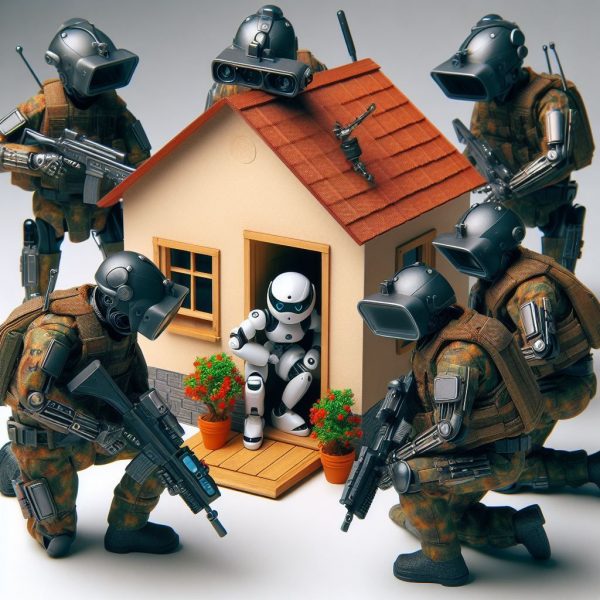
(Image created by Dall-E Copilot Prompt: “5 Robots disguised as soldiers with dash cams on helmet encircle a small house where another robot is hiding” on 2024-4-23)

Schachliteratur

Es gibt sie noch, die Personen, die Schachbücher lesen und kaufen. In vielen Sprachen existiert die Niche der heimlichen Strategen. „Teaching old dogs new tricks“ oder ist es eher „teaching young dogs old tricks“. Das ist eine empirische Frage. Nicht nur Zeitungen für sogenannte BildungsbürgerInnen haben noch kleine Spalten zumeist mit Schachproblemen. Manchmal findet sich Schachspielen sogar als Schulfach. Lesestoff zum Schachspiel findet sich reichlich. Schach in der Literatur ist jedoch verschieden von der Schachliteratur, die sich mit Strategien und Tempi befasst.

Das Lesen von Schachliteratur mit Meisterpartien hervorragender Spielenden ist vergleichbar dem Lesen einer Partitur einer Symphonie oder Oper. Das Kino spielt sich dabei überwiegend im Kopf ab. Gelegentliche unvermittelte Gesten oder Ah-laute sollten den Spielenden ihrer Verzückung wegen entschuldigt werden. Vielleicht sollten die Schulen diese Kulturtechniken mehr vermitteln. Macron‘s Vorschlag Theaterspielen mehr in den Schulen zu vermitteln erscheint in diesem Vergleich als ein Entgegenkommen an die „Generation der sich ständig selbst inszenierenden“. Mehr Spielen ist aber schon mal ein wegweisender Vorschlag.

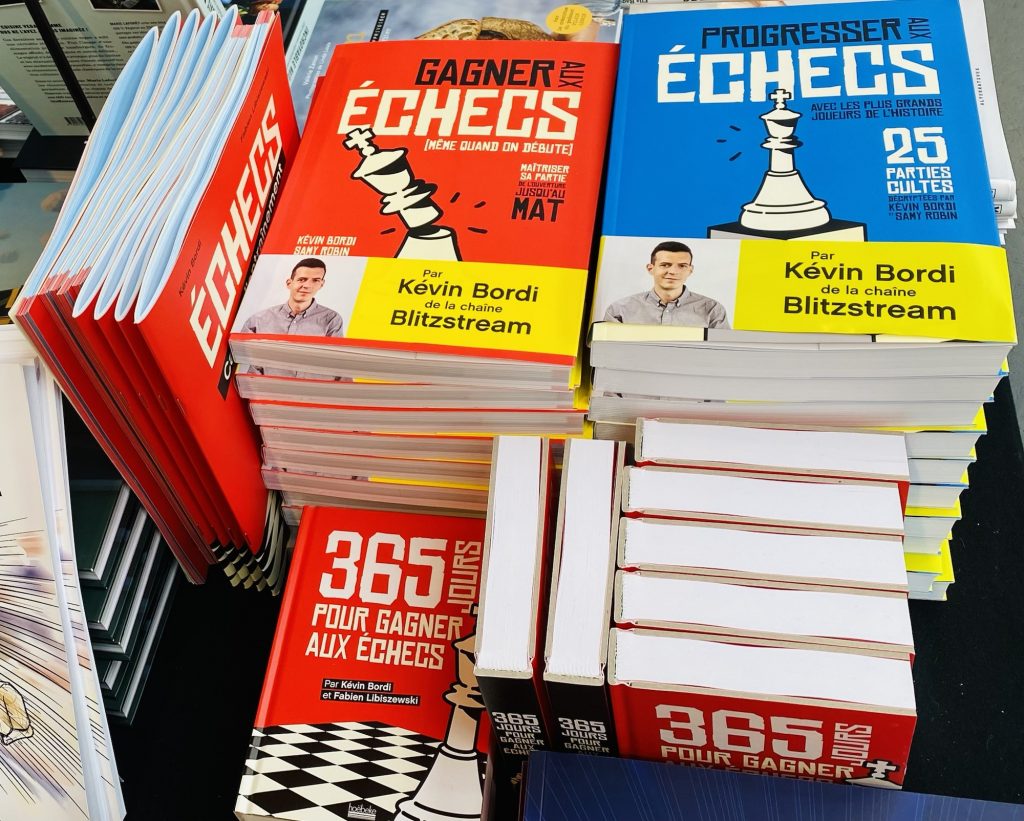
Schachbücher 2024