
Failure time

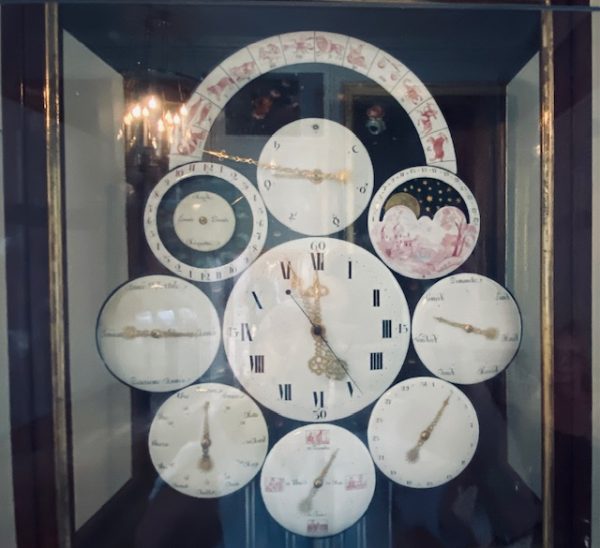
In mechanical as well as medical components it is interesting to know about the usually hidden failure time of a product. The failure time simply means probability the component will seize to function properly or altogether. Usually, this probability of failure increases with the duration and the intensity of use. We might know this from cars or heating systems, but airplanes and heart valves obey the aame basic statistical models. Programmed failure time is a nuisance, which works against all efforts of sustainability, Over-engineered products would work much longer than the actual use case. Locomotives with steam engines that still function well even today might serve as an example of the latter case. The issue becomes a bit more complex if we consider not only the product but each single component. Maximizing profits often leads to taking risks with failure times or failure rates over a fixed time (a more general term than the guaranteed lifetime of a product). This sounds rather abstract thinking, but in modern military equipment the consideration of failure time, self-destruction or destruction by enemy play an important role again. Failure time of military equipment has moved to the forefront of issues of equipment and is part of strategic planning, like it or not.  
Foul-smelling dictatorship

The animal world is full of interesting strategies of how to turn over a foul-smelling ruler or dictatorship. The ant queen of “lasius orientalis” infiltrates a colony of “lavius flavus” to spray the incumbent queen with a foul-smelling substance which turns the worker ants against their own queen and eventually kills the queen. This is a rather intelligent strategy to trick the defense system of rival colonies and prepare a takeover of a whole colony to install your own reign.
This may constitute a stark warning for democracies just as much as a threat to persistent dictatorships. In the age of the not so social media there is a lot of foul-smells produced. Beware of the risks to democracy as open societies are much easier to infiltrate than closed societies or dictatorships. (Link)

Weaponized Interdependence

The shift in the international political system is clearly expressed in the contribution by Henry Farrell and Abraham Newman in “Foreign Affairs” (2025 (Nr. 5) p.25). “… governments must navigate a terrain with many more players, figuring out how to redirect private-sector supply chains in directions that do not hurt themselves while anticipating the responses of a multitude of governmental and nongovernmental actors.”
As the number of bigger global players increases, the complexity to identify best strategies increases as well. Going it alone is only second best to coordinated actions. New matches of interests may result in the medium term. This could entail enormous long term realignments.
Russia attempted to play the China, and subsequently the India, card to achieve new strategic partnerships in this multipolar world. Other international players test new forms of alliances and strategies (like hybrid wars) in this period of weaponized interdependence as well.
The weaponization of such interdependencies puts critical limits to the basic economic rationale and a world building on comparative advantages together with trade, rather than going it all alone or try the coercive way of exploiting dependencies of mineral resources, supply chains, computing power and AI.
(Image: Chess figures attributed to Charlemagne, dating from 1080-1100 ” BNF Galerie Mazarin 2025-10)

Marc Aurel Book 6

Some passages of Book 6 can be understood like quotes of much later works, even like writings of the enlightenment period. Take this one: “If someone can prove me wrong and show me my mistake in any thought or action, I shall gladly change. I seek the truth, which never harmed anyone: the harm is to persist in one’s own self-deception and ignorance.” (para 21 in Penguin Classics version, also in Greek original and French translation).
The same passage in historic English: “If anybody shall reprove me, and shall make it apparent unto me, that in any either opinion or action of mine I do err, I will most gladly retract. For it is the truth that I seek after, by which I am sure that never any man was hurt; and as sure, that he is hurt that continueth in any error, or ignorance whatsoever.” (Para XX in Gutenberg.org online reader).
Why is this already an enlightened vision of truth? In the search for truth, he is open to criticism or doubt by others (maybe even irrespective of societal standing) and, moreover, ready to change his conviction and action. Religious doctrines of the time and many centuries after his writings would not have accepted such a doubtful mind who might change due to (scientific) reasons. Long before “Cogito ergo sum” (René Descartes, (1637), I think, therefore I am, of the early enlightenment, Marc Aurel might be summarized in this paragraph as “Cogito, ergo dubio”, I think, therefore I doubt – and I may change accordingly.
(Image: Ossip Zadkine, Forêt humaine, Musée Zadkine Paris)

Marc Aurel Philosopher

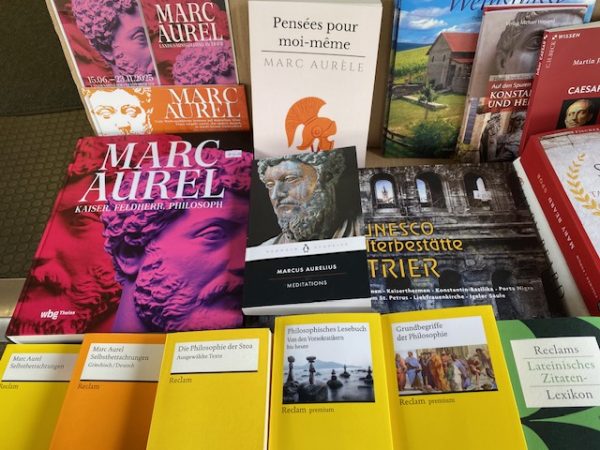
2025-9 marks an additional landmark in the achievements of the late Marc Aurel. In the Roman built city of Trier, 3 museums offer exhibitions on the life, ideas and imperial governance style of Marc Aurel. Libraries and bookshops around the city portray a wealth of books and studies by and about Marc Aurel as well in many languages (image below 2025-9). The stoic author and practitioner has served as an example of a leadership style which became for many subsequent leaders a hard-to-achieve precedent. The writing style of Marc Aurel in short paragraphs and aphorisms proved highly accessible, although his readership swell only after a Latin translation of his Greek original appeared in the 16th century. The title “Meditations” in English, “Pensées pou moi-même” in French or “Selbstbetrachtungen” in German demonstrate the difficulty to get to grips with the author’s intention and objectives in writing down these reflections on life, ethics, humanity and good governance. Through the use of Greek rather than Latin he puts himself in the line of Greek philosophers rather than the succession of Roman emperors. As the numbers of bad leaders still outnumber the good governance style advocated by Marc Aurel, these exhibitions in the Simeonstift, the Landesmuseum and the Stadtbibliothek are a perfect opportunity to demonstrate that good governance is something that can be studied and learned even in the distant Roman history.  

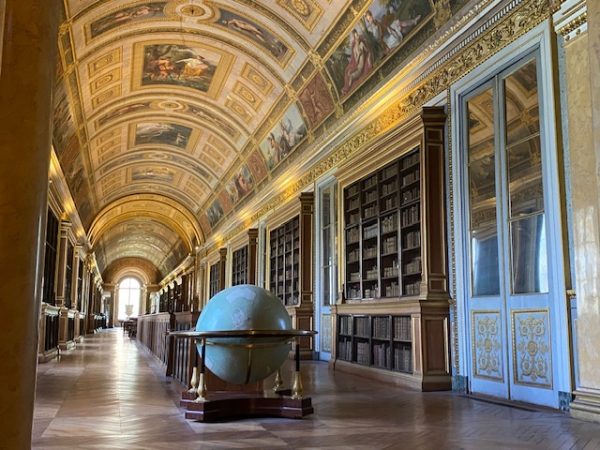
Fontainebleau library

The “Galerie de Diane” in Fontainebleau has been built during Napoleon’s reign. It hosts the library with a large collection of books. The function of the books seems to be more to intimidate the persons passing by rather than ready for inspection. The globe at the entrance reflects the ambition of the ruler. The fact that you have to walk some stairs upwards increases the impression to be little compared to this universe of knowledge. It is great that libraries have flipped this perspective and today we study the period of Napoleon’s reign with our democratic values in mind. The top-down approach was the incarnation of Napoleon’s style of government. Despite the revival of such governance styles in the 21st century across the globe, they are unlikely to last for more years than Napoleon’s fate. A simple reason for this may be the only representative or intimidating role of knowledge in such forms of governance rather than an open mind approach. 

Killing fields

According to “Le Monde” dated 2025-5-26 the persons who died in the war initiated by Putin amount after 3 years to 250.000. The numb of injured soldiers would be 3-4 times as high. The loss of lives and tarnished life expectancy of persons involved in combat adds up to a huge loss for the Russian people. Being misled by political and military leaders, apparently substantial numbers of recruits for all sorts of services face the choice between the combat field or desertation. Tough choices which remind us of the moral conflict raised already during peace times if you were refusing to join the compulsory military service. Western people are better prepared for such moral dilemmas than the glorification of war in the Russian society. Of course, certainly in Germany we are thankful for the hardships the Russian army and people had to endure during the 2WW. Liberation Day would not have happened without the Soviets, Russia and Ukraine plus many other nations fighting until Nazi- Germany surrendered. The positional battles of the Great War seem to be back again enhanced with a war of drones. The killing fields for a generation of Russian troops is completely self inflicted. How many thousands Putin needs to acknowledge this cruelty? (Image exhibition by Yoko Ono Berlin Gropiusbau 2025-5).

War of drones

The use of drones in warfare is not new in 2025. However, the news reported in the WSJ 2025-05-05 that sea drones from Ukraine with U.S. adapted missiles downed 2 Russian jet fighters made headlines. Compared to jet fighters such drones carrying missiles are a rather cost-effective alternative in warfare. The speed of jets compared to drones made such successful attempts rather unlikely. The information that infrared technology can achieve such identification of targets and guiding missiles is another innovation of the Ukrainian military technology.
Technology is well known to be a game changer in warfare for centuries or across the whole military history. Adaptations of defense strategies will allow Ukraine to hold against the Russian aggression albeit limited financial resources. The defense of air space is one of the crucial elements for Ukraine to deter Russia from moving further ahead through the continuation to increase the costs of war to Russia.
Following a fast moving object and transforming it into a target is an astonishing accomplishment.

Unwinding USA

Stock markets move largely due to expectations. Therefore, the mixing of economics and politics can create lots of signals, which are likely to raise price expectations. Inflationary pressures will call for central banks to increase interest rates which will reduce economic activities that are largely financed through the credit market.
The unwinding of the economy reduces turnover and most likely also profits of companies. The fate of Tesla cars in the last 2 months (Link) and the stock market value of Tesla shares (Link) have plummeted. The unwinding of shareholder value and inflation on the rise as well are a the effects of the MAGA narrative and Musk‘s appointment in politics as chief of GOPE.
The „home made recession“ in the US and the choice to prioritize own products might work in the long run, but the costs of the short-term induced inflation will affect vulnerable consumers more than the people who buy many products that show few price increases. The unwinding of the economy of the USA is likely to cause shock waves rippling through the global economy.
Image: Prices to charge e-cars with solar energy in Germany according to sunshine.

Screenshot


Betrayal Politics

Most economists would hold that in free market economics there is no room for moral statements. Betrayal, therefore, is left out of most standard text book economics courses. However, more advanced courses that include strategies based on so-called “game theory”, where actors may breach prior commitments, betrayal has entered economic science. A “tit-for-tat” strategy is frequently the best “game-theoretic” solution to such strategic behavior to deter also repetition of defecting on agreed rules or bargaining outcomes. For real world applications beyond the simple strategic advice, the maths involved are quite challenging. We’ll check soon, how AI is changing that game.
Another popular economic theory is one of “gift exchange”. You gift a sum of money (or weapons for self-defense to a country) with no explicit consent that the money should be repaid (through rare earths) in peace time. A betrayal occurs, if a country suddenly asks things in return for the previous gifts. For politicians that understand themselves as “market marker” and “deal maker”, there will be a tendency to claim back a gift in order to come to some kind of gift exchange rather than an altruistic donation.
William A. Galston wrote in the WSJ (2025-2-26) naming the US political action of the 2nd Trump administration a “betrayal of Ukraine and American values”.
If free markets mean making ruthless use of “tit for no possible tat” and “gifts are always a gift exchange”, we move back to mercantile and medieval practices, where settles could claim land at gun point.
What way out of this? Adam Smith, champion of classical economics, wrote before his famous book on “The Wealth of Nations” a lesser known, precursor book on “The Theory of Moral Sentiments”. Actually, he was convinced that the one would not work without the other.
Maybe, going back to classical economics is much better than a Trump administration version of neo-classical economics in a new era of political economy 3.0.