National interest

Especially in times of international conflicts, it is customary that politicians refer to “the national interest” as a justification for their actions beyond the state borders, commonly named foreign policy. There is a huge literature on the subject, in which the concept of the national interest is useful, (1) because it suggests some higher ranking political goal, (2) because it clarifies and prioritizes a country’s goals, particularly at times of military interventions and (3) because it “arouses the support necessary to move towards a realization of the goals” (Rosenau 1968, Int. Encycl. p.34).
A critical assessment of this concept in international relations should start with the democratic perspective that a country’s government is subject to regular elections, whereby the goals a previous majority had put forward, might substantially change as a new majority takes the lead. Continuation of the same foreign policies is not excluded, but at least subject to revision. In authoritarian regimes the definition of the national interest is probably more stable, because authoritarian leadership does not hesitate to define the national interest in “splendid isolation” from its people.
Overall, the concept appears to serve mainly communication purposes, both internally as well as towards the outside as in communicable foreign policy goals. Conflicts between countries can thus be named and become subject to diplomacy and international treaties. But we have to fill this with substance over and over again as new topics arise like climate change and global warming.
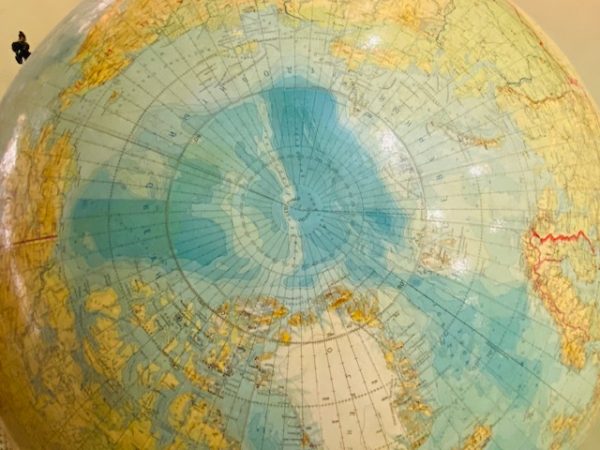
Interconnected multipolarity

In a very long-term anthropological perspective on the balance of power on the globe, the period that mankind lived on this globe has been characterised by an unconnected multipolarity. People lived in their more or less isolated communities before the Egyptian, Roman, Chinese, Australian, African or Japanese empires and people of the world became connected through new means of transport and communication networks.
In the 21st century the world wide web has broad us closer together and suddenly we realize that unipolarity or bipolarity might be options again through the unipolar dominance in airspace and radio frequencies. Even if unconnected multipolarity has been by far the longest period of mankind, the new developments in international politics resemble more a world of interconnected multipolarity than an American dominated unipolar or bipolar world of the Cold War period until the collapse of the Soviet Union. Stephen Walt (2026) and Raja Mohan (2026) discuss the concept of multipolarity in the same issue of Foreign Affairs (Vol. 105 Nr.2). Whereas Walt emphasises the USA as a “predatory hegemon”, Mohan describes the USA as being tempted and actually currently going it alone in international politics.
The current military image of world politics seems to be dominated by unipolarity again, maybe just before the longer run realities of economic, demographic, financial, trade and productivity developments, already reflected already in such data, take the upper hand again. The spectrum of the unipolar, bipolar, multipolar world privots around multipolarity in the long run, even if bipolar or unipolar intermezzi are part of the historical evolution.
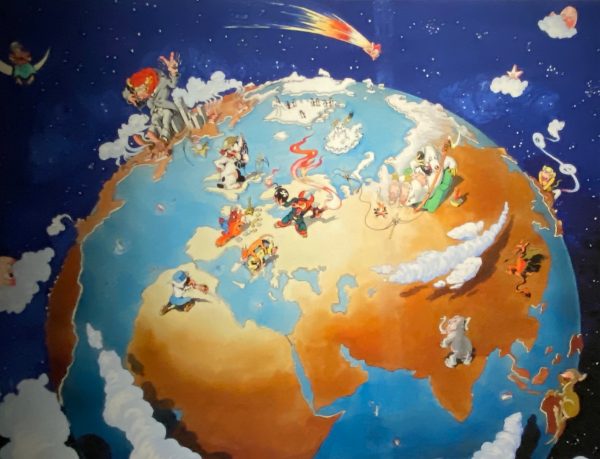
(Image: view of Obzorno-geografceskij globus, Moskau 1994, Stabi Berlin 2026-1)

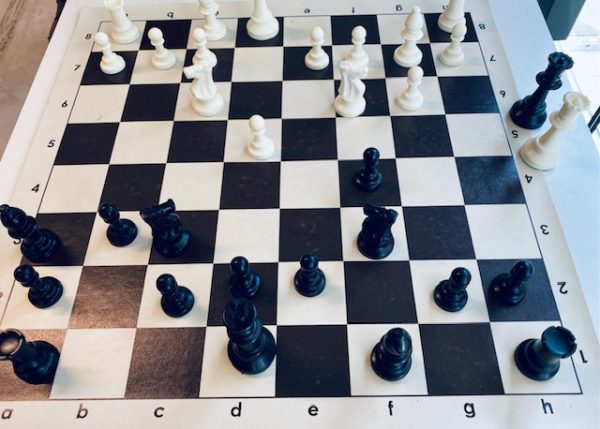
Chess without Queen

It is perfectly possible to play chess without a player having a queen on the chessboard. This certainly gives an advantage to the opponent, but in case of a lack of an adequate strategy or being overly confident to win, the advantage can be compensated by the party who does not have a queen in the arsenal of weapons. The paper by Lissner & Warden (2026, p.109) on the new way of war following the Russian invasion of Ukraine in 2022-2-24 states that “nuclear weapons have not given Moscow the coercive leverage many assumed they would.” Nuclear weapons hit the civilian population without differentiation the hardest, just as much as taking nuclear power plants as strategic war targets would do. What we have seen so far in Russia’s strategy is to use civil infrastructures of water and heating as targets within Ukraine as part of a kind of psychological warfare against the Ukrainian civil population. The more committed Ukrainian soldiers, even with the lack of a nuclear weapon, seem to hold the line against the Russian aggressor that so far has restrained from the nuclear option, if the Tschernobyl disaster has not been a precursor of a weaponisation of nuclear infrastructure.

Future Conflicts

Since 2014-2-27 Russia has occupied the Crimean peninsula. This invasion had started with an undercover mission of unmarked soldiers to take full control of Crimea about 3 weeks later. Russia did not officially declare a war, although the intentions were identical to a land grabbing war. The western world did not react much to this violation of international law. Apparently, this contributed to the next cynical “special operation” by the Russian army to fully invade Ukraine on 2022-2-24 in a failed “Blitzkrieg”, a rapid invasion, which attempted and failed to annex the whole of Ukraine. According to Lissner & Warden (2026) the Russian invasion of Ukraine bears 4 lessons for future conflicts: (1) the risk of using nuclear weapons is real, (2) in addition to nuclear options, prolonged and very destructive conventional wars remain an option, (3) escalation thresholds emerge and evolve over the duration of the conflict, (4) allies and partners in war keep adjusting their risk tolerance as well as escalation options. The authors argue from a US perspective and add a practical comment: “The USA cannot go this alone, but should coordinate closely with allies and partners in time before another conflict arises. Multilateralism seems a valid option and even more so as we move into a multipolar power play on the global scale propelled by AI.
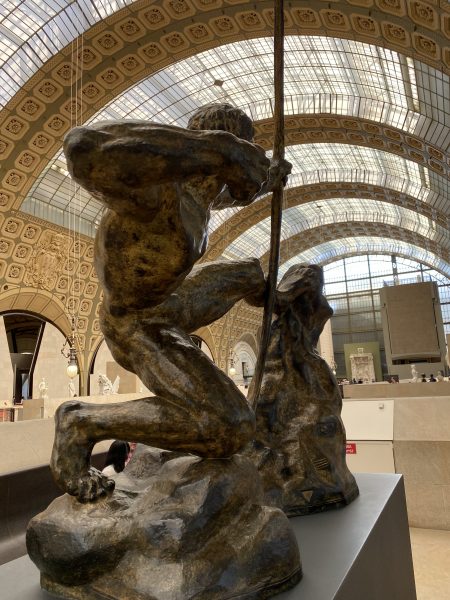
(Image: Musée Orsay, Paris – Archer, Bogenspannende)

Peace and war again

“If you want peace, prepare for war”. This is one of the famous citations from Vegetius an early Roman general. For centuries we have been aware that peace and war are not opposites in a broader sense. Preparation for war can resemble war, if a country’s economy is already heavily turning towards production of weapons and intensifies research in dual use technologies. Political terminologies that shift to a vocabulary using more belligerent language may also be interpreted as a early signs of a shift in balance between peace and and early warnings on war. 4 years of the war of Russia on Ukraine territory have left traces in our vocabulary as well as budgets devoted to the preparation of a defense in Europe.
More countries of the EU state openly what is in their “national interest”, as if they were ready to go to war (Charap & Haukkala 2026) to in case major elements of the national interest were endangered. In going back to Clausewitz’s writing, a long historical line can be drawn from the Crimean War(s) to Putin’s imperialist war of 2014 and 2022 trying to capture Ukrainian territory, irrespective of enormous human losses.
Another lesson from these historical events might be: Let’s not forget to prepare for peace during the hot conflict.

External-Internal Threat

In a time perspective of at least since the German unification of 1990, we have to reconsider the perception of what constitutes an external versus an internal threat. Prior to the implosion of the Soviet Union and the Glasnost years, the external Russian threat has been transformed across the globe into more hybrid threats coming from internal forces which have been “instrumentalized” by external forces. In an essay by Valentine Faure (Le Monde 2026-2-21) this twist to internal politics has been described as a form of new forms of interference of external forces into European internal political, economic and social affairs. In fact the basic strategy is as old as the famous Trojan horse, but the strategy has been refined and to work over much longer time spans as well as in other scientific applications. Any form of powerful, interested party would rather use the soft power of persuasion than brutal force to reach political objectives. Corruption and buying votes, directly or indirectly, has become a legitimate way in this hybrid or open use of power from the inside of a society than through a more traditional external affairs strategy. The confrontation of the bipolar world made it easy to put emphasis on external military power. A multilateral as well as more multilayered international political arena precludes to some extent the bipolar confrontation as conflicts on several frontiers  increases risks exponentially. In search of other strategies it seems plausible to turn to hybrid as well as disguised external force. Europe and democratic systems in general are more vulnerable than autocratic states, because the belief in an open form of society is part of its DNA. Open societies shall have to sharpen their sensory systems to transformed external to internal threats.

Rule and divide leadership

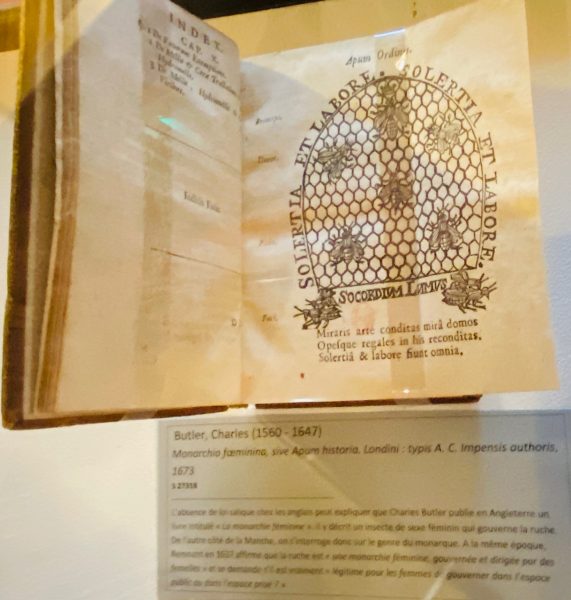
We have known the leadership style, which has been coined as “rule and divide”, at least since the Roman imperial period.  In conquered countries it was a strategy to rule by way of creating divides between peoples or regions within a conquered country. The struggle for power within a country is likely to avoid that a powerful opposition to the occupant can build up. What is well researched in the history of international politics, has also been applied to the realm of management strategies. Anthony Galluzzo demonstrates that the strategies of management often attempt to split the workforce in at least 2 different camps in order to better keep employees and their trade unions under some sort of control. For society as a whole, so-called dual labor market theories have hypothesized the existence of such management strategies since the 1980s. With the labor practices in food and grocery deliveries as well as in taxi services such management strategies are applied again. “Old wine in new bottles”, but still seems to sell and catch on. (Image: extract from Butler Charles, 1637, Monarchia faeminina)


Multilateral world

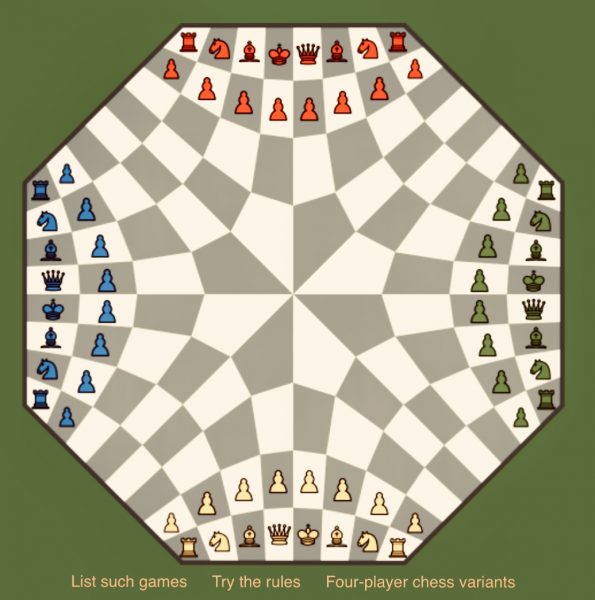
In the relatively brave new world of 21st century, it is not only a question of how the super powers like the USA, China and Russia shall push their strategic goals, but also what role so-called „Middle Powers“ will play. Europe and the European Union will have to make up their minds, whether they want to belong to one or the group, individually or jointly. New as well as shifting alliances seem to be a realistic scenario. Coalitions of middle powers will be effective counterparts to the threat of domination by a single or joint brutal force of superpowers. The power of interference of middle powers in the confrontation of superpowers is considerably higher if they were to collaborate more effectively than with each of the superpowers previously in a simple 2 opponents game of chess, much more familiar to us so far. (Image: Game of chess with 4, 5 or 6 players on the same board, here adapted from chessboard for 4 players, source: greenchess.net webpage)

Time simultaneously

The simultaneous experience of time forms part of the basic understanding of what society is about. However, the participants of a simultaneous game of chess might arrive at a different perspective on time. At the same time when time advances for say 20 chess players, the one person facing the 20 players is advancing on 20 processes simultaneously, but also on a single time measure shared by all. The different processes, or chess clocks, all run in the same timeframe. The experiences of time will be rather different as the simultaneous games usually stop at very different times. Each player has to live up to her own competence, only the one simultaneous player lives in multiple games or time simultaneously. The experience, even on a much smaller scale to handle just 3 parallel processes is a challenge for us. The fascination of juggling might convey a similar experience just on a more physical level.

mAga mEga mIga mOga mUga

Just take all the vowels of the Latin alphabet and the absurdity of the MAGA saga becomes evident. If other states would start to claim like the US under President Trump to make X great again, the world would soon fall into disaster. Let us go through the hypothetical cases like MEGA, make Europe, England or Ethiopia great again. Go back to colonial imperialism? Certainly not. How about make Israel, Indonesia or India great again? Well, that would alarm neighbors, just as much as make Osmania, Oman great again. With the potential of Russia getting its way to keep illegal possession of parts of Ukraine, make Ukraine great again spells continued trouble on the European continent. Once MAGA mania has been unleashed, it is difficult to get the spirit back into the bottle and close it firmly again. Return of brute force rather than diplomatic exchanges become the rule. A return to rule based international politics in a multilateral context needs to be reclaimed by the vast majority of states that have an interest in lasting peace without expansionist views.  (Image from: “The beast is dead”)