
Time dependent failure

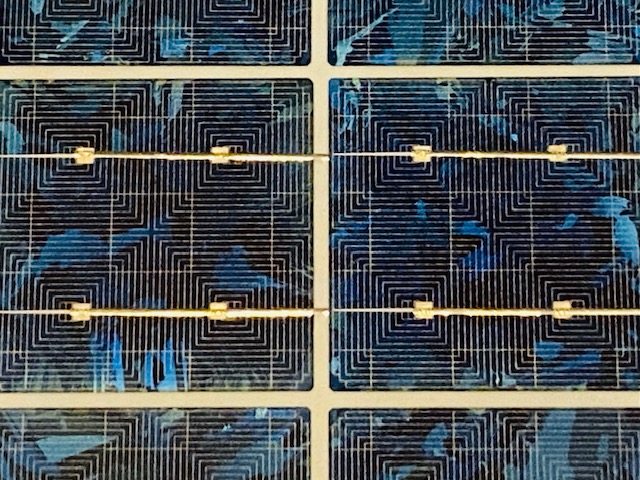
The collection of failures has an ambiguous relationship with time. Some innovations that are celebrated at a specific point in time shall be considered failures at some later point in time. The Musée des Arts et Metiers has an early version of a solar panel on display dating back to 1996 (see image below, Photowatt 1996). This example reflects the cycles of public as well as expert opinions about technical innovations that either are en vogue or at disgrace. Ecological, design and economic considerations enter into the consideration of what constitutes a failure. Claims of European energy sovereignty may additionally enter into the failure equation. The time horizon over which energy savings are generated is yet another element in the judgement. The more general perspective should take sustainability and depreciation of quality of an object into consideration. The Flops exhibition just scratches a bit on the surface of an important and rather complex issue of the relationship of society, technology and innovation.  Surely, there is more to come in terms of flops and failures, and this is okay in most cases. 
Electricity generation

On a global scale, electricity generation based on wind and solar has been growing quite fast since the year 2010-2024. Wind and solar have outpaced nuclear energy production as well as the stagnant sector of water based energy production. The Global Electricity Review by EMBER provides the statistical evidence for this evolution in 2025.
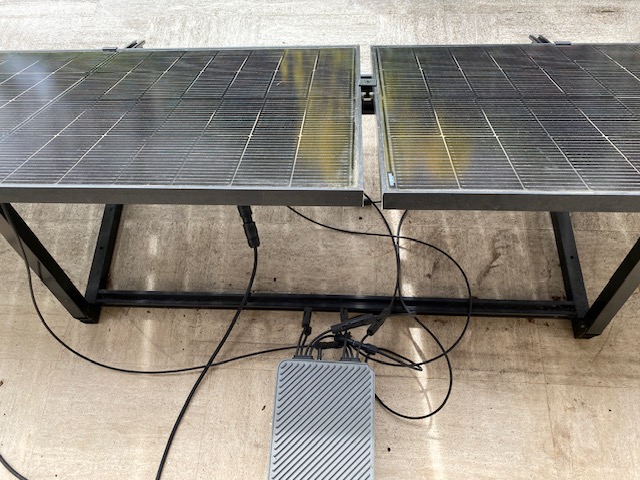
The interesting evolution arises mainly because countries with a lower level of GDP have invested heavily in solar and wind energy as this form of decentralized energy production does not need heavy investments in network infrastructure. Countries with larger population growth can keep up with electricity generation according to local needs. Local production and consumption become a key in strategies of local development. The finding that households in low-income countries use on average only 1 kWh per day is an amount that 2 small solar panels can already cater for (example image below).
Countries next to the equator have relatively constant days of 12 hours daylight across a whole year. The feasibility of no-carbon sustainable energy production is driving global growth in this sector.

Sustainability in computing

As the huge size of data centres become visible for everybody we begin to question the sustainability of computing infrastructures as well. The need for energy and water resources (for cooling) grow in line with the growth of data centers, the whole issue of input of resources and global trade has to be re-assessed. Based on European trade data, we know that computer software is heavily imported from the US, whereas we import the hardware to run the software in even higher shares from China. In view of the AI boom, this risks to worsen the European trade balance in the coming years. European digital sovereignty suffers as well, if we do not act upon it (compare Figure 8 in Eurostat report).
An easy fix is the shift to more computing-efficient software, which does not need or rely on more processor and memory imports from China for the hardware and imports of services like operating systems or office software from the US.
Just changing to Linux and OpenOffice lets you keep your hardware for several more years. Sustainability in computing isn’t hard to do. It is just a matter of determination. We can do it, if we really want to do it. The more rare earths become rare and more expensive, the larger the amount of people and businesses, who shall think twice about this.
European Digital sovereignty can work as a driver of sustainability in computing as well.

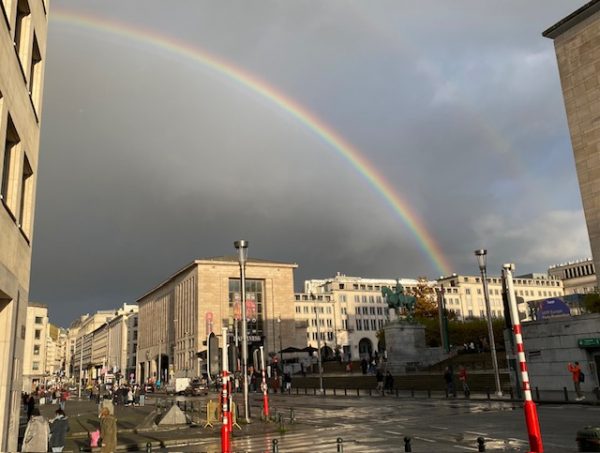
rainbow in front of clouds Brussels Central 2025

More eCooking

Cooking powered by electricity rather than fossil fuels like gas is an efficient and smart solution. Through the daily cooking activities over the course of a year the savings due to eCooking add up quite a bit. Even compared to an ordinary electric stove the eCooking by induction technology saves almost an additional 10+ percentage of energy as you heat the pot or pan directly rather than an in-between metallic element, which stores heat even after you have switched it off already for a while. In private kitchens the induction option is straightforward. In professional settings the change to induction eCooking needs careful planning. The health aspect of no burnt gas emissions in the kitchen is, however, a strong argument in favor of eCooking as well.
If we apply this logic to low-income countries and cooking in schools or other institutions as well as companies, the environmental and economic benefits add up quickly. In rural areas where no electricity grid is available or stable enough, the decentralized provision of electricity through for example solar energy creates a cost-effective alternative. In urban areas with high levels of various kinds of pollution the “clean” alternative could make a considerable difference as well.
The eCooking evidence is another pillar of the “all electric society” of the 21st century.
(Image: Rirkrit Tiravanija, untitled (Café Deutschland) and extract from “Freiheit kann man nicht simulieren“, Berlin Martin Gropius Bau, 2024-2025)

Sustainable Food

Climate change has a severe impact on sustainable food production. The OECD reports annually on the evolution of volumes of production and monitors the resources and subsidies allocated to the agricultural sector of the economy. The sector and the whole nutrition chain are frequently perceived as a major driver of shrinkflation, greedflation and cheatflation.
Changes need to be introduced with a medium and long-term perspective in order to allow for smooth adaptations of the sectors involved and to avoid so-called hog cycles.
Most economic debate is focused on the quantity of production. The loss of production due to climate change and Russia’s war in Ukraine has been and continues to be substantial causing starvation and premature deaths. Another issue is the lower quality of food due to droughts. Repeated events call for adaptations. Certainly the adaptation of more resistant crops is part of the answer. However, the other side of the same coin consists in the consumer’s readiness to buy products that suffered during a drought. Just as the reduction of fertilizers and less water in the production of droughts reduces the size of fruit, for example, we, the consumers will be systematically challenged in our purchasing habits of fresh food.
Price-sensitive consumers will have to choose the products that have reduced prices due to drought quality loss. Other consumers may choose the drought affected product if a “resilience message” is attached to such products. Solidarity with climate affected farmers, just like bio-farmers’ products in ecological production, opens up another perspective to more sustainable consumption and farming.

Electronics repaired

The all electric society will have a number of consequences. We need to think about durable electronics. Many electronic appliances get broken rather quickly even by normal usage. The task to repair the beloved electronic gadgets of your children or simple electronic household devices reveals the fallacy of the consumerist societies. “Use it and throw it away, if it is not working any more”. This is the standard mantra of our societies. In order to save resources, we have to reuse, repair and re-engineer a lot of electronic devices. So far, the engineering process consisted largely in finding ways to assemble fast and with inputs as cheap as possible. The task of designing products that are repair-friendly, circular and allow to disassemble the product easily is a bit counter-intuitive to the consumerist society. If your juicer lasts for years, you will be unlikely to buy another more fancy one or even a connected one very soon.
Repair-friendly design and assembling will be the next generation products of the all electric society. Plugs, interrupters, relays and electric engines of older devices will be valuable after the original use in a household product, which has seized to function. Many parts can be put to other use. Re-engineering with sustainability in mind has an important function also in the move towards gaining autonomy again. For the repair of electronic devices we shall focus more on fine motor skills of our hands again. The shortages of electronic components to build cars after the Covid-19 crises and the disruption of supply chains for other reasons provide a good lesson to advance faster in the direction of electronics repaired.

Ranking Enterprises

The Spanish economic newspaper has published on its front page an updated ranking of the top 10 Spanish companies using environmental, social and governance (ESG) criteria (see below). elEconomista.es on 2024-10-12 shows through this updated ranking that ESG criteria continue to be relevant information for investors. It is not just a nice to have information but gives important information on the sustainability record of a company. Continuous monitoring is key to show and reward the efforts and investments companies have made to improve sustainability. This information needs large distribution in order to keep up the awareness that there is more to a balance sheet than just turnover, profit margins, debts and investment. Churning of employees creates costs to society as a whole as well. Any early information on ESG indicators, therefore, allows a much broader assessment of the full impact of enterprises, 360 degrees and over time. Certainly a good example to follow up on.

freight transport

The transport of goods is an important and crucial economic sector to achieve reductions in CO2 emissions. According to statistics from Eurostat Total Road Freight Transportation increased by an annual 0.6% percent between 2019 and 2023. Considering the slack during the Covid-19 economic restrictions this is a remarkable development. Most people agree that more freight on rail could allow a much better performance concerning CO2 emissions. This needs substantial investments in infrastructure and intelligent solutions for optimised and accessible freight loading points. The logistics of the last mile for delivery has found many innovative solutions with battery-supported e-vehicles. The tough issue seems to be the production of e-lorries at competitive prices to the Diesel-engines. Considering the legal obligations to take breaks to ensure sufficient concentration of lorry drivers, the battery charging infrastructure has to be planned accordingly. Ports and airports a certainly key infrastructure for freight transport as well. Industry has additional key locations with high freight frequencies and tonne-kilometres. Eurostat data show that EU-wide empty running vehicles account for about 22%. Scope for optimization is, therefore, a continuous challenge for the sector.
E-transportation is high on the agenda in the sector and production of e-lorries a big challenge. There a many positive signs that the sector has taken up the challenge as there are an estimated 100.000 € per year cost advantage of battery-driven lorries compared to traditional ones (Le Monde 2024-9-24 p.16). This is simply a long-term survival issue for the sector. Smart transport solutions add to the productivity potential of the sector in combination with electrification.

Green Olympics

Paris 2024 has won a medal for the Green Olympics. Sustainable building of Olympic sites is a crucial element in this struggle for saving resources. Just as important is the CO2 footprint of the transport within the city if you cannot prevent thousands of people from flying to the venues. Public transport in Paris used the occasion to improve its services considerably. The restrictions to cars driving around in the inner city also for security reasons made the Olympic experience for Paris a healthy walking experience for all. The view from the “Arc de Triomphe” during the Olympics in Paris is even more pleasant and relaxed as the noisy and polluting traffic is reduced to minimal levels. You were able to grasp the feeling what inner cities could be like if people were the overriding concern of cities rather than circulation of automotive vehicles. Redressing this balance in favor of people living, working and visiting is overdue and we all know this. The city of Paris used the occasion to demonstrate that another way or compromise is possible. This is also a way to write history and create unforgettable moments. Paris discusses already what to keep from the Olympics for longer. Maybe the vasque, maybe the cleaning crews. New Metro lines, of course. Why not the different traffic and mobility patterns? It’s well worth a lasting Green Olympic medal.

LED light

For decades now, we have the LED light technology around us. In many instances we do no longer realize the presence of light emission devices (LEDs) for example in our television screens or in road lighting. However, this still is an exciting field of electrical engineering and the replacement of gas lighting as well as other electrical devices with higher energy consumption are high on the agenda for sustainable lighting. There are important health and security aspects related to lighting (sleep and road traffic).
In Berlin the demonstration and test area for innovative LED lighting is also an open-air museum which can be experienced throughout the year. The party-goers and club visitors might best know the demonstration street as part of the “Deutsches Technik Museum” The energy saving potential of LEDs use in street lighting is substantial and should interest most rural and city councils. The demonstration of the differential effects of targeted lighting and broad illumination based on the same technology is impressive. Of course, the design aspect of LED-technology with the colourful potentials are of interest beyond the technical aspects to replace for example gas lighting. There is much more to lighting than just opening your eyes in the morning. (Image FG Lichttechnik TU Berlin)