Future of work

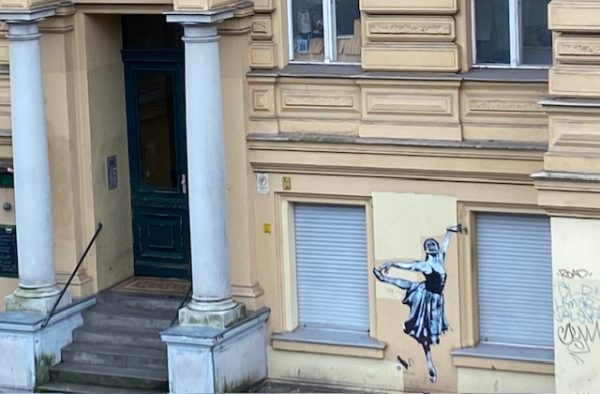
The beginning of the 3rd millennium has brought about several fundamental changes of work and employment. What had previously been thought of as utopian in the realm of work, has become a normal feature of work. Just like in the historically grounded, utopian perspective described by Bernard Gazier “Tous sublimes” (2003) we have a growing group of employees and self-employed persons who enjoy privileged positions on the labor market with sufficiently high salaries and access to mobility on the labor market at their own discretion. In addition to these examples described in Gazier’s utopian perspective, the 2020s added permission of remote work from anywhere and use of AI-assisted technology and robotics. A previously utopian view of the future of work has become a reality for many more people nowadays. The utopian element no longer is the how this world of work might look like, but how many people will enjoy the benefits of the technological progress. With a substantial increase of the efficiency and productivity of work, the distribution and sharing of the fruits shall become even more important. We have entered into a new phase of “the brave new world” of work as of 2025. (Image: Graffiti Berlin 2025-12).
Telework Challenge

There is a seminal trend that many employees prefer to have a choice to work on the premises of the employer or remote from home. This flexibility has become a major element of collective bargaining on work and time in larger companies in order to clarify rights and obligations.
In France it is about 1 in 5 of employees who do telework one day per month (1 in 6 in Nouvelle Aquitaine). The higher up in the hierarchy a person is, the more likely s/he is to do telework. Higher levels of educational attainment and seniority in a company also improve the access to and use of telework. There are still many employees who would like to do telework in their jobs, which technically could be done remotely, but who cannot do it (1 in 3). Most of those are denied the possibility by their employers.
Data from a survey in Germany from 2014 showed that before Covid-19 men were worked more often remotely than did women (Lott & Abendroth, 2019). The latest figures from France 2024 show that women have overtaken men as remote workers (Askenazy et al. 2025). As working from home has become more a part of the “standard employment relationship” today, the fears of loosing out on career opportunities due working from home seems to play less of a role nowadays, probably for both gender. Compared to 2014 the costs of equipment and availability and ease of installation of fast internet have become more affordable and might push the spread of telework even further.
The data from France show a strong positive correlation of remote work and commuting distance to work. Hence, long commuting distances “drive” more people into telework, which makes a lot of ecological sense, too.

Embedded Artists

The Brussels districts have their specific identities. 

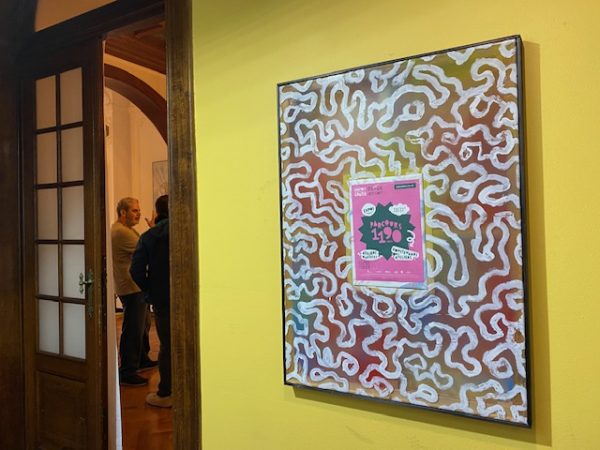
The Forêt district is reconfiguring itself rapidly. In addition to the Modern Art Gallery Wiels, It hosts a multitude of diverse artists. Many of them opened their doors to the public as part of the 4 days of Parcours 1190. It turned out to be a truly Inclusive experience in the broadest sense possible. The immersive experience of seeing the work and the artists, some of them in their private homes, created a sense of an embedded connection to their work and personalities. The artists are embedded in the district around them nd the people of the district might feel a bit more connected to the artists surrounding them. The artist has integrated the pink poster of parcour1190 into one of his works under the overarching theme of inclusion. Social inclusion can take many forms, The Brussels district Forêt has added new dimensions to it. (Image entry to Hassan Bouzougarh‘s exhibition on 2025-10-5, Brussels Forêt). 

Vacation or Workation

Vacation or Workation, that is the question. Remote work and outsourcing of work have  created the opportunity for more people to work from distant places. Logging into the firm’s or the administration’s secured intranet enabled to work from where you prefer to work rather than on the premises of the firm. After the technological shift to enable secure remote work, the acceptability of remote work is a societal issue. Whereas bosses worked or had to work while on travel for many decades, the same has become feasible due to reduced costs for many other employees as well. The Covid-19 pandemic has forced another shift in the need to accept and advance remote work as well. Taken together the option of a “workation” instead of a vacation became equally more feasible. The borderline between remote work, “workation” and vacation has become more and more blurred. It remains to be seen, whether these options enhance an outsourcing trend by firms or whether  more “back-sourcing” or “in-sourcing” will be the consequence.
Employers with their associations and employees with their trade union representatives have a need to include such topics in their bargaining agenda in addition to pay, health and safety, as well as working time adaptations.
(Image created with Canva 2025-9)


Work time reduction

One of the major elements of social progress in the 20th century consisted in the reduction of work time. Reductions from 48 hours per week in the first half of the century were largely reduced to 40 hours per week or less in some industries with strong trade union representation. State regulations also pushed in this direction with positive implications for physical and mental health as well as wellbeing. Advances in longevity of employees may be attributable to this social progress agenda of the 20th century. In the 21st century we witness a new thrust of enterprises and employees striving to implement a 4 day work schedule by at the same time organizing a further reduction of work hours. The scientific evidence which is based on pre- and post trial assessments of workers satisfaction shows rather positive results (Fan, Schor, Kelly, Gu 2025). More studies are due to accompany this potential of further health and wellbeing effects of reduced work time and the reorganization of work time in enterprises. 

Work and Time

The link between work and time has been evolving as a major element of social progress over centuries. In what younger generations seem to take for granted, <40 hours week, paid time off-work. 4-5 days per week to name only the major ones, has been the result of huge struggles and hustles driven by employees and their trade unions to achieve such milestones. The current debate to get employees back into offices and/or to work longer hours again, is also in the end a debate about work and time. The advantage of working from home consists among other factors in saving a lot of valuable time and stress from commute to work. This unaccounted time to go to work has become a major health hazard even in an apparently comfortable company subsidized car or any other means of transportation. The traffic jams of so-called rush hours, when in fact everybody is slowed down, are a serious health hazard usually ignored by employers. However, these hours are a major part of the work-life-time balance of employees. In many negotiations and collective bargaining about working time this is the big elephant in the room rarely addressed.

AI Workday

Our workdays have seen considerable changes throughout the last few days. The home office boom has allowed employees to work for extended hours from home. The there is an abundant literature on the effects of home office work on well-being or the work-life balance. Productivity gains could be reaped by employers and a better work-life balance was a lasting advantage for employees.
The increased use of AI specific to some occupations has introduced a new form of added  productivity for some occupations or professions, AI as complementarity, whereas other occupations suffered a higher risk of being substituted by AI applications.
Based on time diary data, the study by Wei Jiang et al. (2025) reports that users of AI have longer work time and reduced leisure time. Competitive labor markets increase the pressure to put in even higher hours of work. Nerds, just like workaholics, are likely to be drawn into excessive hours of work with increased health risks. Enterprises and consumers appear to be gaining more than the employees, who are at a higher risk of loosing out on their work-life balance over time.

Humanoid services

In the shadow of AI enhanced chatbots, agentic AI and generative Ai, the developers make considerable progress in robotics. The humanoid versions like from Persona AI will surround us in months, or maybe a few years from today. Investors believe it is rather sooner than later. There are many use cases for humanoids that may take over dangerous, hazardous or unhealthy tasks from humans. But even simple tasks like carrying home most of our shopping could be done for us by humanoids that follow you around the shopping mall and home. This would be a kind of personal assistant. I even thought of my humanoid robot to walk my dog on some occasions on the usual trail. 

Welcoming visitors at the doorstep could be another function to delegate in offices or even in private homes, although as a sociologist I would recommend to carefully check the sorting algorithm(s) applied to avoid unpleasant situations. The administration of medication might be another option, if only we could trust that the correct dosage would be applied. 

Knowledge Work

In the social sciences the term knowledge work defines the group of professions that deal with and deal in knowledge. Most of them are in academia, but there are many other professions like ICT professionals or lawyers that used to shuffle paper who now work all digital. Hence the relatively new addition to the sociological vocabulary is “mobile knowledge work”. We, and yes I am part of this group, can do our job from almost any place with a stable internet connection. Breda Gray et al. (2020, Made to work: Mobilising contemporary worklives.) highlight the importance of gender considerations when we study these new forms of work. Similarly, social class and cultures of more or less trust are thriving for independence. This will play a role in who choses these new forms of work. The digital technology enterprises, media and social media workers are and will be the forerunners of this change. The education sector and academics in general have followed suit.

The issue of autonomy has also received some attention by the authors and this is likely to be a big challenge to standard work relationships as we knew them before the digital turn and the Covid-19 pandemic. The mobile knowledge workers were the first to insist on change of work practices, there will be other professions that will strive for greater autonomy of various kinds.

AI and dialect

The training of Large Language Models (LLM) uses large data sets to learn about conventions of which words are combined with each other and which ones are less frequently employed in conjunction. Therefore, it does not really come as a surprise that training which uses standardised languages of American English might not be as valid for applications that receive input from minority languages or dialects. The study forthcoming in the field of Computer science and Language by Hofmann et al. (Link) provides evidence of the systematic bias against African American dialects in these models. Dialect prejudice remains a major concern in AI, just like in the day-to-day experiences of many people speaking a dialect. The study highlights that dialect speakers are more likely to be assigned less prestigious jobs if AI is used to sort applicants. Similarly, criminal sentences will harsher for speakers of African American. Even the more frequent attribution of death sentences for dialect speakers was evidenced.
If we translate this evidence to wide-spread applications of AI in the workplace, we realise that there are severe issues to resolve. The European Trade Union Congress (ETUC) has flagged the issue for some time (Link) and made recommendations of how to address these shortcomings. Human control and co-determination by employees are crucial in these applications to the world of work and employment. The need to justify decision-making concerning hiring and firing limit discrimination in the work place. This needs to be preserved in the 21st century collaborating with AI. The language barriers like dialects or multiple official languages in a country ask for a reconsideration of AI to avoid discrimination. Legal systems have to clarify the responsibilities of AI applications before too much harm has been caused.
There are huge potentials of AI as well in the preservation of dialects or interacting in a dialect. The cultural diversity may be preserved more easily, but discriminatory practices have to be eliminated from the basis of these models otherwise they become a severe legal risk for people, companies or public services who apply these large language models without careful scrutiny.
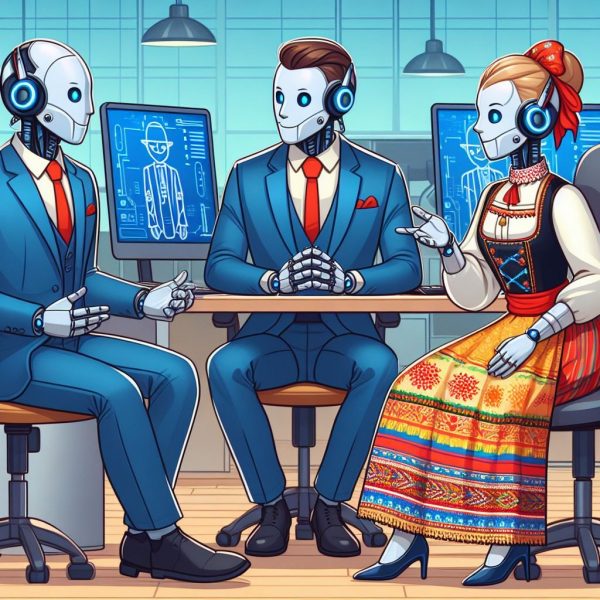
(Image AI BING Designer: 3 robots are in an office. 2 wear suits. 1 wears folklore dress. All speak to each other in a meeting. Cartoon-like style in futuristic setting)