Promise of good time

Some literature is packed with the promise to have a good time when reading it. Travel literature or travel guides also work as enablers or facilitators to have a great experience or moments somewhere else. Escapes from daily routine through reading is itself in most cases a good time as well. Many professional conferences which include traveling should keep an eye on the promise to have a good or inspirational, encouraging time. The good time is most frequently associated with meeting interesting people or impressions that last longer than usual. The Frankfurt Book Fair manages to live up to the expectations of visitors to have a good time while working and meeting people who believe that having a good time is still often related to books in all sorts of formats. Reading as a joint endeavor starts in childhood and maybe revived in old age. Sharing of narratives is key. Passing on a book or recommendations through tiktok or youtube have become a popular way to promote how to have a good time. 

Books about photography 2026-10

Commuters dissatisfaction

Commuting to work is only in few cases a choice. The stress associated with commuting is not negligible. Most employees report low satisfaction levels with commuting to jobs and subsequently this has a negative impact on overall satisfaction with one’s job. A study on urban China shows that employees on formal work contracts can often compensate with shorter weekly working time or higher earnings from work, but only partially. The negative impact of commuting on job satisfaction is rather sticky and substantially higher for employees on informally employed workers in urban China, who do not have resident permits in urban areas. With millions of workers commuting daily to work beyond China, the evidence suggests to take commuters’ dissatisfaction more seriously. Public transport infrastructure has to keep pace with more people working in urban areas, but willing to accept long commuting distances. If we add commuting time to working time, the long hours of work over years constitute a considerable health hazard.

Activity and dementia

In view of the huge challenge of dementia to people and the public health systems, it is primordial to test potential remedies with high precision. So far general measures of just any physical activity like walking were considered beneficial. Recent and more comprehensive data on domain-specific physical activities by Feter et al. (2026) emphasize the importance to differentiate between walking for leisure or walking rather stressed to work. The former contributes to a delay of the onset of dementia, whereas the latter bears higher risks of dementia due to the “negative” stress involved. However, as Kivimäki and Hamer (2026) point out dementia itself has a long gestation period in which persons might reduce physical activities because a “silent” onset of dementia is not yet diagnosed but inhibits already more activities. Commuting to work or leisure might already be a challenge in early dementia particularly if public transport has to be organized independently. 

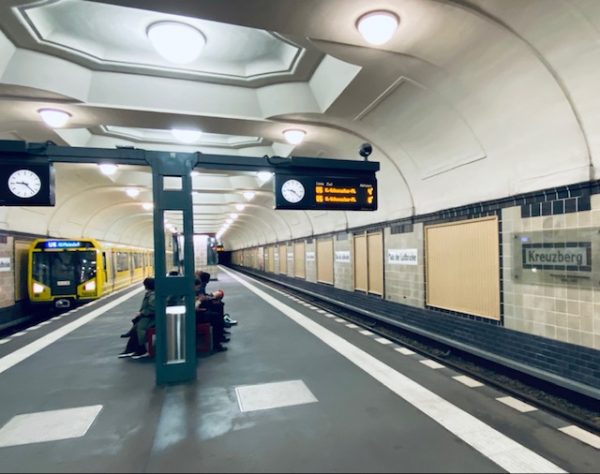
Commute in Berlin by underground U-Bahn

China Job Quality

In a small study of 771 Chinese adults, Dong, Wu, Ni & Lu (2021) have reported on the impact of long working hours on job satisfaction. If you work few hours, job satisfaction increases as you work more hours. However, working many hours already, additional work, 40+ per week, does no longer increase work satisfaction in China. In order to preserve the recommended or communist work ethos of a “996 work schedule” (from 9 a.m to 9 p.m, 6 days a week) the authors recommend that managers support more autonomy for workers to fix their schedules as this could increase their job satisfaction. Autonomy to schedule your work and more autonomy in decision-making moderate the impact of long work hours on job satisfaction. Eventually the Chinese comrades might get satisfaction in other areas but work as well.
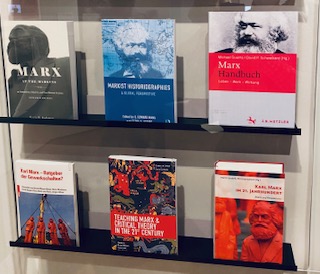
(Book Exhibits on Karl Marx, Museum Trier Germany Books 2023)

Job Quality Insights

In the U.S. the Upjohn Institute for Employment Research conducts a major empirical study on job quality (Houseman et al. 2025 1st wave 18.000 respondents). The documentation and the full set of questions (Link) cover 5 dimensions of job quality: compensation and job security; work structure and autonomy; work environment; worker agency and voice; growth and development. The special merit of the survey is that it makes great efforts to cover also new forms of (precarious) self-employment (Abraham et al. 2026). The degree to which can you make autonomous decisions is of relevance to the self-employed as well as it is a part of the job quality of dependent employees in small, large or big firms.
Related to the use of AI for work purposes question 31 asks for the influence on the decision to use new technologies in your job. This is the modern version of a question, whether you have influence on how you do your job. Bullying in a job may come from supervisors, colleagues or customers and respondents report on this. Beyond the answers given for “your main job”, it is noteworthy that the inclusion of questions on a secondary job allow to identify with more precision the precarious forms of how people try to manage to make a decent living in the U.S.A.
(Image: Exhibition Fashion Council Berlin at New National Gallery 2026)

Autonomy as Job Quality

As many labour markets have been confronted with employment and skill shortages in OECD countries, the interest in what constitutes a good job has increased. After the “decent jobs” campaigns by the ILO, it became crucial to be able to better measure what constitutes a decent job and job quality more generally. The COVID-19 crisis had pushed remote work, but the impact on job quality has been mixed.
A larger empirical effort set out to measure job satisfaction and job quality more precisely. The study funded by the Luxembourg Chamber of Labour (Steffgen, Sischka et al. 2020) puts autonomy at work in the category of “job design”. The findings suggest that autonomy has substantial correlations with almost all other measures of job quality, but in a multivariate setting work-life conflicts, job security, atypical working time, mobbing, time pressure or social demands overwrite the issue of autonomy as a statistically significant impact on general well-being. Social support, however, has the strongest positive impact on overall satisfaction. Solidarity at work drives overall well-being.
The more narrow concept of satisfaction with one’s job find autonomy just as important as career advancement on the 5% significance level. Participation in decision making, income and again social support have somewhat stronger impacts. Autonomy concerns time and tasks. Can you decide what to do, how to do, where to do and when to do your tasks?
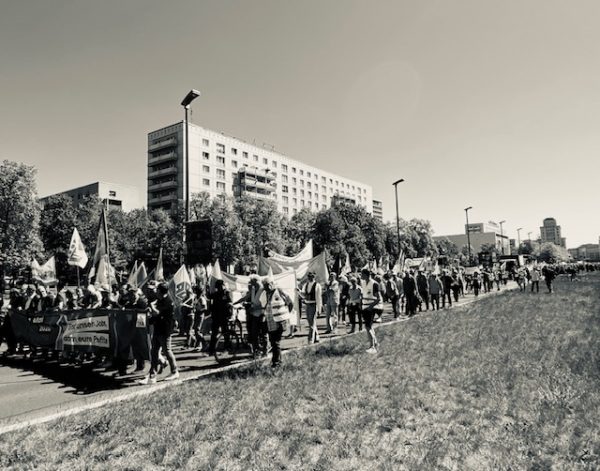
Depending on how you answer these questions on a 1-5 scale, the more or less satisfied you are with your job. Of course, leadership styles might interfere additionally. (Image: May 1st 2026 Berlin)

Bob the AI-enhanced builder

Most kids today and GenZ youth have come across the TV-series “Bob the builder”. Baby boomer parents have been worried about the work ethos which might be the hidden agenda of the videos. In 2026 we can now draft a new episode called “Bob the AI-builder”. Many episodes could be re-written when Bob and his team have access and get training with AI toolboxes. The study published by ActivTrak (2026-3-11) reports that companies make on average use of 7+ different AI-tools, up from 2 in 2023. This constitutes a hint that complexity at work is increasing as each tool has to be managed and the boundaries of its use need to be respected. As most search engines offer an AI-short cut to search it is not surprising that now 80% of the workforce use some form of AI in 2026. The productivity increases in quantitative terms as more output can be achieved in the same time or slightly shorter work days. However, workload is moved even more to weekends now.
The upcoming challenge through AI-tools is the reduced “the AI users’ focus time”, which suffered 9% compared to non-users. For Bob the AI-enhanced builder this means “AI is being used as an additional productivity layer, not a substitute for existing work”. The overall workload is not reduced by AI. The intensity of work increased between 2023-2025.
There is still a puzzle in the data. Multitasking (+12%) and collaboration (+34%) both increased, but the duration of an average focused session and focus efficiency dropped. The challenges for employees increase. Handling simultaneous processes and keeping an open mind to collaboration are key competences for Bob the AI-enhanced builder.
(Image: LEGO-shop in Paris 2026-2)

Being On Time

“Being on time” has a different meaning,  depending on the society and culture you are living in. Of course, this tends to reinforce stereotypes and raises expectations about the punctuality, the respect of time as a means to effectively synchronize human behavior and its interaction with technology. Train or bus services are commonly referred to in this context. However, our interest here is with the wider margins or, statistically speaking, the normal or not so normal distribution around a specific point in time.
Colloquially we refer to these time periods as being late (more common) or as being early (less common). Add to this perspective that you may be very late (early) or too late (early) and we are going to really deal with the spice of life. Just think of the last instances when you were late, very late or too late.
The same rationale of a “statistical view of time” can inform the sociology of technology. Some innovations can come too early for society to be ready to deal with it, or they may come too late to save us from disaster.
Genetic engineering of human cells is an issue in this regard, both too early for wider applications, but too late for persons in need of curing a specific diagnosis. There is an additional social-psychological aspect to the cognitive process of being on time. It is the cognitive dissonance of what you expect from yourself or somebody else and the actual experience of not being on time which causes stress. Societal norms of being on time can contribute substantially as well to the overall mental load associated with time. Take it easy.  

Medical Life Course

The analyses of the life course have taken individuals as their starting point and linked their life courses to broader societal developments like periods of educational expansion, job growths or periods of high unemployment. Medical life course research has further dis-aggregated the life course of a person into, for example, the life course of human organs.
There is already an established line of research which collects and analyses lung function trajectories. The research starts even before your first “autonomous” breath and typically ends at death, although transplants become feasible. It is helpful to think of those measures lung function trajectories as a life course of lung health, because the air we breathe is subject to many social and environmental impacts. Some we are in control of (active smoking, less so with passive smoking), some others like inner city smog or pesticides inhaled in areas of agricultural production. Work environments play an important role in the life course of the lung as well. Global warming, particularly increases in summer heat, pose additional challenges on the overall aggregate level to lung health trajectories.
Inhale, exhale, … then force your breath out quickly, … keep breathing normally. That’s about the instruction for the “Forced Vital Capacity test”, which is a standard measure of your FVC just repeated over the life course. (Image: The healing of Tobit 1630, follower of Caravaggio and The finding of Sebastian 1649, Georges de la Tour, Gemäldegalerie Berlin)

Time and money

In the English-speaking world, most people will be familiar with the expression “time is money”. In times of working for money as pay, rather than growing your own crops, we calculate hourly, monthly or yearly salaries. Time is a habitual point of reference in production systems and calculations of economic growth. Inflation and depreciation speak to value over time, just as investment and returns accrue over time. For comparisons of different investments the chosen horizon becomes a decisive factor. Of course, in the long run we are all dead, but in the meantime time matters a lot, doesn’t it? Take out a loan and you realize how much time will matter, suddenly. Now, let’s turn around the causality, Money is time or can be buy time with money? For many processes this seems to be the case. With money you can buy time off working, or pay somebody to do work instead of doing the work yourself. You can “win time” or gain more free time this way. However, towards the end of your life, money might no longer suffice to buy you time before death even with lots of disposable income or cash. From a philosophy of science perspective, we might even question the concept of time-linked causality altogether. The relationship between time and money gets even more interesting if. we take intergenerational considerations into account like inheritance and environmental heritage. … and “the times are a changing”.