AI in Central Banks

Yes of course, Central Banks will use AI, and some do so already (Kazinnik and Brynjolfsson, 2025). Beyond the standard application of AI by its employees, there are many potentials to use AI to analyse and publish data at a faster rate or in order to detect financial crimes. Similarly, data collection based on webpage harvesting might yield new indicators of inflation, expenditure for environmental risks (heat waves, flooding etc.) earlier and in addition to the normal set of indicators. Hence, Central banks might be better and faster in forecasting inflationary tendencies using more AI tools in their daily routines. Of course, it is difficult to predict a disruptive tariffs policy of a major economic player in the world economy, but the calculation of more, even hallucinatory scenarios become more feasible. It is feasible to weigh overall risks of different scenarios to the economy.
(Image: Celtic coins, Museum of the Belgian National Bank)


AI earnings effects

In the first few years of wider adoption of AI in an economy, there is the expectation that this might lead to substantial productivity gains for enterprises which use it as well as for employees who are early adopters of the relatively new technology. The study by the Stanford Digital Economy Lab by  Chen, Chandar and Brynjolfsson (2025) showed that so far there are no significant earnings effects for employees. Based on millions of recent payroll data from US companies productivity gains have not trickled through to the paycheck in terms of monthly salaries. Participation of staff in a company’s overall turnover or profit might change this as time evolves. For civil servants the adoption of AI might mean increases in cases dealt with as some tasks can be executes faster than before with the use of AI.
The evidence points to employment effects of AI rather than earnings effects so far. A hypothesis is yet unresolved: senior employees using AI might employ fewer junior workers at entry positions, if these “hallucinating” young professionals can be replaced by hallucinating AI. In science the hallucination has sometimes lead to disruptive new approaches and findings. It is a tough choice to pick the young entrants with high productivity potential and eventually high remuneration for this in terms of labor earnings.

AI employment effects

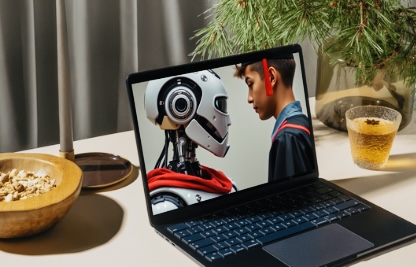
The first robust empirical evidence about employment effects of AI in the USA has been published by the Stanford Digital Economy Lab by  Chen, Chandar and Brynjolfsson (2025). A previous paper by Wang and Wang (2025) highlighted the comparative advantage of persons who use AI in their work compared to others and the authors coined the term “learning by using technology”.  The prediction of the model was that there might be job losses of more than 20% in the long run and half of this already in the first 5 years of the introduction of the technology. The Stanford economists have estimated with real world data these effects in the USA and find quite surprisingly that the negative employment effects of AI have the strongest impact on young labor market entrants with few years of labor market experience. Middle-aged and more senior employees seem to benefit from “tacit knowledge” about the work, which is more difficult to replace with AI, at least for the time being of the early days of AI. This evidence is based on recent payroll data from the largest payroll processing firm “ADP” in the USA which has firms overrepresented from the manufacturing and services industries as reported in another paper  (Firm size maybe another source of bias).  However, the effect that youth 22-25 years of age suffered the most calls into question the common belief that older workers are more likely to suffer the consequences as during in the rise of the digital economy around the year 2000. (AI Image created with Canva)

Bench the benchmarks

In the social sciences as well as in engineering it is common practice to use benchmarks as indicators of performance. Thereby, several countries or regions within a country are compared with respect to quantitative indicator. Let’s take employment ratios. A higher employment ratio, which includes many persons working few hours in part-time work, is different from a slightly lower employment ratio, but hardly any part-time employees.
The same rationale holds true for benchmarks of AI systems or the newer versions of agentic AI that are under construction in many fields. The paper by Yuxuan Zhu et al. (2025) proposes the ABC (agentic behavior checklist) for agentic AI developers. The reporting of benchmarks by such models should include (1) transparency and validity, (2) Mitigation efforts of limitations and (3) result interpretation using statistical significance measures and interpretation guidelines.
The aim of this research is to establish a good practice in establishing benchmarks in the field of agentic AI. The sets of criteria to test for is large and the focus of how the agentic AI treats, for example, statistical outliers much above or below the average i.e. (> 2 standard deviations from the average) assuming a normal distribution, is one case of application only.
We welcome the efforts to bench the benchmarks in the field of AI as is common practice in other sciences as well.

Learning by using

Is learning by using different from learning by doing? In an economic model to test the employment/unemployment impact of AI in the USA, Wang & Wong (2025) suggest an important impact of employees’ productivity due to learning by using AI. In terms of the traditional language of economics the employees who use AI in their work shall have comparative advantage to those who don’t.
In a model of job search in the economy there is the additional possibility, similarly to robots previously, that certain tasks maybe influenced by the, more or less, plausible threat of an employer to replace the employee by training an AI system to perform the tasks. The credibility and acceptability of such threats are likely to impact wage claims and unemployment risks. All these effects do not happen instantaneously, but evolve over time with varying speed. Hence, calculations of effects have high error margins. The resulting model yields oscillations of “labor productivity, wages and unemployment with multiple steady states in the long run”.
Learning by using seems to be a good description of what occurs at the micro level (the employee) and at the macro level of an economic sector or the economy as a whole. Society may guide the use cases of AI just as much as the business case to use AI, for example in the creative industries as infringements of copyrights may occur on a massive scale. However, learning by using is not free of risks to society at large. Just like allowing people to use automotive vehicles has lead and still leads to thousands of deaths annually, learning by using produces external costs. Overall, this is another case for a benefit/cost analysis for businesses, the economy and society.

AI 2nd round effects

The most popular topic currently is AI.
Most writers, assisted by some form of AI, will deal with the 1st round effects of AI. These consist in the immediate consequence of the use of AI in office work, medical and military applications, music and all producing or creative industries. As an economist you take the input – output matrix of the economy (OECD countries) and take AI as an additional dimension of this I/O matrix, for example. The result is an AI-augmented model of the economy. This 3-dimensional cubic view of the economy asks to reflect on the potential short-term and medium-term impact of AI.
Let’s take the example of translation and editing services. AI will in the short-term or the 1st round effects make it easier to offer mechanical translations with fast turnaround. Most likely, this will lead to less translators needed for routine translations of longer texts, which would otherwise be a very costly endeavour. The 2nd round effects, however, will make the expert knowledge of translators of texts, where every word counts, more necessary in order to provide the best version of a translation targeted on specific audiences.
In the legal domain, for example, the precision of words is primordial and errors can be very costly. Hence, the 2nd round effects of AI in this field will increase the demand for high quality translation services more than before the use of AI. The important shift consists in these 2nd round effects of AI, which give a push to multilingual societies as just one medium-term outcome.
Please use AI to read (listen) to this paragraph in your native language or even dialect using your favourite AI-tool.

Home Leaks

When did you last think about leaks in your home?
Usually we associate leaks with water leaks, or the heating system leaking somewhere. In the 21st century leaks at home are more importantly the leaks of your home security, especially your email, digital and cloud services which are at risk. You may test your favourite AI system to advice you on your risks for digital leaks, but we know little whether these systems are yet another dangerous port of entry into your home or privacy themselves.
There is a helpful tool to find, whether your email has been hacked or distributed widely already for potential thefts of your identity. Hence, better check this from time to time using for example the “leak checker“, just like checking whether you closed your door or the water tap before leaving for vacations. As we live more and more in “virtual homes” in addition to our physical homes, checking your digital identities should become a part of our personal hygiene routine. Let’s just take a shower from time to time and change passwords regularly.

Hallucinations serious

There serious hallucinations by AI and there are funny hallucinations by AI. Do we want our various AI models, from time to time, to crack a serious or funny joke? Well, that’s a bit the spice of life. However, not knowing when the machine is joking and when it is serious, this is more likely to seriously disturb most of us. This reminds us of our school days were teachers were not amused some pupils not taking them seriously in their efforts to transmit information. Now we know that a good atmosphere is conducive for better learning progress. AI as teaching and learning assistance could well work best in a “fearless“ classroom. Repeating a lesson several times and at your own learning rhythm will help independent of the seriousness of your teacher. Self-directed learning with a little help by AI might do the trick for many to advance how and when they feel ready for it. Hallucinations rates are a standard test for AI models. They range from 1% to 25% of queries.  This is not in itself a problem. It has become tough to find out about the 1% -2% models because you no longer expect them to give wrong information. These are the 1-2 out of a hundred of cases where we are confronted with serious hallucinations, seriously.
(Image: extract from „cum Polaroids“ from Eva & Adele, Hamburger Bahnhof, Berlin 2024-5-22)

Home security

Digitalization has made it possible to step up home security at reasonable costs. The video surveillance of homes inside and the immediate surroundings are feasible through the use of connected cameras. The footage can reach sizable amounts of data, but intermittent recordings reduce or the AI-assisted detection of movements on a person’s property have become standard home security. Even for apartments the video enabled door bells and digital locks have improved the security level for those who are willing to invest in home security. A good neighborhood watch system is, of course, in most cases a superior solution. But neighbors change and social interaction is often reduced to minimal contact in most suburban regions. As with heating of homes, home security is also depending on what makes you feel comfortable at home. For some 20 degrees Celsius is enough and a solid mechanical lock is sufficient. Others have made very different experiences and want their digital devices directly linked to a professional security or police service. Like it or not, home security is part of the modern home just like many other digital devices or TV sets. 

testing testing

Before the installation of the new AI chatbots or other agentic AI, they need profound testing. Wise statistics are quoted with the conviction: it is all about testing, testing, testing. Any systems that build on statistical reasoning (LLMs or machine learning) will behave erratically on what is known as an area with stronger impacts of, for example, statistical outliers. On both ends of the “normal distribution” of events or reasoning the statistical models and algorithms used in AI will produce “spurious” errors or have larger error margins on such topics a bit off the 95% of usual cases.
This means, testing, testing and testing again for the programmers of such AI systems before the release to the public or enterprise specific solutions. The tendency to keep costs of testing phases low  compared to developing costs bears obvious risks to the “precautionary principle” applied in the European Union. Testing is most important to check the WEIRD bias of the most basic AI systems. In this sense AI development has become a sociological exercise as they have to deal with “selection bias” of many kinds that could have very expensive legal consequences.
(Image: Extract from Bassano, Jacopo: Abduction of Europa by Zeus, Odessa Museum treasures at exhibition in Berlin Gemäldegalerie 2025-5).