AI as individualizer

In a one pager in the journal “Rolling Stone” (2025, p. 9) Bruno Patino writes about the legendary David Bowie who was the first rock musician to launch a new song on the internet before it became available as CD (Telling Lies, 1996). As a pioneer in co-creation, Bowie anticipated somehow the trend and wish of people to personalize preferred songs even further and distribute such versions among friends. In this process, AI has become a powerful tool to push individualization even further and the digital social media allow even broader audiences beyond a more narrow circle of friends. Music maybe setting the trend  for some in the same field, other creative fields might follow the footsteps. The need to co-create collective experiences and participate in collective musical moments is likely to rise again as well.
Good news for music festivals across the world. Live concerts are the new form “collective individualism”.


Passing barriers

In quantum physics the real trick is not the rebound of electrons like the rebound of droplets, but the passing of electrons of an insulating barrier. The experiment of the ”Josephson junction” has set a precedent to research the surprising macro-effect of “quantum tunnelling”. The 2025 Nobel Prize has been awarded to Clarke, Devoret and Martinis who observed these effects on a macroscopic scale. The applications in the most advanced quantum computers of today shows the enormous potential of this demonstration in pushing computing speed boundaries. The international competition to develop such, ever faster computers, based on quantum physics, is running on high development speed. In combination with the artificial intelligence (AI) developments, these types of combined machines are likely to outpace the development of human-based intelligence. It becomes even more important to define the limits for those machines by us. Subsequently, we shall have to make sure that such combined machines stick to the rules, we define(d).

Deus ex machina

The term “deus ex machina” used to be applied more in its figurative meaning. With the rise of digital tools like chatbots, facilitated and enhanced through AI, God is speaking to us not only in multiple languages, but also from our pockets through our smartphones and headsets. This is a rather recent form of “deus ex machina”, which we did not expect some years ago. The bible as e-book or pdf-file has been around for some decades, but only more recently we can enter conversations with God through chatbots as another version of “deus ex machina “ about almost everything (and pay for it via digital credit card). Programming of such an AI-tool is easily achieved. AI will prepare a weekly or daily sermon or prayer for you, following your predilections of your favourite quotes of the bible. An interesting twist to the programming is to use authorized as well as unauthorized translations of the bible across several centuries.
Another interesting enlargement of the input data base is the inclusion of interpretations and discussions not only within your own religious community, but beyond. Maybe the discussion of several different religious chatbots with each other could prevent aggressions due to differences in basic beliefs. These “dei ex machina” might further our understanding of what makes us humans different from machines and machine-based solutions of human conflicts.
As genetic clones of ourselves have become already technically more feasible, our digital alter-egos (the comprehensive collection of traces in the internet and digital images, plus social scoring) help to empower those “dei ex machina”.
This kind of “Brave New World” asks us to be rather brave ourselves.
(Image: interior St Denis Basilique Cathedral Paris 2024)

Chatbot Me We

In order to dig deeper into the functioning of AI, I deemed it expedient to construct, for example, a simple chatbot on a limited knowledge base from my own writings on AI (link to reader in previous blog entry here).
A toolbox from Google offers powerful assistance in such an endeavour. The outcome uses only my input text and no other sources. It is dynamic in the sense that it interprets questions and searches within the text file provided only. The answers are edited with a LLM (large language model) and provide flawless English texts. You can try it here using catchat as magic formula and Google account so far.
With a bit of programming knowledge (htlm, python, Java) and related learning sites it is feasible to come up with a “static” chatbot hosted at a free of charge provider as well. For learning purposes this step by step building and coding of a chatbot is helpful. The outcome is rather limited or requires a lot of time to increase the scope of Q & A interactions and to move from a static (predefined Q & As) to dynamic ones.
Full control of answers, excluding any hallucinations and high-speed replies, come at a cost. Take a look here. It is a very basic version so far, just to get the idea of it. full web address:
https://schoemannchatbot.eu.pythonanywhere.com/

Chatbot Me

Chatbots are helpful to allow queries to larger data sets like the blog entries here. So here is a try of a Chatbot to query all entries on AI using ChatGPT to create a Chatbot that uses and references it source from www.schoemann.org/tag/ai and the AI reader in pdf-format.
Please send me an email if the hallucinations of this Chatbot 1.0 on AI from a social science perspective are giving strange results. I’ll get back to you. Please use at your own risk as I cannot guarantee for all answers. The usual disclaimer applies here.

ChatGPT proposed the following set of Questions and Answers on the blog for an entry into the chat: Example Q&A with the chatbot

Q: What are the social science concerns with AI?
A: Bias in results, job shifts, democracy risks, privacy, and new inequalities.

Q: What does the text say about reinforcement learning?
A: It’s seen as the next step for AI: focusing on learning and reasoning, not just predicting text. It also uses fewer resources.

Q: How are robots described in the document?
A: Robots are mostly assistants. They can follow people or carry small items, but more complex tasks need sensors and AI training.

Q: What about biased results?
A: Studies can be misleading if control groups are flawed. AI faces the same challenge — social scientists warn: “handle with care”.

Q: What is Schoemann’s blog view on AI?
A: He links AI to energy use, fairness, and its role in the “all-electric society” — stressing efficiency and responsibility.

More on the chatbot (in testing phase) and the Link to the coding help received from ChatGPT on this mini-test-project :
https://chatgpt.com/share/68c1d160-0cc0-8003-bf04-991b9e7c3b24


AI Podcasting Me

Content producers have lots of tools at their disposal to get their content across to very different audiences. For some time the traditional media of newspapers, radio and TV were the prime outlets for content distribution. Social media have changed this to many more senders of content than before.
In the 21st century, AI allows to automate media productions. In a trial run I just used Google’s NetbookLM to generate 3 podcasts based on my own writings on AI over more than a year by now. The result is available and using artificial voices it is possible to broadcast yourself without revealing your own personal voice. I am not done with the evaluation of the outcome(s) yet, but the first impression is an interesting other form to spread content.
More tests are necessary to check for hallucinations as well.
Here are the links to my virtual podcasts:
AI, intimacy and insecurity

AI, Society and the Human Spirit

AI and the Human Mosaic: Navigating Our Interconnected Future

Video Doku by AI

Based on my own blog on this webpage “schoemann.org” Google NotebookLM creates a video of about 7 minutes. Using Microsoft Clipchamp automatic subtitles with a slightly different storyline are produced based on the video data. In the end, the blog entries are re-modelled into something like a lecture on “AI in a wider social context” (see and play below). No voice layover so far, read by yourselves. A podcast format is another option.
It feels like walking across landscapes in my own mind. Content creators of today or the past never imagined the impact they might have through the powerful tools of AI. The only caveat, jokes I incorporated into the texts cannot really be handled by AI tools unless they are explicitly designated as such. These AI tools take me much more seriously as I do myself. This is serious.

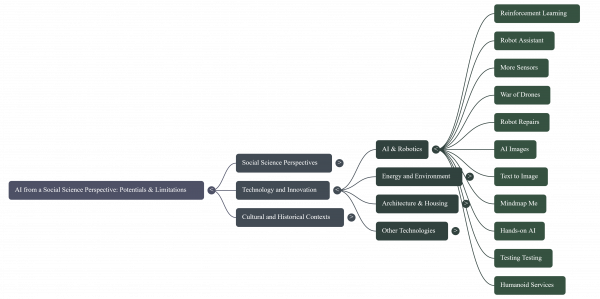
Mind Map Me

AI tools are great to assist learners in the task to get more structure into larger documents or books. It is up to the teachers or lecturers to use the tools themselves to pre-structure content they want other persons to learn. Mind maps are useful to summarise larger content and offer a tree-like structure to a text moving from the general to more specific content and then into details by at the same time not loosing sight of the overall structure of the content. Basics can be provided by Google’s NotebookLM and you may rework this basic structure yourself linking the mind map to the detailed content. Learning may start with a comprehensive mind map at the beginning to move on to details. Alternative versions of a mind map are equally feasible to come up with new combinations of subjects. This can be done using the tags of the blog entries in addition to the categories and fast search keywords.
It is a fascinating way to mind map yourself based on longer texts written by yourself. This clarifies a bit what potential readers or learners are likely to retain from reading your document(s) or blog entries.
Its worth trying, as others will most likely use these tools from now onwards anyway, whether we like it or not.
Image: Google NotebookLM Mind Map of my AI blog entries 2025-9-9.

Own AI related entries

The digital drafting of blog posts facilitates the publishing of volumes based on a selection of entries. Pdf-files, or EPUB formats are quite common. The choice of a flipbook is more suitable for larger screens of tablets or notebooks. It also serves as a rapid stock taking of entries and missing topics to cover a broader field. In some fields AI is not yet popular, for example in agentic home applications, whereas in other fields text, translation or image production AI has grown into a threat to professional fields. Even computer languages are a major field of application with substantial negative employment effects.
Hence, enjoy the latest comments on AI towards the end of my latest Flipbook.
Just click here.

ChatGPT provides a summary of my AI-reader as follows:

From the uploaded text AI from a Social Science Perspective (Dr. Klaus Schoemann), social science concerns with AI focus on potentials and limitations of how AI interacts with society:

  • Labour and employment: AI impacts jobs, but adjustment processes are slow. For example, there’s a shortage of engineers and care workers, while robots are still limited to simple assistant tasks. This raises concerns about who benefits and who is left behind.
  • Bias and fairness: The book highlights issues of biased results in research and decision-making. When AI systems rely on incomplete or selective samples, results can be misleading — a challenge also familiar to social scientists.
  • Democracy and accountability: Journalists and scientists are framed as part of a “checks and balances” system. AI adds complexity here, as the fast spread of information without accountability can weaken democratic processes.
  • Human–machine relations: Topics like intimacy, housing, and memory are re-thought in the context of AI and digitalization, raising questions about privacy, social norms, and cultural heritage.
  • War and security: AI-driven technologies like drones change the nature of warfare, raising ethical and political questions.

On his blog, Schoemann also stresses the energy and resource costs of large AI models and how reinforcement learning offers a more efficient alternative. He warns that AI should be understood not just technically, but as part of an “all-electric society” where social sciences help assess risks, inequalities, and long-term consequences.

👉 In short: AI raises social science concerns about equity, bias, democracy, labour, cultural shifts, and global risks.

Marc Aurel AI

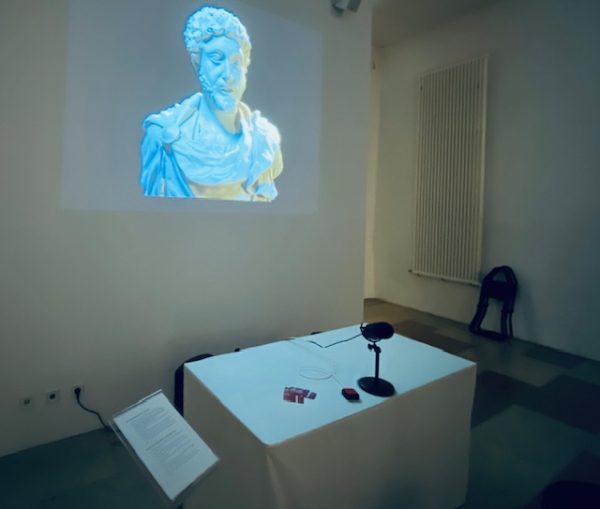
In the 21st century it is possible to chat with Marcus Aurelius. Part of the exhibition at the Simeonstift is a chatbot you may freely consult and questions with or about Marc Aurel. Based on your questions the animated screen image of Marc Aurel will reply based on his own writings like the Meditations and (probably) other secondary literature on Marc Aurel. Questions about feminism or slavery are answered based on the original texts. Some of these answers  appeared rather modern like the basic equality of all including women or slaves. The Meditations are an idealistic vision of mankind in the stoic tradition. In practice such ideals have proven very ambitious for the many and growing temptations in the day-to-day lives of ordinary people including their political, religious, business and military leaders. The AI is confronted with the issue to give answers to ethical questions which refer to the time of the author, but not all can apply to today’s ethical standards and basic human rights. Reading the original source, therefore, remains the preferred choice.