Broken Promises

In a library catalogue, the entry of « broken promises «  returns more than 3000 times that the title has been used. « Promises kept » is almost as popular. A rapid inspection of titles reveals that the former titles suggest more factual analyses, whereas the latter is frequently used in the form of an imperative in combination with “should be kept”. The book by Fritz Bartel “The Triumph of Boken Promises …” (2022) demonstrates the importance of the concept of broken promises in the social sciences. The rivalry between socialism, capitalism and the rise of neoliberalism is strongly influenced by the way they handle the breaking of promises made to their respective societies. The promises of increasing wealth and wellbeing have been part of all political regimes. To keep these promises is a completely different story. Especially since the first and second oil crises and many other kinds of crises, it has become much harder to keep these promises. Working hours, retirement ages or minimum wages are all at risk to no longer live up to the promises made in earlier periods. This has put welfare states under pressure that millions of voters perceive politics as a “game” of broken promises. Socialist political regimes like Russia are ready to use physical violence to shut up people that remind leaders of these broken promises. In democracies the ballot box is often used to sanction governments that do not live up to expectations of previous promises. A lot is about public infrastructure which is failing people. Migration, education, social and labor reforms are on top of the political agenda if it comes down to broken promises. The elections of the European Parliament gave many a chance to express their discontent about various broken promises. Maybe democracy is better in providing forms of letting off steam early and protracted protests rather than the Russian way to suppress any critical analysis, let alone opposition movements. Just like the move from industrial production to services as production models, with AI we are likely to see similar problems and probably also broken promises. The challenge is huge and promises should be made with an eye of what promises could be kept.

Public swimming pool closed for reconstruction 2024

Adaptive Expectations

In economics it is important to understand the concept of adaptive expectations. We all form expectations about prices and inflation, but there is more than just simple expectations. These expectations guide our behaviors in many domains. If we expect a drastic price change for goods and/or services we shall most likely modify our behavior in response. We might want to advance a purchase to take advantage of currently lower prices in the expectation of higher costs later on. Most people would follow the price changes on a regular basis and adapt their expectations according to the updated information. It is an important process as there are millions of people who do this and this process drives price levels in many countries. In Europe we would like to see not only inflation, but also expectations about inflation to be around the target level of 2% per year. After the high price rises of energy and food (Putin’s war) as well as the disrupted supply chains (Covid-19 crisis) we were unsure, whether we would have to adapt our expectations for the coming years. The credit crunch in the last few years forced people to adapt spending plans and expenditures. We seem to have overcome these major crises due to rapid adaptive expectations. The crucial mechanism to achieve this is a timely and open communication of changes. Media have a role to play to not only spread the information, but to explain underlying reasons. This contributes to a widespread understanding of basic economic principles that helps countries to navigate stormy weather. It is like players of chess who adapt their strategy after the other player has acted or not according to their expectations. It’s simple, isn‘t it?

Co-authorship Kafka

In science Co-authorship is a tricky issue. Therefore, many higher reputation journals list precisely who has contributed what to the paper. In the teaching and supervision of bachelor, master or doctoral dissertations it is imperative to scrutinize the original contributions of authors to the subject. There are huge differences between universities to the amount of innovation or originality that is required to award degrees or the publication of the research and results. Rüdiger Safranski published with Hanser 2024 an essay on Kafka which has 224 pages, but a 16 page long list of the sources of the copy-paste citations used from the orignal Kafka writings. By scientific co-authorship practice Kafka should claim co-authorship of the book and the costs of the „Process“ should be paid by the publishing house. However, I enjoyed the many links between comments and the originals next to each other. It is like a data analysis that sticks plausibly to the original data. AI still has a hard time to rival with these skills, although AI is catching up faster than many of us might believe or want to believe. From a social science perspective we might say the original work of maybe only 180 pages is inflated to make for a longer text of 240 pages. This justifies, probably, the publisher’s price (€26) and the marketing costs. On the other hand it becomes evident that Kafka has an enormous impact on writers and seems to take possession of them in an encompassing fashion. You move with him, but rarely beyond him. Tough lessons indeed from the publishing world.

Bikenomics

There is a whole cluster of enterprises associated with bicycles. Selling a bike is only the first we might think of. Repair works are the most tricky part of bikenomics, a bit like bidenomics. In many cities during spring and summer it is even more difficult to get an appointment for bicycle repairs than for a doctor’s appointment, and that can be hard at times. Shortages of skilled technicians are pervasive in this sector. DIY for do it yourself is the best alternative. With the arrival of e-bikes and the digital connectivity the skill set has been enhanced recently as well. Insurance for bikes, lockers, helmets, airbag system or clothing including spectacles are part of the standard safety and security set of bicycle riders nowadays. Many, many job opportunities there and the willingness to pay for bicycles has steadily increased over the last years.

Berlin has just seen its 48th bicycle demonstration in 2024-6 on roads including 2 motorways with several ten thousands of participants. In a star like fashion multiple tracks met at the city center. The final meeting with stands and information was at the Deutsche Technik Museum with refreshments and repairs. The exhibition of cargo bikes and taxi bikes or “rickshaws” was another highlight. We need to rethink our mobility concepts and try to get the sharing to work more comfortably. For different purposes and activities you need a different bike. Ownership of each is no longer adequate as for example with aging alone your preferences for mobility with bikes also changes. Sharing is caring and this is also part of bikenomics.

Law Nature

There exists a rather complicated relationship between law and nature. It is part of constitutional law to check whether nature figures at all in a state’s constitution as part of the fundamental legal principles. On a global scale the nations or people living in the closest relationship with nature most often do not have written constitutions. In the same vein, animals or biodiversity do not figure in most constitutional documents (nice project to substantiate this claim). The philosophy of law has line of literature devoted to “Naturrecht” which is more concerned with human beings and their differentiation than the millions of other species.
Administrative law is probably the domain with most of the legal judgements with relevance to nature or the environment as for example any larger scale construction is either land, water, air or biodiversity grabbing. Rights and limits need to be defined precisely. In this field the role of law as “appeasement” is widely applied. However, this is more complicated in cases when a whole population of an island in the ocean is threatened to disappear due to the rise of the sea level like in the case of the Torres Strait Islands, next to and part of Australia.
The UN Human Rights Committee (UN-HRCee) in Geneva has made a decision on the claim of these people to have rights that the nature of the islands as low-lying islands is threatened by disrespect of their fundamental rights of existence and survival. The claim has been received by the court, but the court deems that the threat to their culture and survival is not imminent. In practice, therefore, the sword of law is rather weak and time until the disaster is used as a right to continue the usual economic exploitation of earth as before despite the deferred consequences for the planet in a rather unequal way.
(Image by AI copilot designer 2024-6-2 “5 judges in red gowns sit in a flooded courtroom”, 2 propsitions)

Cars electrified

It is not only cars, but the whole automotive industry that got somehow electrified. The U.S. have imposed a 100% tax on electric cars produced in China recently. Europe is feeling the heat as well (compare Fressoz in Le Monde 31.5.2024). Production of cars is not a for fun activity. It is firmly embedded in our economic system which believes in profit maximization even at high environmental costs. Therefore, the production of cars follows the logic to build cars that generate the highest profits. Bigger cars yield bigger profits and this has been known for decades. Why should we expect our car producers to deviate from this logic. Investors push hard in this direction as well. Small e-cars generate small profits. This can only be economically valid if large numbers are produced. China’s home market has the market size and air pollution levels that make this a viable strategy also for the lower income people. If not sold in the US or Europe, the home market is able to absorb huge amounts of electrified cars. Downsizing of cars needs to happen particularly in inner cities. The implementation of this is not going to be easy and without resistance.

Killing me softly

The problem with pollution is, it is killing you softly from inside. It is almost impossible to escape air pollution as it is pervasive in cities, but also in the countryside where you do not expect it that much. This is the result of the study by Kuzma et al. (2024) published in “The Lancet Regional Health Europe”. Based on a data set of 8 million persons from Eastern Poland the effects of air pollution on myocardial infarction incidence was analysed. The use of the “European Union’s Earth Observation Programme” contributed data on air pollutants like PMs, BaP (benzo(a)pyrene), SO2 and NO2 concentrations. The multi-level data of 5 voivodeships, 101 counties, and 709 communities in Poland allows to differentiate the effects of damage to the heart tissue on cardiovascular disease. The other well-known factors are arterial hypertension, diabetes, obesity, chronic kidney disease, hyperlipidaemia, and smoking as most of us know already. The effects of  BaP (benzo(a)pyrene) is shown for rural areas despite the lower observed traffic density in these areas. The killing occurs softly from within our bodies by just breathing in and out, and in and out continuously. The disease burden in these regions is observed with “recorded 63,154 hospitalizations and 5921 in-hospital deaths (9.4%) due to STEMI; and 76,543 hospitalizations and 4079 (5%) in-hospital deaths due to NSTEMI”. In short, the need to reduce air pollution further is an urgent demand that saves lives eventually.
(Image from public domain wikipedia or “do-it-yourself” here).

AI Racing

AI has entered the racing of cars after we have been racing horses, dogs and camels for many decades. The fact behind all these races is the huge market for gambling. Anything you can bet on will do for juicy profits in that industry. The recent “Abu Dhabi Autonomous Racing League” is the latest addition to the racing craze. Moving online with 600000 spectators at its peak on video and gaming platforms the investment seems promising. The only problem, AI is not yet ready to really compete with the world of real drivers. The progress, however, is astonishing. Just one lap of 2 minutes on the circuit yields 15 Terrabyte of data from 50 sensors. These are closed circuits so no person can enter or animal can get in their way. The challenge to integrate more data and faster processing as well as algorithms for fast decision making is steep. Great learning opportunities for advances in robotics. The hype has not been able to live up to the expectations as no real racing took place yet. We have replaced the gladiators of the Roman empire with Formula 1 drivers. It is only fair to retire those drivers soon and let AI race cars against each other. It feels like a computer game on screen and it is as we shall most likely watch these races on a screen as well. Hence, what is the point. Watching youth on TWITCH play racing games will probably not change the viewing behavior of the masses. The programmers have nevertheless great learning opportunities and will find their way rapidly into the job market. The other challenges of ASPIRE seem more important for humanity like human rescue and food for the growing world population. In the meantime let the boys play around with cars and learn about potentials as well as failures of AI-programmers and dealing with both.

Puccini Media

In honor of Giacomo Puccini the Media enterprise Bertelsmann features one of its treasures. In cooperation with the “Archivio Storico Ricordi” of Milano, Italy, 100 years of Puccini’s oeuvre is celebrated with this exhibition. Fans of Puccini’s operas will have to visit the archives but the interest of this small exhibition lies in the impressive success story of Puccini and his publisher (part of Bertelsmann). Continuous innovation and adaptation to new media, like disks, accompanied an extraordinary marketing campaign throughout the 100 years. Even today there are cycling tours around Puccini’s hometown for the modern eco friendly tourists. We learn a lot about how the media industry functioned in the 20th century. It was absolutely vital to fighting for the rights of authors, composers and rights to receive royalties for performances as well as for the publishing on media. The exhibition in “Unter den Linden 1” is just next door to the Staatsoper which also gave honor to Puccini’s “Madame Butterfly” in 2024. His uncompleted Opera Turandot closes the exhibition with his rough sketches of the final scene. Merchandising is not an invention of the 21st century, but almost a century old tradition. This exhibition is a great testimony for this. It remains an important effort to allow authors and composers to gain a comfortable living during their lifetime. The gains for humanity as a whole are enormous.

Bertelsmann, Berlin 2024 Puccini.

Photos Exhibit

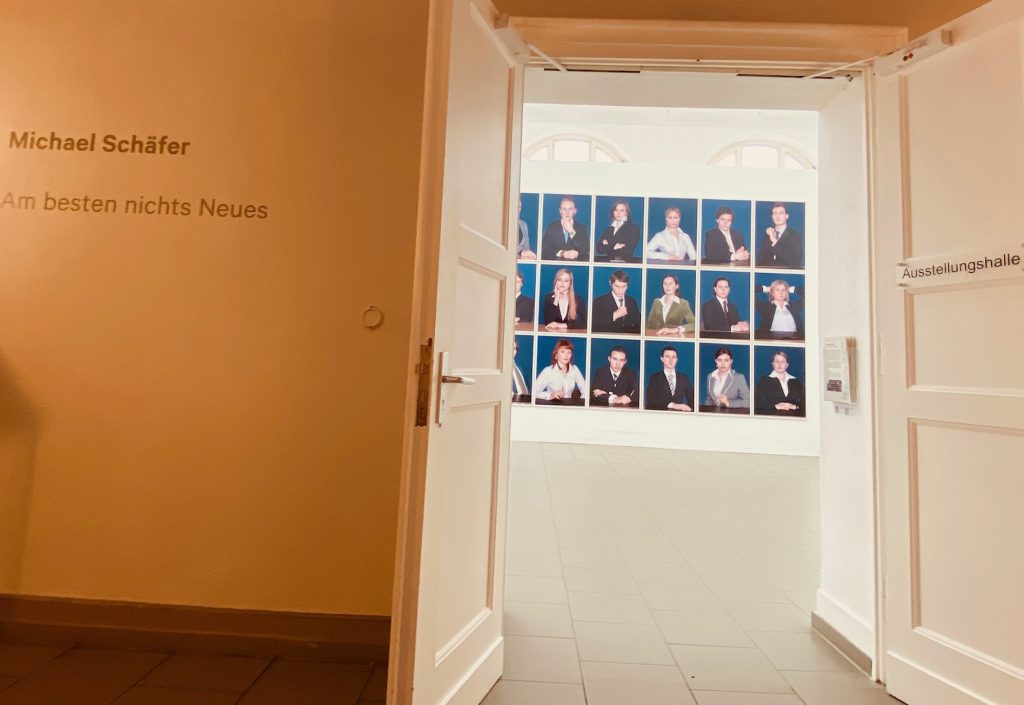
Our usual expectation of an exhibition of photography is to look at photos at a wall. Sometimes there is more it. The Exhibition Space at the “Haus am Kleistpark” features Michael Schäfer who attempts to go a bit beyond these traditional forms. In the works of photo cubes on water surfaces “2021_57”, or a dice floating on the waves of oceans, the video representation of his photographs takes the assembled images beyond their flat 2D surface. However, the 2D representation is at the origin, then transformed into a 3D dice, which then is animated as a 4D format. Moving beyond the flat screen image takes photography into the 21st century.
His work “Les acteurs 1-26” from 2007 is shown at the entry hall of the exhibition. It shows pupils of a class at an elite school who deem themselves in leadership roles in the near future. Is it acting? Is it projection into a future role they are likely to take on. They represent stereotypes, of course, but some are pretty convincing in these roles already. Some others still seem to reflect on what they are doing there. Even acting these roles, they are aware of the meaning of social rank and class in society. Without having read the sociologist Bourdieu, all are aware of the fine, little elements of distinction as they have evolved over time. We could teach an interesting sociology class in this exhibition.