Vaim and the sea

Vaim is not a person, it is an imaginary place, somewhere next to the sea, rather small in size, and in conventional terms nothing much is happening there, aging persons go about their daily routines in their more or less splendid isolation, speaking to someone is a rare act of achievement, most of the talk is speaking to yourself not even really thinking aloud, just ruminating on and on for days, sometimes weeks or maybe years in a person’s life 

Okay, my exercise in “slow writing”, a wee bit attempting to copy Jon Fosse, kept me going for 10 lines before the end of my paragraph. Jon Fosse keeps going without the end of a sentence  punctuation for 66 pages in the German translation by Hinrich Schmidt-Henkel. Reading the three phrases of Vaim, each as an extended poem and an “homage” to life from three intertwined perspectives, resembles a cubist painting and, maybe, at least for me, each one like the novella “The old man and the sea” by Ernest Hemingway. It is also a triptych in the religious tradition of paintings, just as much as “Vaim” follows in the footsteps of “Waiting for Godot” by Samuel Beckett. For all those who don’t care about any previous literature just read Jon Fosse as an endless love story of platonic relationships, silence and romance,  next to the sea. Please, don’t pass on your copy of Vaim to school-aged children as they might become very creative about punctuation. The only allowed end of a sentence are occasional question marks, which is a nice philosophical twist in Jon Fosse‘s literal exploration of time and love. 


Dystopian Utopia

Anybody who had warned about the disastrous effects of global warming 10 years before 2025 would have been branded as telling a dystopian tale. However, according to the report by the climate scientist and the “World Weather Attribution Network”, the year 2025 has been among the 3 worst years for humanity with thousands killed and millions displaced due to extreme weather events on our planet. It is all to easy to turn the page and focus on a New Year for those unaffected, but the costs of these man-made disasters have reached dystopian levels already, much faster than projected 10 years ago. 10 years after the Paris Agreement the efforts to cut emissions haven proven to be insufficient. The consequences of this failure hit the poorest people and regions the hardest. Beyond the importance to monitor and to keep track of the events the compensation for people who suffer the “externalities” of unrestrained emissions has to be addressed with international solidarity as a basic human principle.

Utopian Antifascists

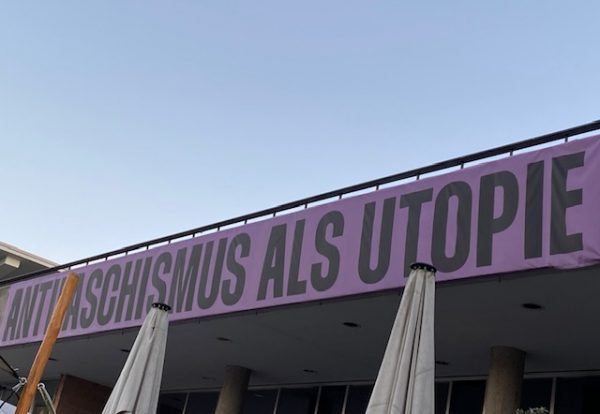
Next to the exhibition on “Global Fascism” in Berlin in 2025-12 there was a banner on the wall, which stated “Antifascism as Utopia” (see image below). This statement invites the question, whether an antithesis can serve as a positive utopian idea guiding large numbers of people. It is certainly necessary that all people who subscribe to democratic principles and human values should be able to unite under the banner of antifascism, but the ways to pursue this goal are manifold. This makes the claim of an utopian objective a bit more obvious and, at the same time, more plausible as a potentially overarching objective. The statement might well turn out to be the defining statement or key visual of the year 2026 with rising nationalist and in some places also fascist ideas and rhetoric. Thoughts and words might be only precursors of more such actions in the coming months. 

Saint-Simon Utopia

Towards the end of the 18th century and during the early 19th century, the early signs of what the industrial revolution would mean for the working people became visible. Saint-Simon had lived through the ups and downs of the French revolution himself and had been to the Americas with La Fayette before he developed his utopian socialist vision of a unified class of working people, which for him included blue as well as white collar workers. At the advent of the 2nd industrial revolution through general and agentic Artificial Intelligence (AI) in 2025, we shall most likely witness a renewed interest in utopian scenarios and grand ideas of what the future of technology, society and humanity might be like. In 2026 we shall re-read Saint-Simon quite a bit in order to learn about ways to make sense of arising trends and how to come up with a positive utopia that can motivate people to thrive again for more equality within and between societies. 

Q Q Utopia

Projections into the future, the painting of a futuristic image or an utopian narrative can be based on a quantitative or a qualitative approach. A quantitative projection into the year 2100, for example, is form of creating an utopian vision of quantitative developments. Projecting the small reduction of working hours into a very distant future will eventually approach zero hours (tous sublime). Alternatively, utopian scenarios for qualitative characteristics of work and employment range from full health and safety or “cure yourself by work” (?really, “Arbeit macht frei”) to AI and robots designed to solve major laborious tasks and challenges for us. It is important to differentiate between the qualitative and quantitative forms of utopian visions. The time frames matter, too. In politics various combinations of utopian perspectives have frequently been combined. The human mind’s capability to project itself into the future explains our tendency to come up with utopian ideas or scenarios irrespective of our ability for rationality. We better acknowledge these human characteristics rather than insist on an either, or image of ourselves.  

Positive negative Utopia

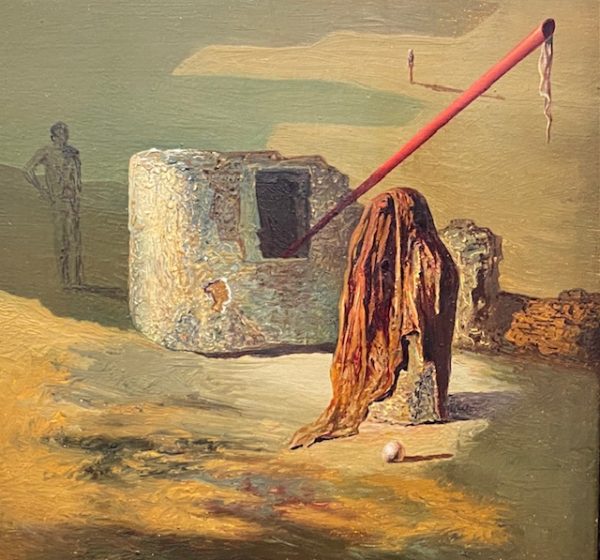
We have been used to distinguish between a positive or a negative utopia. The idea of a paradise is usually associated with a positive utopia, however, from the perspective of mankind being unable to live together without the idea of God being the ultimate arbitrator, this is more like a negative utopia. The industrial revolution and communism as the utopia to spread wealth equally across generations and all people, have been turned into negative utopia by dictatorships and authoritarian regimes. The fascist ideas of superiority of a race has also turned into negative horror and Nazi-terror. Hence, skepticism is in order, if either form of utopia is advocated. There are numerous examples of unintended or not explicitly stated consequences that have to be considered as well. (Image: Extract from Salvador Dali, Looming Danger Alarm, 1934, Neue Nationalgalerie, Stiftung Pietzsch)  

Future of work

The beginning of the 3rd millennium has brought about several fundamental changes of work and employment. What had previously been thought of as utopian in the realm of work, has become a normal feature of work. Just like in the historically grounded, utopian perspective described by Bernard Gazier “Tous sublimes” (2003) we have a growing group of employees and self-employed persons who enjoy privileged positions on the labor market with sufficiently high salaries and access to mobility on the labor market at their own discretion. In addition to these examples described in Gazier’s utopian perspective, the 2020s added permission of remote work from anywhere and use of AI-assisted technology and robotics. A previously utopian view of the future of work has become a reality for many more people nowadays. The utopian element no longer is the how this world of work might look like, but how many people will enjoy the benefits of the technological progress. With a substantial increase of the efficiency and productivity of work, the distribution and sharing of the fruits shall become even more important. We have entered into a new phase of “the brave new world” of work as of 2025. (Image: Graffiti Berlin 2025-12).

Communist Utopia

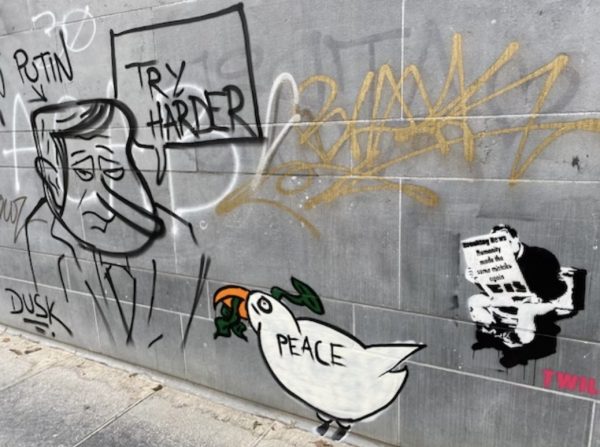
Putin has not only killed thousands of his own people, but he he has also killed the communists’ utopia of a better world and future, if only private property would be replaced by a top down, one party rule of a leadership that pretends to act on behalf of the people. Young Russians have little choice than to follow orders, learn how to bribe superiors not to be sent to the killing fields or be sanctioned. Putin has put an end to the ideas of Glasnost and Perestroika in Russia and utopian ideas about communism as well. He must have sensed it during his time in Eastern Germany that without brutality the Soviet union will not survive for long. As soon as he came back to Russia he prepared the shameless abuse of his power and ideas about a law-based socialist system in favor of the return of the military state. Borders are for those who believe in a rule-based international legal system. Changed to this international legal framework are hard to believe by European nations, but have to be accepted as a new form of “Realpolitik” in the international arena. (Image: Graffiti in Brussels Mont des Arts 2022-3-1) 

Make someone believe

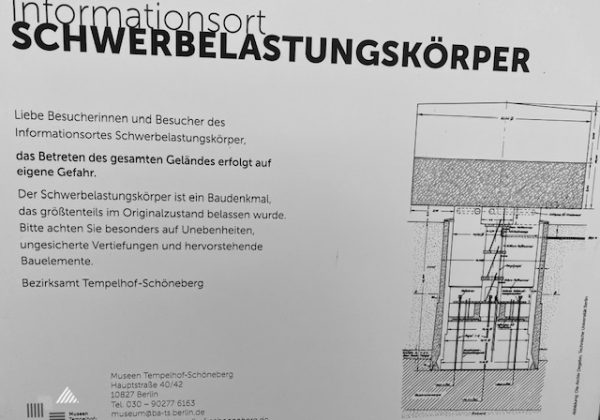
Some people are very successful in making others believe they are or can be part of something very big. Selling grand, utopian ideas to people is an old recipe to get people to support a person who might have great ideas and appears to be capable of obtaining this utopian goal. The Romans built their amphitheaters for the people to keep them interested in the Roman empire. Nazi-Germany made Germans believe in the grand idea to build the new city of Germania in place of the city of Berlin. To fool people further they needed to come up with ever greater plans and the test drills and small beginnings where realized irrespective of the war efforts and terrible losses of lives. Utopian plans, a bit like MAGA-mania, need ever greater utopian designs so that followers still adhere to the basic utopia. It is amazing to what extent people want to be fooled rather than proceed in small steps. It has been dangerous for humanity in many respects, but the utopian sagas keep popping up.  (Schwerbelastungskörper, Berlin) 

Perestroika – Glasnost

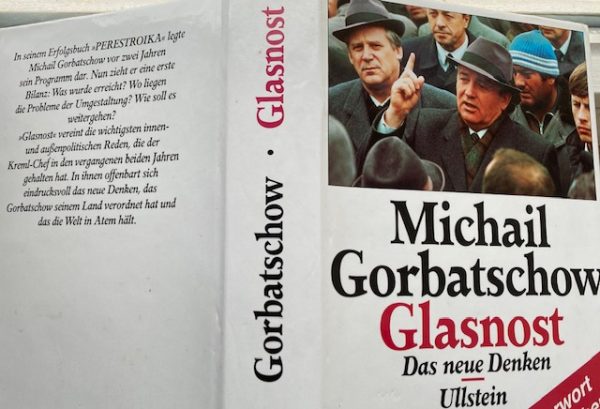
The extraordinary leadership of Michael Gorbatschow with his introduction and subsequent implementation of the principles of Perestroika and Glasnost has changed the lives of millions of people in Eastern Europe to the better. The independence of occupied countries became feasible. The aim to build a “socialist state based on law” (p. 86) and the belief in the power of the people without differentiation of what information is for all and what information is reserved to closed party circles and leadership were perceived as sweeping reforms. More than 25 years later there is little left over from these radical reforms. Putin and his narrow circles have locked in people and their freedom of expression again. The practice of Perestroika and Glasnost have been relegated to a distant dream again. (Image: book cover Gorbatschow).