« Tomorrow is the question ». This is the imprint on the 8 table tennis tables in the Martin Gropius Bau 2024. As part of the Contemporary art exhibition by the artist Rirkrit Tiravanija, the tables are very busy throughout the day and invite people to meet, play and greet. If tomorrow is the question, today is the answer. Is it? Maybe the answer is the day after tomorrow? Time appears to be the answer and the question. Such questions touch on basic philosophical questions about our relationship to and concept of time. Future orientation or even the belief in life after death touch upon basic religious beliefs. Intergenerational transmission is useless if there is no tomorrow or concept of tomorrow. Sustainability is most relevant if we are convinced there will be a tomorrow. Fatalists or warmongers rate today so much more than tomorrow that everything is subordinated to the urgency of now. Not easy to strike the right balance between „for now“ and „for tomorrow“. Simple financial discounting of benefits which accrue only tomorrow do not solve the urgency issue of behavioral concerns. My personal discounted value of ice cream tomorrow might be superior to ice cream now, but it is based on the tacit assumption that the shop still exists tomorrow or any other time in the future. The exhibition invites people not only to play table tennis but also to discuss the question of tomorrow across language barriers and across tables and cultures. 
Phase Shifting
The Berlin “Hamburger Bahnhof Nationalgalerie der Gegenwart” recently acquired “Phase Shifting Index” by Jeremy Shaw. As part of an exhibition of new acquisitions, Sam Bardaouil, the director of the museum and curator of this exhibition has installed the large-scale video and sound installation at the end of the long corridor of the “Rieckhallen”. The impressive, even overwhelming art work was created in 2020. It was first shown at the Centre Pompidou in Paris. 
The piece consists of seven large suspended screensand creates a space like in dance club, discotheque or dance studio. The visual and sound experience is allmost psychedelic. The near obsessional dancing shown on the screens represent different periods of dancing with their particular patterns of movements and choreographies. The phase of the electromagnetic waves is shifting from one screen to the other and towards the end of the performances it becomes clear, that they all follow a similar wave or rave pattern. Sublimation or ecstasy are the underlying index-like common traits. Each period or decade 50s, 60s, 70s, 80s, 90s, all had their peculiar dance and movement patterns. The video-installation is like a history of art of expression through body movement, amplified and indexed through rhythm and sound.
Electromagnetic waves can be characterized through wave shifting in various forms. This work gives us a feeling for the fascination of movement and phase shifting emotions. Don’t worry, the immersion ends after 10+ minutes and, if you like, you might read up on the physics of electromagnetic waves and phase shifting to calm you down.
Images: “Phase Shifting Index” by Jeremy Shaw, 2020, Berlin, Hamburger Bahnhof, 2024-9

Heat Stress
Heat causes cardiovascular and pulmonary stress. This has been well-known for a long time. A newly published epidemiological study for Germany reiterates this finding and adds more details to the picture of who is affected most by heat stress and heat-related mortality. Old age and being female increase the heat-related deaths in Germany according to the study by Zhang et al. (2024) published in the Lancet Regional Health. Our body’s thermoregular responses to heat stress like vasodilation or hyperventilation cause additional stress to our cardiovascular and pulmonary system. Excessive sweating and dehydration, possibly increased through medication, amplify heat-related risks. The study corrects the estimates by using fine particulate matter (PM2.5), ozone (O3), and nitrogen dioxide (NO2) data on the district level in the analysis. High concentrations of PM2.5 and NO2 increase heat stress and related deaths as well. Inner cities are, therefore, not the best place to be during the hot season. Most southern European inhabitants of big cities are aware of these health hazards and act accordingly. In Germany it is much less a habit to quit inner cities during the hot days in summer, but climate change will make this a major concern. Greening inner cities is an urgent necessity, which is not just nice to have, but saves lives. (Image Berlin Bears, Berlin City Center 2023)

Gas light
Even if it sounds crazy from today‘s perspective gas lights once were the symbol of progress. In the middle of the 19th century gas lights started to lighten and brighten the boulevards of major cities in Europe. The historic evolution of the various designs can still be followed in Berlin in the open space museum of gas light in the Tiergarten area near Zoologischer Garten. These gas lights were brighter than candles or petroleum lights and needed less maintenance. The CO2 footprint was no concern at that time and also safety concerns have been tolerated. Mechanical maintenance was relatively easy and sufficiently qualified personnel still abundant. All this has changed and the lamp posts powered by gas are mostly a part of industrial history now. The image below shows a fine example from Amsterdam. The solid construction shows nice ornaments on steel. The rounded shape remained quite unique.
Unfortunately, the accessibility of the museum has contributed to the loss of many nice examples of gas light designs. Many were destroyed during the football world cup in Berlin in 2006. Let’s hope the Tiergarten survives the Euro2024 better than the previous huge football events and Love parades. Serious precautions have been taken with quite solid fences to protect the inner city wild life.

Family Kafka
100 years after Franz Kafka’s death nearly all facets of his life and writings have been analyzed. The archives of the editor Wagenbach and the publishing house have now opened an exhibition at the “Stabi Ost” in Berlin adding a family picture book description of Kafka’s life (Curator Hans-Gerd Koch). This is of interest because Kafka himself had written an extensive letter to his father (Brief an den Vater) in which he tries to understand his intricate relationship with his father and other family members.
Nowadays, some people would try to analyze Kafka’s life through the parapsychological technique of family constellations. The far-reaching and pan-European family networks of the Kafka (father) and Löwy (mother) families were more than just an excellent source of inspiration. 2 younger brothers died in their first year. 3 younger sisters followed more traditional evolutionary patterns within families. The television series on Kafka’s life add to the understanding of his sources of inspiration and “parallel worlds” he created and lived in. The exceptional “fictionalization” of his own life and existence in the spirit of André Breton’s surrealism remains a milestone in the history of literature.
Kafka himself thought he was not really “instagrammable”at the time, but his image has reached and still reaches millions of people (Link to Picture archive). He himself would probably have defended the thesis that the most powerful images are within us. … and they are hard to escape from.
(Image from Exposition in Staatsbibliothek Berlin 2024-4, QR-code links to reading in originals!) 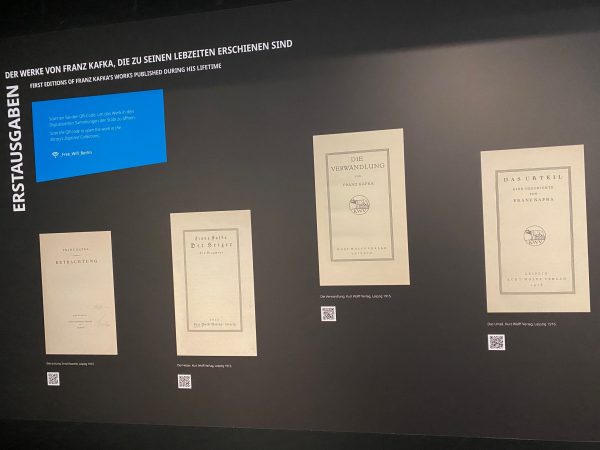
Election Re-election
Politics is a lot about decision making, coalition building and communication strategies. Therefore, there have been well established election and re-election cycles in all democracies, even the so-called illiberal pseudo-democracies. The time span between elections is itself a constituent part of democratic practice. 4 years of office for an elected parliamentarian seems to be common sense across many countries. More intensive participation and election schedules have advantages in tighter checks and balances, but may have disadvantages with respect to democratic fatigue, i.e. the time and effort needed to stay informed and cast votes. “Liquid democracy” is a concept of decision making which requires highly engaged persons willing to get involved beyond average commitments. Delegation to politicians within parties and parliaments remains an effective version of democratic practice. Checks against corruption and illegal practices is a necessary condition of each system of delegation. Rapidly changing governments are similarly perceived as a risk to democracies as the repeated call to the ballot box might be unsettling more than calming the spirits.
Berlin in 2024 (like 2023) provides another lesson on the sense of elections and re-elections. The repetition of parts of the federal election in parts of Berlin was required by the constitutional court. Due to failures in correct provision of access to voting and voting material results might have been biased. According to an online reporting by the local radio station (rbb24) based on the official electoral statistics, the participation in the re-election decreased from 75% to 51% in the 455 out of 2.256 districts that repeated the election. There seems to be a high level of democratic fatigue in these districts where the re-election in general accounts of participation in elections marks a low point in achievement. It appears worthwhile to question the judicial decision to repeat the election to the drastic reduction of representativity of the re-election. In statistical terms we trade one form of bias against another form of bias with an unclear overall outcome.
Organising elections is a professional task and requires specific competences. As this is at the heart of democracies, we need to improve our organisation and surveillance of this fundamental democratic process. Repetition seems to be worse than other second or third best solutions. Investing in democracy starts also at the ballot box. Electronic voting is not a panacea, but might be part of the solution. (Image source: Landeswahlleiter Berlin, left: Erststimmenmehrheit, right Wahlbeteiligung, combined election + re-election) 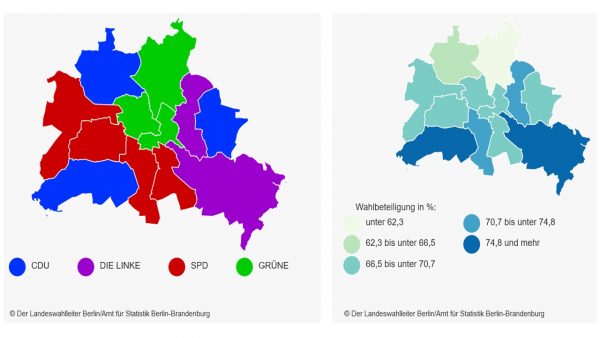
West Europe
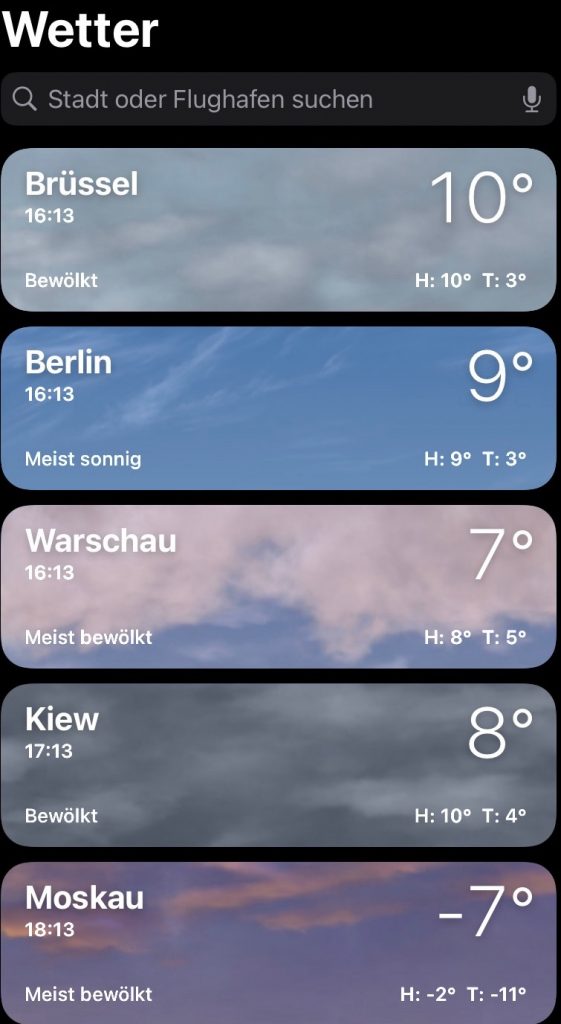
There has been a shift of political borders in Eastern Europe. Russia has been trying to shift its border further to the West by brutal force attacking Ukraine. Political defence and military action have managed to preserve western values in Ukraine. On the 13th of February 2024 the meteorological data confirm a clear belonging of Ukraine to the western climatic conditions. Temperatures in Kiev are very similar to the western hemisphere and very different from the cold in Moscow. This is just a little detail or coincidence but it bears a nice resemblance to the political weather currently in Europe. It is by all means much colder in Moscow than in western Europe. The time and the climate are a changing.
Berlin Moscow
Some historians have a hard time to sort long-term relationships between countries into adequate periods. The ups and downs between Berlin and Moscow are a peculiar example of this. The artist Peter Laszlo Péri expressed this unease in a poster where both cities stand for the dictatorships presumably in the name of the working class. This alliance between Berlin and Moscow, Hitler and Stalin led to occupations of several neighboring countries and war in the following years. With an uncritical stance after German unification the Berlin Moscow link has again facilitated the land grab of Russia with Ukrainian territory. Buying complacency of Berlin in return for cheap oil and gas from Moscow has ended for most European countries now. Great to see Europe united with few minor exceptions and that alliances with other European cities reveal strong and powerful in hope of a more peaceful Europe. 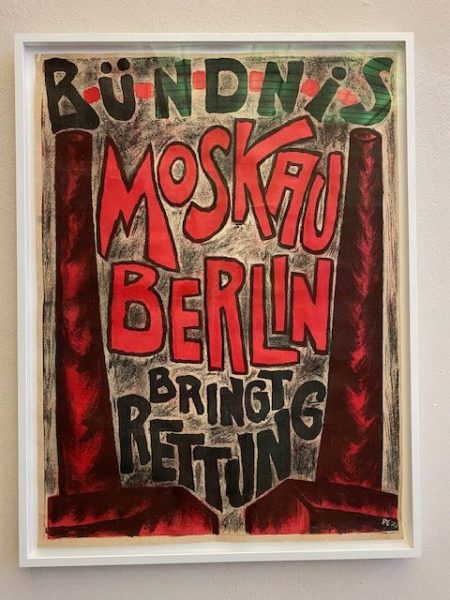
Clearing Rubbish
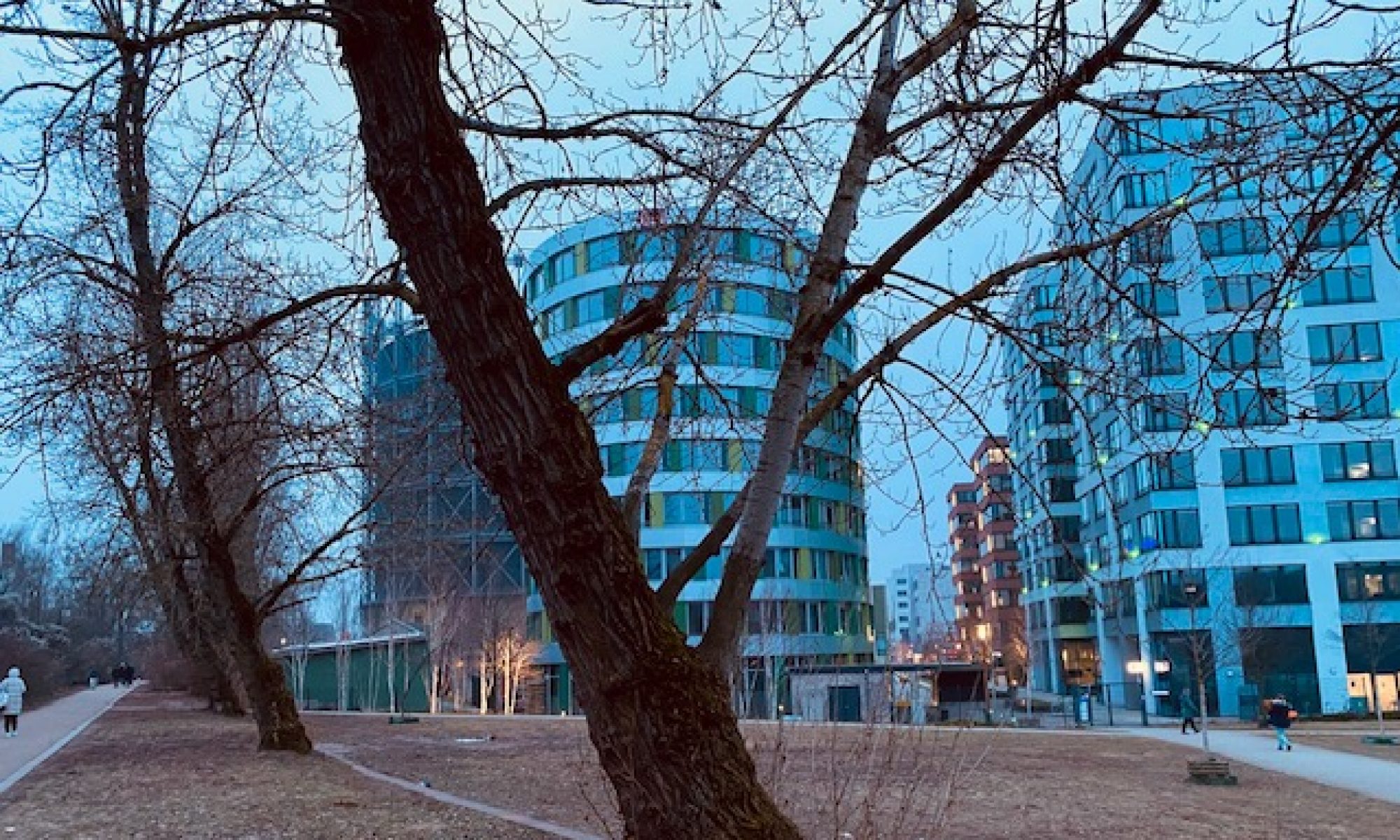
Just next to the Circular Line “Ringbahn” and the Gasometer in Berlin there is yet another huge area in preparation for further construction. The “Berlin Südkreuz” train station connects by ICE directly to Leipzig, Nurnberg and Munich. New company headquarters have been built in the direct neighbourhood and several housing blocks. Clearing more areas that mainly stocked rubbish like broken cars over years had to move out and thousands of people will be able to find new homes soon. Demand for such projects is still high, although the financing with high interest rates has become a challenge for private persons. Interesting building concepts have been realized in the district of Berlin with some focus on social and inclusive housing in a broad sense. A process of gentrification is also observable, whereby the higher rent in the district pushes out people and families that no longer can afford the increases, most of them even above inflation rates in the past few years.
The urban planning advances in large strides. With the almost finished Gasometer the vision from the visitors’ platform on the top will soon allow to observe the next construction site. Clearing rubbish is already a good step ahead. Getting rid of the pollution and contaminated ground will take some time as well.
In the East of Germany, the sun rises early and so do construction workers. We expect to continue to be early birds in this area. Maybe we can have a few additional trees, schools and a kindergarden as well for the newcomers. The whole local infrastructure will be put to yet another test. You have to like change and embrace the continuing challenge of becoming more densely populated in Berlin. It is a social lab right in our neighbourhood. The “Rote Insel” is clearing out its rubbish, the number of buggies with babies is rising fast now. 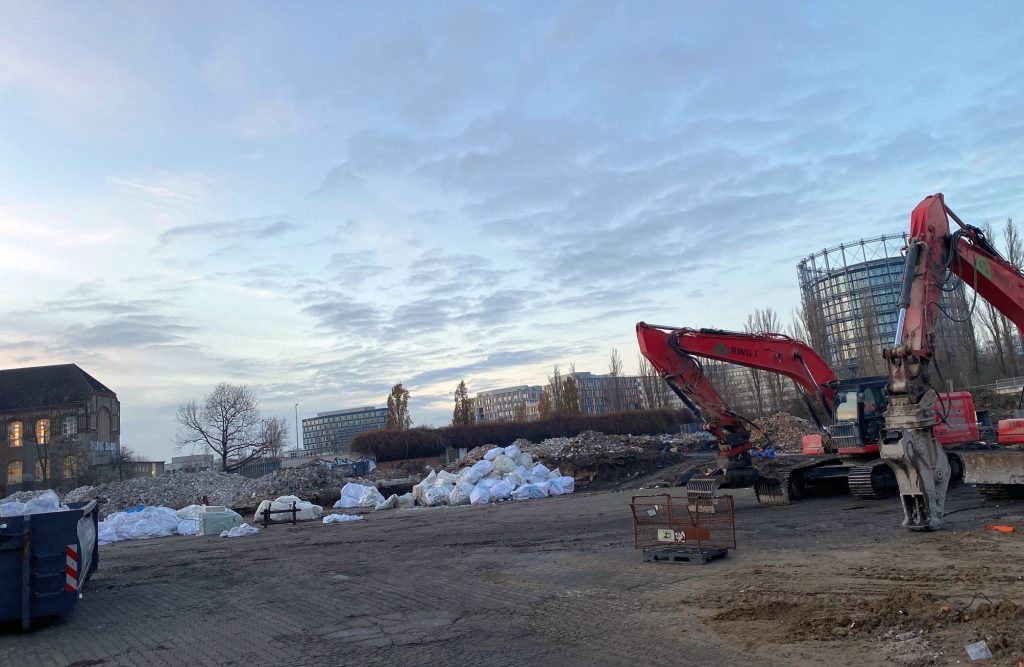
Nachhaltigkeitskonzept
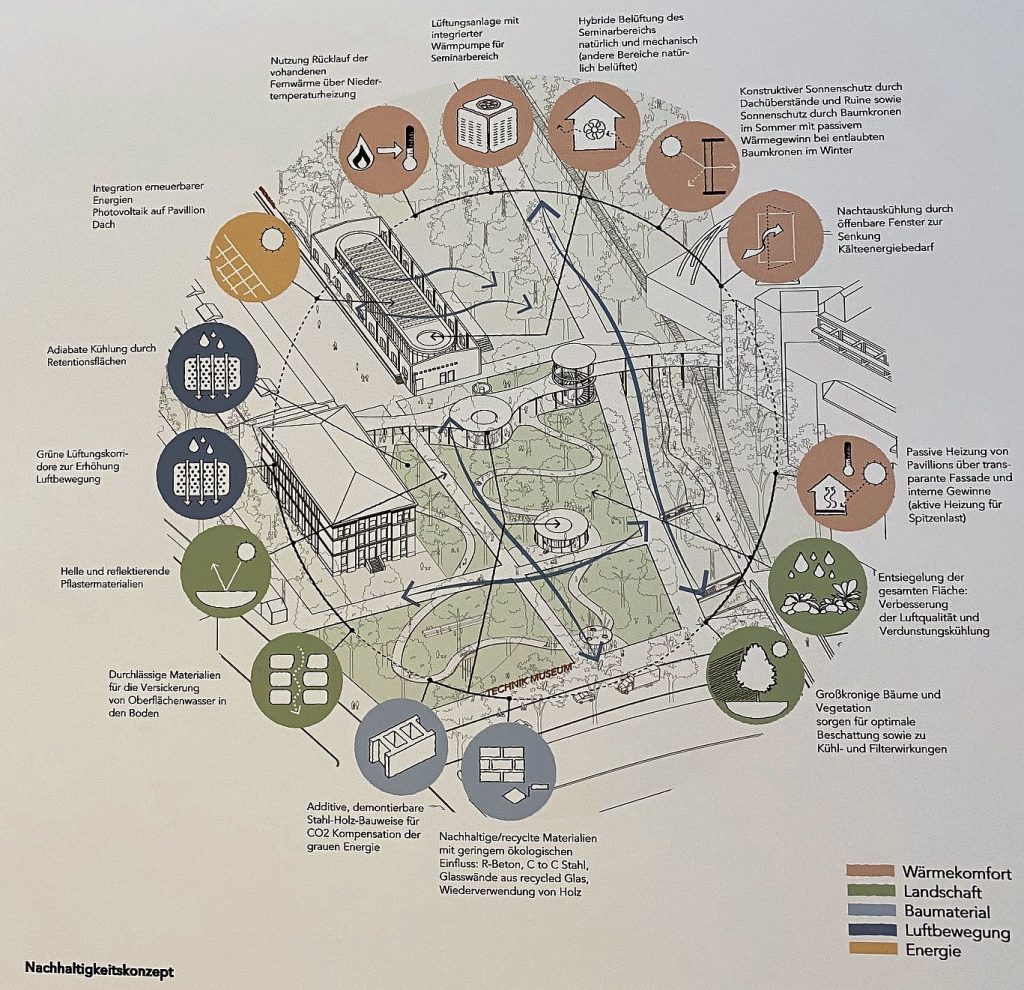
Ein Nachhaltigkeitskonzept gehört zum Bauen mittlerweile wie das Gelbe zum Ei. Die Einreichungen zum Realisierungswettbewerb eines Portals für das Deutsche Technik Museum Berlin hatten entsprechende Anforderungen zu erfüllen. Für ein Technik Museum können dazu die Anforderungen schon etwas höher sein und die oft geforderte „Technologieoffenheit“ oder die Diskussion darüber zumindest andeuten. Der Anerkennungspreis ging an ein Konsortium für die Einreichung 1110, die eine klare Übersicht ihres Nachhaltigkeitskonzepts vorstellten (siehe Auszug Image unten, Foto aus der Ausstellung 2023-12). Nachwachsende Baustoffe gehören zum Repertoire. Gleichzeitig sollte die Erhaltung oder gar Förderung der Biodiversität Teil der nachhaltigen Konzeption sein. Innerstädtisch ist die Rückumwandlung der Versiegelung der Böden eine wichtige gesundheitsfördernde Bauweise. Kühlung in den aufgeheizten Städten ist durch Grünflächen und Beschattung zu erreichen. Tolle Architekten sind das, die den Mut aufbringen den Stachel in die Wunde zu legen. Die Anwohnenden und Besuchenden würden es den Verantwortlichen jahrzehntelang danken.
Das sind längst keine abgefahrenen grünen Ideen oder Träumereien mehr. Paris hat es schon längst vor gemacht. Ganz nah beim Eiffelturm ist das „Musée du Quai Branly – Jacques Chirac“ das als Neubau mit Garten vom konservativen Präsidenten Jacques Chirac eine grüne Naturoase mitten im Herzen Paris hat bauen lassen. Es ist immer noch eine Art Geheimtipp für Pariser in den zu warmen Sommermonaten. Berlin könnte wie mit der vom Pyramiden-Architekten Pei geplanten Eingangshalle vom Deutschen Historischen Museum mal wieder mit einem Nachhaltigkeitskonzept mit Paris gleichziehen. Gemeinsam können wir auch nachhaltig. Mit der vom Menschen und seiner Technik verursachten Erderwärmung haben die nachfolgenden Generationen noch lange genug zu kämpfen. Mehr Nachhaltigkeitskonzepte braucht die Technik. Das ist die wirkliche Herausforderung des 21. Jahrhunderts.