70s revival

Brussels celebrates each year the “Car free Sunday” as final part of the mobility week. On 2026-9-20 this event coincides with the very high oil prices again. Just like in the oil crises of the 70s in 1973 and 1979 saving energy for mobility and transport is high on the political agenda in many countries. Just think of the benefits of such events. Less consumption will reduce “greed-flation” and upward pressure on prices. Pollution levels of fine particles and noise are drastically reduced. Children feel safe while riding their bicycles, scooters or skateboards. Parents are no longer on permanent alert due to the risk of accidents. For those who remember or lived during the 70s, they might have a “déjà vu” experience and enjoy a revival of the 70s. The roller skates are up for a revival as well. 
Brussels Car free day 2026-9-20

Water pleasures

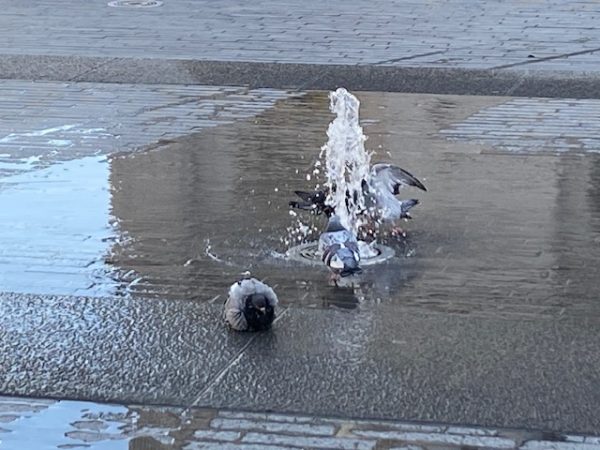
Maybe some of us associate water pleasures with the splendid fountains in the castle of Versailles (France). Our daily concerns, however, are much more about making cities more resilient and able to cope with water scarcity. According to a study by Krueger et al. (2025) the user perspective and behavioral challenges that go along with saving water by end users has been neglected for years. Water management in cities is part of the infrastructure package that has to be managed efficiently. Aging water distribution infrastructure is just as much a problem on the supply side of water as consumption has its (increasing) price on the users side. Rainwater capture, re-use and recycling are promising alternatives to simply providing more water. Pollution is, of course, another hazard that needs our attention. In the meantime we may think of water pleasures for all including the animal world.

Brussels relaxes

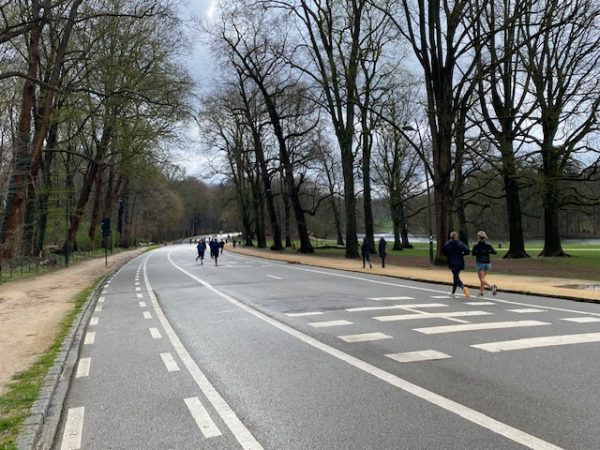
Especially during the weekends and the summer activities some roads can be blocked for other uses. The obese societies of the 21 century need to make room for more exercise wherever possible. Brussels has done so for more than 5 years already. The “Bois de la Cambre” offers an amazing space to all those seeking respite from the busy and warm urban surroundings (Image below). Children and families exercise all sorts of activities and sports. The closed roads are perfect for cycling and jogging as well as the learning of both. Levels of air pollution drop and the running sport is no health hazard as in inner cities. Each and everybody advances at her/his own rhythm (Video Weekend jogging in Bois de la Cambre on Road 2026) or just watches others passing by. Ways to relax in cities are manifold, in a matter of choice and commitment. Commit to relax and detox, at least on weekends. This can be quite a behavioral change with serious health benefits.

Make Russia pay

The initiative from the European Parliament to make Russia pay for its destruction in Ukraine could use about 200 billion Euro of frozen assets from Russia. Until a peace agreement is reached that sum could serve as a guarantee for infrastructure rebuilding in Ukraine already during the war by Russia on Ukraine’s civil infrastructure, like energy supply, airports and railways. It is an accomplishment of transparency to be able to trace the Russian assets. The largest amount is stored in Belgian banks according to the material distributed by the European Parliament. All these funds make up for a substantial effort that otherwise tax payers of other European countries will have to spend. The cooperation in the EU and beyond is at yet another test. Belgium plays a rather strange role in this respect as it benefits the most from many European Institutions and lobby groups being based there.

Surrealism Networks

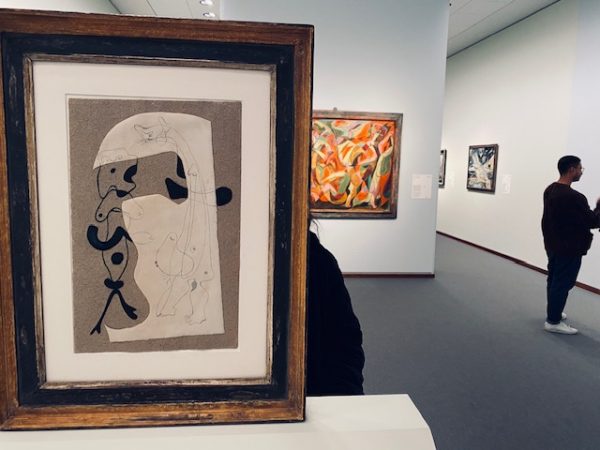
The research project on the networks of artists in the group of surrealism ranges from the male proponents Breton, Ernst, Magritte, Miró to female painters like Lenora Carrington and Dorothea Tanning. The collection of Ulla und Heiner Pietzsch, donated to the Neue Nationalgalerie in Berlin, excels not only in the depth and breadth of the collection of surrealism, but also in the way it contributes to our understanding of artistic movements and network dynamics. For those familiar with the theoretical and literary underpinnings of surrealism by André Breton, the collection allows to follow the traces of ideas into artworks. Interdependent inspiration in multiple ways becomes visible in this exceptional exhibition. The special concern and concept to honor provenance of the artworks makes the trajectories of each artwork explicit. Thereby, the geographic dimension, importance of collectors, galleries and personal relationships to gallerists become tangible. Additionally, the seizure of the 2WW heightened the need to have contacts to survive Nazi-terror. You find it all condensed into just one room at the Neue Nationalgalerie Berlin thanks also go to the Zentralarchiv to facilitate and participate in the research and documentation. (Image: Miró Collage, Berlin Neue Nationalgalerie 2025)

Codes of Emperors

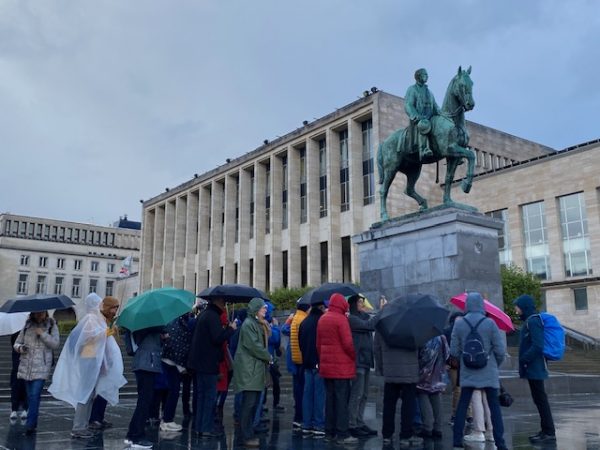
Even in the 21st century we spot the ancient codes of emperors. In Brussels the statue of King Albert, who ruled until 1933 and celebrated the first centenary of the Kingdom of Belgium in 1930, shows the Emperor riding a horse without saddle. This iconic position was started as a symbol of a powerful leadership by Marc Aurel and continued by Napoleon’s reign as well as several other ones.
The position on the elevated podium of the emperor on the horse, which further raises him beyond the level of the people, all contribute to the idealized perception of the king above the people. Such a vertical or hierarchical perspective on society or even mankind, including the colonial approaches of the emperors, are the lasting attributes of those times.  According to Els Witte et al. who wrote on the political history of Belgium, King Albert I was also named King Knight by some.
The portrayal and self-portrayal played an important role already centuries ago. No surprise that democracy has brought about an avalanche of idealized self-portraits or “selfies”.

Racine Andromaque

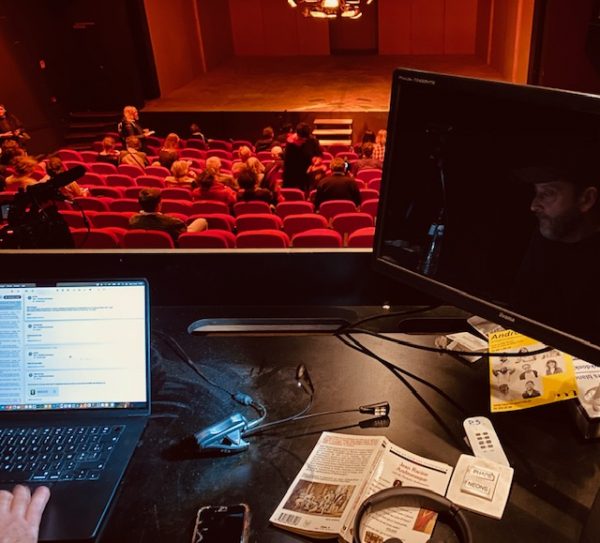
The representation of Jean Racine’s “Andromaque” in Brussels at the Theâtre des Martyrs in 2025 has been an interesting choice, because the revival of a 17th century tragedy dealing with the intricacies of the Greek and Trojan war (mostly remembered for the Trojan horse). Jean Racine turned French theatre back to tragedies with his Andromaque (Résumé and analysis in French!), rather than the comedies or tragi-comedies of previous great authors like Molière.
The literary analysis of Andromaque by Roland Barthes (“Sur Racine”, 1963) identified 3 separate locations: chamber, anti-chamber and exteriors. The real power seems to live in the chamber as the place of respect, but also terror. (Compare also Mithridate). The anti-chamber is the place of diplomacy and the place of exchange of ideas, information and strategies. The exterior world is mostly closed off through walls or balconies as views from above. For Barthes this “symbolizes” even the prison inside or the pure heroic life inside the walls.
Besides this 21th century interpretation of 17th century theatre, Racine is remembered for his tragic love stories where A loves B, but B loves C and, maybe C falls in love with A. (Compare Robert Horville, 1991) The Condorcet paradox (Science of it) described only formally in the 18th century enlightenment, many decades later, had proven mathematically that such combinations of personal preferences are impossible to resolve. Hence, these confusions are great stuff for tragedies to evolve live on stage.  


Modernist Urban planning

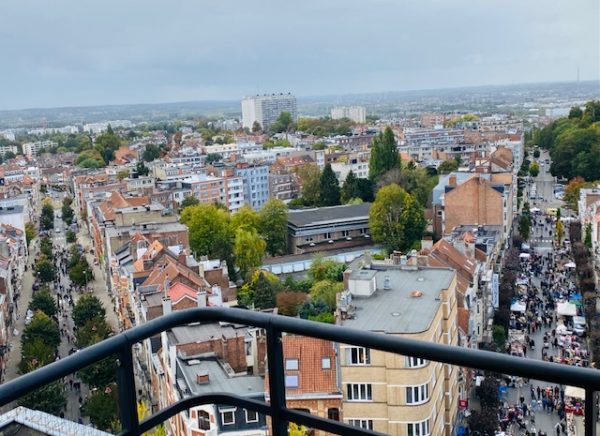
Saint Augustin in Brussels is one of the lesser known defining architectures in Brussels. It is visible from far away much beyond the immediate surroundings. Situated on Altitude 100 it is on the highest hill in Brussels with a 58 meters high Campanile built out of concrete in 1933 in a predominantly art nouveau style. The order of the St. Augustines in the center of Brussels was terminated and at the outskirts of Brussels as a new city suburb was being built starting in the late 19th century An appropriate way to demonstrate continuity despite discontinuity was the placement of the church in the middle of a roundabout and a star-like organisation of roads des descending from the top. The form of an equal length (orthodox) cross is in the spirit of the unity of the Christian churches. Even despite the prominent and exposed situation, most people pass by with little concern for the innovative, architectural features of this edifice. (Image: View from capanile St Augustin Brussels). On a small scale this urban planning concept resembles the Paris of the « Arc de Triomphe » and the views and corridors which we designed and implemented.


Music Lunch

The possibility to pass a lunch break with live music inspiration is, unfortunately, quite rare. The Brussels festival “midis minimes” has created a popular format for classical music to be performed in easy to reach venues in the city center. Working in the center allows to hop into a 45 minutes performance of varying artists, instruments and music styles. The “Cercle Royal Gaulois” offers enough seats. Even without a reservation it is feasible to forget about work and get inspired by musicians. and the composers and arrangements they propose. Gaëlle Solal and Juliette Hurel offered short digestible pieces by Bartok, Ravel and Piazzolla with a focus on their popular dance tunes often based on previous folk tunes. We virtually traveled from Romanian tales to La Habanera and Tango and back to work for some.

History coined

It is an ambitious project to frame history of a country or continent according to the succession of coins. In the KBR such an attempt is currently on display in 2025. The history of a country in the center of Europe is reflected sometimes through different occupying forces who imposed their currency onto the occupied territories. The Greeks and Romans had an overriding impact on the development of coins in human history and society.  Precious metals were used as basis to embody lasting value into coins. The images on coins are also a way to reiterate the dominance of a new ruler or governance. From the Roman occupation there are nice specoin the KBR collection as Julius Caesar named one part of the 4 occupied territories “Belgica” beyond what we define as borders of Belgium in the 21st century. Control of your own currency means also to be able to produce unique pieces in your own foundries. The history of coins is also a history coined by those in power to enforce their political power onto the economy. (Image: KBR, The history of Belgium illustrated through coins, 2025).