Olympic Shopping

After the Paris 2024 Olympic Games have closed officially it is high time, not only for the international tourists, to do some shopping of souvenirs from Paris. Some of the flagship stores like Le Printemps Haussmann renovated a 100 years old splendid staircase (image below) for this centennial occasion of Olympics in Paris. You may test your performance there and check which grades you will receive from passers by. The first numbers of the increase in tourists in Paris show significant increases from across the world including many countries from which previously few tourists arrived. Many will want to return to the marvelous sports sites and the great shopping experiences Paris has to offer.

The Galerie Lafayette, which recently closed a shop in Berlin, is a major attraction for international tourists. It offers unique instagramable images to visitors on the platform outlook into the world of luxury. Very difficult to not be seduced after so many exciting Olympic contests.

Credit donations

“credit” stems from the original latin word “cedere”. In the 1st person you write “credo”, which means I believe. If said in a religious building or church you show with this pronunciation that you believe tbe narrative of the religious community. In the 3rd person “credit” stand for s/he/it believes. In the financial sense it is the receiver of money from your credit card who believes or trusts you that you made an honest payment. Now, banks take commissions from each of these exchanges of trust. You are credit worthy or not. In some churches you now make donations using your credit card to facilitate business. Credit card companies also charge you on your donation. Win win situation we call this. I keep asking myself, whether I still “believe in angles” or only business angles. (Image Église Notre Dame des Victoires Brussels 2024-7)

Sport Fashion

Sport is fashion and fashion is sport. Not only in the Euro 2024 the teams make a big fuzz about the design of their sportswear, but certainly the Olympic games in Paris 2024 will demonstrate the close links between the 2 worlds. We might say playing football is a bit like a fashion catwalk. Keep going right on target, despite obstacles, when thousands of people are watching your performance and potential failures very closely. Making a “bella figura” is a must in both spheres. There is also a strong tendency for “the winner takes all”, that s/he takes the trophy and the jackpot.
Both worlds are also big business in their own right. It is at least 100 years old that sport and fashion got married. The “Musée des arts décoratifs” in Paris had an excellent exhibition on the combination of sport and fashion (booklet link). According to the curators both spheres have always been interlaced. High-level performance and specialized fashion just made for a splendid combination. As the rich and wealthy had more than a penny or two to spend on their leisure activities the combination of sport and fashion soon became itself a big business, beside the visible beauty of the bodies, movements and dresses. Just watch the breakdance fashion as the latest addition to the repertoire of olympic disciplines. In a recent article in “Le Monde” (2024-7-11) the value of the market of sports including its fashionable merchandising is estimated to reach a turnover of € 500 billion in 2022.
The competition of sports has been turned into a competition of the best images and videos. Fashionable as well as functional clothing can assist in climbing the podium. In the Euro 2024 Football Final the teams equipped with Adidas (Spain) and with Nike (England) compete for the trophy. Changing equipment sponsorship from one to the other can raise substantial amounts for a team (€ 100 million/year for the German national team). Big business seems to take over sports and fashion after the century-old marriage of sport and fashion. Since then, they have jointly been on an extended honeymoon. (Image from www.emptyspacetm.com 2024-7)

Error 444

The error message 444 is a not so rare encounter while surfing on the web. The error code 444 stands for the message that from the side of the server the connection is closed without any additional message. The occurrence leaves you without further indication of what exactly went wrong in building a connection to a web service or website. You just simply get shut out and that’s it. It may be tough on you if concerns your online banking or other access to vital services delivered through the internet.
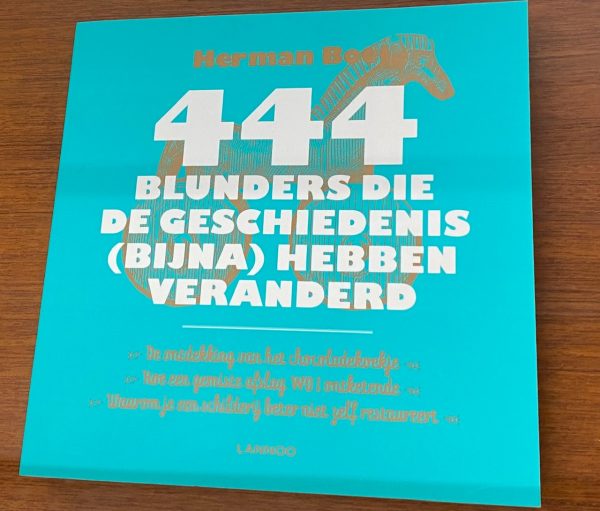
In organization science and social science there are many new studies dealing with the finding, dealing, coping or handling errors. It has become much more acceptable to deal openly with errors, blunders or failures. From an individual as well as organizational perspective the cultures that deal openly with these events seem to have a certain advantage to overcome the consequences of errors at all or faster than others.
In some biographies failures are part of the lessons learned throughout life. It is deemed important to acknowledge failures or paths not taken for better or worse. Organizations just like individuals seem to learn more intensively from their failures or omissions than from everything seemingly running smoothly. Learning curves are faster also for “machine learning” if you have access to a huge data set which contains ample data on failures rather than encountering failures after release. Hence, the compilation of errors is an important part or early stage of a learning process. Failed today? Fail again tomorrow. You’ll be really strong the days after although it might hurt.

Energy Ethics

Around the topic of energy there many ethical issues that urgently need sorting out. Carlos Diaz-Rodriguez and co-authors have provided a sound basis for such ethical considerations. To leave the disastrous path of energy provision through polluting fossil fuels and, additionally very risky, nuclear energy, they propose a departure from the principles and values that have guided us into a dead end. In their opinion we suffer from a mistaken belief to be able to control in extremis, through scientific methods, the forces of nature. In ethics this mistaken belief has roots in religious beliefs that mankind is mandated to make the earth subordinate to its own will. The authors propose to overcome this old paradigm with a new paradigm. This builds on the (1) “precautionary principle”, (2) justice as equity, (3) protection and the (4) principle of responsibility.
Most European readers of philosophy and social science are familiar with these principles. The virtue of the paper is to expose and juxtapose these principles in a clear format and a stringent application to the ethics of energy (production as well as consumption of it).
The precautionary principle is part of the European treaty on the functioning of the European Union Art. 191, but its implementation on energy issues reveals that it is a tiger without teeth. Younger generations across the globe are right to claim a more forceful implementation of this principle.
The perspective of justice as equity is bringing in later born generations as well into the balance costs and benefits of “cheap energy today” but huge costs of dismantling, repairing, stocking deferred to the future.
The protection principle refers to the loss of biodiversity and exploiting resources in areas of world heritage, for example.
The principle of responsibility goes beyond the judicial and economic principle that the person, company or state causing damage through exploitation of resources, and in producing energy with it, has to pay for repairing those damages.
As this is hard to achieve in real terms, there is an urgent need to reiterate the responsibility principle at all levels. Despite the inefficiencies of legal systems, the international legal order in particular, there is no way around than to insist on responsibility from the individual behaviour, company strategic goals as well as objectives set by nation states and international organisations. The Paris agreement and all COP XY conferences only prove the fact that irresponsibility continues to be a guiding principle.
Maximalist positions as well as continuing like decades before is failing people on earth. Organising a discourse on these ethical issues is a first step, but we have to be able to address negationists as well.
The missing principle so far is the solidarity principle. Without a firm commitment to intergenerational and international solidarity we shall remain unable to solve the ethical puzzle. It is high time to organise solidarity related to the field of energy.
(Image: “The fallen tree of knowledge” by Fabrice Samyn. Exposition in Yerres, France 2021-11)

Energy Food

For more than a decade now researchers have shown the link between energy prices and food prices. At first sight this might seem surprising. In traditional or romantic associations with growing food, there is no link between the cost of energy and food production. Growing crops in your garden does not need more than sunlight, soil and water. Yes, that was long ago. Industrial production of food is heavily relying on energy to heat, feed and water plants or animals. Additionally, the supply chains have become far more distant, which increases the CO2 footprint even further. Therefore, it is no longer surprising that a great number of econometric studies confirm the close link of energy prices and subsequent pressure on food prices. This is not restricted to Europe, but has reached global contamination.
Enjoying seasonal local food is a double catch solution. You grow according to local weather conditions and use traditional conservation methods, if the crop is exceeding your demand at that time. Providing heating for animals to increase productivity or quality of products appears to be one of the most wasteful ways to further increase the spiralling up of energy and food prices.
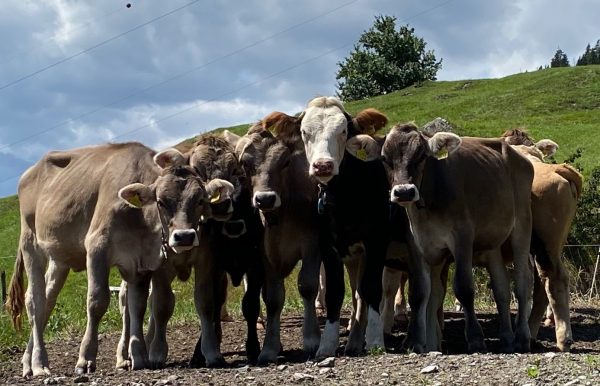
In agricultural science there is a lot of research into the “energy intake” of animals to better grow or produce more milk etc. This is the expensive intermediary step using energy to produce energy intake for animals rather than humans. It is surprising that we take so many years to address these well-known linkages that have turned to serious problems after Russia’s war on Ukraine. Agriculture and farmers can be part of the solution rather than a problem themselves, if the link of energy consumption and food prices is taken seriously.

10000

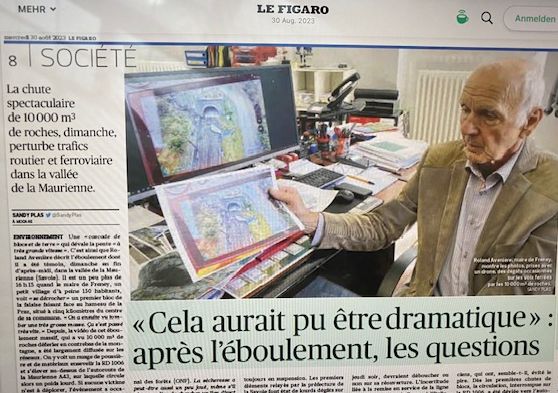
In France 100.000 is associated with Monsieur 100.000 Volt Gilbert Bécaud due to his dynamic singing and performance style. Since August 2023 we now have an additional association with the number 10.000.  Ten thousand m3 was the size of stones that came down from the mountains near the popular skiing resorts in the French Alps (Le Monde Link+video). To visualize the amount, a back of the envelope calculation with a standard container size of 25 m3 returns 400 loads of lorries to be removed from hard to access landscapes. Count this into the costs of running ski resorts.
A study in the scientific journal “Nature Climate Change” in 2023 highlighted the increasing risks to European skiing sites. Same holds for the Alpes in Switzerland.  Some areas relying on water resources to create artifical snow do so in less and less safe areas. Costs accrue to communities who benefit only indirectly from the skiing hype, celebrating 100 years of Olympic skiing next year. After all it is big business to sell or lend equipment, provide hotels and meals for all those sports women and men.
The so-called collateral damage is probably even worse. Interrupted railways, bridges, motorways and traffic in general becomes a severe disruption for quite some time adding to the total costs of having fun in winter. Is it worth it? A tricky question to ask in a referendum. We shall have to revise our past decisions to expand skiing resorts in light of the new evidence of higher risks and costs involved. A book on 10.000 years of history of glaciers is full of side-effects of glaciers melting away, which cause instability to valleys on the sidelines. In the most recent break-up of rocks it is actually more the access to the skiing resorts that was blocked, but this demonstrates to all: passing this area now, is not without serious side-effects.

Barbie explore

The film on Barbie after more than 60 years of the first puppets to arrive on the market is a huge money spinning exercise. Hitting more than 1 billion $ is really a huge box office success. More interesting even is the banning of the film in some countries like Algeria. This gives the film an interesting subversive touch to it, which we in the Western countries no longer see as something special. Emancipated women pose a threat to authoritarian regimes.
However, we see in the stereotypes of beauty-driven dolls not that much of an emancipatory chance. To view emancipation independent of the looks of a person is another interesting twist to the role in stereotypes of beauty. It is not only fun to play around with stereotypes, that is mostly, if you are not negatively affected by them (age, gender, ethnicity, extraordinary persons). A nice task for sociology and psychology to explain the working of stereotypes in society and possible remedies. Tolerance is a competence that needs to be learned and updated continuously, from early age onwards.
Therefore, the website created by the US Design Agency Rvnway offers an entertaining way to play around and learn about stereotypes. Perceived, generalized beauty or gender roles can be explored using the tool. Maybe some see themselves differently after such explorations. Everybody is a model. This is the message. www.bairbie.me will let you explore other formats of yourself. After 3-D rendering and printing your children or grandchildren will decide what role they would like you to play in their playfull, or virtual “real” life. I suppose many of us will be up for a big surprise. Go on and imagine in 4D. In the age of selfies all around us, all the time, we believe we are very modern, but the artists of the 19th and 20th century following all great painters before, frequently started their careers with an “autoportrait” or “Selbstbildnis” or series of those as they were aging.

Too big

Too big to fail. We all thought that after the financial crisis some fifteen years ago, we would not deal with the same kind of problems again. The banking sector in Switzerland has proven us wrong. One of the 2 big banks Credit Suisse in Switzerland was about to default and asked for 170 billion state guarantee middle of March 2023. Only after a forced merger with the other big bank UBS (which was rescued in 2008 already) and the huge state guarantee the solvency of the even bigger bank was re-established. Tax payers were expected to foot the bill. Less than 6 months later the Finance Minister Karin Keller-Sutter announced that there is no longer a risk for tax payers to pay for the mismanagement of the bankers involved. This is a relief for the political system which is going to the polls next year.

Many unresolved questions remain. Financial market supervision is faulty to say the least. Banking left to bankers as controllers is risky. Apparently fines do not work only prohibition to exercise similar functions (internationally) again is likely to be effective (NZZ 2023-8-9 S.19). Other remedies lie in a complete overhaul of the governance system of banks and beyond. Supervisory boards should in theory be able to assess the risks incurred by the management board. Failure to do so has no consequences for them either. Representatives of the employees in the board is likely to introduce more longer term concerns into decision-making. Saving jobs is a valuable goal not necessarily in the interest of investment bankers. Capitalism is at high risk of survival and with it our democratic systems. It was not a bank in Niger that got into trouble, but at a major European financial center. Too big to fail in a tiny country still sends shivers throughout Europe. And the other big bank is growing even bigger now, probably un-savable now. If I had a bucket of Swiss Franks, I would rather sell them.

Sichtweise

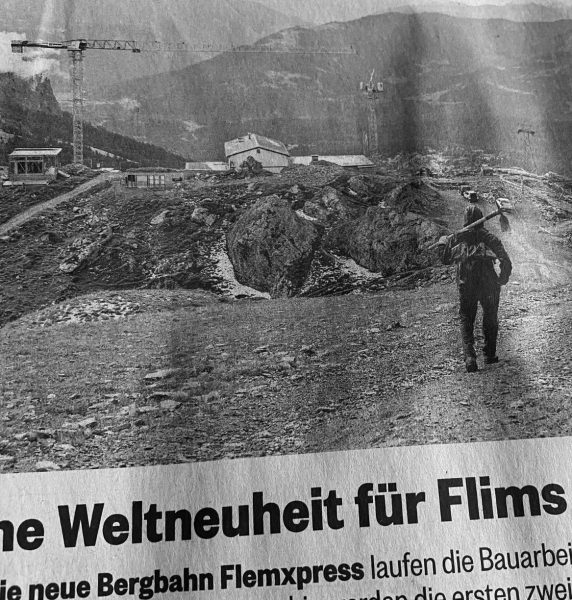
In vielen Fällen stimmt die eigene Sichtweise nicht mit der Sichtweise von anderen überein. Das kann sich bei Personen bis hin zu Persönlichkeitsstörungen auswachsen. Bei ganzen Gesellschaften, Kantonen oder Regionen führt die verzerrte Selbstwahrnehmung zu gewissen Befremdlichkeiten oder Entfremdung. Die Lokalpresse der Südostschweiz zeigt zwei fröhliche BauarbeiterInnen, die gemütlich auf ihre Baustelle zuwandern. Weit gefehlt. Der Helikopter hat längst die Hauptarbeit übernommen und diese BauarbeiterInnen (à la Heidi) gehören einer Vergangenheit an, die längst untergegangen ist.
Aber Zeitungen verkaufen sich lokal wohl besser, wenn sie an dem idyllischen Bild der Vergangenheit als Selbsteinschätzung und Selbstvergewisserung festhalten. Die Fremdsicht kommt eben auch nur von Fremden. Die Personen zahlen letztlich gerne für den Lift, um das Naturspektakel der Alpen auf 2000m noch eindrucksvoller erleben zu können. Dabei wäre mit Bussen und einer kleinen Bergwanderung dasselbe Panorama bei höherer Endorphinausschüttung zu erleben. Ob es für das Transportieren der Mountainbikes im Sommer nach oben und mehr Skifahrenden bei weniger Schneegebieten im Winter eine solche Investition benötigt, die noch mehr Grünflächen verschwinden lässt, bleibt äußerst fraglich. Der Kampf zwischen Mountainbikern und zu Fuß gehenden Personen wurde bereits durch getrennte Strecken entschärft. Zwischen den Menschen, nicht aber die weitere raumgreifende Nutzung der Natur.