Citizen Services

In addition to public services there are many citizen initiatives that pick up common interests of citizens. These range from long-term infrastructure projects to daily care and provision in small neighborhoods. Such efforts build on volunteers and the organization of volunteering as an integral part of community life and services. To facilitate these organizational tasks online tools can make a real difference. However, the trust in specific tools beyond the general platforms known for their sketchy treatment of data privacy and protection is low. Therefore it is necessary to rely on trustworthy open source software to support local communities and networks of volunteers in their work and efforts. Secure e-tools for collaboration have an important role to play to reward volunteers with e-learning and being part of or even driver of new digital services. The software „wechange“ offers a platform with several tools for e-organization and communication small communities can set up themselves. Bottom up organizing in addition to the more top down public services complement each other. Going digital is the way forward in both domains.

Start-up Winner

The SCCON 2024 has awarded one of its prizes for start-ups to „neuraflow“, which proposes the programming of chatbots for small communities or cities among other AI-applications. The test in multiple languages for the city of Bremerhaven is fun to test and shows that online public services can be witty and fun to use. The incorporation of local dialects gives the impression of a very personalized service. Moving the administration closer to the heart and the location of its citizens is achievable through shifting communication online. Prior information before a first contact speeds up information and administrative processes for everyone involved. Congratulations to the team involved and we look forward to many nice applications of the same technology in other cities. Admin can be fun, even in Germany 😉😂

Of or about

There exists a fundamental difference between taking a picture of something or someone as opposed to taking a picture about someone or something. With the term about we denote or refer to a more abstract category of trees, animals or human beings. The use of of, however, refers to a specific realization within a specific category. Painters or photographers have applied this distinction for a long time. It is similar to social scientists who consider persons or relationships as belonging to more general categories. Gender is such a category which has preoccupied us for years before concluding that just 2 gender categories are not enough to come up with reasonable descriptions and predictions of behavior. The realizations of gender are manifold and not necessarily or only binary in nature as well appearances. Eventually social categories are enlarged to fit empirical patterns in more adequate ways. The image of someone/something therefore is something very different from an image about someone/something. (Image of: Children’s corner at Musée Rodin Paris. Image about: Pedagogic approaches to art, here sculptures « Le penseur », Rodin 19th century)

Greening Brussels

We tend to believe that inner cities have lost the fight against traffic jams and climate change. However, the number of projects that stem the tide is growing and some have gained visibility beyond their immediate neighborhood. This is the case of an urban planning project in Brussels that has taken back space from urban traffic to the citizens living there. Planting new trees and a gardening space reserved for flowers changed the street into a pleasant environment where people meet and greet again rather than hold their breath and disappear as quickly as possible. Parking of cars has been reduced on the street and instead bicycle parking has become a hint towards more sustainable mobility in inner cities. Walking the city, staying and shopping nearby will allow behavioral change for healthier lifestyles. It needs a lot of persuasion to accomplish this impact and years of reaching majorities for such projects and the ability to raise sufficient resources to implement them. The additional challenge is the need to take care of the green spaces that only works with the support of neighborhoods assisting in the care and protection of the urban lungs. As the awareness to act against inner city heat and pollution increases the number of persons willing to act and devote resources as well as time for such projects increases as well. It is a long way to improve inner city health again, but these signs of exemplary projects will convince many other people that urban renewal can work to the benefit of people.

Jury Competition

We can enjoy a lot of competitions in the field of the arts. In each of these competitions there is a different kind of rationale about how to judge the performances of candidates. The composition and competence of the members of the jury are of particular importance. We all tend to agree on this. However, the basic aim or direction of the competition needs to be defined or even redefined from time to time. Some perceive a competition useless if for example nobody takes notice of the results or the event. A good fight or drama within the jury helps to attract attention to it even if candidates suffer at times. The Belgian Music competition „Concour de la Reine Elisabeth“ has an annual major competition of young musicians competing for the beginning of a career as soloist. All phases of the competition are up for streaming so we all can watch and form our own opinions on the many candidates. It is not just the solo performance which counts but also the team performance with orchestra and the openness to new compositions in the realm of classical music. There is no vote of the public (yet?) like in the widely followed „European song contest“ but public acclaim does not leave a jury unmoved I believe. Tough work for jurors to single out small differences of fairly high standards to even enter the competition. The success of a jury has probably another evaluation criteria which consists in the follow up of candidates 5 or 10 years after the event or the awards. The making or destroying of careers as solo performers might hinge on very small differences on a single day. One competition with several prizes awarded is an encouraging way to promote musicians or other artists.

Concours de la Reine Elisabeth 2024 RTBF

Publishing2024

With new channels of publishing online the publishing world continues to change. Scientific research  moves also online and the reach of audiences has become a much more important factor in evaluation of success. Elite circles of in-groups publishing and quoting each other have a harder time to survive. It is a form of democratising the world of research which is by very large amounts financed by public budgets. Public radio and television now start to feel the heat as so-called influencers, some working independently, challenge the world of traditional journalism. The good news is that there are many more people active to produce news and entertainment and the two separate worlds become more and more integrated. Young people who have left the “official” media world, engage with their own peer groups and make their voices heard and more influential.  The quality of the provision of information is, however, a matter of concern. Audiences will have to check even more carefully than before which sources can be trusted. This is not an easy task. Speed of spreading information becomes an additional factor. It has always been like that, but the rhythm of a daily or weekly newspaper was very different from the publishing and consumption of news and information today.
The second factor that has drastically changed is the influence of “external” influences and information as well as disinformation campaigns that have an impact on “internal” reporting and commenting. What used to be the world of professional journalists has become an accessible possibility for many more than journalists. Publishing has become a very different world from the printing days and yet printing remains one important channel of publishing. (Link to own edited volumes of blog post for printing here).
Previously, we prepared the manuscript in paper, nowadays this seems to move online and the edited and sometimes corrected versions will be published in print later on. The challenge to science and journalism is ticking. Not accepting that there is a serious challenge is no solution either. (Image from Exposition “Books that made Europe”, 2016)

POSSE

for a German speaking audience POSSE stands for a farsical popular drama of the 18th and 19th centuries. Nowadays POSSE has particularly in the English speaking world a completely different meaning. POSSE is short for Publish on your Own Site, Syndicate Everywhere. In other words publish your own creative work, text, tech or melody on your own website first before spreading the content on other platforms. By this strategy you make sure your content stays your content even if a platform like eXitTwitter disappears or the hype has passed like with facebook. And if at any point in time you decide the whole internet is a farce, you will be able to edit the content from your own webpage as a book or audio version as an edited volume. Do not make yourself a modern slave of tobacco, drugs, alcohol or platforms for whom you create (mostly unpaid) content they use to sell advertisements with huge untaxed profits. With POSSE you can make an end to this farce. We still rely on search engines like QWANT, Ecosia, duckduckgo or Mozilla’s Firefox, to name a few less well known web searching tools. They ensure that other people find your webpage beyond the elephant in the room called Google.

Examples of search engines of the internet

Communicate Broadly

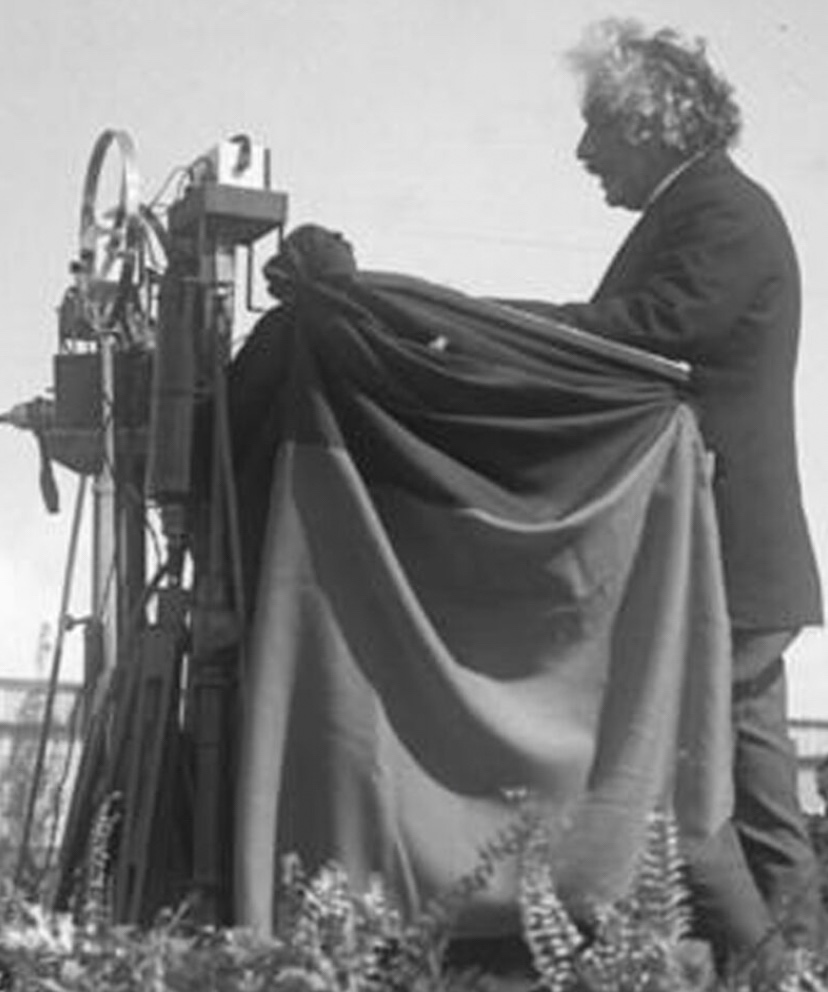
Broadcasting before podcasting has been a kind of revolution in communication technology. The potential of mass communication was promising at the beginning with cultural practices spreading to wider groups in society. Let us take the example of the Rundfunk-Sinfonieorchester Berlin (RSB). Suddenly the audiences grew enormously and it became a public duty to allow the participation of the masses in so-called high art. The foundation of the Rundfunk-Sinfonieorchester Berlin had and has again such a mission. In a memorable address to the foundation of the radio Albert Einstein gave an historic address (Link). He praised the scientific method of discovery and the engineering skills that allowed the new technology to serve all people. The fascists in Germany were early in abusing the technology to manipulate society. Albert Einstein was well aware of this danger to society. His speech is a historic testimony before the waves of emigration began fleeing Nazi-Germany. The best brains were the first to sense the power of the new communication technologies to influence the masses. Broadcasting is around with us in even more invasive ways and many praise themselves to be influencers.

Albert Einstein 1923 Speech Radio Berlin

Mastodon

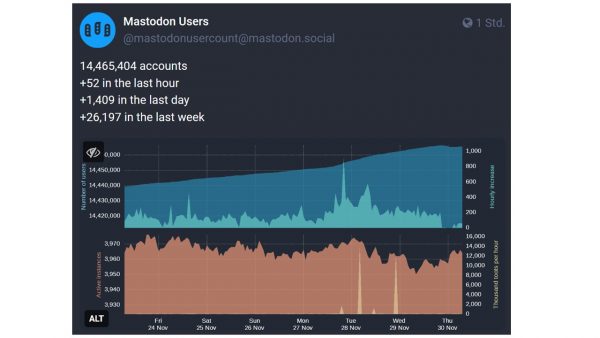
In the Post-Twitter-world there is room for other platforms to take over the information function and opinion exchange on an international level. Mastodon has made a good start to fill this gap. The number of registered users has surpassed the 10 million users by large. If the anger about the union-busting and Trump supporter Elon Musk increases further, more and more people will join Mastodon as users and content providers. Advertisers will follow where they can reach their appropriate audiences. If you sell seats on a spacecraft to the moon you will advertise on eXit-Twitter. If you care about responsible investment you advertise on elsewhere or on Mastodon, because that is where your audience will be. Ethically responsible advertisers started to make such moves already. The decentralised structure to potentially filter human rights violating hate messages will need to grow accordingly on this platform. This is a challenge for all platforms and involves costs. To better understand the idea behind Mastodon, think of a platform which connects many other local networks or platforms. Yes, it is a platform of platforms. Decentralised instances provide and can remove access to the local platform. Even whole sub-platforms might be shut out. This increases the potential to build a “caring platform”. Decentralised organisation often incurs higher costs than a central instance that decides and administers a one-size fits all solution. But it is worth a try.
An example makes is more clear, what are the advantages of such decentral organisation to achieve more shielded privacy. For example, a small local chess club targeting primarily youth can open its own server on mastodon and admit only its known members to the network. It is easy to control who gets access to your posts of solutions to riddles or innovative game and learning strategies. Access to other Mastodon instances is an additional option. For enterprises or larger organisations, it needs the communication department to talk to the IT-service to get such a structure on its way. A dedicated person needs to monitor what content gets posted and what kind of “traffic” is generated. But this can largely be automated. In case you know your members of the local platform it is much less likely to occur than on the eXit-Twitter or other centralised huge international platforms.
Many federated structures will find it useful and part of their social-DNA to join the FEDIVERSE. We shall have to wait for some more time to get the so-called social media platforms civilised. These are social investments and learning processes which deviate from the profit-maximising rationale of other platforms. (Image: screenshot from @mastodon-user on 2023-11-30).

Civil Protection

A lot of important activities do not receive the attention they deserve. During a humanitarian crisis, Europe frequently acts with varying involvement of Member States. This holds true in droughts, inundations, earth quakes, civil wars or imperialist state conflicts. The extent and time of commitment are an additional and differentiating element. Coordination of such activities is important for those wanting to help and those asking or receiving assistance. Efforts, equipment and political support vary enormously as well. There is a need to approach this topic more strategically. The Union Civil Protection Knowledge Network (UCPKN) goes a long way to attempt to find a common language, data infrastructure and responses in this respect. It surely is important to go beyond the piecemeal approach of the past to be able to address emergencies in multiple kinds more effectively. It is, however, also in some instances a highly controversial issue as well. For each term in this old (Tschernobyl nuclear disaster) and still novel field (Fukushima) for joint activities, we have to come up with compromises of definitions.
For example, what constitutes an emergency? Does the climate crisis and disasters related to it already constitute an emergency now? Some say yes, we have to act now to avoid bigger floods and wild fires as of next year. Others, do not want to tackle the root causes, but rather focus on curing actual devastating effects of disasters.
We are back to a well-known topic of preventive rather than curative approaches. In the meantime, we are convinced that we have to commit more resources to both approaches: immediate relief and structural change to prevent an otherwise never-ending sequence of disasters in varying places.
Most important probably is the keeping of address books and fast digital networking facilities to react and communicate with the competent institutions and civil organisations. Beyond the involvement and linking of experts in the field, the larger public and volunteers make up for additional invaluable resources to act.
It is crucial to make it possible for decentral links between cities like in city partnerships to be involved. Building on existing human to human links motivates and mobilises huge additional resources. Of course, continuous training is a very important element in all those efforts. We should embrace it in the private and public sector, at school and in retirement even. (Image: Extrait de Peter Paul Rubens La chute des géants MRBAB, Brussels)