Playing around with AI it is nice to test take fun examples. Image you want to plan a vacation, then the use of AI is ready to suggest to you a couple of things to do. Of course, AI is eager to propose travelling services like transport or accommodation to you where it is likely to earn some commissions. So far, the use of the “Vacation Planer of Microsoft’s BING Copilot” is free of charge. In entering the time period and a region as well as some basic activities you’ll receive suggestions with quotes on the sources (webpages of public services from tourist offices mostly). It seems like trustworthy sources and the suggestions of D-Day activities in Normandy is a positive surprise to me. These are popular activities which attract huge international crowds every year.
Thinking further on the potentials it becomes evident that travel suggestions will be biased to those paying for ranking higher on the algorithms selection criteria, which are not disclosed. Entering into the chat with the AI you and AI can target more precisely locations and also hotels etc. You are disclosing more of your own preferences in the easy-going chat and probably next time you will be surprised to be recommended the same activities at another location again.
So far, I have bought travel guides or literature about locations to prepare vacations. This is likely to change. I complement my traditional search or planning with the “surprises” from AI for travelling. I rediscovered, for example, the public service of tourist offices and their publications ahead of the travel rather than the leaflets at the local tourist office. In order to plan ahead there is value in the augmented search and compilation capacities of AI. Drafting a letter in foreign languages is also no problem for AI. The evaluation of the usefulness of AI, however, can only be answered after the vacation. Outdated info or databases have a huge potential to spoil the fun parts as well. 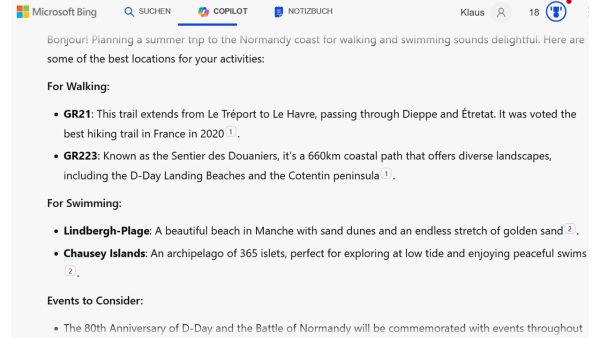
AI and languages
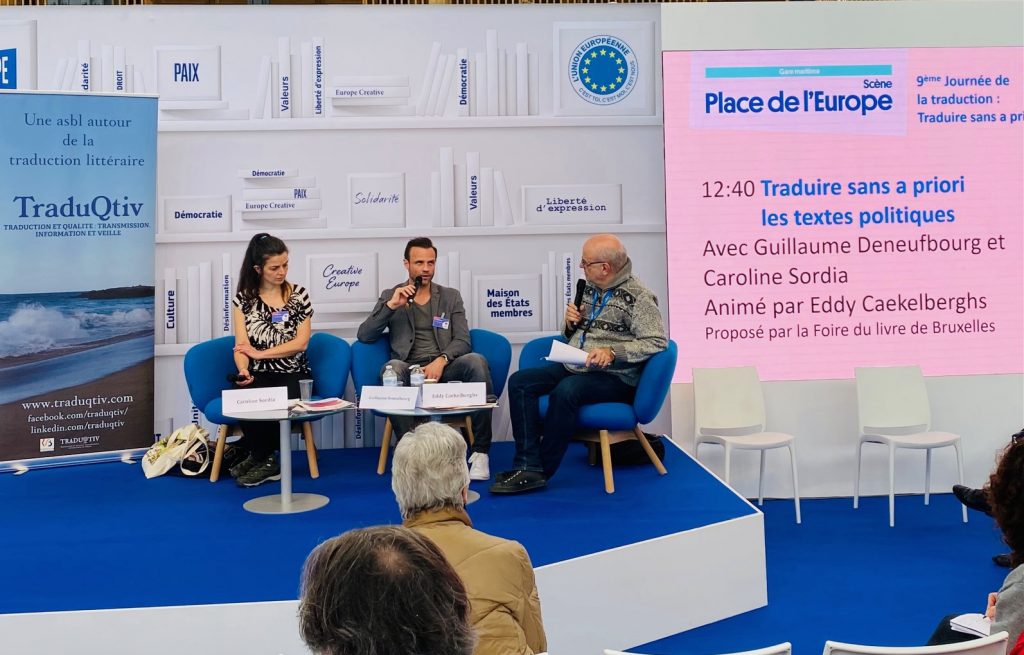
A big potential of AI is in the field of languages. Translations have been an expert domain and a pain for pupils at school. In professional settings translations are an expensive extra service for some or a good source of revenue. AI has shifted the translation game to a new level. In terms of speed of translating large amounts of written text AI is hard to beat. In terms of quality the battle of translaters against AI is still on. For chess players the battle against AI has been lost some years ago already. It remains an open question whether translators can still outperform AI or just adapt to using the technology themselves to improve both speed and quality of translations. The European Union with its many languages and commitment to cultural diversity can serve even more language communities with documents in their own language than before at marginally higher costs. A panel on the 9th day of translations at the „foire du livre de Bruxelles” 2024 expressed their reservations with regard to the use of AI in translation of political text or speech. Misunderstanding and misinterpretation will be the rule rather than the exception with potentially harmful consequences. Checking the correctness of translations is a permanent challenge for translators and can be very time consuming. There is room for an AI-assisted translation, but similar to other fields of application of AI, relying exclusively on AI bears high risks as well. We should not underestimate the creative part of translators to do full justice to a text or speech.
Corruption Watch
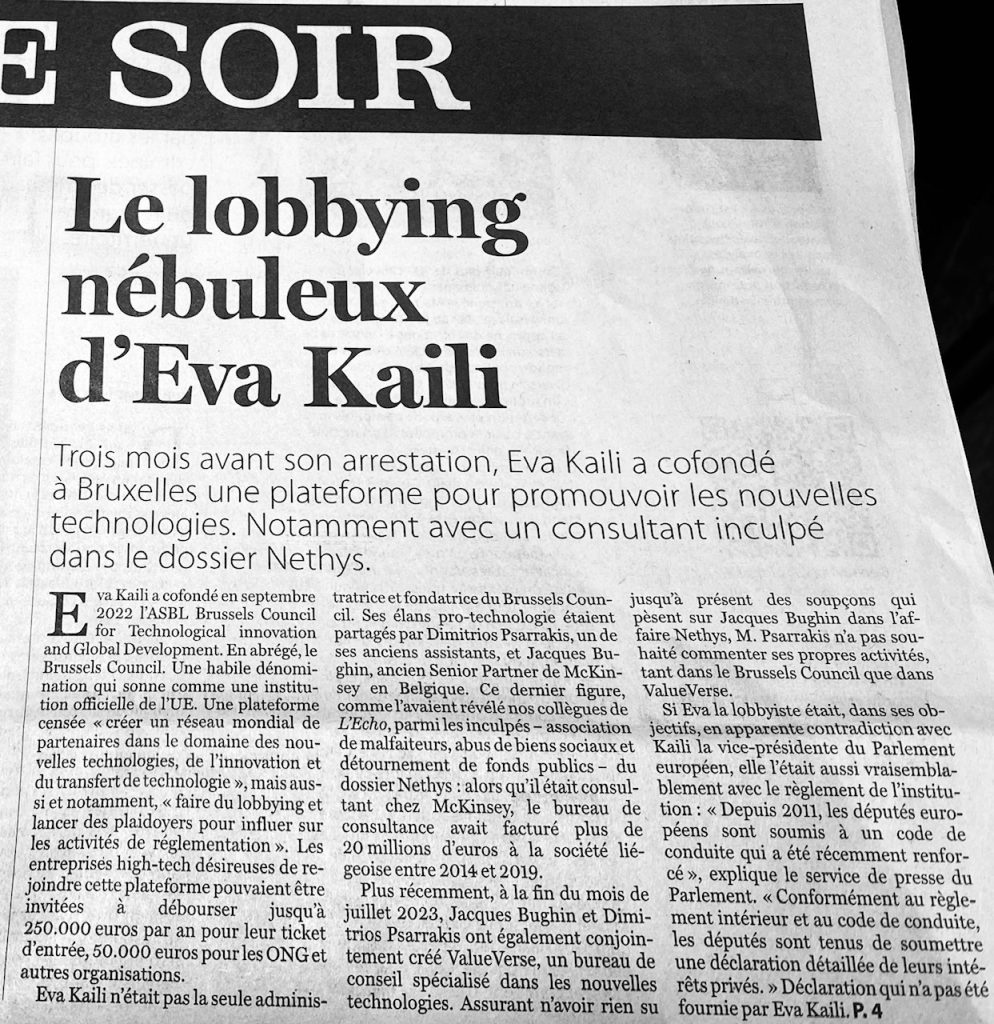
There is a persistent need to watch carefully whether corruption is involved in political as well as economic deals. Transparency Watch is doing a great job in reporting on corruption cases. In democracy we can talk openly about corruption but in authoritarian regimes it is life-threatening for yourself to talk and report on corruption. The case in Europe around the network of Eva Kaili continues to make headlines due to the ruthless abuse of rules the European Parliament. (Link to Le Soir, image below, 2024) The close monitoring of activities and lobbying of powerful industrial interests targeted on parliamentary candidates and officials will continue to be essential for the survival of democracy. The organization „Abgeordnetenwatch.de“ is doing just this. Investigative journalism needs to complement the work of NGOs in this field. Thanks to these efforts it has become much harder to cover up corruption. Only if the risk to be found out is a credible threat corruption can be contained. Let us watch out carefully and probably with the assistance of AI to uncover early any attempts of corruption.
Paper and Pastel
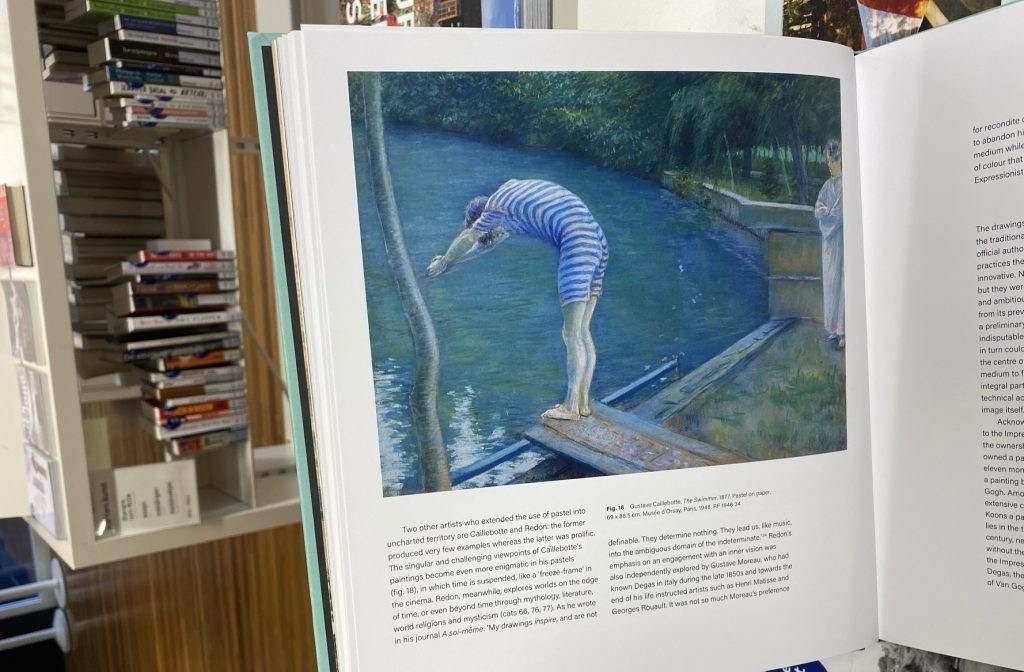
Sometimes the art is in the material. At least this could be a rapid conclusion of the exhibition presented in London at the Royal Academy of Art in 2024-1. From the informative Catalogue the importance of material is demonstrated. The ease of taking your equipment with you, like a sketchbook and out into nature have been an important feature of the impressionists’ movement. With artists challenging traditional techniques of painting and paintings as such even the apparently less noble material as paper had become a statement of being different from the established art academies making use of more noble materials. The impressionists made a convincing point with their additional use of materials accessible to all. Capture the moment and capture your very own impression of it. This is one way to immortalize the emotion and essence of the scene. In the catalogue of the exhibition I spotted “The Swimmer” drawn by Caillebotte with pastel on paper. Freezing the moment, freezing the motion and emotion is evident here, too. Testing different materials is part of the journey to find your artistic impression, expression or materialization of imagination. The ways and means are manifold.
NS München
The documentation centre in Munich of the National Socialist time and crimes has an encompassing collection of documents on display. As the prime centre of the Fascist movement in Germany in the 1920s and early 1930s Munich was the home to party elites from the first months of the movement that became the epicentre of the dehumanizing policies we can follow throughout Europe (Topography of Terror, Berlin). The historical research in both documentation centres complement each other in many respects. Understanding the beginnings of the Fascist movement remains important to today. Fascist movements need to be stopped before terror even against neighbours takes hold. Records of the evolution of membership, men’s and women’s movements later on, attacks of the parliamentary system all have to be taken into account to be able to stem the Fascist tide at that time and today again.
“Materializing” is the current exhibition, which can be visited in part online. How can we deal with the “Shoah“? Polish artist have a long experience to cope and deal with the unimaginable horrors, the Nazis and the “Wehrmacht” committed in Poland.
Memories have to find a place, a piece, a word, a sound or an emotion to materialize. In that sense yesterday joins today and is preserved as learning and warning for tomorrow.
In addition to the much discussed “Wehrmachtsausstellung“, the work by Jochen Böhler provides ample evidence to debunk the myths of war without crime. This holds for the past and for the present. (Source: Böhler, 2019, S. 59-68, Die Wehrmacht und die Verbrechen an der Zivilbevölkerung während des deutschen Überfalls auf Polen 1939, Image below). 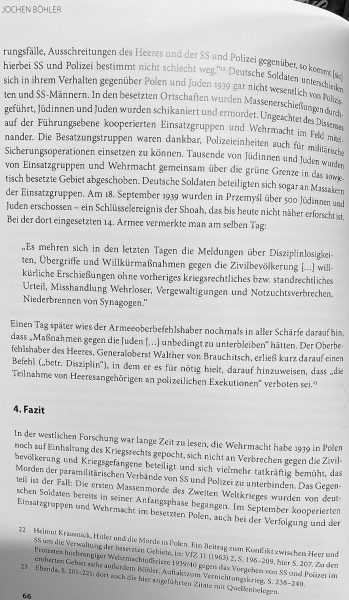
Timeless Values
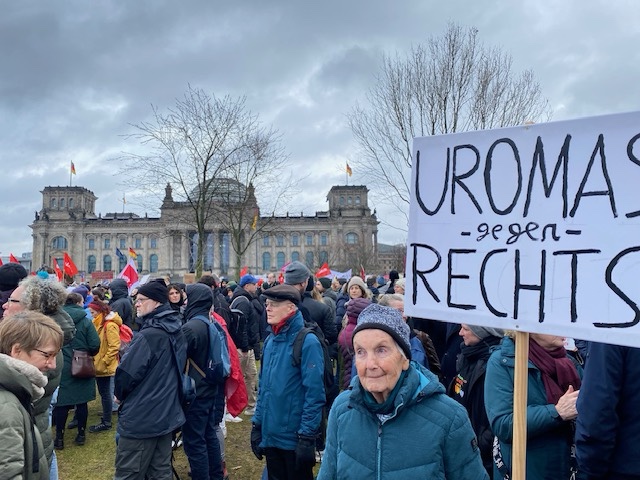
The declaration of human rights is more than 200 years old. However, the need to stand up for the defense of these rights needs many people to act accordingly. Political parties and courts are not strong enough to be the only defendants of democracy and human values. Solidarity across generations is another part of the struggle to defend democracy. In addition to the broad movement of “Omas gegen rechts”, the age distribution has been further enlarged with the “Uromas gegen rechts”. This most likely the generation with first hand life experiences from Nazi Germany and they should have reached an enlightened view of the horrors caused by the Nazi-regime. Unfortunately there are still some who continue to be prisoners in a fascist “brown” cage of mischievous memories. The great grandmother who was present at the demonstration was clear in her statement to stand up against right-wing extremism. (Image: With the permission of the lady I am happy to have evidence of the presence of super-agers at the demonstration in Berlin).
Flotow Paris1
Die Biografie von Friedrich von Flotow, verfasst von seiner letzten Ehefrau, beschreibt die erste Parisreise und den prägenden Aufenthalt für die Ausbildung des noch sehr jungen Komponisten (S.29 ff). Bereits im Februar 1828, mit erst 15 Jahren, begann der erste Studienaufenthalt in Paris. In einer den Eltern bekannten Familie wurde der junge Friedrich aufgenommen und begann sein Musikstudium am Konservatorium. Prof. Friedrich Reicha war dort sein Lehrer, der 1825 seinen “Traité de la haute composition” veröffentlicht hatte. Schon Adam und Berlioz hatten bei Reicha Kompositionsunterricht einige Jahre vorher. Die Juli-Revolution 1830 in Paris führte jedoch zu solchen Unruhen, dass die Familie den Sohn rasch nach Mecklenburg zurückrief.
Die frühe Erfahrung in Paris, und wie wir heute sagen “total immersion” in die französische Sprachwelt und Musik, eröffnete dem jungen Komponisten einen Berufsweg, der sicherlich ohne den Aufenthalt völlig anders verlaufen wäre.
Seine letzte Komposition “Der blinde Musikant” ist als reale Erfahrung des jungen Flotow in der Biografie erwähnt. Zusammen mit seinem Freund Aubry hätte er für den stadtbekannten blinden Musikanten als Straßenmusikant Geld gesammelt. Mit seiner letzten Komposition hat er im Vorgriff auf seinen eigenen Tod, dem blinden Musikanten noch ein Denkmal gesetzt. Dieser war bald nach dieser Aktion dennoch verstorben.
Schüleraustausch und Studienaufenthalte zwischen D und F kann eine äußerst prägende Wirkung entfalten. Das trifft auch noch 200 Jahre später zu. (Image: Flotow Biografie 1892. A.28-29.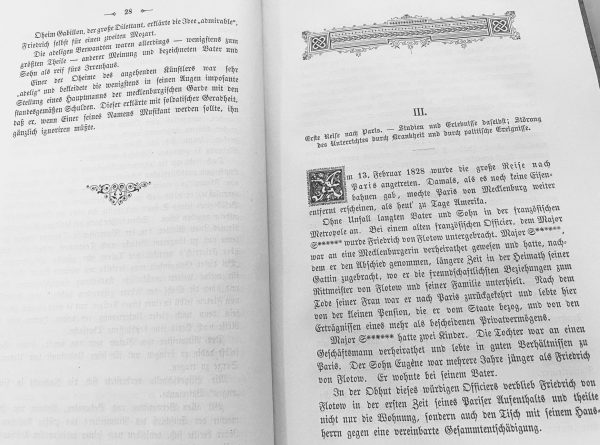
Zwangsarbeit
Die Annäherung an das Thema Zwangsarbeit ist nicht einfach. Auch heute prangern wir zu Recht Zwangsarbeit egal wo auf der Welt an. Die mit weitem Abstand grausamste und umfangreichste Durchführung von Zwangsarbeit haben die Nazis in Deutschland und von ihnen besetzten Gebieten vollzogen. Neben den Schrecken der Konzentrationslager mit dem millionenfachen Mord an Menschen jüdischer Abstammung ist die Aufarbeitung der Verbrechen in Zusammenhang mit der Zwangsarbeit lange in den Hintergrund getreten. Selbst die Zeitzeugen wie Francois Cavanna (2020, S. 10-11) vertraten die Ansicht, dass im Vergleich zu den Ermordungen und Kriegsopfern ihre Erfahrungen und Leiden im Zusammenhang mit der Zwangsarbeit in den Hintergrund traten. („… cela me rendit plus modéré dans l’expression de mes souffrances. … nous ne pouvons que fermer notre gueule. Ce que je fais. »).
Neben der systematischen Ermordungsmaschine der Konzentrationslager in der NS-Zeit verdient das millionenfache Leid und die Terrordrohungen und Anwendungen der Nazi gegenüber den ZwangsarbeiterInnen eine angemessene Bedeutung. Das Dokumentationszentrum NS Zwangsarbeit in Berlin Schöneweide bietet dafür eine hervorragende Ausgangsbasis. Die Ausstellung ist für alle Altersgruppen geeignet. Behutsamer Einstieg für Schulklassen ab der 5. Klasse und zum Nachdenken anregend für Erwachsene mit Informations- und Lerninteresse. Das Ausstellungskonzept mit seinen vielfältigen biografischen Materialien von Zeitzeugen erleichtert, neben der Faktenfülle, einen emotionalen Zugang zum Thema. Online lässt sich beispielsweise die Verteilung der Zwangsrekrutierten die Arbeitsdienst leisten mussten je nach Stadtviertel oder sogar Straße verfolgen (Link Datenbank und Map).
Die Löhne für deutsche ArbeiterInnen und Ost-ArbeiterInnen aus den osteuropäischen besetzten Gebieten waren fast zehnmal höher. Die in westlichen Besatzungsgebieten zwangsverpflichteten Personen oder selbst anfänglich mit scheinbar höheren Löhnen als vor Ort (Organisation Todt) üblich angeworbene Personen erfuhren die spätere Abwertung ihrer Entlohnung. Es bleibt die Betonung auf Zwang, Terror und Einschüchterung bei der Zwangsarbeit meistens in menschenunwürdigen Massenbaracken aus industrieller Massenproduktion. Einstieg in die Erfahrung: NS Zwangsarbeit Dokumenteationszentrum. 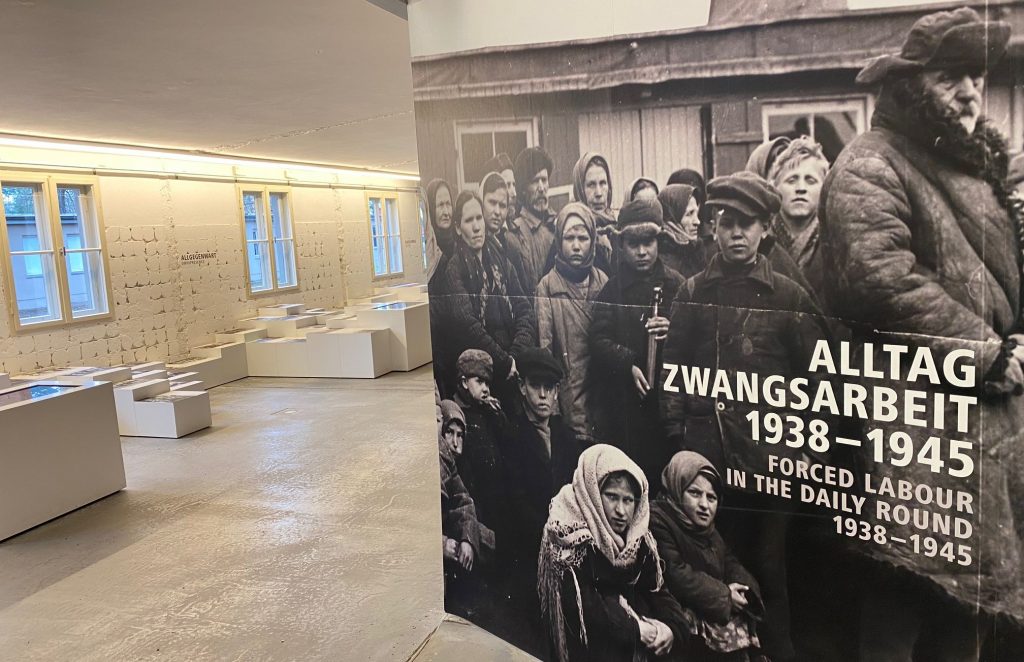
Poster Design
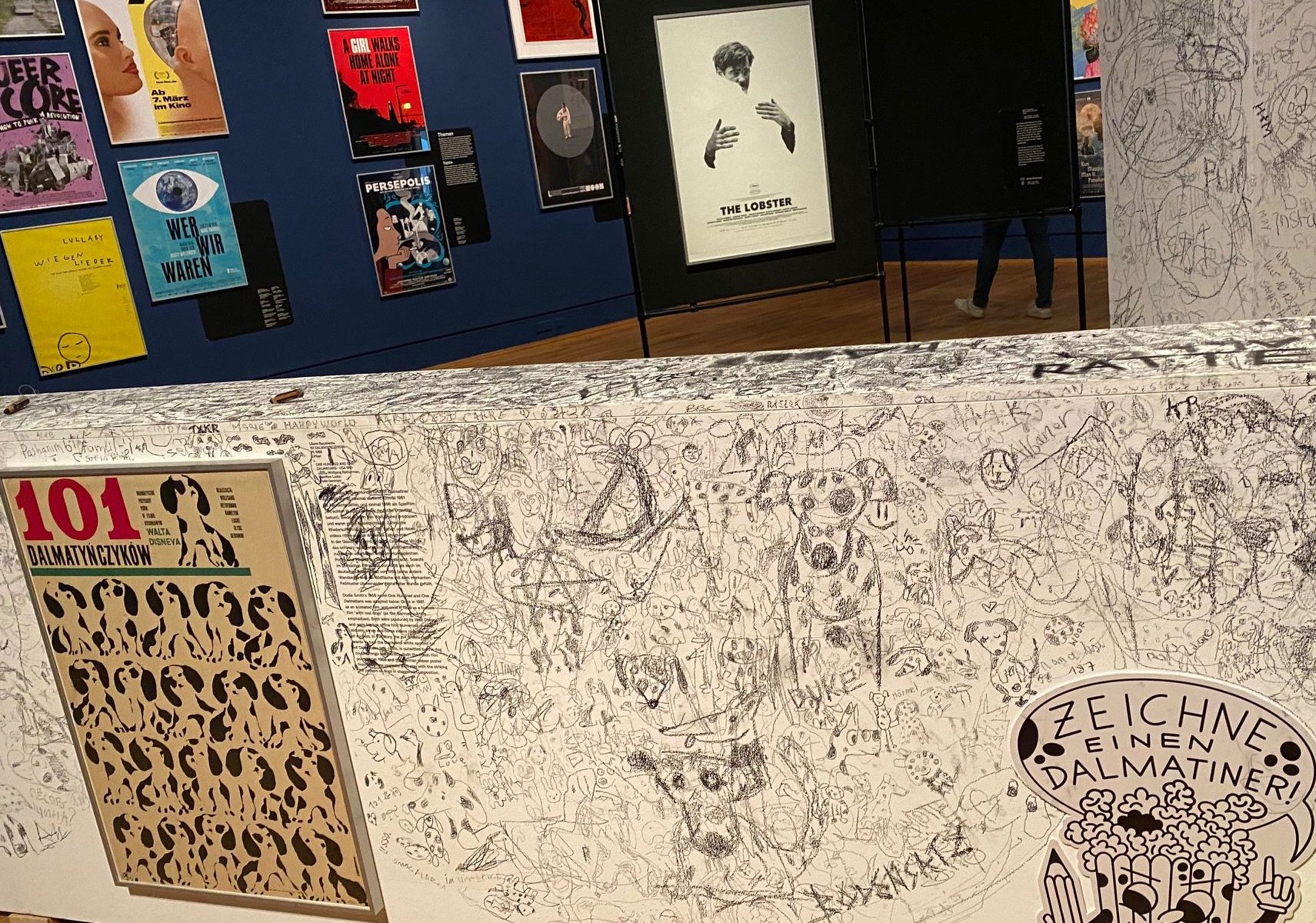
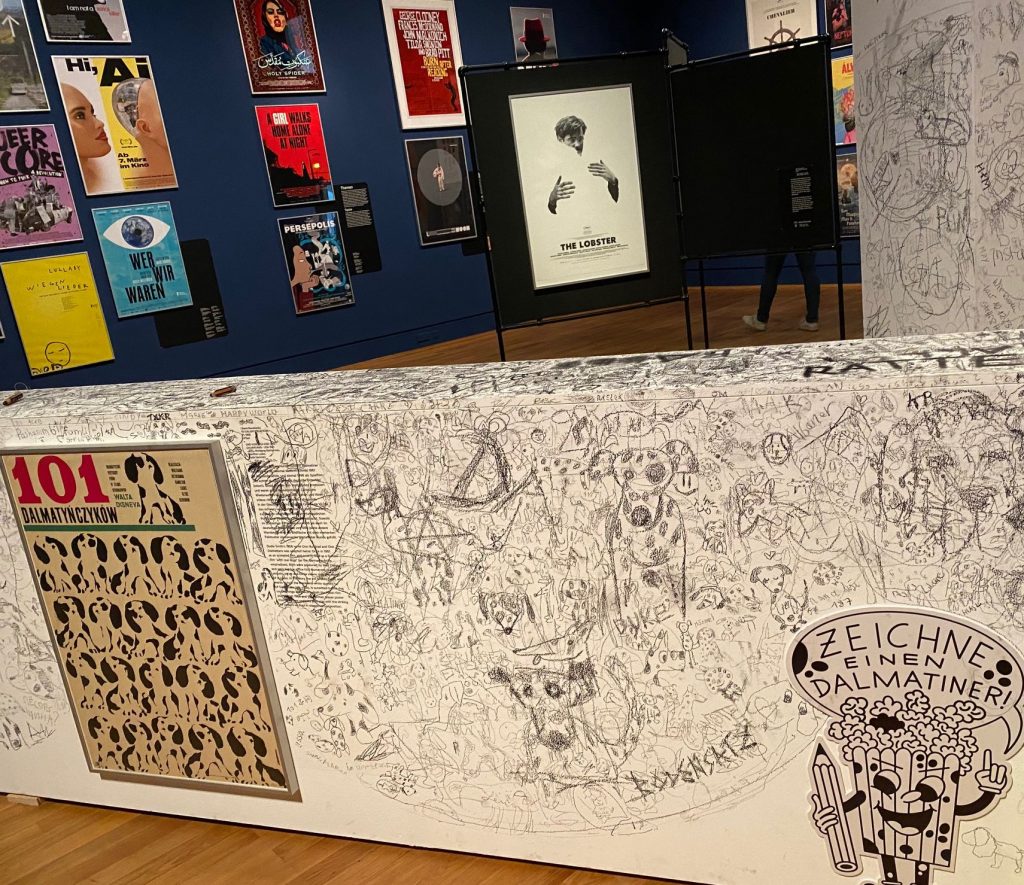
The effective use of posters in visual communication is a specific craft. Artists have been associated with poster design for more than a century. Cinemas continue this practice. For each movie produced there is an announcement posted in print or digital form. In combination with the Berlinale 2024 film festival the Kunstbibliothek in Berlin shows milestones of the history of movies and their representations in form of posters. Besides the historical approach there are many hints how to interpret the design language of posters throughout the 20th century. The encouragement to try to produce one yourself not only reserved to children is an additional activating feature of the exhibition (Link here). Cats and dogs will always catch attention and the playful approach chosen might be a start into a graphic design interest. Overall the exhibition offers a low threshold entry into the world of art and design. Instagramable image on posters evolved into short preview clips, just like instagram paved the way to tiktok video clips. In retrospect posters also provide shortcuts for our memories to recall whole movies that have accompanied us growing up and growing older.
Berlin Moscow
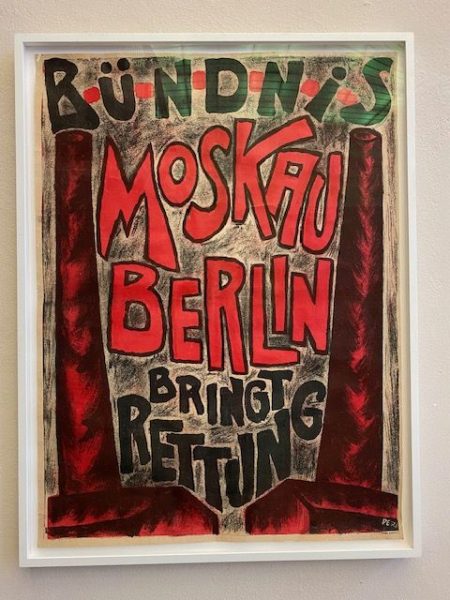
Some historians have a hard time to sort long-term relationships between countries into adequate periods. The ups and downs between Berlin and Moscow are a peculiar example of this. The artist Peter Laszlo Péri expressed this unease in a poster where both cities stand for the dictatorships presumably in the name of the working class. This alliance between Berlin and Moscow, Hitler and Stalin led to occupations of several neighboring countries and war in the following years. With an uncritical stance after German unification the Berlin Moscow link has again facilitated the land grab of Russia with Ukrainian territory. Buying complacency of Berlin in return for cheap oil and gas from Moscow has ended for most European countries now. Great to see Europe united with few minor exceptions and that alliances with other European cities reveal strong and powerful in hope of a more peaceful Europe.