
State capitalism

It is the 2025-12-17 edition of the Wall Street Journal (WSJ) that touts President Trump’s governance as “state capitalism”. Through a listing of recent state interference into the functioning of the economy, the branding of this as state capitalism by the capitalist-owned press is without precedent. The President’s office has obliged NVIDIA to pay 25% of revenue from its China business on advanced semi-conductors to the Trump-run government. We might call this a kind of kick-back or blackmailing, if you want to expand or keep your business with a specific client. Major institutions like the Central Bank (Federal Reserve in the USA) are tackled to follow state orders rather than keep an eye on their independent assessment of facts about the economy. Nomination of governor positions have been subject to persistent interference from the president’s office rather than the government taking a moderating role of divergent interests, competences and lobbying.
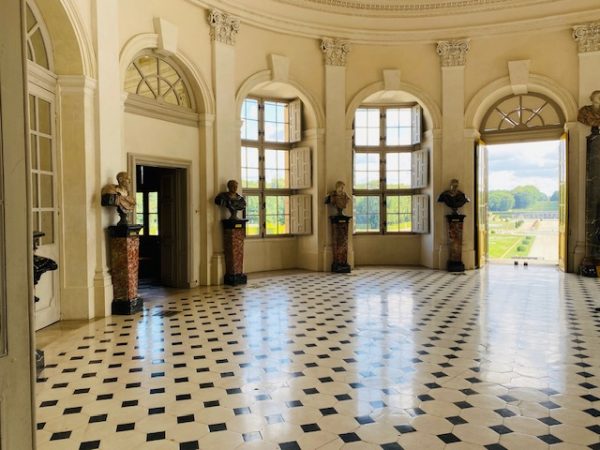
The medium and long-term inefficiencies of an “at-will economy” have several examples, many in South American economies. The US economy is moving South in several respects, with the loss of the value of the $ compared to the €, maybe even devaluation is used as a strategic economic weapon. (Image: Ballroom in Chateau Vaux-le-Vicompte, France)
Balance and justice

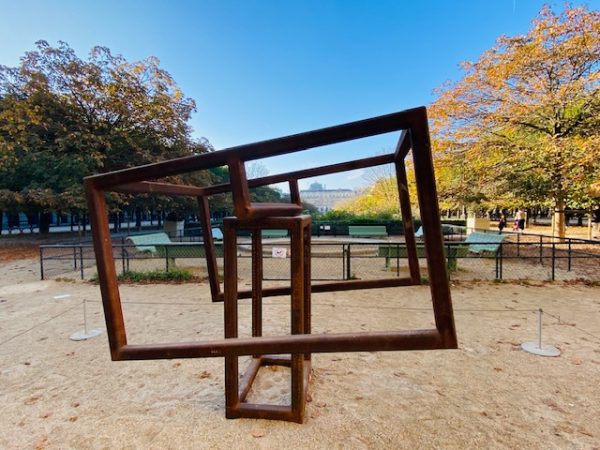
Justice is often represented with the symbol of a balance. This dates back at least to the Roman times when the Roman law reached an unprecedented spread across Europe. The philosophy of law dating even further back to the Greek philosophers, notably Aristotle, founded comparative law with his comparison of constitutional principles in various Greek city states of his time. Striking the right balance, therefore, is encrypted into law, legislation and the American constitutional principle of checks and balances. In Paris the sculpture in the “Parc du Palais Royal” of heavy metal balance at the opposite end of the park is moving as well. Facing the ”Conseil d’état” and the “Le conseil constitutionnel”, this is a forceful reminder of the basic principles of a republic and democracy.
In the 21st century, particularly, since the weights attached at each end of the balance pull more forcefully at the moment in several countries.
Institution building and safeguarding the existing ones have become “the challenge for democracies in 2025 in many “centuries-old” democracies.
(Image: Sculpture by Raul Mourao in Parc Palais Royal, Paris 2025-10)

Marc Aurel Advice

The study of Marc Aurel’s Meditations offers advice on how to conduct one’s private and public life. The role as advisor or teacher is an important part of his writings, albeit quite indirect. In going back to Book 1 and his acknowledgements of his own advisors, teachers and good examples indicate the motivation and intention to write down his meditations. “People exist for one another. You can instruct, or endure, them” (Book 8, paragraph 59, see also Barrientos 2020). Marc Aurel does not shrug away from the treatment of general concepts of humanity like justice. In his view “… justice entails the exercise of wisdom, kindness, and fairness in our relationships with others both individually and collectively.” This includes already tolerance as a part of justice as in Book 4 paragraph 2, according to Robertson (2020). The idealistic view of humanity, following Platon’s philosophy and other Stoic authors, still serves as a benchmark against which many leaders are measured today (compare Le Monde 2025-9-25 p. 26).

Napoleon legacy

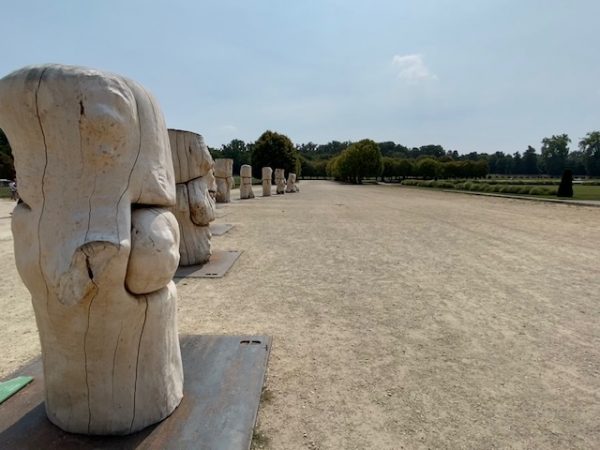
It is huge historical project to try to summarize the legacy of Napoleon Bonaparte. AI is by design less hesitant to come up with any length of a summary statement some with good references on which the statement is based. In combination with a visit at Fontainebleau and a first hand impression of the environment of the autocratic ruler, the remainders like the introduction of a Civil Code to guide also administrations to lawful conduct, we still see influences of this legal innovation in many other countries across the globe. The recognition of Jews as equal citizens and to allow equal access to property and many professions have been influential across Europe mostly in occupied territories. Military service for Jews in Napoleon’s army was another consequence, which spread into the Prussian army and the 1st world war. It is in the 21st century that we see shifts towards more authoritarian governance styles spreading again, we did not want to see this happen until Russia‘s war in Ukraine. (Image: La Chair de la forêt, Frénésie des Géants by  Wang Keping Fontainebleau 2025-8)

Health Systems

Comparing health systems across the EU can be complex at times. However, there seems to be a consensus that the Irish health system is an oddity within the European health systems. On the one hand Ireland is a rather wealthy country in terms of GDP, but the primary care system excludes a high percentage of people from access to it. The scientific journal “The Lancet Regional Health” published a paper and comment on this rather unique exception to the rule to offer a universal health care system to its citizens. The controversy is about the coverage of costs of a visit to a general practitioner. More and probably earlier visits to a GP reduce the (over)burdening of
hospitals later during the life course. Prevention helps a great deal to lower overall costs of a health system.
The roots of the Irish health system have been built upon “subsidiarity”, which means that the public support system should only step in, if the individuals or families are unable to cover costs by themselves. Poor households had to apply for a card giving them access to medical care free of charge. Building hospitals was the next challenge and local communities managed to raise funds in support of such additional structures. In 2025 it can be very costly to enlarge the coverage to a universal access to primary care and the challenge to attract sufficient numbers of general practitioners is a very European one. In this respect Ireland is just like any other European country again.
The question of how to best achieve a universal health care system remains an important one. Apparently, you can be rather “health poor” in an otherwise “economically rich” country.

Sovereignty of People

In France the judiciary has made an influential decision to ban a politician from the possibility to be elected after conviction of fraud. This is just what is to be expected from the 3rd power in the organization of a democratic state. It is surprising that there was a political debate about a person convicted for a crime to be eligible for public office. Several eminent scholars published columns in major newspapers to support the judicial decision. Pierre Rosanvallon focused both on the justification of the verdict and the constitutional role attributed to the judiciary to operate as a kind of memory of the “general will of the people”, the ultimate sovereign. In the struggle of power within a state the judiciary defends individual rights as well as moderates between the executive and the legislative branch. In the theory of democracy this creates a double bind situation in which the individual has a right to be defended against the state and individuals who ask for judgment of cases one against another one. Eric Halphen has also argued in favor of the often neglected role of the judiciary to stand up for the “general interest”, a notion which is not easy to define without historical references in each country and its historical trajectory of democracy. The short debate about the role of the judiciary has strengthened the defensive capacity of the French democracy. Other, even mature democracies may turn their eyes on the decision of the judges involved not to shun away from unpopular decisions. The independence of the judiciary is part of the sovereignty of the people and non-negotiable part of it.

Law and Legality

Some persons consider themselves to stand above the law or push all interpretations of regulations beyond usual understanding of it. Even after a person has been dealing with pharmaceuticals or drugs used also for doping purposes, the conviction of such a person may take several years if not decades. In France, Mr Bernard Sainz seems to be a good example of such a relentless case of practicing para-medical consultations to assist mainly cyclists in endeavors to win championships or professional status. Le Monde  and Cash investigation have raised awareness of the public for such dubious practices. The “French Federation du cyclisme” and medical doctors association fight a continued legal battle against this persons exercising illegally such doping assistance. 

With apparently 56 legal procedures in connection with this person, the legal system has to bear the majority of costs of such illegal practices.

The reach of such dubious practices might be extended if the systems beyond doping, but for assisted euthanasia cannot be controlled effectively. Hence, the precursor cases of positive stimuli like doping pose similar challenges to the legal system as “negative stimuli” weakening persons as assistance to die. The end of a life course is not only a medical issue. Society-wide debates need to take place in order to organize a large consensus on the implications more liberal practices shall entail. 

(Image: Palais de Justice, Paris 2025)

Corruption Caught

In fraud or corruption it is primordial that the probability to be caught is very high to deter potential fraudulent activity. The new Trump administration has enacted as one of the first executive orders that the FCPA stops to take on new cases of suspected corruption as well as reconsider some of the running procedures. In the same vein, the Corporate Transparency Act (CTA) has been silenced so that American companies to not have to disclose ownership information that fall under the CTA until 2025-3-21 until a major reform will be published.
These policy shifts concern more than just US citizens. The competition between countries will be effected because as companies trading with the US which used US bank accounts were also liable under this legislation and subject to prosecution. The FCPA has been an important example for other countries to follow at least within the Member countries of the OECD. The shift in priorities of the Trump administration might open doors again to corruption which we believed were shut with lasting effect.
In conjunction with the rapid increase in military spending when the capacity for the production of military equipment is slow to increase might increase the risks of corruption talking hold again. Market economies build on fair competition, but less prosecution of corruption introduces a bias into negotiations which works against innovation and competitiveness. We have a hard time to understand any kind of logic in such economic and legal strategies.
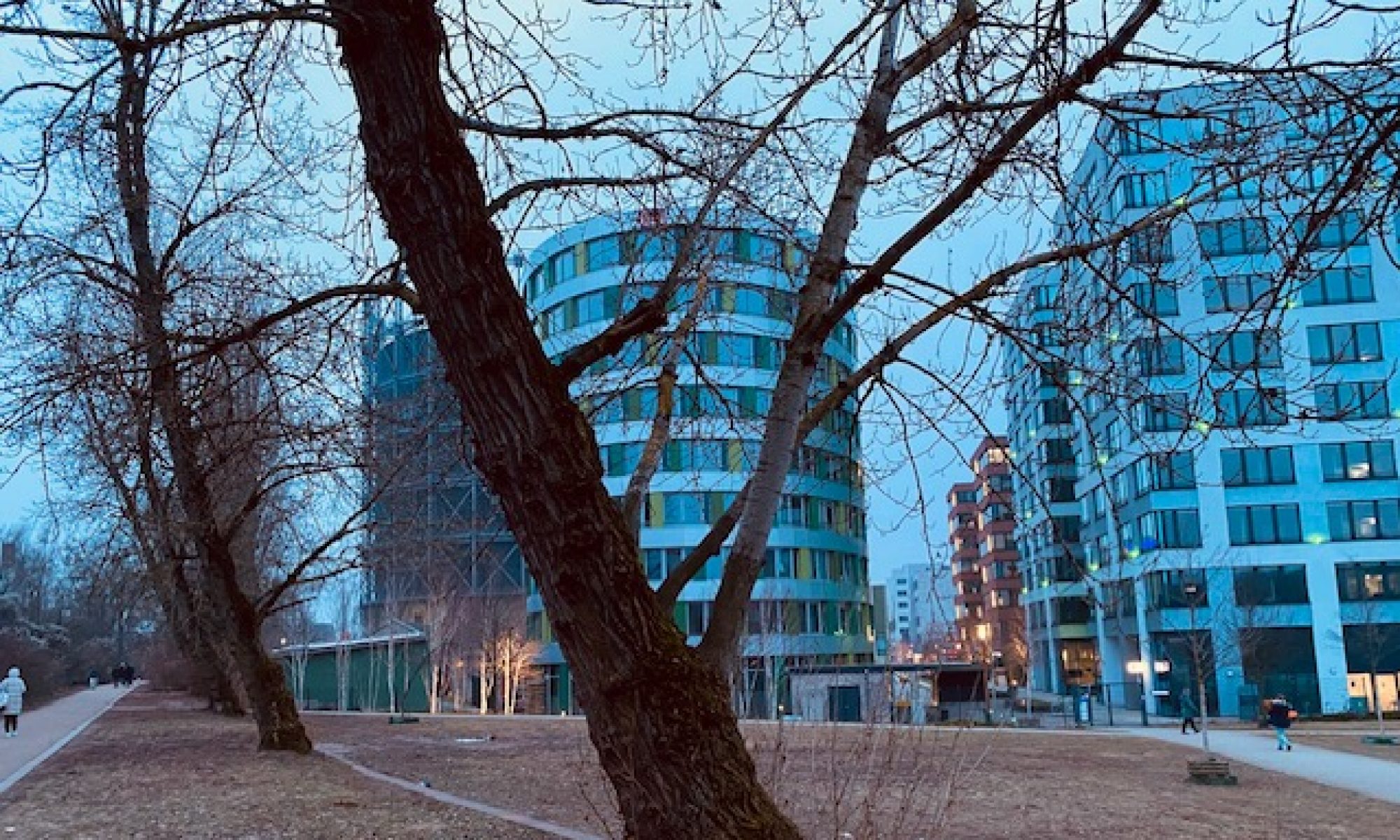
Image: Bridge collapsed due ro material defects. Archive Berlin Tempelhof Schöneberg.

Insecurity Council

The UN Security Council has been turned into the Insecurity Council. The UN Plenary Session voted with a 2/3 majority on 2025-2-24 the draft Resolution L.10 stating: “Three years after the Russian Federation’s full-scale invasion of Ukraine, the General Assembly today adopted two resolutions reaffirming Ukraine’s sovereignty and territorial integrity …”. As part of this resolution the UN General Assembly claims “accountability for the most serious crimes under international law committed on the territory of Ukraine …”.
The UN Insecurity Council (15 Members, China, USA Russia, F, UK as permanent Members) adopted  almost in parallel with 10 votes in favor and 5 abstentions (Denmark, France, Greece, Slovenia, United Kingdom) resolution 2774 (2025) calling for a swift end to conflict. The most notable change in international politics is the changed voting behavior of the USA, which has retreated from an outspoken condemnation of Russia as aggressor and occupant of foreign territory.
The “revealing of masks” in what appears to be a neo-imperialist period of time has come. The set-up of the post  1945 UN institution of the Security Council has lost a major function to prevent armed conflicts and early reaction potential. The force to aim for and guarantee international peace lies much more in the hand of the plenary of the UN rather than the small select Security Council dominated by previous superpowers largely due to their possession of nuclear weapons of mass destruction.
The voting of a resolution by the Insecurity Council, which is in contradiction with a resolution of the UN General Assembly concerning the spirit, if not the words, is a source of insecurity itself. A reform of the UN system, which risks to become a “shopping system” of lenient organizations, where you join and leave the organization (UNESCO, WHO, WTO …) will loose impact.
For many people and countries, the only hope for a guarantee of human rights lies with the United Nations Human Rights Charter, peace keeping missions and International Courts. The UN Security Council as an Insecurity Council is likely to let down many people truly seeking a peaceful life.
(Image: The Fall of Icarus, Pablo Picasso, at HQ UNESCO, Paris)

Korean Uprisings

With the recent Korean uprising against the imposition of martial law the world has witnessed a successful defense of democratic rule in South Korea. International politics has quickly moved on to other areas of the world where people’s struggle to obtain or sustain the freedom to vote and the freedom of expression.
However, the Korean history of uprisings goes back a least as far as the beginning of the Cold War period with the separation in 2 Koreas. The 1980 uprising of student protests in South Korea was extinguished with brutal force and mass killings. Can literature heal the wounds of uprisings? Only the best of literature can. The Korean female author and poet Han Kang (Nobel laureate 2024) has accomplished this. In the novel 소년이 온다 “Human acts” (English title), “Celui qui revient” (French), ”Menschenwerk” (German) the Gwangju Uprising 1980 is the historic backdrop against which the loss of human dignity during dictatorships is narrated. Han Kang manages to depict the empathy of family members who are confronted with the brutality of the military forces. It is tough on readers as they become the witnesses of the violence described as such and the sorrow of the whole social environment of the victims.
The Nobel Prize for literature 2024 honors the “world literature” aspect of Han Kang’s writings over many years. Many prizes have been allocated for representative writers (80+ % were men) of a country. The different titles of professional translators chosen for this novel reveal the potential to link to very different national narratives and connections to national memory of uprisings. Translating literature from different cultures can be challenging as readers frequently want the narratives somehow to relate to their own “endured” experiences. World literature, just like world history, goes beyond this and takes the reader by the hand and broadens emotional and human horizons.
(Image: Gallery Lee Bouwens, Brussels, exposed Jungjin Lee Voice #02, Voice #26 in 2025, inkjet pigment prints, Jungjin Lee)