Medical Life Course

The analyses of the life course have taken individuals as their starting point and linked their life courses to broader societal developments like periods of educational expansion, job growths or periods of high unemployment. Medical life course research has further dis-aggregated the life course of a person into, for example, the life course of human organs.
There is already an established line of research which collects and analyses lung function trajectories. The research starts even before your first “autonomous” breath and typically ends at death, although transplants become feasible. It is helpful to think of those measures lung function trajectories as a life course of lung health, because the air we breathe is subject to many social and environmental impacts. Some we are in control of (active smoking, less so with passive smoking), some others like inner city smog or pesticides inhaled in areas of agricultural production. Work environments play an important role in the life course of the lung as well. Global warming, particularly increases in summer heat, pose additional challenges on the overall aggregate level to lung health trajectories.
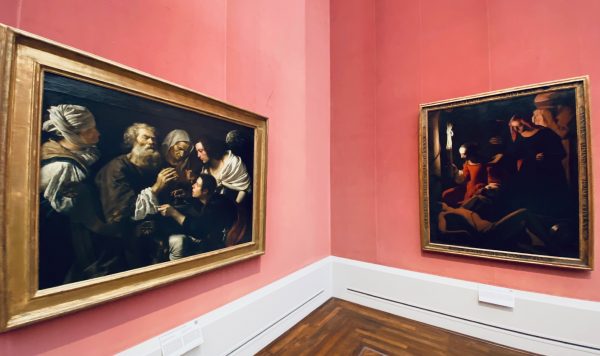
Inhale, exhale, … then force your breath out quickly, … keep breathing normally. That’s about the instruction for the “Forced Vital Capacity test”, which is a standard measure of your FVC just repeated over the life course. (Image: The healing of Tobit 1630, follower of Caravaggio and The finding of Sebastian 1649, Georges de la Tour, Gemäldegalerie Berlin)
Multiple clocks

There is nothing more confusing that multiple clocks that are ticking away without being synchronized, which means, they ought to show the same time. A medical and social science perspective on multiple clocks, however, builds on the fact the different social processes run with different speed, i.e. multiple clocks are ticking in parallel but one may be more advanced than the other. The study of longevity has recently acknowledged that each human organ is aging at its own speed and if the time to failure is close for the liver, the time until problems of your heart might still be far off. Overall longevity is determined by the time to failure of a major organ, despite the fact that multiple clocks of organs are running in parallel.
The can be observed for social processes where, for example, the timing of unemployment or retirement might be dependent on a parallel process of a household dissolution causing a peak in stress. Overall life satisfaction, therefore, depends largely on multiple clocks that might be running in a synchronized or not-synchronized manner. Hence, we all live with multiple clocks ticking inside us and around us. The illusion is, to believe that time is just a single, unique measure.

Time – The Clock

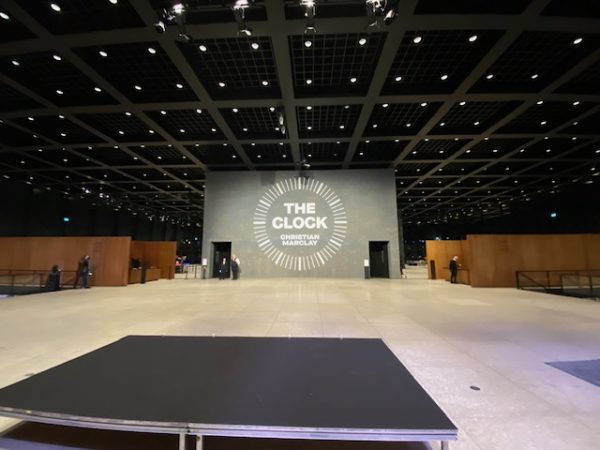
Time keeps puzzling us. The 24 hours of concatenated clips from well-known cinema films are a bit overwhelming or even lengthy. However, this spurs lots of time to reflect on time, on a kind of meta level. We see the clock or clocks ticking in all sorts of situations and environments. Nearly all emotional states can be interpreted relative to a time stamp provided by a clock. Christian Marclay’s oeuvre is screened at the Neue Nationalgalerie in Berlin at a time when we feel multiple clocks ticking at the same time. For the sociologist, there is time on the macro-societal level, like overall socioeconomic development, but also individual time. A single person or a single moment in time may have very different macro-social implications. The possibility to live through the cineastic interpretations of ten to, as opposed to, ten past the hour, are interpreted by us with very different meanings. In a longer or historical sense, the timing of time does not matter that much. Point in time or time as duration, that is the question. Art in cinema can play with this like rock around The Clock. Don’t ask me how much time I spent watching, thinking and feeling through time in this movie exhibition, Should we always measure time with a clock.  Want it or not, we measured by our smartphones all the time and on multiple timelines.

БЪЛГАРИЯ Bulgaria

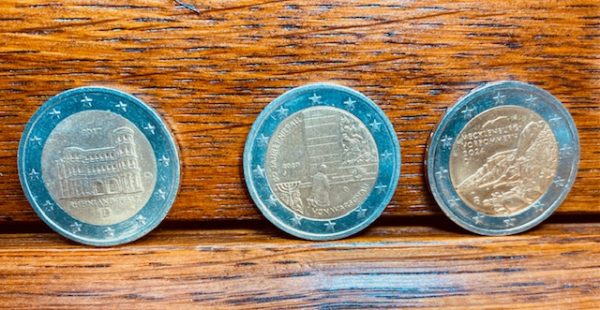
The expectations of the entry of Bulgaria into the EURO-Zone are high towards the end of 2025. On the 1st of January 2026 we have new coins circulating in the Euro-countries. The addition of a country to the European currency yields insights into this country’s own cultural heritage. Piece by piece we learn, if we want to, to take a closer look into the more and more obsolete practice to handle currency in form of coins.
I cherish some of the coins with specific meaning to me (see image below, city of Trier, Willy Brandt, Chalk coast on Baltic sea). My small collection of coins from Greece allow me to refresh my Greek alphabet, words and historical landmarks of democracy. The circulation of Euro-coins with Bulgarian inscriptions in the Cyrillic alphabet will broaden our horizon again. Beyond the national features, we cherish the regional or federal organization in some countries, that feature their regional hotspots within this European cultural heritage. With a highly mobile Bulgarian population, not only within the EU, we shall soon see more Eastern Euro-coins with Cyrillic letters in our pockets and collections. … can’t wait for it … Ukraine in 202x, maybe 203x. 

Installation Guide Linux

Use the info available in various help forums, maybe videos.
Optional: Check size of your hard disc for backup.
Why not renew your backup on an external drive or USB-stick now?
Test your system loading interruption key combination.
Upon RESTART on most systems you use press Power-up key, follwed by either ESC or DEL or F1, F2, F10, F11 key, while power-up runs to load your BIOS.
Have an empty! USB sticks (4 GB+) ready.
Download the for example the latest Linux Mint 22.2 on it (and flash it using etcher on USB from hard drive, if downloaded to hard disk).
Power-up computer with loading system from USB-key not hard drive. (Select option!)
Remember it has English keyboard as default when you connect your WLAN.
Basics are ready!
Keep starting from USB or after some further tests of components install Linux to the hard disk and say goodbye to a slow and costly Windows and Office packages.
Donate to whoever supported you. Perhaps your local repair shop.
Spread the word and help others.

Shift to Linux

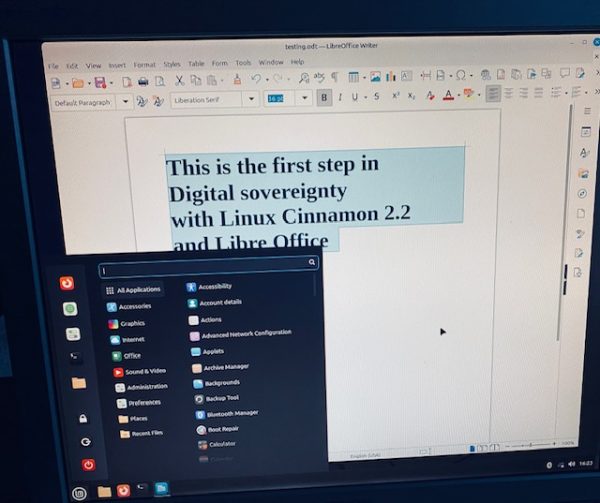
We have become rather lazy and sometimes even ignorant when it comes to what kind of operating system we use on our computers. The phasing out of security support for Windows 10 based computers creates worldwide a huge pile of computers that cannot update to 11 due to limited hardware 4Gb of active memory only. However, for many simple tasks these computers work perfectly fine. Browsing through the internet or just drafting texts or spreadsheets doesn’t ask for larger sizes of memory. Most AI applications run on the web and not locally on your computer. No need to throw away these devices and spend, spend, spend on the latest technology. It takes a bit of time and effort to read through the guides for such a shift. Maybe you need to come back several times between documentation and a bit of trial and error, but the learning of digital skills is always a rewarding experience as well. My fanless computer will serve me for many more years as a quiet companion in drafting blog entries and research. Additionally, it is a step towards digital sovereignty so many people talk about these days. (Image: Computer Screen with Linux cinnamon 2.2 and Libre Office in background).

Philosophy of Voyage

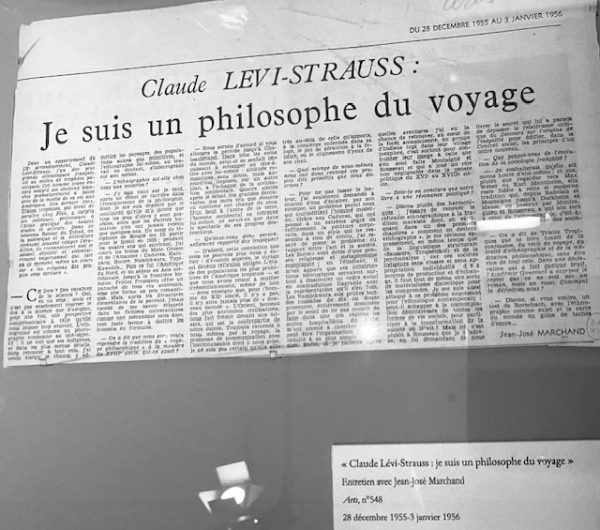
In an interview Claude Lévi-Strauss described himself as a philosopher of voyage. The excursions which lasted sometimes several months to live with indigenous people and study their languages, habits and culture became a scientific field of its own called social anthropology. He travelled with his wife and wrote down hundreds of notes and collected items. Only years later the concept of stuctural theory became evident to him. A voyage might go on after the end of traveling. It might start well before departure as well, not the least due to all the preparations. Colette, the French writer and polyartist, coined the phrase “ce qu’on sait faire, au fond, c’est de la route, ce  n‘est pas du voyage ” in the novel « La chatte ». In the pre- and immediate post 2WW years “taking to the roads” often had a gendered view of this with women being rare to hold a driver’s license. To “find meaning through voyages” or “the voyage is the meaning” fill whole libraries. For better or worse, travel books are still best selling books in a shrinking overall book market (less print books sold, but still higher value of sales).   

Marc Aurel Book 10

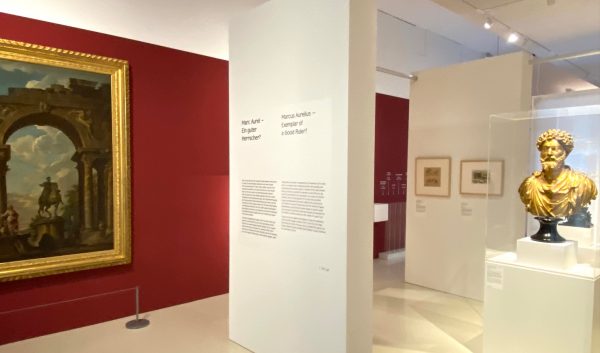
Book 10 offers some referrals to previous books and topics: Marc Aurel defends a wholistic vision as in book 10 paragraph 17: “Keep constantly in your mind an impression of the whole of time (χρόνον) and the whole of existence (οὐσίαν)…” (Penguin Classics version, also in Greek original/French translation). In the same vein, he wants all this knowledge and considerations to be “actionable”. This reads in his words: “No more roundabout discussion of what makes a good man. Be one!” (book 10, paragraph 16 in the same two editions). As the late Marc Aurel’s writings progress, he becomes even more “exigent” in the sense of demanding ever higher standards (of himself). “Whole-ism” paired with a request to, nevertheless, be ready for action at any time is not only a high cognitive demand, but also a reminder to leave procrastination behind. The virtue of a stoic leadership style remains an ambitious challenge.
(Image: Trier Exhibitions on Marc Aurel, 2025-9)

Marc Aurel Book 6

Some passages of Book 6 can be understood like quotes of much later works, even like writings of the enlightenment period. Take this one: “If someone can prove me wrong and show me my mistake in any thought or action, I shall gladly change. I seek the truth, which never harmed anyone: the harm is to persist in one’s own self-deception and ignorance.” (para 21 in Penguin Classics version, also in Greek original and French translation).
The same passage in historic English: “If anybody shall reprove me, and shall make it apparent unto me, that in any either opinion or action of mine I do err, I will most gladly retract. For it is the truth that I seek after, by which I am sure that never any man was hurt; and as sure, that he is hurt that continueth in any error, or ignorance whatsoever.” (Para XX in Gutenberg.org online reader).
Why is this already an enlightened vision of truth? In the search for truth, he is open to criticism or doubt by others (maybe even irrespective of societal standing) and, moreover, ready to change his conviction and action. Religious doctrines of the time and many centuries after his writings would not have accepted such a doubtful mind who might change due to (scientific) reasons. Long before “Cogito ergo sum” (René Descartes, (1637), I think, therefore I am, of the early enlightenment, Marc Aurel might be summarized in this paragraph as “Cogito, ergo dubio”, I think, therefore I doubt – and I may change accordingly.
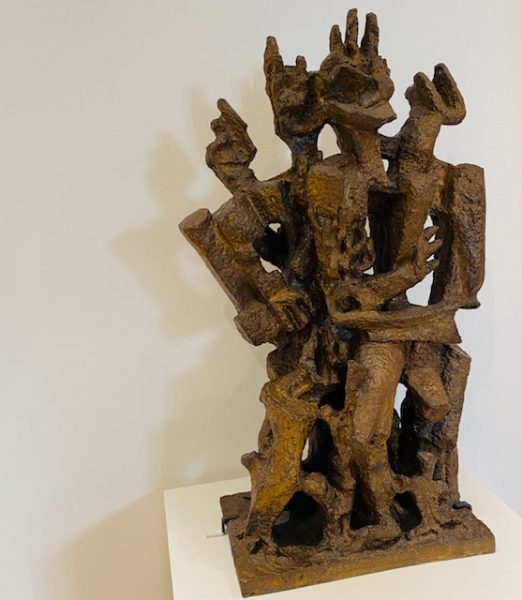
(Image: Ossip Zadkine, Forêt humaine, Musée Zadkine Paris)

Chatbot Me

Chatbots are helpful to allow queries to larger data sets like the blog entries here. So here is a try of a Chatbot to query all entries on AI using ChatGPT to create a Chatbot that uses and references it source from www.schoemann.org/tag/ai and the AI reader in pdf-format.
Please send me an email if the hallucinations of this Chatbot 1.0 on AI from a social science perspective are giving strange results. I’ll get back to you. Please use at your own risk as I cannot guarantee for all answers. The usual disclaimer applies here.

ChatGPT proposed the following set of Questions and Answers on the blog for an entry into the chat: Example Q&A with the chatbot

Q: What are the social science concerns with AI?
A: Bias in results, job shifts, democracy risks, privacy, and new inequalities.

Q: What does the text say about reinforcement learning?
A: It’s seen as the next step for AI: focusing on learning and reasoning, not just predicting text. It also uses fewer resources.

Q: How are robots described in the document?
A: Robots are mostly assistants. They can follow people or carry small items, but more complex tasks need sensors and AI training.

Q: What about biased results?
A: Studies can be misleading if control groups are flawed. AI faces the same challenge — social scientists warn: “handle with care”.

Q: What is Schoemann’s blog view on AI?
A: He links AI to energy use, fairness, and its role in the “all-electric society” — stressing efficiency and responsibility.

More on the chatbot (in testing phase) and the Link to the coding help received from ChatGPT on this mini-test-project :
https://chatgpt.com/share/68c1d160-0cc0-8003-bf04-991b9e7c3b24